Tag Archives: Morning Prayer

So teach us to number our days

IMG_0640


So teach us to number our days,
that we may apply our hearts to wisdom. 
(Psalm 90:12)

In the context of Psalm 90, and in popular usage, this verse recalls us to a sense of our mortality. “Numbering our days” means understanding that we don’t have long to live and we should make every day count.

“Numbering our days” has stuck with me this week for a different reason, though.

In the context of the Daily Office, the ancient Jewish and Christian pattern of prayer in the morning and evening, we “number our days” in a very particular way.

I’ve been reflecting (especially since a great conversation over coffee on Wednesday with a clergy colleague) on how the Daily Office builds an awareness in us of a different “numbering,” a different way of organizing time.

The rhythm of morning and evening prayer includes collects (BCP 98-99, 123) that give shape to our weekly reflections, especially on Fridays (Jesus’ passion and death), Saturdays (God’s creative activity and our Sabbath rest), and Sundays (Christ’s victory over death and sin).

The offices also help attune us to the seasons of the Church Year, which have their own emphases and lead us through regular cycles of reflecting on Christ’s incarnation (Christmas) and his resurrection (Easter). There’s also a good long stretch of plain old “ordinary time” all summer long.

I sometimes wonder whether we Christians can regain a sense of our own sacred calendar in the face of the advertising onslaught of Back to School, Labor Day, Halloween, Thanksgiving, Santa Claus, the Easter Bunny, Mother’s Day and Father’s Day, Memorial Day and July 4th.

“Numbering our days” according to the Christian calendar might be one gentle witness to the countercultural Gospel we proclaim and to the Son of Man, Lord even of the Sabbath (Matt. 12:8), whom we follow.
Them I know … but who are you?

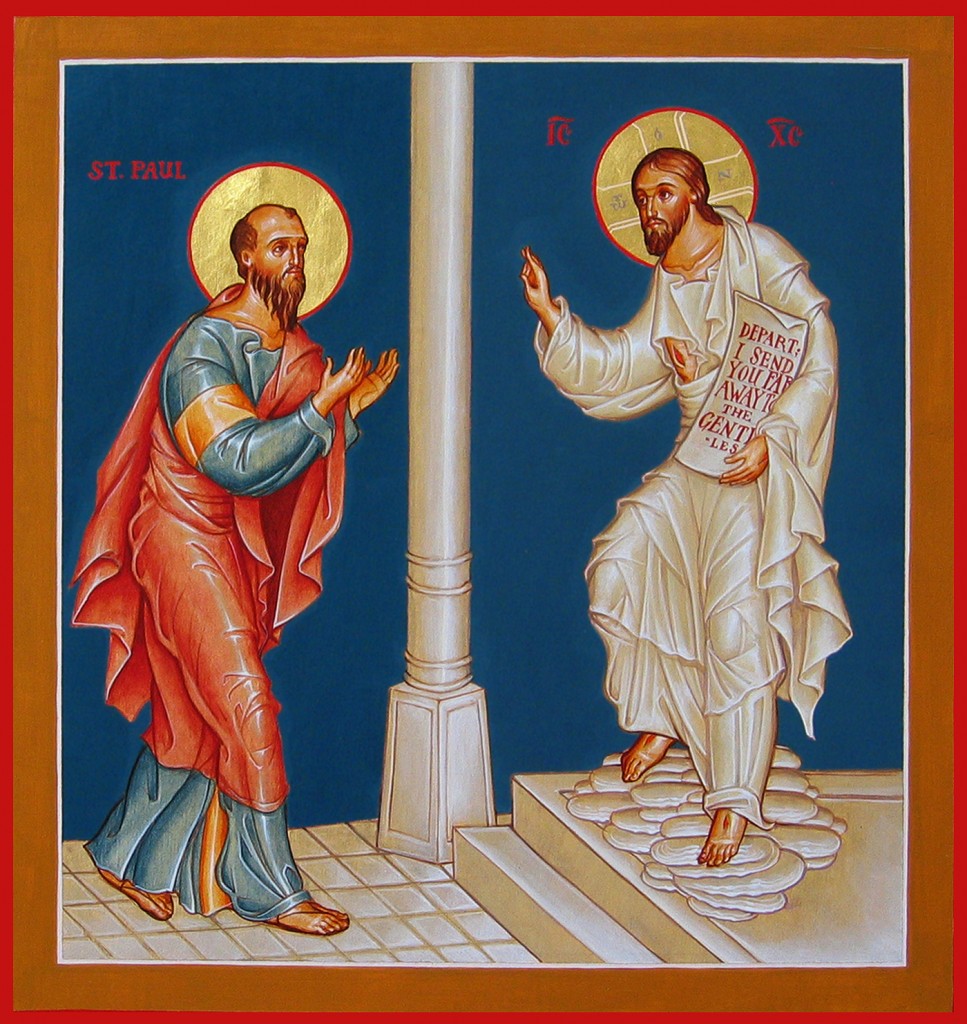
St. Paul and Jesus

St. Paul and Jesus

Then some itinerant Jewish exorcists tried to use the name of the Lord Jesus over those who had evil spirits, saying, “I adjure you by the Jesus whom Paul proclaims.” Seven sons of a Jewish high priest named Sceva were doing this. But the evil spirit said to them in reply, “Jesus I know, and Paul I know; but who are you?” (Acts 19:13-15)

Who are you?

Would you be recognized as a follower of Jesus (not just by evil spirits, but by anybody you meet)?

When you talk about your faith, are you talking about an abstraction or are you talking about someone you know?

You don’t have to be perfect, that’s for sure — just look at David, featured in our Old Testament reading this morning in the act of committing adultery with Bathsheba and having her husband Uriah killed.

However, you do have to be known by God, and you have to do what God’s followers do — repent.

Knowing God and being known, just like any friendship, means putting in the time. That’s largely what we are doing when we pray the Daily Offices — spending face time with God.

Coming face to face with the living God, especially as we meet him in Jesus, highlights our sinfulness and leads us to want to change.

David will be confronted by Nathan, the prophet of God, in tomorrow morning’s reading, and he will repent of his sin.

Saul, whose early ministry was to persecute Christians, repented after he began to know the risen Jesus. In a complete turnaround (which is basically what repenting means), his new ministry under the new name of Paul was to help establish new churches.

Who are you?

Are you a friend of God?

Are you putting in the time and making the changes that your friendship requires?

Lose Yourself to Dance

Then David said to Michal, the daughter of Saul:

Here, take my shirt
and just go ‘head and wipe off all the
sweat, sweat, sweat …
Lose yourself to dance! (2 Sam. 6:21-22, paraphrased)

And Paul said, “So then, whether we live or whether we die, we are the Lord’s … Why do you pass judgment on your brother or sister, or why do you despise your brother or sister? Lose yourself to dance!” (Romans 14:7-10, paraphrased).

In the presence of the Lord

Mary Magdalene announcing the resurrection to the apostles (c. 1123).
St. Albans Psalter, St Godehard’s Church, Hildesheim.

The Lord watches over the innocent;
I was brought very low, and he helped me.

Turn again to your rest, O my soul,
for the Lord has treated you well.

For you have rescued my life from death,
my eyes from tears, and my feet from stumbling.

I will walk in the presence of the Lord
in the land of the living.

(Psalm 116:5-8)

The Collect for today tells us that Mary Magdalene was “restored … to health of body and of mind” and “called to be a witness of [Jesus’] resurrection” (BCP 242).

What does it mean to be a witness of the resurrection but simply to speak of Jesus’ living presence in your life?

Mary Magdalene was the first to do that, telling the apostles that Jesus had risen and she had seen him. Each of us today is likewise to speak of what Jesus’ living presence means to us.

How has Jesus’ presence restored you — rescued your life from death, your eyes from tears, your feet from stumbling?

Follow Mary Magdalene’s example and speak simply about your walk in the presence of the Lord.

Beloved

20130523-060723.jpg


The beginning of the good news of Jesus Christ, the Son of God. (Mark 1:1)

I received an email a couple weeks ago from a young woman asking to be baptized at St. Thomas, the parish I serve in the Diocese of Fond du Lac.

She did not grow up in a religious household, but she has pursued deeper and deeper spiritual engagement and is now led to make a mature commitment to Christianity.

In the Daily Office readings this morning, I couldn’t help reflecting on her request as I read about Peter’s vision regarding the Gentiles. When he arrived at Cornelius’ house, he saw that the Holy Spirit had come into their lives, too. He asks, “Can anyone withhold the water for baptizing from those who have received the Holy Spirit just as we have?” (Acts 10:47).

This young woman knows that the Spirit is in her life, and that Spirit is moving her to make a public act of faith.

Jesus himself makes the same public act in this evening’s reading from “the beginning of the good news” according to Mark.

The Spirit is surely already present in the life of the Son of God, just as the Spirit “proceeds from the Father” — Jesus does not need baptism in order to receive the Spirit, but the Spirit moves him to reveal his identity in a public way.

And what is that identity? “You are my Son, the Beloved,” says the voice from heaven; “with you I am well pleased” (Mark 1:11).

All of us who are baptized into the Body of Christ share in his identity as Beloved.

I look forward to the day — soon, I expect — when we will welcome another Beloved daughter into the fellowship of Christ’s Body.

Where is your charity directed?

Now in Joppa there was a disciple whose name was Tabitha, which in Greek is Dorcas. She was devoted to good works and acts of charity. At that time she became ill and died. When they had washed her, they laid her in a room upstairs. Since Lydda was near Joppa, the disciples, who heard that Peter was there, sent two men to him with the request, “Please come to us without delay.” So Peter got up and went with them; and when he arrived, they took him to the room upstairs. All the widows stood beside him, weeping and showing tunics and other clothing that Dorcas had made while she was with them. Peter put all of them outside, and then he knelt down and prayed. He turned to the body and said, “Tabitha, get up.” Then she opened her eyes, and seeing Peter, she sat up. He gave her his hand and helped her up. Then calling the saints and widows, he showed her to be alive. (Acts 9:36-41)

About a year after graduating from college (almost 25 years ago now), I got a job at Cathedral Shelter of Chicago, one of the Episcopal Charities of the Diocese of Chicago.

I didn’t know it, but I had walked into the middle of an ongoing dispute between the executive director (I was his assistant) and the board of directors over the future direction of the agency.

The dispute boiled down to whether Cathedral Shelter should emphasize programs like its Christmas Basket distribution, very popular with suburban parishes, or seek state funding to expand its residential halfway house for recovering addicts. In the fallout of the disagreement, my boss was let go (and I went with him, three months after I had been hired).

As you can see from the Cathedral Shelter website, their inpatient addiction treatment program was recognized as “Best of Chicago” from 2008-2011. They continue to offer the popular Christmas Basket program, but it’s listed third among their programs and services.

Peter doesn’t know it, but he’s about to turn the same corner. He will meet Cornelius in tomorrow morning’s reading, and his experience will raise a question of emphasis.

Should the Jewish believers in the Way continue to focus only on themselves and on helping through acts of charity like those exemplified by Dorcas?

Or will the new church have to also embrace the much harder road of reconciling Jew and Gentile, proclaiming more broadly the saving love of Jesus Christ and incorporating people who will stretch and test their capabilities?

It’s not an all-or-nothing choice, but a new emphasis that will take the church in many new directions and shape its mission profoundly.

At the heart of that decision, however, is Peter — the faithful disciple who not only “gave her his hand and helped her up” (Acts 9:41), but also proclaimed “I truly understand that God shows no partiality, but in every nation anyone who fears him and does what is right is acceptable to him” (Acts 10:34).

Unshakable witness

perseverar-em-Jesus-3


“Look,” he said, “I see the heavens opened and the Son of Man standing at the right hand of God!” But they covered their ears, and with a loud shout all rushed together against him. Then they dragged him out of the city and began to stone him; and the witnesses laid their coats at the feet of a young man named Saul. While they were stoning Stephen, he prayed, “Lord Jesus, receive my spirit.” Then he knelt down and cried out in a loud voice, “Lord, do not hold this sin against them.” When he had said this, he died. And Saul approved of their killing him. That day a severe persecution began against the church in Jerusalem, and all except the apostles were scattered throughout the countryside of Judea and Samaria. (Acts 7:56-60)

The Seven — commonly called the first deacons — were appointed by the apostles to ensure that the ministries of care and preaching were extended to the Greek-speaking as well as the Hebrew-speaking Christians (Acts 6). Stephen was not running a soup kitchen; he was preaching the Word. His preaching having landed him in hot water with the council in Jerusalem, he also became the first Christian to die because of his faith.

Stephen is the prototype for those who trust completely in God’s assurance of salvation, who do not even fear death. That unshakable faith is probably one of the reasons that following the naming of the Seven, “the word of God continued to spread, the number of the disciples increased greatly, and a great many of the priests became obedient to the faith” (Acts 6:7).

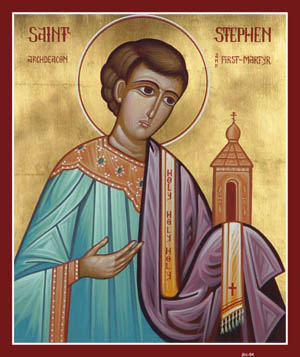
Many icons of Stephen show the Church resting in his arms. Stephen saw Jesus face to face, and the Church must forever rest on the unshakable faith of witnesses (martyrs) like him.


The stone which the builders rejected

rothko_chapel

The same stone which the builders rejected
has become the chief cornerstone. 
This is the LORD’s doing,
and it is marvelous in our eyes. 
On this day the LORD has acted;
we will rejoice and be glad in it.
(Psalm 118:22-24)

How is it that people associate Christians with holier-than-thou attitudes and an insistence on purity? How is it that judgment is the face the world too often sees?

We are built around “the same stone which the builders rejected” — Jesus, a convicted criminal executed by the Romans. The foundation supported by that cornerstone, the Church, was built out of his followers, who rejected him, denied him, grasped for power, and persecuted each other. They generally got it wrong throughout Jesus’ life, and only the Spirit of God could get them going in the right direction. We still get it wrong more often than not.

If we are a holy temple, acceptable to God, we are built out of broken bricks and rocky rubble, not smooth and shining stones.

Why should people think they have to be holy in order to come in to the Church? We ourselves weren’t holy; we’ve been made holy by having our pitted pebbles grafted into others’ cracked concrete.

Unity in the Spirit is what makes the temple beautiful, not the uniformity of the building material.

Collect of the Day

Almighty God, you have built your Church upon the foundation of the apostles and prophets, Jesus Christ himself being the chief cornerstone: Grant us so to be joined together in unity of spirit by their teaching, that we may be made a holy temple acceptable to you; through Jesus Christ our Lord, who lives and reigns with you and the Holy Spirit, one God, for ever and ever. Amen. (BCP 230)


Who are we to hinder God?

20130629-111425.jpg

Come and listen, all you who fear God,
and I will tell you what he has done for me.
I called out to him with my mouth,
and his praise was on my tongue.
If I had found evil in my heart,
the Lord would not have heard me;
But in truth God has heard me;
he has attended to the voice of my prayer.
Blessed be God, who has not rejected my prayer,
nor withheld his love from me
.
(Psalm 66:14-18)

I think it is easy to miss how astonishing Peter’s rooftop vision in Joppa truly is, and how completely it overturns the Church’s notion of who and what is acceptable to God.

Peter sees a vision of a sheet being lowered before him. It contains all sorts of animals, especially animals that are considered unclean by the Jews according to the Torah.

Peter hears a voice from heaven saying to him, “Get up, Peter, kill and eat” (Acts 11:7). Over Peter’s protest — he is an observant Jew who follows the dietary laws — the voice says “What God has made clean, you must not call profane” (Acts 11:9).

Not only are the animals themselves clean, the act of eating them is also clean.

Peter is being commanded to act in a way that God previously called sinful. He is being commanded to break a law that identifies him as a Jew — that sets him apart from the people around him.

When he is taken to Caesarea, to the house of Cornelius the centurion, Peter sees the evidence of the Spirit in the lives of Gentiles. He begins to understand: “If God gave them the same gift that he gave us when we believed in the Lord Jesus, who was I that I could hinder God?” (Acts 11:17).

This report silenced the objections of the Church at Jerusalem, we read, “and they praised God, saying, ‘Then God has given even to the Gentiles the repentance that leads to life'” (Acts 11:18).

Those who do acts that once were forbidden to the Jews, but which now are commanded to Peter, have the repentance that leads to life. Those who were previously set apart by their observance are no longer to be set apart, but share in the same Spirit.

The acts themselves do not separate us; our racial or cultural identity does not separate us. We are all sinful, though we must be careful not to call profane what God has called clean. All who repent share life in Christ and the gift of a new Spirit.

Who are we to hinder God?

Glory to God, whose power, working in us, can do infinitely more than we can ask or imagine: Glory to him from generation to generation in the Church, and in Christ Jesus for ever and ever. Amen. (BCP 102)

I’ve got a wild story to tell you

rothko_no14

All were amazed and perplexed, saying to one another, “What does this mean?” But others sneered and said, “They are filled with new wine.” But Peter, standing with the eleven, raised his voice and addressed them, “Men of Judea and all who live in Jerusalem, let this be known to you, and listen to what I say. Indeed, these are not drunk, as you suppose, for it is only nine o’clock in the morning. No, this is what was spoken through the prophet Joel: ‘In the last days it will be, God declares, that I will pour out my Spirit upon all flesh, and your sons and your daughters shall prophesy, and your young men shall see visions, and your old men shall dream dreams. (Acts 2:1-21)

I read recently that one reason the purple stone in a bishop’s ring is an amethyst is that the Greek word “amethystos” means “not drunk” — an interesting custom apparently derived from this morning’s reading. Don’t know if it’s true, but it sounds good.

“We are not drunk,” says Peter, “but have I got a wild story to tell you!”

As my own diocese continues its search for a new bishop, I wonder if we’ll consider our need for someone to tell the wild story — of the Spirit blowing in our midst and turning everything upside down — as much as we’ll consider our need for someone to maintain our little corner of the institution born on that Pentecost day so long ago.