Reclothe us in our rightful mind

Dear Lord and Father of mankind,
Forgive our foolish ways!
Reclothe us in our rightful mind,
In purer lives Thy service find,
In deeper reverence, praise.
-John Greenleaf Whittier

I reflected in my sermon yesterday that the unity we share as Christians comes not from group membership but from the individual relationship each of us has with the living Christ.

In him, we are united in one body, because each of us has known his forgiveness.

The words of this beautiful hymn came to my mind this morning, especially the phrase, “Reclothe us in our rightful mind.”

People in recovery from alcoholism often speak of the “stinking thinking” that is as much of a problem for the addict as the drink itself.

People practicing recovery and learning to live well with mental illness also know what it is to suffer from problems in the mind, medical conditions in the brain that make living such a struggle.

Forgiveness, for me, began with admitting how badly my drinking had affected me and those around me.

Forgiveness felt first like being stripped naked, being fully known, being seen in the unlovely state I was in.

The grace I have received in recovery — in the love of family and friends who looked with me, in the support of my church and recovery group who held me, in the reawakening of my appreciation for the Daily Office and the practices of the Christian life and of recovery that shape me — all of these feel like by grace I am being “reclothed in my rightful mind.”

And now another lovely hymn springs to my lips: “O to grace how great a debtor daily I’m constrained to be!” Where pride and frustration once colored my life, gratitude paints a different picture.

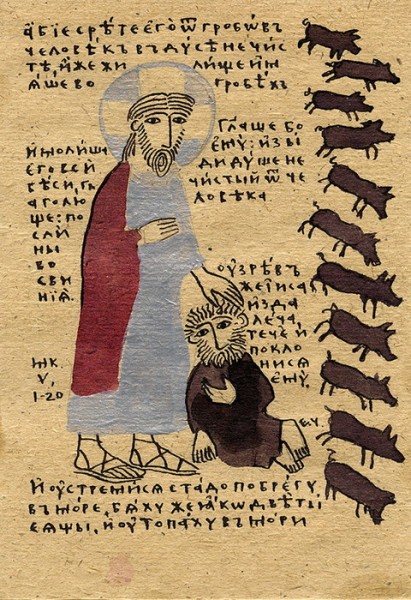
If you for a long time have “worn no clothes,” and feel like you’re living “not in a house but in the tombs” — like the Gerasene man whom Jesus healed in the story from the Gospels (and the source of the hymn) — know that in forgiveness and in recovery you, too, can be “found … sitting at the feet of Jesus, clothed and in [your] right mind” (Luke 8:35).

From Pravmir.com commentary on the healing of the demoniac by Metropolitan Anthony of Sourozh.

From Pravmir.com commentary on the healing of the demoniac by Metropolitan Anthony of Sourozh.

Reclothed in our rightful minds, we then find our fulfillment, as Whittier suggests, in trying to lead “purer lives” of “deeper reverence.”

Not that we are perfect by any means, but our service and praise show God how grateful we are and can offer hope to others who still suffer.

Top 10 differences between Green Bay Packers Family Night and Church

10. We cannot fit 69,700 people into St. Thomas Church, even if people do sit over on *that* side of the church.

9. We don’t give away the altar party’s vestments after the Holy Eucharist, though in summer they’d be just as sweaty.

8. The choir doesn’t sing “Back in Black” at every service.

7. We don’t even give the acolytes incense, much less fireworks and a laser show.

6. When our rookies — our children — do the Lambeau Leap up to our altar rail, they are slightly less likely to get beer, ketchup, or nacho cheese spilled on them.

5. It’s farther to walk for refreshments — here at St. Thomas. The whole “concourse” in the side aisle is, frankly, wasted space without pretzels or brats.

4. Even with our recent resurfacing project in the parking lot, there’s still more parking on Hwy. 41 than at St. Thomas.

3. We’d rather watch and analyze every move of Rodgers’ 12 than Jesus’ Twelve.

2. We wear green and gold on more Sundays … at church. (If you wonder how that’s even possible, Episcopal 101 classes start again in September.)

1. The pews are less comfortable … at Lambeau Field. But there’s no waiting list to get assigned seats right here at St. Thomas.

From the wound a lovely flower grew

Br. Curtis Almquist SSJE writes this morning in “Brother, Give Us a Word” about Ignatius of Loyola, founder of the Society of Jesus.

Healing
Ignatius of Loyola had his life’s quite-vain ambitions completely dashed by a mortal wound. Through that wound he found a kind of healing for his soul: an experience of love, freedom, and clarity to attune his desires to what God desires.

I can’t help hearing echoes of a song by Sting called “The Lazarus Heart”:

He looked beneath his shirt today
There was a wound in his flesh so deep and wide
From the wound a lovely flower grew
From somewhere deep inside

While Sting is also referencing the myth of the Fisher King — the sickness of the land is visible in the king’s body, and his healing saves the land — Br. Curtis points to the cross-shaped life that Ignatius embodied.

From a powerful fall, a crippling wound that should have ended his military usefulness, Ignatius became something new, a soldier for Christ. His discipline and ferocity were transmuted into rigorous prayer and daring service.

Each of us will find in our own falling, in the “wound in our flesh so deep and wide,” the seed of new life in Christ — if we wish to flower.

Though the sword was his protection
The wound itself would give him power
The power to remake himself
At the time of his darkest hour
She said the wound would give him courage and pain
The kind of pain that you can’t hide
From the wound a lovely flower grew
From somewhere deep inside

Continue in what you have learned

O God, you have taught me since I was young, *
and to this day I tell of your wonderful works.
And now that I am old and gray-headed, O God, do not forsake me, *
till I make known your strength to this generation
and your power to all who are to come. (Psalm 71:14-18)

The Thursday morning Bible study group I belong to is reading Adam Hamilton’s Making Sense of the Bible, and today we discussed chapter 14, “Is the Bible Inspired?”

Hamilton starts with Paul’s reminder to Timothy:

But as for you, continue in what you have learned and firmly believed, knowing from whom you learned it, and how from childhood you have known the sacred writings that are able to instruct you for salvation through faith in Christ Jesus. All scripture is inspired by God and is useful for teaching, for reproof, for correction, and for training in righteousness, so that everyone who belongs to God may be proficient, equipped for every good work. (2 Timothy 3:14-17)

As the image on today’s blog suggests, I am one of those who “from childhood [has] known the sacred writings.”

Without going into too much detail, I really appreciate how Hamilton draws out the various meanings we attach to the notion of “inspiration.” The writers of Scripture are inspired, we readers find inspiration as we read, and the community’s traditions and teaching inspire us in certain ways (129-38).

He also gently teases apart how some notions read into the Scriptures something that really isn’t there — notions like the “verbal, plenary inspiration” and the inerrancy and infallibility of the Bible. Hamilton disagrees with those who would suggest that “every word in scripture is equally inspired” (140-41).

Today’s Daily Office readings offer an object lesson in one of the stories about David from the tumultuous time just before he is made king of Israel.

David answered Rechab and his brother Baanah, the sons of Rimmon the Beerothite, “As the LORD lives, who has redeemed my life out of every adversity, when the one who told me, ‘See, Saul is dead,’ thought he was bringing good news, I seized him and killed him at Ziklag — this was the reward I gave him for his news. How much more then, when wicked men have killed a righteous man on his bed in his own house! And now shall I not require his blood at your hand, and destroy you from the earth?” So David commanded the young men, and they killed them; they cut off their hands and feet, and hung their bodies beside the pool at Hebron. But the head of Ishbaal they took and buried in the tomb of Abner at Hebron. (2 Samuel 4:9-12)

None of the details of the story specifically represent the will of God. None of them offers a command binding down to our time and place. None of them answers the question, “What, then, should we do?” (Luke 3:10).

Instead, they paint a picture of human ambition, ambivalence, power, cruelty, and sentimentality. These are the people through whom God will accomplish his purpose?

Reading this passage in the context of the Daily Office is also important, I think, because immediately after we read this lesson, we respond by saying Canticle 8 – The Song of Moses, which is appointed for Thursday mornings.

The Lord is my strength and my refuge; *
the Lord has become my Savior.
This is my God and I will praise him, *
the God of my people and I will exalt him.
….
With your constant love you led the people you redeemed; *
with your might you brought them in safety to
your holy dwelling.
You will bring them in and plant them *
on the mount of your possession,
The resting-place you have made for yourself, O Lord, *
the sanctuary, O Lord, that your hand has established.
The Lord shall reign *
for ever and for ever. (BCP 85)

The juxtaposition between these two passages of Scripture further accentuates the difference between David’s political power and cruelty and God’s saving power and constant love.

The Lord has become my savior,” we remind ourselves, not David the king. God will bring us in and plant us, not any human leader or authority.

Reading the Scriptures in the context of the Daily Office is one way to remember “what [we] have learned and firmly believed, knowing from whom [we] learned it.”

That is, allowing the tradition of the community to speak is part of the process of inspiration that we trust is at work. The practice of engaging with the Scriptures in the context of prayer will bear fruit over time if we, like those who came before us, “continue in what we have learned.”

A Collect for Guidance

Heavenly Father, in you we live and move and have our being: We humbly pray you so to guide and govern us by your Holy Spirit, that in all the cares and occupations of our life we may not forget you, but may remember that we are ever walking in your sight; through Jesus Christ our Lord. Amen. (BCP 100)

My ways are not your ways. Gosh!

Seek the Lord while he wills to be found; *
call upon him when he draws near.
Let the wicked forsake their ways *
and the evil ones their thoughts;
And let them turn to the Lord, and he will have compassion, *
and to our God, for he will richly pardon.
For my thoughts are not your thoughts, *
nor your ways my ways, says the Lord. (BCP 86)

Today, we see in the lessons, canticles, and collects of Morning Prayer three examples of the upside down ways of God.

It was only a question … gosh!

In the OT reading we have the beginning of the story of David and Goliath, which we may remember from childhood as the victory of the small over the great. David with his slingshot (and his faith) triumphs over the strength and weapons of the giant Philistine.

David, the youngest brother, is only supposed to be bringing food to his older brothers, but he hears around the camp that the king will reward whoever kills Goliath.

His eldest brother Eliab heard him talking to the men; and Eliab’s anger was kindled against David. He said, “Why have you come down? With whom have you left those few sheep in the wilderness? I know your presumption and the evil of your heart; for you have come down just to see the battle.” David said, “What have I done now? It was only a question.” (1 Samuel 17:28-29)

But there’s also a subversive political strain to the story, since the shepherd boy David is being groomed by God to supplant the king of Israel. The anointing of God is being taken away from Saul and giving to David instead.

God shows no partiality

We see that same subversive streak in the lesson from the Acts of the Apostles.

Then Peter began to speak to them: “I truly understand that God shows no partiality, but in every nation anyone who fears him and does what is right is acceptable to him. You know the message he sent to the people of Israel, preaching peace by Jesus Christ– he is Lord of all. … While Peter was still speaking, the Holy Spirit fell upon all who heard the word. The circumcised believers who had come with Peter were astounded that the gift of the Holy Spirit had been poured out even on the Gentiles, for they heard them speaking in tongues and extolling God. Then Peter said, “Can anyone withhold the water for baptizing these people who have received the Holy Spirit just as we have?” (Acts 10:34-36; 44-47)

The anointing of the Holy Spirit, which the disciples had assumed was an additional gift to the Chosen People — the Jews who believed in Jesus as Lord — is now falling on anyone who hears the good news.

Even Gentiles are receiving God’s spirit. What next?

You stretched out your arms of love

What’s next for the disciples is the conviction that in Jesus, God was acting to save all people.

Paul’s letters crisscross the Mediterranean world, reminding new Christians that grace, not law, is their guide and salvation …

The Gospel writers begin to compile their chronicles of Jesus’ life and teaching, four accounts that together draw out just how upside down his message was, for those with ears to hear.

John, writing later than the others, even recounts Jesus saying “I have other sheep that do not belong to this fold. I must bring them in also, and they will listen to my voice. So there will be one flock, one shepherd” (John 10:16).

The religious rules and the political order both turn upside down in the face of God’s grace and truth, seen most clearly in Jesus’ last gift of love.

A Prayer for Mission

Lord Jesus Christ, you stretched out your arms of love on the hard wood of the cross that everyone might come within the reach of your saving embrace: So clothe us in your Spirit that we, reaching forth our hands in love, may bring those who do not know you to the knowledge and love of you; for the honor of your Name. Amen. (BCP 101)

The vows we make | A response to Rod Dreher

A Facebook friend and former parishioner shared, at my request, some of what he’s been reading about the Supreme Court’s Obergefell decision regarding same-sex marriage.

One of those was Rod Dreher’s June 26 article “Orthodox Christians Must Now Learn to Live as Exiles in Our Own Country” in TIME magazine.

Here are my thoughts in response to Dreher’s five main points.

A culturally post-Christian nation

We have to accept that we really are living in a culturally post-Christian nation. The fundamental norms Christians have long been able to depend on no longer exist.

I could not agree more with Dreher on this point.

However, I see this as a good thing. Our dependence is to be on God alone, not on “the fundamental norms [we] have long been able to depend on.”

Orthodox Christians and other social conservatives

It is hard to overstate the significance of the Obergefell decision — and the seriousness of the challenges it presents to orthodox Christians and other social conservatives … LGBT activists and their fellow travelers really will be coming after social conservatives.

Dreher suggests an equivalency between orthodox Christians and social conservatives that I believe is false.

Certainly, the Episcopal Church to which I belong has long understood that people of various political persuasions belong together as practicing Christians.

We’ve also seen in recent news regarding the environment encyclicals and statements by both Pope Francis and Patriarch Bartholomew — bastions of orthodox Christianity — that could by no means be called “socially conservative” in the sense Dreher uses.

In the second part of this paragraph, Dreher also suggests that “the next goal of activists will be a long-term campaign to remove tax-exempt status from dissenting religious institutions.”

Here again, as a Christian (and a non-stipendiary ordained deacon) I must say that I read this as a positive development.

It may be good for Christians no longer to belong to institutions that enjoy the benefits of a special status beyond what others receive — that’s what tax exemption is.

Instead of depending on our institutions or on “fundamental norms” that others in American society don’t enjoy, perhaps we should focus on practicing our faith in the middle of lives that are just like everyone else’s.

The institution of marriage

Third, the Court majority wrote that gays and lesbians do not want to change the institution of marriage, but rather want to benefit from it. This is hard to believe, given more recent writing from gay activists like Dan Savage expressing a desire to loosen the strictures of monogamy in all marriages.

Here Dreher makes a non sequitur between those who want to be married and those who “desire to loosen the strictures of monogamy.”

The Obergefell ruling is about those who want to be married.

Those who don’t want to be married (or don’t want to be monogamous) still don’t have to be married (or respect their spouses). The decision doesn’t change that.

The individualism at the heart of American culture

In his final argument, Dreher gets tangled up again.

[T]he Obergefell decision did not come from nowhere. It is the logical result of the Sexual Revolution, which valorized erotic liberty. It has been widely and correctly observed that heterosexuals began to devalue marriage long before same-sex marriage became an issue. The individualism at the heart of contemporary American culture is at the core of Obergefell — and at the core of modern American life.

Dreher correctly draws a line between the Sexual Revolution and the time when “heterosexuals began to devalue marriage.”

But to suggest that Obergefell is the logical result of the Sexual Revolution just doesn’t make any sense, and it’s another non sequitur.

Obergefell is about those who value marriage, those who have waited for years to have their faithfulness legally recognized, not those who “valorize erotic liberty.”

If Christians, for our part, want to combat “the individualism at the heart of contemporary American culture” we ought to encourage everyone to be married or to participate in intentional community.

The Benedict Option

2013-04-14 05.59.28

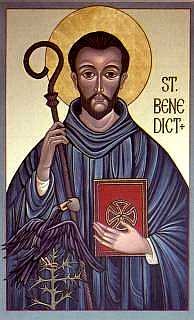
Dreher concludes his article by describing what he calls “the Benedict Option,” a shorthand reference to Christians retreating from the Roman Empire into monasteries following the example of Benedict of Nursia (d. 547).

He asks the question:

How do we take the Benedict Option, and build resilient communities within our condition of internal exile, and under increasingly hostile conditions?

And here at the end, you won’t be surprised that we answer the question differently.

In The Episcopal Church we already have a Benedict Option, and it’s called the Book of Common Prayer (or BCP).

The Book of Common Prayer, historically influenced by Benedictine worship, outlines a pattern of daily, weekly, seasonal, and occasional prayer that “builds resilient communities.”

It’s portable and can be carried out of our communities and into our lives in exile. The daily prayers are even available on an iPhone app. Everyone can participate in the Benedict Option.

See my other blog about the Daily Office for reflections about using the prayer book in just this way as I go about my work and ministry.

But here’s my biggest concern with Dreher’s version of the Benedict Option: When conditions are “increasingly hostile,” as he suggests, we ought all the more to open the doors of our resilient communities to all guests.

Benedict himself wrote in his Rule that “all guests are to be welcomed as Christ” (Ch. 53).

The vows we make

I have often taught that the vows a couple makes in the marriage ceremony are very much like the vows made by someone entering a monastic community.

Even though monastics traditionally make vows of stability, obedience, and conversion of life, the essential vow is the first one: to stay put in one community until death.

Benedict has harsh words for monks who continually go from place to place, looking for novelty.

Similarly, a couple being married promises to stay together “for better for worse, for richer for poorer, in sickness and in health, to love and to cherish, until we are parted by death” (BCP 427). The essential vow is to stay put “until we are parted by death.”

For most heterosexual Christians, the way we experience the spiritual benefit of making and keeping vows is through marriage.

The more of us who can practice this spirituality, making room in our lives for another person and making our homes into “havens of blessing and peace” (BCP 431), the better.

Isn’t it great that, at least in the Obergefell decision, the Supreme Court has expanded the number of people in America who can now make those promises in the context of marriage?

We can’t always count on American society to mirror the best practices of Christianity (and I agree with Dreher that we shouldn’t expect it), but in this case I’m glad to see it.

For freedom Christ has set us free | St. Peter and St. Paul

Blessed be the Lord, the God of Israel; *
he has come to his people and set them free.
He has raised up for us a mighty savior, *
born of the house of his servant David. (BCP 92)

God has come to his people and set them free

The Spirit includes in our fellowship people we normally wouldn’t include, and the apostles proclaim inclusion and freedom.

Peter has a vision from God that leads him to understand God is doing a new thing, inviting him to move beyond the familiar boundaries of Jewish law and practice.

In response to that vision, he follows God’s leading — “the Spirit told me to go with them, and to make no distinction between them and us” — and goes to the house in Caesarea where some Gentiles are gathered.

And as I began to speak, the Holy Spirit fell upon them just as it had upon us at the beginning. And I remembered the word of the Lord, how he had said, ‘John baptized with water, but you will be baptized with the Holy Spirit.’ If then God gave them the same gift that he gave us when we believed in the Lord Jesus Christ, who was I that I could hinder God?” (Acts 11:15-17)

Peter’s story convinces the leaders of the Jerusalem church. “When they heard this, they were silenced. And they praised God, saying, ‘Then God has given even to the Gentiles the repentance that leads to life'” (Acts 11:18).

God has included in our fellowship people we were once commanded to avoid, and the leaders of the church recognize that God is doing a new thing.

It’s a good start, but it doesn’t last very long.

People don’t want the freedom God offers

It’s no accident that the lectionary appoints the passage from Ezekiel for Morning Prayer on this Feast of St. Peter and St. Paul.

Like Peter and Paul themselves, the early church struggles between law and grace, and in fact we still struggle with it to this day. We refuse to hear the message of inclusion and freedom.

Mortal, I am sending you to the people of Israel, to a nation of rebels who have rebelled against me; they and their ancestors have transgressed against me to this very day. The descendants are impudent and stubborn. I am sending you to them, and you shall say to them, “Thus says the Lord GOD.” Whether they hear or refuse to hear (for they are a rebellious house), they shall know that there has been a prophet among them (Ezekiel 2:3-5).

It is, however, a lovely coincidence that the lesson appointed for this Monday morning (Proper 8) in the normal lectionary tells exactly the same story of rebelliousness.

Samuel summoned the people to the Lord at Mizpah and said to them, “Thus says the Lord, the God of Israel, ‘I brought up Israel out of Egypt, and I rescued you from the hand of the Egyptians and from the hand of all the kingdoms that were oppressing you.’ But today you have rejected your God, who saves you from all your calamities and your distresses; and you have said, ‘No! but set a king over us.’” (1 Samuel 10:17-19)

We do not want the freedom God intends for us, the special covenant relationship with God that saves us. We want what everyone else has.

So Samuel gives us Saul, whom he has already warned us about and (with God’s grudging permission) anointed as our king.

But (what a bunch of jerks!) we don’t even want the king that we chose instead of God’s freedom.

Then Samuel sent all the people back to their homes. Saul also went to his home at Gibeah, and with him went warriors whose hearts God had touched. But some worthless fellows said, ‘How can this man save us?’ They despised him and brought him no present. But he held his peace. (1 Samuel 10:25-27)

Can this man save us? Of course not, as Samuel has been trying to tell us.

For freedom Christ has set us free

Our apostles (whom we call bishops) still have to beat their heads against our stubbornness.

Like Paul before them, they have to keep reminding us not to slip backward into law, into exclusion, into wanting what everyone else has — a secular king who will enslave and exploit them.

We need our apostles to remind us to keep pressing forward into inclusion and freedom.

For freedom Christ has set us free. Stand firm, therefore, and do not submit again to a yoke of slavery. (Galatians 5:1)

Transformed by the renewing of our minds | Sermon for June 28, 2015

I subscribe to the daily emails sent by the Franciscan priest and teacher Richard Rohr, who said once at a lecture at All Saints Episcopal Church in Pasadena that:

Religion distinguishes between education and transformation. They’re not the same thing! You can be educated and not transformed, and you can be uneducated and profoundly transformed.

But the apostle Paul blends the two in his letter to the Romans, where he writes:

Do not be conformed to this world, but be transformed by the renewing of your minds, so that you may discern what is the will of God – what is good and acceptable and perfect (Romans 12:2).

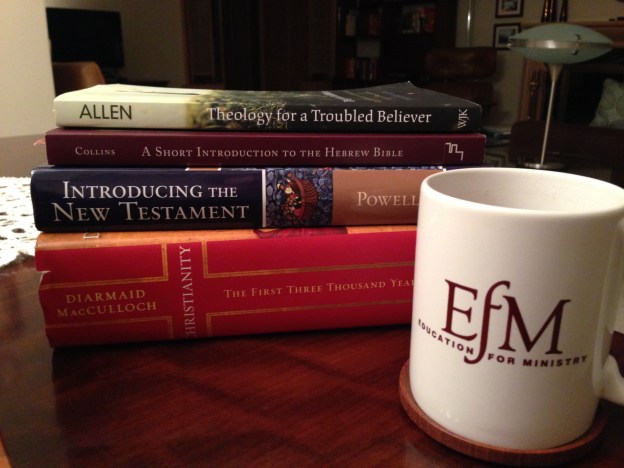
Education and transformation go together in the program called Education for Ministry, or EfM, which Joanne and Barb invited me to talk about today here at St. Luke’s.

EFM as education

Students in EfM really are students. They read textbooks chosen by staff at the Beecken Center of the School of Theology of the University of the South in Sewanee, Tennessee (one of the 11 historic Episcopal seminaries).

EfM was created 40 years ago as a “four-year distance learning certificate program of theological education,” and students will testify that they learn a lot.

EfM students in Year One listening to today’s Gospel might be thinking about the Old Testament’s (excuse me, the Hebrew Bible’s) ritual purity laws.

John Petty of ProgressiveInvolvement.com writes that:

Mark does not explicitly mention violations of the ‘purity code,’ but there are two of them in this reading. First, the woman with the hemorrhage touched Jesus, rendering him unclean. Second, Jesus touched the dead young woman, which also would have rendered him unclean.

EfM students in Year Two might be thinking about the New Testament and how to interpret documents written in Greek nearly 2,000 years ago.

Mark Davis, on his blog Left Behind and Loving It, translates the Greek of each week’s Gospel reading directly and comments on the problems or insights he discovers.

Mark the Gospel writer’s prose is urgent and breathless anyway, but this passage takes the cake:

And a woman being in a flow of blood for 12 years and having suffered much by many physicians and having spent all that she had and not having benefitted but having gone from bad to the worse having heard about Jesus having gone into the crowd she grabbed his garment from behind.

Davis goes on to say, “She is as defined by her determination as by her suffering. That is the value of respecting Mark’s string of participles and being patient for the main verb. After all that she suffered and did, she grabbed his garment.”

EfM students in Year Three might be thinking about how the political maneuverings and bloody wars of 3,000 years of church history are seemingly unrelated to today’s Gospel.

As one student in my group observes nearly every week, “The church history author hardly mentions Jesus at all!”

The church history we read is really the history of 3,000 years of religious change.

The last couple of weeks have seen momentous changes, with the events in Charleston and the Supreme Court’s rulings on the ACA and marriage equality, with President Obama’s eulogy at the funeral of Rev. Clementa Pinckney and the Episcopal Church’s election of the Rt. Rev. Michael Curry, another African-American preacher, as our 27th Presiding Bishop.

And yet we realize that the past is prologue, that history repeats itself, that even today girls in Zimbabwe, Kenya, or Haiti who have reached the age of menstruation often have to miss school because their period is seen as shameful. Girls in Bangladesh and India suffer infections for lack of clean supplies.

As for their hopes of an education or independence, they might as well be dead — like the synagogue leader’s unnamed daughter.

And EfM students in Year Four will have been reading stories and academic analyses about how people in different cultures read the Gospel differently, about how men and women read the Gospel differently, about how the powerful and powerless read the Gospel differently.

Deborah Blanks, associate dean of religious life at Princeton University, writes for the African-American Lectionary.org:

[Jesus’] message is clear – that the unnamed woman is of no less importance than the ill daughter of a person of power. She becomes a perpetual reminder that the socially marginal have a conspicuous place in the realization of God’s reign.

EfM might help us learn a lot that enriches our appreciation of the Gospel, but it doesn’t stop there.

EFM as reflection

We don’t simply gaze in admiration at all of the pictures our teachers have painted.

Instead, we deliberately – in a process called theological reflection – look more closely at the pictures, entering into the emotions and dilemmas and questions they depict.

In our “TRs” (as we call them) we seek a glimpse of how God is acting in our lives and share with each other our transformed understanding.

If we were doing a theological reflection on efficiency, for example, we might picture Jesus as a paramedic and look closely at his presence in this chaotic and emotional scene.

Peter Woods, on his blog The Listening Hermit, writes an entry called “Jesus has no time for triage”.

With all the drama of a novel rushing to its climax, Mark inserts the older hopeless woman into the story of Jesus’ mission to heal the just girl. The old bleeding woman is an interruption and an energy thief to boot! Yet, as the story unfolds both are healed. The young and the old, the hopeful and the hopeless. There is enough time, power, compassion, and grace to go round so that no one needs be written off.

Or, if we were doing a theological reflection on vulnerability, we might remember that the woman is ritually impure, shunned because of her bleeding; the child is unclean (and her father prostrate with grief) because she is dead. We might see ourselves in the portrait before us.

David Lose of Lutheran Theological Seminary in Philadelphia writes on the blog Dear Working Preacher:

We tend in our culture to avoid vulnerability – to avoid admitting that we don’t have it all together – because of the way it can leave you feeling exposed, desperate and, well, vulnerable. And there is something of that in these stories. But we’ve also seen that only in admitting our vulnerability are we able to receive help, and only by owning our moments of desperation are we willing to try something out of the ordinary, discover the courage to be and act differently.

Being transformed for ministry

Jesus’ presence in the whirlwind encounters with the woman and the child transformed them. The child was brought back to life, and the woman was brought back into life.

Jesus transformed and encouraged them both.

He encouraged Mark and the other disciples to “turn the world upside down” (Acts 17:6), and the world keeps turning upside down.

Having “the courage to be and to act differently” – that’s what it means to be transformed by Jesus.

Admitting our vulnerability – admitting that we don’t have it all together – and receiving help, that’s the renewing of our minds in Jesus that helps us to “discern what is good and acceptable and perfect.”

Transformation is for all of us. Reflection is for all of us. Education is for all of us.

Shameless plug: Education for Ministry is for all of us.

Being transformed by the renewing of our minds so that we may discern what is the will of God – what is good and acceptable and perfect – that’s for all of us.

Amen.

[Sermon preached at St. Luke’s Episcopal Church in Sister Bay, Wisconsin.]

God looks on my loveliness with favor

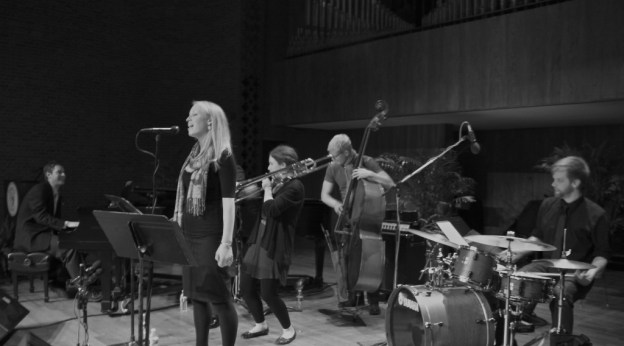
Apparently, Theodicy Jazz Collective played for the Friday morning Eucharist at the Episcopal Church’s General Convention in Salt Lake City.

I followed a link in the Acts 8 Moment’s Resurrection Report to check them out. What extraordinarily lovely music!

As I listened to their album Vespers, I was inspired to start sketching liturgical notes and outlines for “Breathing Under Water: A Jazz Vespers for Recovery.” I’d love to help create and bring a service like that to the Fox Cities, and my head began swirling with the possibilities.

But “The Magnificat” checked my stride (and my pride) and brought tears to my eyes.

My soul magnifies the Lord
my Spirit rejoices in God my Savior
my soul magnifies the Lord,
for God looks on my loveliness with favor.

Can it be true? God looks on my loveliness with favor? I sat stunned and grateful.

My experience of recovery has been an experience of grace, of admitting my own powerlessness and discovering that God pours out blessings on me as I follow “certain steps … which are suggested as a program of recovery” (Big Book 58-9).

I have found the prayers of the Daily Office transformed in the process, and now even more than ever, they serve to build my hope.

Theodicy Jazz Collective have brought me back into a state of grace this morning.

I hope that in their music you will hear that God looks on your loveliness with favor, too.

Constantly, boldly, patiently | Eve of St. John the Baptist

You will have joy and gladness, and many will rejoice at his birth, for he will be great in the sight of the Lord. He must never drink wine or strong drink; even before his birth he will be filled with the Holy Spirit. He will turn many of the people of Israel to the Lord their God. With the spirit and power of Elijah he will go before him, to turn the hearts of parents to their children, and the disobedient to the wisdom of the righteous, to make ready a people prepared for the Lord. (Luke 1:14-17)

Constantly speak the truth

How does one “make ready a people prepared for the Lord”?

Much of my own ministry has to do with teaching the basis, what the Church calls “catechesis.”

From my “Episcopal 101” class for adults on Sunday mornings, to the Education for Ministry group I mentor on Sunday afternoons, to this blog and the teaching I do about the Daily Office, I spend a lot of time helping people use the resources of the Christian tradition.

Many members of my parish are devoted to small group ministry and the ongoing relationships of accountability that help nurture disciples.

How do you help prepare people for the Lord? What does that mean to you?

Boldly rebuke vice

John has some very sharp words for those who come to see him preaching and baptizing at the River Jordan:

You brood of vipers! Who warned you to flee from the wrath to come? Bear fruits worthy of repentance …. And the crowds asked him, ‘What then should we do?’ In reply he said to them, ‘Whoever has two coats must share with anyone who has none; and whoever has food must do likewise.’ Even tax-collectors came to be baptized, and they asked him, ‘Teacher, what should we do?’ He said to them, ‘Collect no more than the amount prescribed for you.’ Soldiers also asked him, ‘And we, what should we do?’ He said to them, ‘Do not extort money from anyone by threats or false accusation, and be satisfied with your wages.’ (Luke 3:7-8, 10-14)

Share your coat — I must have at least six coats that I no longer wear. Why are they still hanging in my closet? Who else needs a coat?

Share your food — While my wife and I regularly host parties and invite people into our home, I don’t make a habit of helping at the meal program hosted by my parish each week. Who else needs a meal?

Live within your means — I’m finally doing better at this, partly out of necessity but also partly because of my own recovery. Buying things fulfills the same kind of craving that other substances do, so I’m working daily to watch my spending. Who else could I help if I stop helping myself?

Don’t rob anyone — This one is harder, because it’s not as simple as saying “don’t steal.” I’m beginning to read Pope Francis’ encyclical on the environment, which starts with the reminder that we all belong to each other and to the one creation. Nothing is in fact ours alone. Who else could use a drink of water or clean air to breathe?

Patiently suffer

John spent some time in prison before he died, and he wasn’t entirely sure if it was worth it.

John summoned two of his disciples and sent them to the Lord to ask, ‘Are you the one who is to come, or are we to wait for another?’ When the men had come to him, they said, ‘John the Baptist has sent us to you to ask, “Are you the one who is to come, or are we to wait for another?” Jesus had just then cured many people of diseases, plagues, and evil spirits, and had given sight to many who were blind. And he answered them, ‘Go and tell John what you have seen and heard: the blind receive their sight, the lame walk, the lepers are cleansed, the deaf hear, the dead are raised, the poor have good news brought to them. And blessed is anyone who takes no offence at me.’ (Luke 7:18-23)

Whether he was “offended” by Jesus or not, John was patient in his imprisonment, even to the point of speaking with his captor on several occasions before his beheading.

“Herod feared John, knowing he was a righteous and holy man, and he protected him [from Herodias]. When he heard him, he was greatly perplexed; and yet he liked to listen to him” (Mark 6:20-21)

What frustrating situation in your life are you struggling with right now? Who might you speak kindly to, even when things aren’t going your way?

Collect of the Day

Almighty God, by whose providence your servant John the Baptist was wonderfully born, and sent to prepare the way of your Son our Savior by preaching repentance: Make us so to follow his teaching and holy life, that we may truly repent according to his preaching; and, following his example, constantly speak the truth, boldly rebuke vice, and patiently suffer for the truth’s sake; through Jesus Christ your Son our Lord, who lives and reigns with you and the Holy Spirit, one God, for ever and ever. Amen.