Category Archives: Daily Office

Why do we call this Friday “Good”?

Just as every Sunday is for Christians a reminder of Easter and the resurrection, every Friday is a reminder of Good Friday and the crucifixion.

At Morning Prayer every Friday, we pray:

Collect for Fridays

Almighty God, whose most dear Son went not up to joy but first he suffered pain, and entered not into glory before he was crucified: Mercifully grant that we, walking in the way of the cross, may find it none other than the way of life and peace; through Jesus Christ your Son our Lord. Amen. (BCP 99)

Just as we live in the light of the Resurrection, we walk in the way of the cross.

Fr. Richard Rohr says:

I believe that the Mystery of the Cross is saying that the pattern of transformation unto God, the pattern that connects, the life that God offers us is always death transformed. The only pattern is the pattern of death and resurrection. We submit to it with trust because Jesus did.

Rohr calls this One Big Pattern “transformative dying.”

On the other side of that dying, whether it is physical illness and death, or the “daily dying to self” of the prayer book, or admitting our powerlessness over our sin, on the other side of that dying we find the truth.

The American author Reynolds Price says that the Gospel of John can be compressed down to a single sentence, “the sentence mankind craves from stories”:

The Maker of all things loves and wants me.

The Maker of all things loves and wants me — loves and wants every single one of us, loves and wants all of us so much that God was willing not only to endure the limitations of becoming human, but also to endure the suffering and death that is our lot in life.

Because he died and rose again, we too can experience “transformative dying,” can claim our small part of the one big pattern.

That’s why we call this Friday “Good.”

Collect for Fridays

Almighty God, whose most dear Son went not up to joy but first he suffered pain, and entered not into glory before he was crucified: Mercifully grant that we, walking in the way of the cross, may find it none other than the way of life and peace; through Jesus Christ your Son our Lord. Amen. (BCP 99)

New in the kingdom of God

While they were eating, he took a loaf of bread, and after blessing it he broke it, gave it to them, and said, “Take; this is my body.” Then he took a cup, and after giving thanks he gave it to them, and all of them drank from it. He said to them, “This is my blood of the covenant, which is poured out for many. Truly I tell you, I will never again drink of the fruit of the vine until that day when I drink it new in the kingdom of God.” (Mark (14:22-25)

What a difference six months makes!

I have come to realize a truth that I had only intellectually known before. As the Collect for Guidance says, “in all the cares and occupations of our life … we are ever walking in God’s sight” (BCP 100).

Six months ago, I was completely discouraged and at the end of my own power. Today, I woke up glad, looking forward to the day.

I could not manage my own life; no human power could have relieved my problem. But God could and would if I sought Him.

“In these holy mysteries,” the Collect for Maundy Thursday reminds us, Christ “gives us a pledge of eternal life” (BCP 221).

In the holy mystery of a man sharing a meal with his friends (and his betrayer) …

In the holy mystery of a teacher serving his students …

In the holy mystery of the incarnate God dying a criminal’s death …

In the holy mystery of  an empty tomb on an early Sunday morning …

That day when the Risen Christ breaks the bread and drinks the cup with us — “new in the kingdom of God” — is about to dawn again.

In that dawn, we can be glad — in every dawn, because of that one, we too can be “new in the kingdom of God.”

The sufferings of the present time

And I said, “Oh, that I had wings like a dove!
I would fly away and be at rest.

I would flee to a far-off place
and make my lodging in the wilderness.

I would hasten to escape
from the stormy wind and tempest.
(Psalm 55:7-9)

The Hermit’s Song

I wish, O Son of the living God, O ancient, eternal king
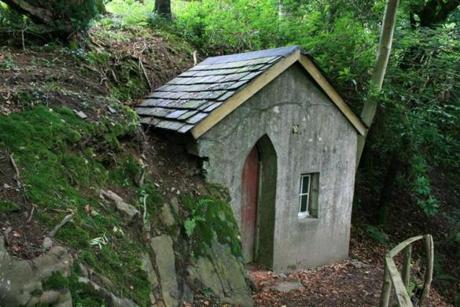
For a hidden little hut in the wilderness that it may be my dwelling.

An all-grey little lake to be by its side.
A clear pool to wash away sins by the grace of the Holy Spirit.

Quite near, a beautiful wood around it on every side,
To nurse many-voiced birds, hiding it with its shelter.

From A Celtic Primer, Brendan O’Malley

How often this kind of lovely picture comes to my mind — especially on days like today when I am conscious of my difficulties and frustrations.

“If only I could just escape, if only I could just get away, if only I didn’t have to face it, if only ….”

That sort of fantasizing, however, really leads nowhere. Even if I could flee to a hermit’s “little hidden hut,” it would still be me sitting inside it, stewing and agitated.

While going to a quiet place, physically apart from other people, is sometimes important, the more important separation here is called detachment.

I must learn to separate myself from the anxiety and circular worries, center myself in God’s presence, and renew my trust in his goodness.

That’s a habit of mind more than a physical location. That’s probably what Jesus meant when he talked about “going into your interior room to pray.”

When we cannot “fly away” physically, we must find a place of quiet inside and there “be at rest.”

Even Jesus himself struggled for that inner peace as Thursday night turned into Friday morning and he prayed that the trouble building around him could pass from him.

His sense of the Father’s presence gave him the confidence to face into the storm.

I wish, O Son of the living God, for a measure of that same confidence.

Collect for Wednesday in Holy Week

Lord God, whose blessed Son our Savior gave his body to be whipped and his face to be spit upon: Give us grace to accept joyfully the sufferings of the present time, confident of the glory that shall be revealed; through Jesus Christ your Son our Lord, who lives and reigns with you and the Holy Spirit, one God, for ever and ever. Amen.

Following the way of the cross

From the Society of St. John the Evangelist -- www.ssje.org

From the Society of St. John the Evangelist — http://www.ssje.org

A Facebook friend whose opinion I respect, William Henry Benefield BSG, posted yesterday about reading the Passion Gospel during Holy Week:

“Perhaps one day, parishes throughout the world on Palm Sunday and Good Friday will have all of us present — the baptized Eucharistic assembly — saying or chanting the part of Christ during the Passion and not playing the ‘crowd’ as our liturgical tradition so often dictates. Our theology teaches us we are the Body of Christ … so it looks and sounds rather strange, not to mention theologically questionable, for us to be shouting ‘Crucify, Crucify’ and ‘Give us Jesus Barabbas.’ Maybe one day we the Church will finally realize who we actually are, break with the previous liturgical tradition when chanting the Passion on these two sacred days, and claim our true identity in the world.”

I’ll admit I had never heard of that being done before, as William said he had experienced at an Episcopal church in New York City.

His thoughtful post got me thinking, and I enjoyed figuring out why I disagree with him.

+ + + + +

It seems to me that while we are the Body of Christ, we are not Jesus. The tension in our lives of faith is between living “in Christ” or “following the crowd.”

I think playing the part of the crowd in the Passion is entirely appropriate as a way of realizing that “while we were still sinners, Christ died for us” (Rom. 4:8). It also helps us accomplish the movement Paul describes to the Colossians: “You have stripped off the old self with its practices and have clothed yourselves with the new self, which is being renewed in knowledge according to the image of its creator” (Col. 3:9b-10).

Our creator, “being found in human form … humbled himself and became obedient to the point of death — even death on a cross” (Phil. 2:8).

In our old self, I think we are the crowd, preferring spectacle, resistant to change, and easily led. By the grace of God and through the self-offering of Jesus, we are given a new way.

Being the Body of Christ means stripping off the old self and following the way of the cross instead of following the crowd.

+ + + + +

While I completely agree with the ancient homily for Holy Saturday that William shared — “together [with Christ] we are now one undivided person” — I’m also conscious at this time in my life that I am not always the “one person” I want to be. Like Paul, I “find it to be a law that when I want to do what is good, evil lies close at hand” (Romans 7:21).

Like AA members do when they share their stories of encouragement, hope, and strength, perhaps we in the Church use the Passion Gospel during Holy Week to remind ourselves “what we used to be like, what happened, and what we are like now.”

+ + + + +

The collect for today, Monday in Holy Week, is very familiar to us as the Collect for Fridays at Morning Prayer.

I hope it will remind you as you journey with Jesus during this Holy Week what you used to be like, what happened as a result of his obedience and death, and what you are like now.

May this Holy Week open the way to life and peace for you.

Almighty God, whose most dear Son went not up to joy but first he suffered pain, and entered not into glory before he was crucified: Mercifully grant that we, walking in the way of the cross, may find it none other than the way of life and peace; through Jesus Christ our Lord. Amen. (BCP 99).

Enthroned above the flood

20140413-055308.jpg

The Lord sits enthroned above the flood;
the Lord sits enthroned as King for evermore.
The Lord shall give strength to his people;
the Lord shall give his people the blessing of peace.

(Psalm 29:10-11)

May this Holy Week be for you a time when the flood waters of your busy life recede just a bit and the Holy Spirit comes to you with a glimpse, even just a slender branch, of the Tree on which our Lord is enthroned.

“Return to your stronghold, O prisoners of hope; today I declare that I will restore to you double” (Zech. 9:12).

May your worship this Palm Sunday and throughout this Holy Week renew the hope that is in you, that “sure and steadfast anchor of the soul.”

Prayer for Mission

Lord Jesus Christ, you stretched out your arms of love on the hard wood of the cross that everyone might come within the reach of your saving embrace: So clothe us in your Spirit that we, reaching forth our hands in love, may bring those who do not know you to the knowledge and love of you; for the honor of your Name. Amen. (BCP 101)

Frost and sleet, ice and cold

20140326-063441.jpg

Since our furnace conked out last night, Morning Prayer today is positively medieval.

I can’t quite see my breath as I say the Kyrie Pantokrator (BCP 90) and the Benedictus Dominus Deus (BCP 92), but my nose is definitely cold.

If I had a surplice at home, it would be appropriate to wear it “over my furry garment” (Lat., super pelliceum). The cats cluster round to help, so at least my legs are nice and warm.

Perhaps monks in their choir stalls sit shoulder to shoulder for the same reason.

I hope your prayers today warm you with a sense of connection to Christians past and present whose voices rise in praise to God winter and summer alike.

Peace a pathway for his feet

Detail from Salvador Dali, Crucifixion ('Corpus Hypercubus'), 1954.

Detail from Salvador Dali, Crucifixion (‘Corpus Hypercubus’), 1954.

Mercy and truth have met together;
righteousness and peace have kissed each other.
Truth shall spring up from the earth,
and righteousness shall look down from heaven.
The LORD will indeed grant prosperity,
and our land will yield its increase.
Righteousness shall go before him,
and peace shall be a pathway for his feet.
(Psalm 85:10-13)

On this feast of the Annunciation I can’t help seeing in Mary the “peace” that the Psalmist sings about: kissed by God’s righteousness and making a pathway for the Messiah’s feet.

God’s righteousness did indeed go before Jesus, who spent his earthly ministry walking from place to place announcing that the Kingdom of God had come near.

His mother Mary’s firm assent to God’s purposes and her role in them, her pondering them in her heart, the “sword that pierced her heart also,” these all became part of the pathway for Jesus’ feet, helping not only to set but also to confirm the direction his life would take.

And when his path led him to Jerusalem, to conflict with religious leaders and imperial authorities, to betrayal and scourging and crucifixion, peace came again and stood at his feet.

How beautiful upon the mountains
are the feet of the messenger
who
announces peace,
who brings good news,
who announces salvation,
who says to Zion, “Your God reigns.”
(Isaiah 52:7)

 As we say the Benedictus at Morning Prayer today, may we also take to heart our role as members of Christ’s Body to follow Christ in the way of the cross, to proclaim God’s kingdom, and to participate like Mary in the unfolding of God’s righteous purpose for creation:

In the tender compassion of our God *
the dawn from on high shall break upon us,
To shine on those who dwell in darkness and the
shadow of death, *
and to guide our feet into the way of peace. 
(Canticle 16, BCP 93)

The strong Name of the Trinity

1940017_260022397509429_1706906093_n

St. Patrick’s Breastplate

I bind unto myself today
the strong Name of the Trinity,
by invocation of the same,
the Three in One, and One in Three.

I bind this day to me forever,
by power of faith, Christ’s Incarnation;
his baptism in the Jordan river;
his death on cross for my salvation;
his bursting from the spiced tomb;
his riding up the heavenly way;
his coming at the day of doom:
I bind unto myself today.

I bind unto myself the power
of the great love of cherubim;
the sweet “Well done” in judgement hour;
the service of the seraphim;
confessors’ faith, apostles’ word,
the patriarchs’ prayers, the prophets’ scrolls;
all good deeds done unto the Lord,
and purity of virgin souls.

I bind unto myself today
the virtues of the starlit heaven,
the glorious sun’s life-giving ray,
the whiteness of the moon at even,
the flashing of the lightning free,
the whirling wind’s tempestuous shocks,
the stable earth, the deep salt sea,
around the old eternal rocks.

I bind unto myself today
the power of God to hold and lead,
his eye to watch, his might to stay,
his ear to hearken to my need;
the wisdom of my God to teach,
his hand to guide, his shield to ward;
the word of God to give me speech,
his heavenly host to be my guard.

Christ be with me, Christ within me,
Christ behind me, Christ before me,
Christ beside me, Christ to win me,
Christ to comfort and restore me,
Christ beneath me, Christ above me,
Christ in quiet, Christ in danger,
Christ in hearts of all that love me,
Christ in mouth of friend and stranger.

I bind unto myself the Name,
the strong Name of the Trinity,
by invocation of the same,
the Three in One, and One in Three.
Of whom all nature hath creation,
eternal Father, Spirit, Word:
praise to the Lord of my salvation,
salvation is of Christ the Lord.

See Hymnary.org for the text and music of this magnificent hymn.

Of a Missionary

Almighty and everlasting God, we thank you for your servant Patrick, whom you called to preach the Gospel to the people of Ireland. Raise up in this and every land evangelists and heralds of your kingdom, that your Church may proclaim the unsearchable riches of our Savior Jesus Christ; who lives and reigns with you and the Holy Spirit, one God, now and for ever. Amen. (BCP 247)

The Ember Days: So what?

im_shrimp_tempura

The Ember Days are a strange item on the Church’s calendar.

They are “traditionally observed on the Wednesdays, Fridays, and Saturdays after the First Sunday in Lent, the Day of Pentecost, Holy Cross Day, and December 13” (BCP 18).

The name comes, most likely, from the Latin Quatuor Tempora, or “four seasons,” so the Ember Days mark the four seasons of the natural year rather than seasons of the Church year.

Various sources link the Wednesday, Friday, and Saturday observance to the early Christian practice of fasting on Wednesdays and Fridays attested to in the Didache (ca. 60 AD) and to the Roman practice of fasting on Saturdays, too.

Since Pope Gelasius I instituted the practice in 494, it also became customary for the Ember Days to serve as days for ordinations. The faithful would join the ordinands in fasting on Wednesday and Friday, and the ordination would happen (as is still pretty common) on Saturday.

This association with ordination is expanded upon in the Episcopal Church’s Book of Common Prayer, and now the three collects appointed for the Ember Days (BCP 256) invite us to pray for:

I. Those to be ordained

II. The choice of fit persons for the ministry, and

III. For all Christians in their vocation

To mark these days in the Daily Office, it would be natural simply to use the first collect on Wednesday, the second on Friday, and the third on Saturday. You will notice that the third collect is the same as one of the Prayers for Mission (BCP 100) that we use regularly in Morning Prayer.

+ + + + +

So what? Why should we care about the Ember Days?

Well, let me bring it closer to home and give you some examples.

I am a member of the Commission on Ministry (COM) here in the Episcopal Diocese of Fond du Lac. Our job is to assist the bishop in the following ways:

  • to determine the present and future needs for ministry in the Diocese
  • to provide discernment processes for parishes and individuals seeking to identify and use their gifts in ministry
  • to provide continuing education for all people, lay and ordained, in their ministries
  • to support the development of the ministry of the laity in the Diocese and within parishes
  • to identify persons for Holy Orders, and to guide and examine seekers, aspirants, postulants, and candidates for the diaconate and priesthood in their journey toward ordination

Four times a year, the Ember Days specifically focus not just the COM but the whole Church on praying for all Christians in their vocation.

Today is Ember Wednesday, so we pray for those to be ordained. In our case, the next ordination in the Diocese is that of Fr. Matt Gunter, who will be ordained as our new bishop on Saturday, April 26. Today I pray not only for him but also for all who are working to make that ordination service a celebration of our life and ministry here in northeastern Wisconsin.

On Ember Friday, we pray for the choice of fit persons for the ministry. The COM just began offering a group discernment process called Circles of Light for all who are interested in seeking God’s will for their ministry, and of the 10 people in the group two think they might be interested in the diaconate and two in the priesthood. I’ll pray especially for those four people this Friday.

On Ember Saturday, we pray for all Christians in their vocation. This Saturday, I’ll be with the young adults of the Diocese at a Happening weekend, and I can’t think of a better time to pray for vocation than with high-school age Christians.

Who might you pray for during this Ember Week?

+ + + + +

Bonus Ember Day trivia!

I am deeply grateful to Michael P. Foley’s article on the Ember Days for this delicious — and I mean yummy! — bit of trivia:

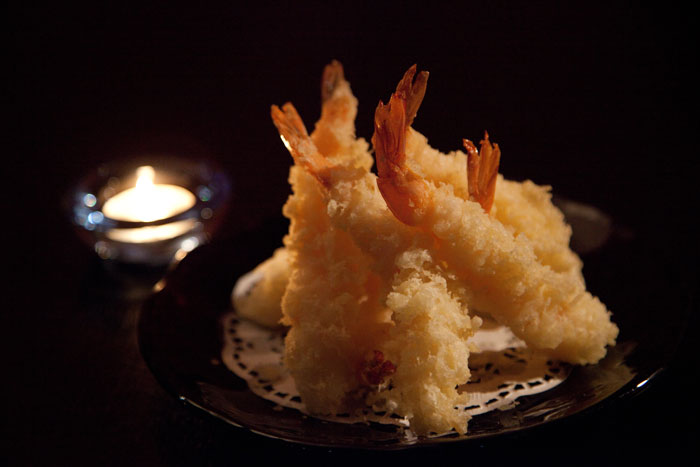
Even the Far East was affected by the Ember days. In the sixteenth century, when Spanish and Portuguese missionaries settled in Nagasaki, Japan, they sought ways of making tasty meatless meals for Embertide and started deep-frying shrimp. The idea caught on with the Japanese, who applied the process to a number of different sea foods and vegetables. They called this delicious food—have you guessed it yet?—“tempura,” again from Quatuor Tempora.

So next time you’re out for sushi, take a moment to pray for those about to be ordained, for the choice of fit persons for the ministry, and for all Christians in their vocation. You’ll be glad you did.

Thanks for reading!

Out of the depths

74585-From-the-bottom-of-the-well_view


Glory to you, Lord God of our fathers; *
you are worthy of praise; glory to you.
Glory to you for the radiance of your holy Name; *
we will praise you and highly exalt you for ever.

Glory to you in the splendor of your temple; *
on the throne of your majesty, glory to you.
Glory to you, seated between the Cherubim; *
we will praise you and highly exalt you for ever.

Glory to you, beholding the depths; *
in the high vault of heaven, glory to you.
Glory to you, Father, Son, and Holy Spirit; *
we will praise you and highly exalt you for ever.

I’m not sure these were the exact words Joseph said to himself as he looked up from the bottom of the pit his brothers had thrown him into (Genesis 37:12-24).

It’s kind of strange that they’re the words we say (Canticle 13) right after we read that lesson from Genesis at Morning Prayer today.

But it’s also kind of appropriate, this juxtaposition between the bottom of the pit and God’s glory, especially during the season of Lent.

Lent makes us mindful how far we are from the glory God intends for us.

Lent reminds us in Paul’s words that “not many of you were wise by human standards, not many were powerful, not many were of noble birth. But God chose what is foolish in the world to shame the wise; God chose what is weak in the world to shame the strong” (1 Cor. 1:26-27).

This particular Lent reminds me, as I work the steps in my recovery process, that I “could not manage [my] own [life]; that probably no human power could have relieved [my problem]; that God could and would if He were sought” (Big Book 60).

The collect we usually read on Tuesday mornings also feels especially appropriate when we consider God’s goodness — God’s choosing us — in the face of our own sin and the predicaments we find ourselves in.

A Collect for Peace

O God, the author of peace and lover of concord, to know you is eternal life and to serve you is perfect freedom: Defend us, your humble servants, in all assaults of our enemies; that we, surely trusting in your defense, may not fear the power of any adversaries; through the might of Jesus Christ our Lord. Amen. (BCP 99)