Tag Archives: Morning Prayer

In this world and in the age to come

hanukkah_4160 egg2cake


A Prayer of St. Chrysostom

Almighty God, you have given us grace at this time with one accord to make our common supplication to you; and you have promised through your well-beloved Son that when two or three are gathered together in his Name, you will be in the midst of them: Fulfill now, O Lord, our desires and petitions as may be best for us; granting us in this world knowledge of your truth, and in the age to come life everlasting. Amen. (BCP 102)

Knowledge of God’s truth

In this morning’s reading from 1 Maccabees we have the story of the rededication of the Temple — the event celebrated at Hanukkah each year. Judas Maccabeus and his followers have liberated the Temple and labored to rebuild it, replacing the desecrated altar and all of the vessels and fittings for the sanctuary.

Early in the morning on the twenty-fifth day of the ninth month, which is the month of Chislev, in the one hundred forty-eighth year, they rose and offered sacrifice, as the law directs, on the new altar of burnt offering that they had built. At the very season and on the very day that the Gentiles had profaned it, it was dedicated with songs and harps and lutes and cymbals. All the people fell on their faces and worshiped and blessed Heaven, who had prospered them. So they celebrated the dedication of the altar for eight days, and joyfully offered burnt offerings; they offered a sacrifice of well-being and a thanksgiving offering. (1 Macc. 4:54-56)

The rededication of the Temple is part of the story of salvation history — the understanding that God continually acts on behalf of his people, bringing them back again and again from their sin and neglect of his covenant with them.

Life everlasting

The rededication of the Temple echoes through the Christian story, too, but is transformed in the visions recorded in the Revelation to John. He pictures a heavenly city, the new Jerusalem, with no more need for a Temple because of the presence of the throne of God and of the Lamb.

Then the angel showed me the river of the water of life, bright as crystal, flowing from the throne of God and of the Lamb through the middle of the street of the city. On either side of the river is the tree of life with its twelve kinds of fruit, producing its fruit each month; and the leaves of the tree are for the healing of the nations. Nothing accursed will be found there any more. But the throne of God and of the Lamb will be in it, and his servants will worship him; they will see his face, and his name will be on their foreheads. And there will be no more night; they need no light of lamp or sun, for the Lord God will be their light, and they will reign forever and ever. (Rev. 22:1-5)

Even the lampstands of the Temple will no longer be necessary, “for the Lord God will be their light” for ever.

When two or three are gathered

These stories have been a source of hope and encouragement for Jews and Christians alike, visions of heaven and reminders of God’s continuing care for those who follow him.

Our hope for life in the age to come, however, should also govern how we act here and now. Today’s teaching from the Gospel of Matthew underscores that fact.

Jesus addresses the question of disagreements among believers, outlining a sort of progressive response — first speak to the person alone, then with two or three, then with the whole assembly. If they still don’t agree, he says, “let such a one be to you as a Gentile and a tax collector”  (Matt. 18:17).

This is a critical point that we usually miss. What does Jesus do with Gentiles and tax collectors?

He seeks them out, talks with them (men and women alike), dines with them, has his mind changed by them, comes into their households, and proclaims that the kingdom of God has come near to them.

Our hope for life in the age to come should create in us the same urgency for reconciliation that Jesus demonstrated, seeking out the one lamb that was lost from the hundred, even giving up his own life in order to break forever the separation of death.

“When two or three are gathered together,” Christ who is in the midst of us sends us out to fulfill our mission: to restore all people to unity with God and each other in Christ (BCP 855).

+ + + + +

Fulfill now, O Lord, our desires and petitions as may be best for us; granting us in this world knowledge of your truth, and in the age to come life everlasting. Amen.

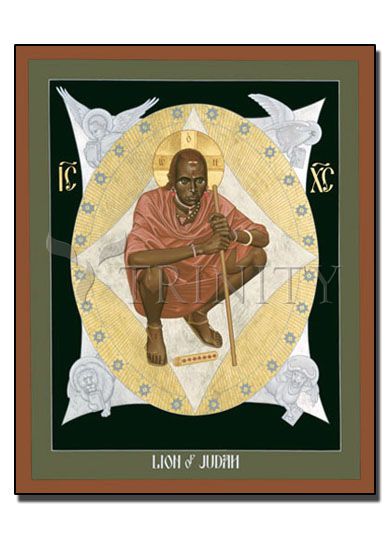
Hail, hail! Lion of Judah!

Icon by Robert Lentz, OFM from Trinity Stores -- https://www.trinitystores.com

Icon of the Lion of Judah by Br. Robert Lentz, OFM

Then I saw in the right hand of the one seated on the throne a scroll written on the inside and on the back, sealed with seven seals; and I saw a mighty angel proclaiming with a loud voice, “Who is worthy to open the scroll and break its seals?” And no one in heaven or on earth or under the earth was able to open the scroll or to look into it. And I began to weep bitterly because no one was found worthy to open the scroll or to look into it. Then one of the elders said to me, “Do not weep. See, the Lion of the tribe of Judah, the Root of David, has conquered, so that he can open the scroll and its seven seals.” (Revelation 5:1-5)

It’s got to be at least 25 years ago now.

A group of Episcopal campus ministers from around Illinois were gathered at Brent House, the campus ministry at the University of Chicago, for a weekend planning session of some kind.

At Eucharist one evening we sang Victory Chant (Hail Jesus) by Donnie McClurkin, and I remember being powerfully moved by the refrain:

Hail, hail Lion of Judah!
How wonderful You are!
Hail, hail Lion of Judah!
How powerful You are!

Hail Jesus! You’re my King!
Your life frees me to sing
I will praise You all my days
You’re perfect in all Your ways

At the time, I think it was the music that impressed me most — the joyous, rhythmic chant sung by friends who were all excellent singers.

I’ve written before about how I ran across this icon of the Lion of Judah by Br. Robert Lentz, OFM, but today it really cements in my mind the powerful “otherness” of Jesus.

That is to say, it helps me understand that the Risen Jesus is always more than we think, always other than we think.

He is both Lion and Lamb. He is not only Jewish, but Gentile. He is not only Mediterranean, but Indian and Chinese and African (and even English and Scottish, Irish and Welsh). He is both Judge and Lover, both King and Suffering Servant.

Part of Jesus’ “otherness,” to my mind, is his power.

“Who is worthy to open the scroll?” asks the terrible angel. “The Lion of Judah,” says the elder, “because he has conquered.”

Jesus has conquered death, we proclaim every Sunday, trampled down death by death. His power, though, is not just for himself but for us. His life — his conquering life — overcomes even our powerlessness and frees us to sing.

Hail, hail! Lion of Judah!

To unity, knowledge, and maturity

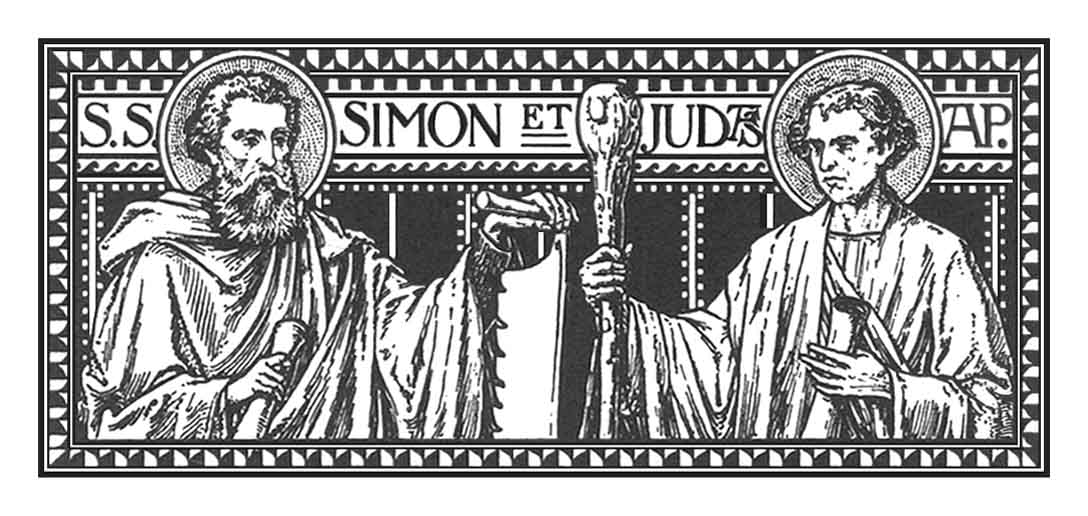
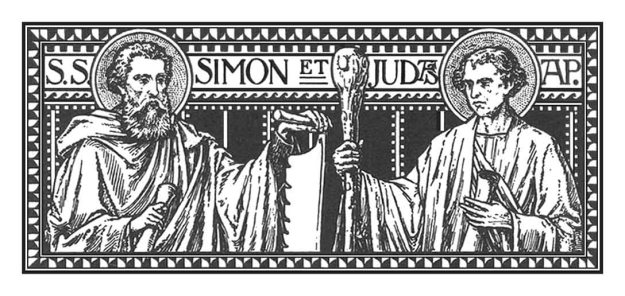
Ss_Simon_and_Jude

The gifts he gave were that some would be apostles, some prophets, some evangelists, some pastors and teachers, to equip the saints for the work of ministry, for building up the body of Christ, until all of us come to the unity of the faith and of the knowledge of the Son of God, to maturity, to the measure of the full stature of Christ. (Ephesians 4:11-13).

Unity

We often hear in the Church the old saw that “unity does not mean uniformity.” What we are trying to express, I think, is that we don’t have to march in lockstep, we don’t all have to be believers in the same exact way.

The Church is gifted — not only with those who guard the faith (apostles) but also with those who upbraid the faithful (prophets); not only with traveling preachers (evangelists) but also with local leaders (pastors and teachers). We all have the same purpose, though: to equip the saints for the work of ministry, to build up the body of Christ.

You may serve in the food kitchen, you may lead youth group, you may knit prayer shawls, you may provide pastoral care, you may give generously, you may go on mission trips, you may host a fellowship group in your home, you may advocate for political change, you may lead a Bible study. As David Allen says, “you can do anything, but you can’t do everything.”

Whatever you do, then, do it in order to equip the saints and to build up the body.

Knowledge

My own particular interests are in teaching the Bible and the practice of the Daily Office.

Isaiah has harsh words in today’s Old Testament lesson for religious leaders who teach nothing more than “precept upon precept, precept upon precept, line upon line, line upon line, here a little, there a little” (Isa. 28:10).

That is to say, teaching only Bible facts without teaching saving wisdom is no help in equipping the saints. It puffs up the teacher (as Miracle Max would say, “hoo hoo hoo, look who knows so much!”), but it does not build up the learner.

How do the words of Scripture become “living and active” in our lives? How do they soak into us until they are there when we need them?

One reason I teach about the Daily Office is that it is a method for reading Scripture in the context of worship that has helped Christians throughout the centuries to “inwardly digest” the Scriptures even as they “read, mark, and learn” (BCP 236) them in Bible studies and other forums. Again, no one method is complete or self-sufficient; each has a particular purpose.

Maturity

The gifts given to the Church are “for building up the body of Christ, until all of us come to the unity of the faith and of the knowledge of the Son of God, to maturity, to the measure of the full stature of Christ.”

“Equipping the saints” ultimately means enabling them to stand on their own two feet — to help learners become believers, and to help believers become ministers themselves.

Another program I’m involved in is Education for Ministry, a program of theological education for lay people created by the School of Theology of the University of the South. This year there are 11 students in my group at St. Thomas Church.

Along with the study we pursue in the four-year curriculum — Old Testament, New Testament, Church history, and theology — we also engage in a process of theological reflection, learning to identify where our beliefs and positions come from and how to turn our insights into action.

As we share our “spiritual autobiographies” with one another, we start to trace how God has acted in our lives. As we study the Scriptures, we learn about how God has acted in the life of Israel and of the Church. Reading church history is a humbling exercise in seeing how we keep getting it wrong, over and over again. And our study of theology is no academic exercise, but an attempt to go from “milk” to “solid food” (1 Cor 3:2) as we serve in our various ministries.

Being “lifelong learners” is wonderful, but as St. Benedict puts it, “the Lord waits for us daily to translate into action, as we should, his holy teachings” (RB Prologue).

Collect of the Day

O God, we thank you for the glorious company of the apostles, and especially on this day for Simon and Jude; and we pray that, as they were faithful and zealous in their mission, so we may with ardent devotion make known the love and mercy of our Lord and Savior Jesus Christ; who lives and reigns with you and the Holy Spirit, one God, for ever and ever. Amen. (BCP 245)


 

Continual prayer and reconciliation

Seven times a day do I praise you, *
because of your righteous judgments. 
Great peace have they who love your law; *
for them there is no stumbling block. 
I have hoped for your salvation, O LORD, *
and have fulfilled your commandments. 
I have kept your decrees *
and I have loved them deeply. 
I have kept your commandments and decrees, *
for all my ways are before you.
(Psalm 119:164-168)

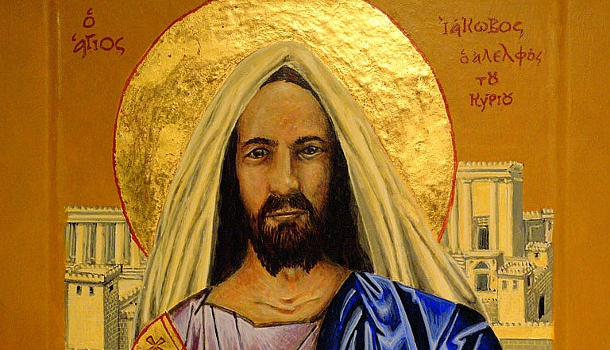
James of Jerusalem, the brother of Jesus, is called the Just because of his decision not to place restrictions on Gentile converts (Acts 15:19).

He was an early leader of the movement Jesus started, even though he wasn’t a believer until after his brother died. After the resurrection, Jesus appeared to Peter and the 12 apostles, then to about 500 followers, then to James, and then to all of the apostles (1 Cor. 15:7).

Imagine being a leader in a movement your brother started, a bishop in the new church, and remaining faithful to that cause for nearly 30 years after he died.

Imagine being a faithful, prayerful, traditional person — and discovering that your new understanding of God meant relaxing some of the restrictions of your faith in order to welcome more people into relationship with God.

Imagine being such an enduring witness to inclusion that your fellow parishioners throw you off the church roof for your trouble.

How does the example of James invite you to continual prayer?

With whom do you need to be reconciled?

What witness are you called to bear?

Collect of the Day

Grant, O God, that, following the example of your servant James the Just, brother of our Lord, your Church may give itself continually to prayer and to the reconciliation of all who are at variance and enmity; through Jesus Christ our Lord, who lives and reigns with you and the Holy Spirit, one God, now and for ever. Amen. (BCP 245)

The roads to Zion mourn

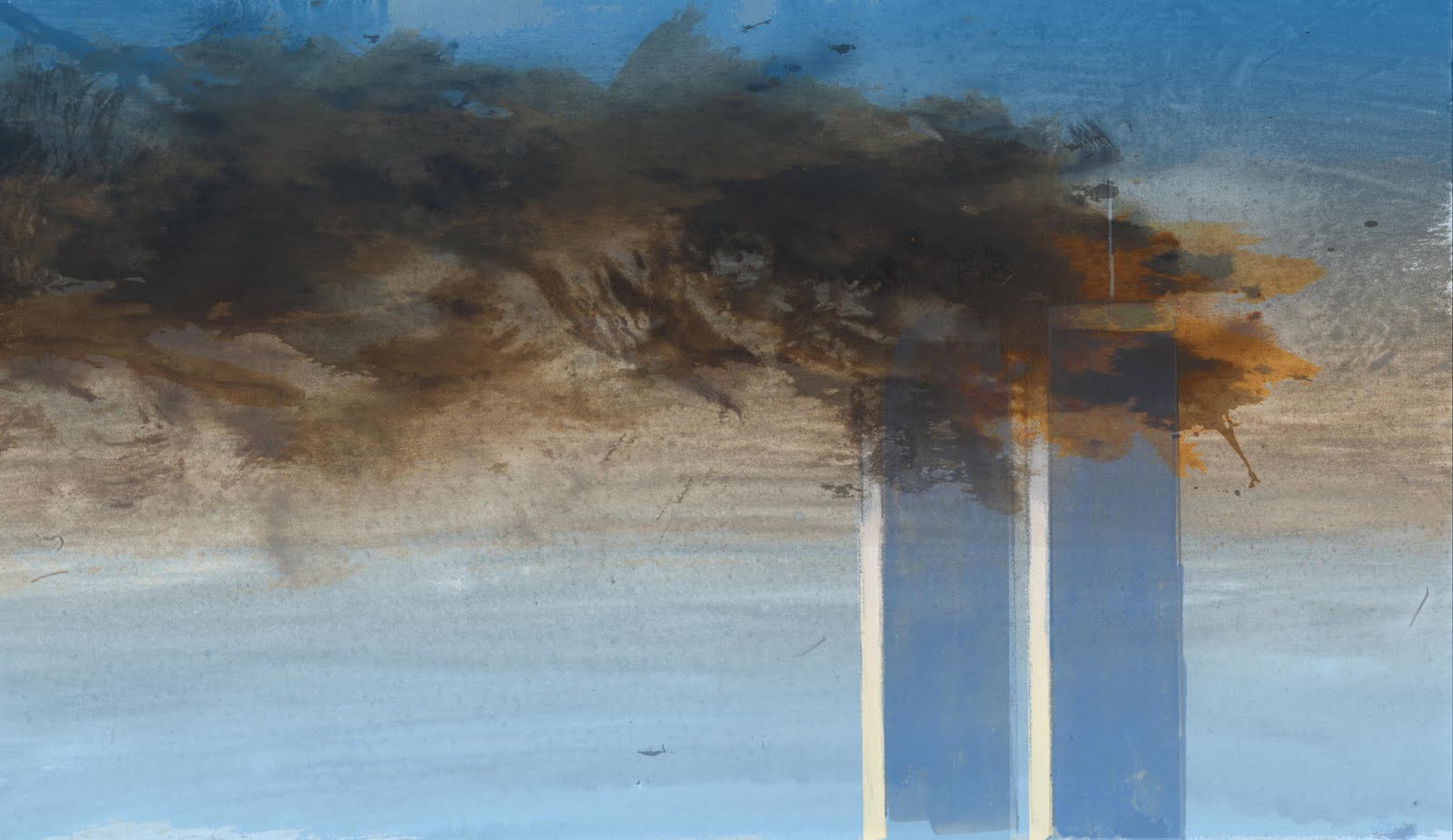
Twin Towers 9-11 by William Wray -- http://williamwray.blogspot.com

Twin Towers 9-11 by William Wray — http://williamwray.blogspot.com

How lonely sits the city that once was full of people! How like a widow she has become, she that was great among the nations! She that was a princess among the provinces has become a vassal. She weeps bitterly in the night, with tears on her cheeks; among all her lovers she has no one to comfort her; all her friends have dealt treacherously with her, they have become her enemies. Judah has gone into exile with suffering and hard servitude; she lives now among the nations, and finds no resting place; her pursuers have all overtaken her in the midst of her distress. The roads to Zion mourn, for no one comes to the festivals; all her gates are desolate, her priests groan; her young girls grieve, and her lot is bitter. Her foes have become the masters, her enemies prosper, because the LORD has made her suffer for the multitude of her transgressions; her children have gone away, captives before the foe. (Lamentations 1:1-5)

+ + + + +

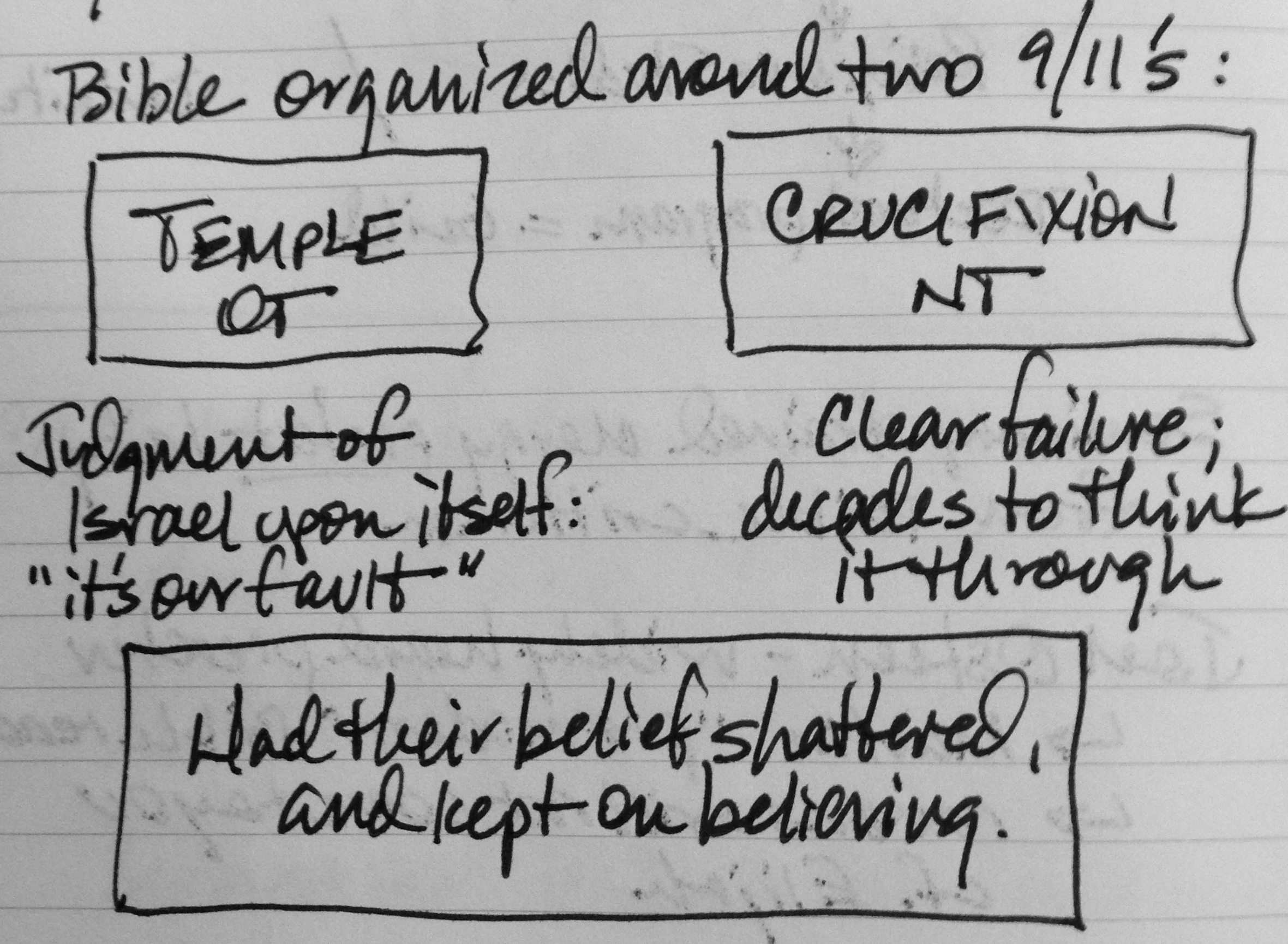
In his course this fall at Seabury titled “This Dangerous Book: Strategies for Teaching the Bible,” John Dally suggests that the Bible is organized around two 9-11’s.

The Hebrew Bible, or the Old Testament, was compiled into its final form after the destruction of the First Temple in 586 BCE and the exile of the Jews into Babylon.

The New Testament is the record of the Church’s attempt to understand the disaster of Jesus’ crucifixion.

Notes from the first session of John Dally's "This Dangerous Book: Strategies for Teaching the Bible" at Seabury.

Notes from the first session of John Dally’s “This Dangerous Book: Strategies for Teaching the Bible.”

The passage this morning from the Book of Lamentations captures the despair of the people of Judah over the destruction of the Temple. In the juxtaposition of this lesson and the canticle appointed for today (Canticle 13), we can see the seeds of Israel’s judgment on itself — “God is worthy of praise; this disaster must be our fault.” An empire has crushed the hope of God’s people.

The story that becomes clear throughout the Hebrew scriptures is the story of God seeking the people of Israel and their turning away from him again and again. In the New Testament, we see the same story written in small letters, but on a cosmic scale.

The New Testament story concerns Jesus of Nazareth — “we had hoped that he was the one to redeem Israel” (Luke 24:21).

Not only did God come into the world he had created, but once again we turned away from him. Even when some came to accept him and place their hope in him, they had their hopes terribly dashed when he was killed by the Romans. Yet again, an empire crushed the hopes of God’s people.

In both cases, however, as John Dally observes, the people of God had their belief shattered and kept on believing.

Paul sums up the Christian understanding beautifully: “Just as we have borne the image of the man of dust, so will we bear the image of the man of heaven” (1 Cor. 15:49).

Though the Bible is organized around two disasters, they are not the point of the story. The point of the Biblical story is the unswerving love of God for the people he made. Just as the Jews in exile came to understand that God was with them in Torah rather than Temple, the early Church came to realize that not even death could separate them from the love of God or stop the plan of salvation that Jesus had set into motion.

That they might lovely be

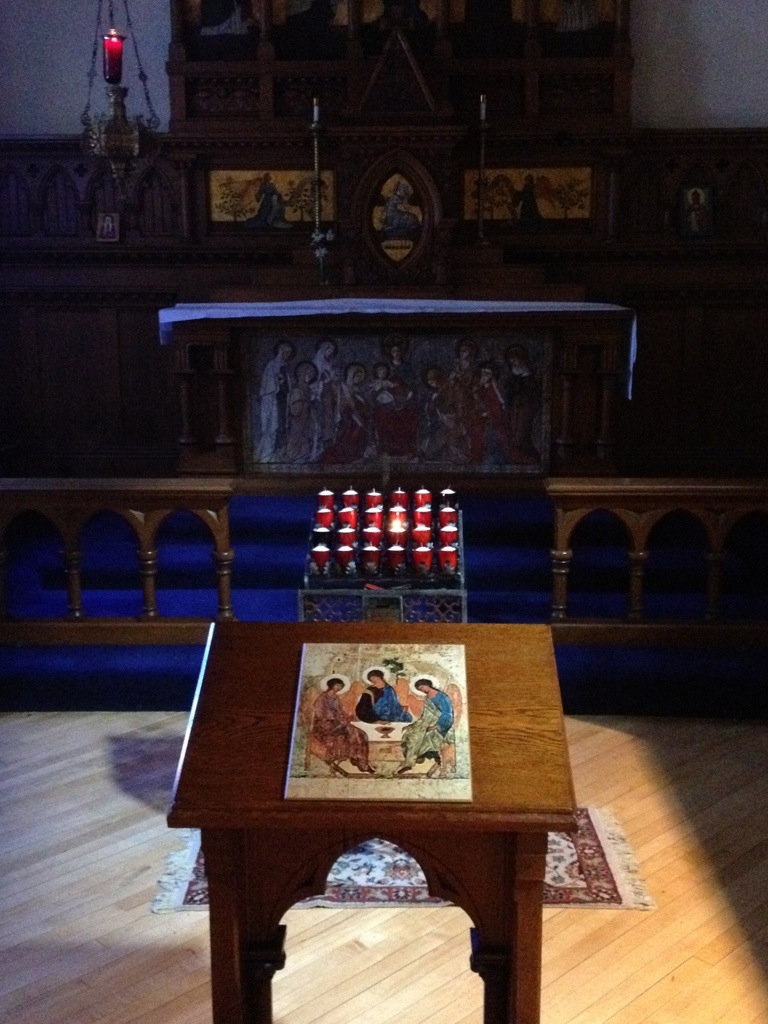
The St. Augustine Chapel at the Cathedral of St. Paul in Fond du Lac, Wisconsin

The St. Augustine Chapel at the Cathedral of St. Paul in Fond du Lac, Wisconsin

Over on Twitter this morning, Charles Hawkins (@Parish_Parson) shared an article by Rowan Williams on Augustine and the Psalms. It’s a typically dense read, but well worth attempting on this feast day.

Williams says that “the psalms represent the unifying of the divine and the human voice in Christ.”

What is distinctive about any hermeneutic of the Psalms is that singing them is quite simply and literally an appropriation of Christ’s life, in history and eternity. And, from this act of appropriation, the church as a whole is revealed as the community where humanity is allowed full scope to say what it is, in terms of its failure and pain, so that it may fully become what it is created to be, the multiple echo of the Word’s response to the Father. “Do not hear anything spoken in the person of Christ as if it had nothing to do with you who are members of the Body of Christ” (Enarrat. Ps. 143.1).

He goes on to say that “the singing of the psalms becomes the most immediate routine means of identifying with the voice of Christ. And that identification carries implications for the kind of mutual relation that concretely defines the life of the church.”

What we try to do in the Daily Office as we sing or recite the psalms morning and evening, day after day, is to more and more become the Body of Christ, in which one member cannot say to the other “I have no need of you” (1 Cor. 12).

The more there is love, the more suffering at the lovelessness of others in the church (Enarrat. Ps. 98.13, referring to Paul in 2 Cor 11). But such love is precisely what we have to offer the loveless within the Body; thus the cost must be borne.

Here Williams’ words call to mind the hymn by Samuel Crossman:

My song is love unknown,
my Savior’s love to me
love to the loveless shown
that they might lovely be.

This love which “bears all things, believes all things, hopes all things, endures all things” (1 Cor. 13) is precisely the bond of our unity as the Body of Christ, the unity we pray for in the Collect appointed for this week:

Grant, O merciful God, that your people, being gathered together in unity by your Holy Spirit, may show forth your power among all peoples, to the glory of your Name; through Jesus Christ our Lord, who lives and reigns with you and the Holy Spirit, one God, for ever and ever. Amen. (BCP 232)

For the extension of God’s kingdom

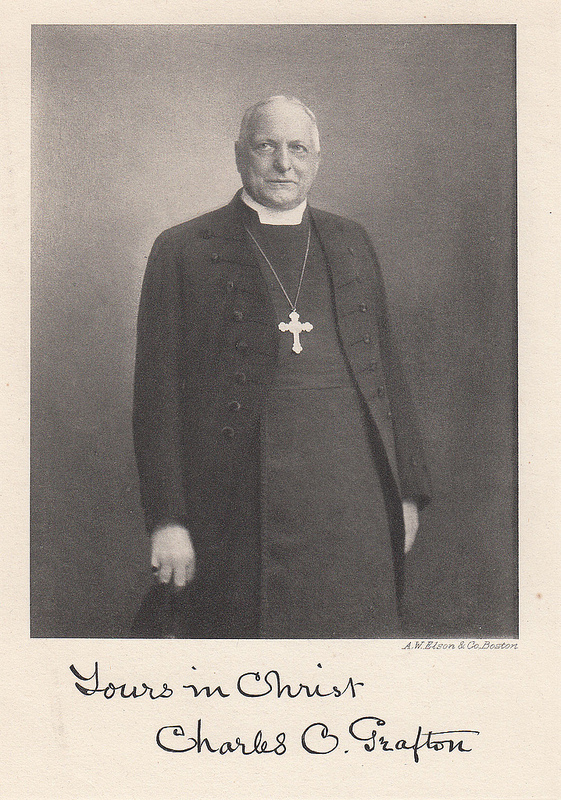
Charles Chapman Grafton


Today in the Diocese of Fond du Lac we observe the feast day of one of our “local saints.”

Charles Chapman Grafton was the second Bishop of Fond du Lac, a noted Anglo-Catholic, and an ardent ecumenist. He was also one of the founding members of the Society of St. John the Evangelist.

In between a Commission on Ministry meeting this morning and a dinner at my church this evening, I look forward to attending today’s Grafton commemoration at the Cathedral of St. Paul in Fond du Lac.

Since I was driving early this morning, I listened to Morning Prayer from the CD Singing the Daily Office by the SSJE community. At the Cathedral this afternoon, we will say Evening Prayer according to the Prayer Book of 1789, which Grafton would have used throughout most of his life.

Far from being an antiquarian curiosity, Grafton’s life speaks to me about the importance of both discipline and ecumenism — qualities vital to the Church’s life today, as always.

Collect of the Day

Loving God, you called Charles Chapman Grafton to be a bishop in your Church and endowed him with a burning zeal for souls: Grant that, following his example, we may ever live for the extension of your kingdom, that your glory may be the chief end of our lives, your will the law of our conduct, your love the motive of our actions, and Christ’s life the model and mold of our own; through the same Jesus Christ, who lives and reigns with you and the Holy Spirit, one God, throughout all ages. Amen.

Having our share in Jesus

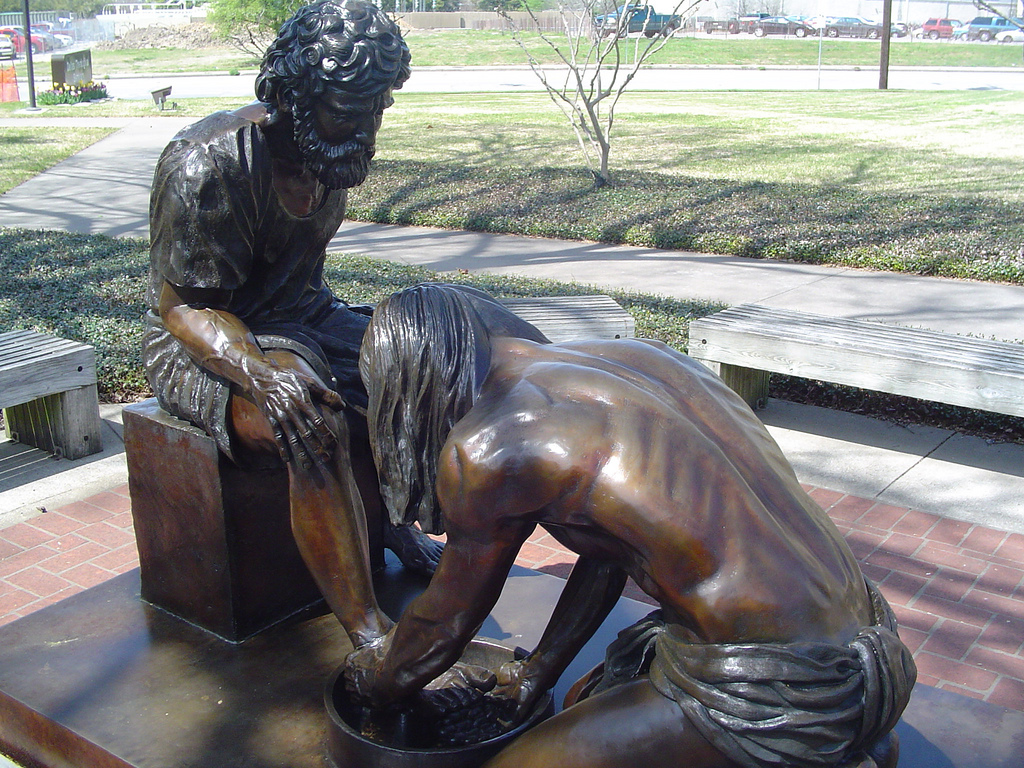
Jesus washing disciples' feet

Jesus washing disciples’ feet

“Then all the people of Israel came to the king, and said to him, ‘Why have our kindred the people of Judah stolen you away, and brought the king and his household over the Jordan, and all David’s men with him?’ All the people of Judah answered the people of Israel, ‘Because the king is near of kin to us. Why then are you angry over this matter? Have we eaten at all at the king’s expense? Or has he given us any gift?’ But the people of Israel answered the people of Judah, ‘We have ten shares in the king, and in David also we have more than you. Why then did you despise us? Were we not the first to speak of bringing back our king?’ But the words of the people of Judah were fiercer than the words of the people of Israel.” (2 Samuel 19:42-43)

Who can lay claim to more of the king’s favor?

That’s what the people of Judah and the people of Israel are arguing about.

It sure seems like David is favoring the people of Judah, even though they represent just two tribes. The people of Israel, comprising 10 of the 12 tribes, are put out and demand their majority share.

Seems perfectly sensible.

However, my mind flashed on the word “share” and its place in a pivotal story about another king, the Son of David.

“And during supper Jesus, knowing that the Father had given all things into his hands, and that he had come from God and was going to God, got up from the table, took off his outer robe, and tied a towel around himself. Then he poured water into a basin and began to wash the disciples’ feet and to wipe them with the towel that was tied around him. He came to Simon Peter, who said to him, ‘Lord, are you going to wash my feet?’ Jesus answered, ‘You do not know now what I am doing, but later you will understand.’ Peter said to him, ‘You will never wash my feet.’ Jesus answered, ‘Unless I wash you, you have no share with me.’” (John 13:2-8)

Having our share in Jesus means receiving from him the lesson he wants us to learn, following him in the way he shows us — serving others and laying down our lives.

Having our share does not mean getting more, but giving more.

A Prayer for Mission

Lord Jesus Christ, you stretched out your arms of love on the hard wood of the cross that everyone might come within the reach of your saving embrace: So clothe us in your Spirit that we, reaching forth our hands in love, may bring those who do not know you to the knowledge and love of you; for the honor of your Name. Amen. (BCP 101)