Tag Archives: Morning Prayer

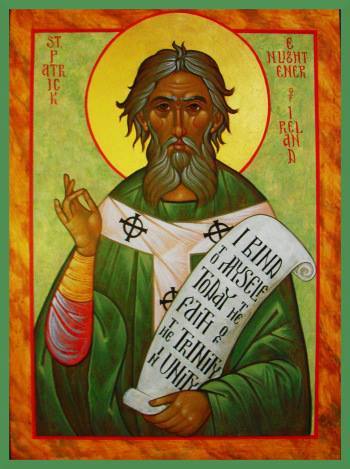
The strong Name of the Trinity

1940017_260022397509429_1706906093_n

St. Patrick’s Breastplate

I bind unto myself today
the strong Name of the Trinity,
by invocation of the same,
the Three in One, and One in Three.

I bind this day to me forever,
by power of faith, Christ’s Incarnation;
his baptism in the Jordan river;
his death on cross for my salvation;
his bursting from the spiced tomb;
his riding up the heavenly way;
his coming at the day of doom:
I bind unto myself today.

I bind unto myself the power
of the great love of cherubim;
the sweet “Well done” in judgement hour;
the service of the seraphim;
confessors’ faith, apostles’ word,
the patriarchs’ prayers, the prophets’ scrolls;
all good deeds done unto the Lord,
and purity of virgin souls.

I bind unto myself today
the virtues of the starlit heaven,
the glorious sun’s life-giving ray,
the whiteness of the moon at even,
the flashing of the lightning free,
the whirling wind’s tempestuous shocks,
the stable earth, the deep salt sea,
around the old eternal rocks.

I bind unto myself today
the power of God to hold and lead,
his eye to watch, his might to stay,
his ear to hearken to my need;
the wisdom of my God to teach,
his hand to guide, his shield to ward;
the word of God to give me speech,
his heavenly host to be my guard.

Christ be with me, Christ within me,
Christ behind me, Christ before me,
Christ beside me, Christ to win me,
Christ to comfort and restore me,
Christ beneath me, Christ above me,
Christ in quiet, Christ in danger,
Christ in hearts of all that love me,
Christ in mouth of friend and stranger.

I bind unto myself the Name,
the strong Name of the Trinity,
by invocation of the same,
the Three in One, and One in Three.
Of whom all nature hath creation,
eternal Father, Spirit, Word:
praise to the Lord of my salvation,
salvation is of Christ the Lord.

See Hymnary.org for the text and music of this magnificent hymn.

Of a Missionary

Almighty and everlasting God, we thank you for your servant Patrick, whom you called to preach the Gospel to the people of Ireland. Raise up in this and every land evangelists and heralds of your kingdom, that your Church may proclaim the unsearchable riches of our Savior Jesus Christ; who lives and reigns with you and the Holy Spirit, one God, now and for ever. Amen. (BCP 247)

Reaching forth our hands in love

LM_Widget_H

Today’s matchup in Lent Madness — you are participating in Lent Madness, right? — features Charles Henry Brent, first missionary bishop to the Phillipines and first bishop of Western New York.

Celebrity blogger Laura Darling writes: “After serving as the senior chaplain of the American Expeditionary Forces during World War I, he became bishop of Western New York. Prior to this, he established himself as a leader in the ecumenical movement, having attended the World Missionary Conference in Edinburgh in 1910. He continued to work for the cause of Christian unity, presiding at the World Conference of Faith and Order in Lausanne, Switzerland in 1927.”

However, Brent is also the author of one of the loveliest prayers for mission in Morning Prayer:

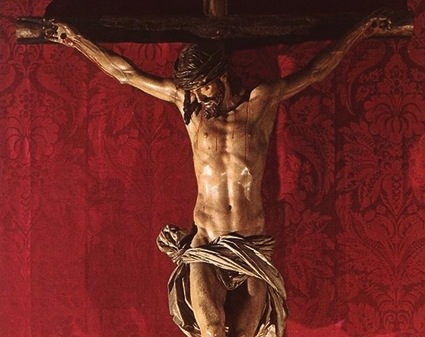
Lord Jesus Christ, you stretched out your arms of love on the hard wood of the cross that everyone might come within the reach of your saving embrace: So clothe us in your Spirit that we, reaching forth our hands in love, may bring those who do not know you to the knowledge and love of you, for the honor of your Name. Amen. (BCP 101)

On this Friday, as on so many others, may Jesus clothe us in his own Spirit as we make this our prayer.

20130530-172526.jpg

Step Four on Ash Wednesday

genuflect

Then I acknowledged my sin to you,
and did not conceal my guilt.
I said, “I will confess my transgressions to the LORD.”
Then you forgave me the guilt of my sin.

(Psalm 32:5-6)

A couple of weeks ago my AA sponsor and I knelt together as I prayed that God would “relieve me of the bondage of self, that I may better do his will … and take away my difficulties, that my victory over them may bear witness to those I would help of Thy power, Thy love, and Thy way of life” (Big Book 63).

This prayer of abandonment to God’s will is what AA calls Step Three and what the Book of Common Prayer calls in the Ash Wednesday liturgy “a right beginning of our repentance, and a mark of our mortal nature” (BCP 265).

Today Lent begins, and for me a very particular process of self-examination and repentance.

I have reached the point in my recovery where it’s time to begin Step Four — to conduct a “searching and fearless moral inventory” of myself — and then to take Step Five, to admit to God, to myself, and to another human being the exact nature of my wrongs.

Though I have been in the Church all my life, I am beginning to understand for myself the wisdom of traditional practices like Confession, what the Book of Common Prayer calls Reconciliation of a Penitent (BCP 447). We need at times to write down what we’ve done wrong, to say it out loud to another person, and to hear from them our Lord’s assurance of forgiveness.

Lent is a particularly appropriate time for this hard and holy work, and I am embracing it gladly as my main observance this year.

And now, O Lord, I bend the knee of my heart,
and make my appeal, sure of your gracious goodness.
(Canticle 14, BCP 91)

Whatever you may decide to do to mark this Lent, I invite you to take it seriously but joyfully.

I invite you, therefore, in the name of the Church, to the observance of a holy Lent, by self-examination and repentance; by prayer, fasting, and self-denial; and by reading and meditating on God’s holy Word. And, to make a right beginning of repentance, and as a mark of our mortal nature, let us now kneel before the Lord, our maker and redeemer (BCP 265).

A baaad soap opera

MidnightDGCinnamon

Picture this: Jacob and his two wives Leah and Rachel are going to flee from his mean old father-in-law Laban. Because he’s mean, they’re going to steal all his stuff, too. Cue the swelling dramatic music as they meet in the field to make the crucial decision. The camera pans onto the worried faces of the wives.

Then Jacob keeps talking:

You know that I have served your father with all my strength; yet your father has cheated me and changed my wages ten times, but God did not permit him to harm me. If he said, ‘The speckled shall be your wages,’ then all the flock bore speckled; and if he said, ‘The striped shall be your wages,’ then all the flock bore striped. Thus God has taken away the livestock of your father, and given them to me. During the mating of the flock I once had a dream in which I looked up and saw that the male goats that leaped upon the flock were striped, speckled, and mottled. Then the angel of God said to me in the dream, ‘Jacob,’ and I said, ‘Here I am!’ And he said, ‘Look up and see that all the goats that leap on the flock are striped, speckled, and mottled; for I have seen all that Laban is doing to you. (Genesis 31:6-12)

Seriously? In the middle of a soap opera story, in the heightened drama of a theft and escape, Jacob starts droning on about sheep genetics? Boring!

And then, as we finish the lesson from Genesis — “thou shalt steal thy father-in-law’s stuff, and flee with thy two wives, and oh by the way, don’t forget to take the household gods, too” — we sing a song of praise, Canticle 13.

Glory to you, Lord God of our fathers; *
you are worthy of praise; glory to you.
Glory to you for the radiance of your holy Name; *
we will praise you and highly exalt you for ever.

Glory to you in the splendor of your temple; *
on the throne of your majesty, glory to you.
Glory to you, seated between the Cherubim; *
we will praise you and highly exalt you for ever.

Glory to you, beholding the depths; *
in the high vault of heaven, glory to you.
Glory to you, Father, Son, and Holy Spirit; *
we will praise you and highly exalt you for ever.
(BCP 90)

Wait, what?

In one breath we go from polygamous, plotting, sheep-stealing (but capably breeding) escapees … to glorifying God, seated between the cherubim.

Anyone who tells you the Bible is clear and easy to understand is pulling the wool over your eyes.

Get it? Wool? Oh, I kid. Get it? Kid?

On the face of it, this is one of those crazy stories, told and retold time and again, that makes your eyes glaze over every time you hear it.

“Oh God, uncle Jacob is telling the story about the sheep again!”

The lesson, and I promise there is one, is that it’s in the distance between our petty, thieving, sheep-stealing ways and God’s glory that we start to get the point of the larger story of Scripture. The Daily Office serves us well when it provides such sharp contrast between two pieces of Scripture.

The God of all creation, from the splendor of his temple, looks down on us and loves us. Even though we are manipulative tricksters, he loves us. Even though we defraud each other, and marry in weird configurations, and dream about sheep genetics, and run away from our lying, cheating families, God loves us.

In fact, he loves us so much that he works out his plan of salvation using us and our efforts.

If it weren’t right there in Scripture, plain as can be, we’d say that was a baaad soap opera.

With sober judgment

20140212-063729.jpg

For by the grace given to me I say to everyone among you not to think of yourself more highly than you ought to think, but to think with sober judgment, each according to the measure of faith that God has assigned. (Rom. 12:3)

The Psalms are the heart of the Office because they have for centuries expressed the “needs, hopes, and concerns” of God’s people. They are very human songs, and more often than not I am caught short by the emotion of the psalmist.

Today, for example, the psalmist’s simple love for the law rings false in my ears, perhaps because my own path has been too twisted lately. The version running through my head as I pray sounds more like this:

Oh, how I love your law!
Even though all day long it’s out of my mind.

Your commandment has made me no wiser than my enemies,
Because it is too little with me.

I have less understanding than any of my teachers,
Though your decrees have been my study.
(Psalm 119:97-99, para.)

Some days the Office is inspiring, giving us a glimpse of the ideal we long for. Other days it reminds us how far we still have to go.

But it always points us to Christ and to the Church, reminding us that we are not alone on our twisted path, that we are not truly separated from the love of God.

The “sober judgment” that Paul urges us to have places our real failings in the proper context of God’s even more real love for us shown in Christ Jesus.

Remembering only one thing


Timeline-of-Church-History

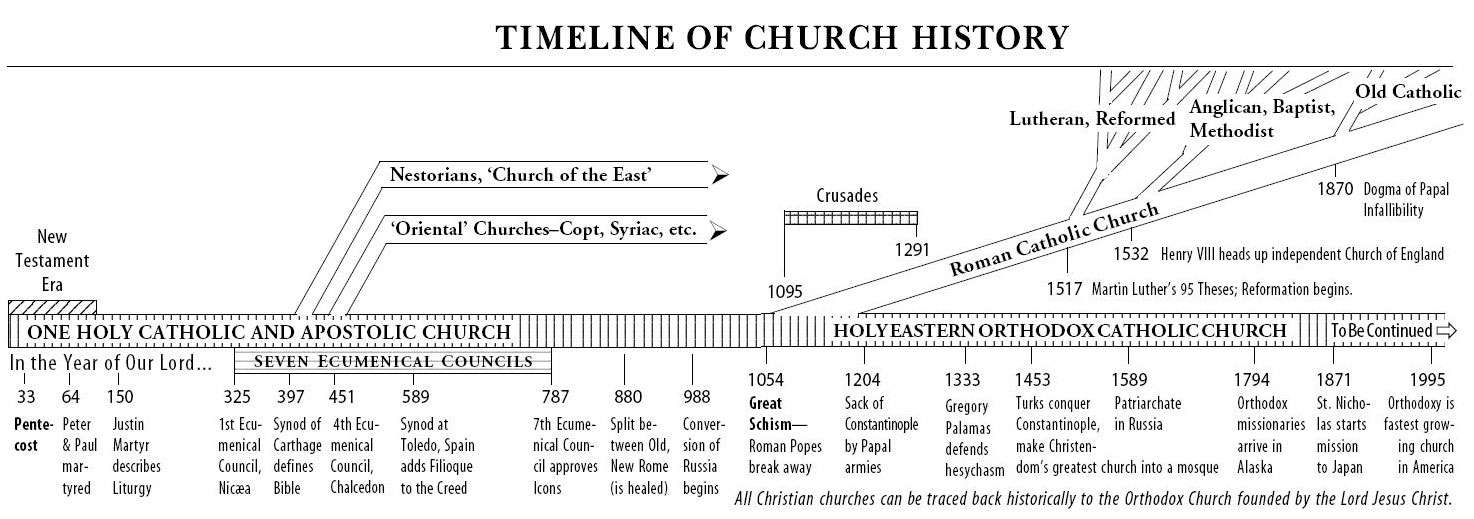
At one of the noon Eucharists last week at Bexley Seabury, during the Week of Prayer for Christian Unity, the Rev. John Dally remarked that there are now some 33,582 Christian denominations in the world.

While it is commonplace to mark the first “unhappy division” of the church to 400 CE (the Nestorians and the “Oriental” Churches) or to the Great Schism between Orthodoxy and Catholicism in 1054 CE, I wonder if we don’t actually see hints of the first division much earlier.

There’s some evidence in today’s reading from Paul’s letter to the Galatians.

On the contrary, when they saw that I had been entrusted with the gospel for the uncircumcised, just as Peter had been entrusted with the gospel for the circumcised (for he who worked through Peter making him an apostle to the circumcised also worked through me in sending me to the Gentiles), and when James and Cephas and John, who were acknowledged pillars, recognized the grace that had been given to me, they gave to Barnabas and me the right hand of fellowship, agreeing that we should go to the Gentiles and they to the circumcised. They asked only one thing, that we remember the poor, which was actually what I was eager to do. (Galatians 2:7-10)

The Week of Prayer for Christian Unity is bracketed by two feasts — the Confession of St. Peter and the Conversion of St. Paul — celebrating two men who became convinced that the good news of the kingdom of God announced by Jesus applied to both Jews and Gentiles, that is, to everyone.

But listen to what Paul describes in his letter: “we should go to the Gentiles and they to the circumcised.” Peter and Paul are, in effect, dividing the mission of the new church between them, creating two apostolates, carving out overlapping jurisdictions, however you want to describe it. They have one goal, but will pursue it in two different ways with two different populations.

Certainly Paul sees this as a happy division characterized by the “right hand of fellowship,” but I wonder if this isn’t how the whole ball got rolling. Two thousand fourteen years and 33,582 denominations later, we have gotten good at division.

Many of the divisions in Christianity are being healed by time — I just sang the same hymn “Christ, Be Our Light” with Lutherans, Episcopalians, and Roman Catholics this past week — so I wonder if in our time we could become equally good at “only one thing, that we remember the poor.”

Imagine 33,582 denominations laying aside rancor and remembering only one thing. Imagine one billion Roman Catholics and one billion of the rest of us in Christ’s Body the Church (two out of five people in the world) uniting in service for, with, and alongside the poor.

What if we extended the right hand of fellowship not only to our brothers and sisters in Christ, but also to our neighbors and all who suffer in poverty?

For the Unity of the Church

O God the Father of our Lord Jesus Christ, our only Savior, the Prince of Peace: Give us grace seriously to lay to heart the great dangers we are in by our unhappy divisions; take away all hatred and prejudice, and whatever else may hinder us from godly union and concord; that, as there is but one Body and one Spirit, one hope of our calling, one Lord, one Faith, one Baptism, one God and Father of us all, so we may be all of one heart and of one soul, united in one holy bond of truth and peace, of faith and charity, and may with one mind and one mouth glorify you; through Jesus Christ our Lord. Amen. (BCP 818)

Daily Office Basics

Daily Office Basics

The Daily Office Anchor Society will be actual, not just virtual, in February.

Join me on Saturday, February 15 from 8:30 to noon at St. Thomas Church, 226 Washington Street, Menasha WI 54952 for a program on Daily Office Basics.

Many Christians choose to observe Lent with “special acts of discipline or self-denial” such as praying Morning or Evening Prayer.

On February 15, you will not only learn how to pray the Church’s daily offices but you will also receive a variety of resources to help you navigate what may be an unfamiliar or confusing practice. We will have plenty of time for questions and sharing with each other.

We will enjoy coffee and light refreshments at 8:30 am and begin with Morning Prayer at 9 am. The program will conclude promptly at noon.

You who remind the Lord

Church-Circle-Graphic

You who remind the Lord, take no rest,
and give him no rest
until he establishes Jerusalem
and makes it renowned throughout the earth.
(Isaiah 62:6b-7)

As the meeting ends, we all stand and form a circle, joining hands in a moment of silence.

“Whose Father?”

“Our Father …” we begin to pray.

+ + + + +

As the Eucharistic Prayer draws to a close, the priest looks out over the congregation: “And now, as our Savior Christ has taught us, we are bold to say …”

“Our Father …”

+ + + + +

Morning and evening, after the Psalms, after the readings and canticles, after the Apostles’ Creed, we begin the Prayers by saying:

“Our Father …”

+ + + + +

We “who remind the Lord” take no rest.

We give him no rest, our Father in heaven, and that’s the way he wants it.

We ask him to be faithful to his promises, and he will.

Listen:

“You have promised through your well-beloved Son that where two or three are gathered together in his name, you will be in the midst of them” (BCP 102).

“Come unto me, all ye that travail and are heavy laden, and I will refresh you” (BCP 332).

“We came to understand that we … could not manage our own lives … but that God could and would if He were sought” (Blue Book 60).

+ + + + +

A Collect for Grace

O Lord God, almighty and everlasting Father, you have brought us in safety to this new day: Preserve us with your mighty power, that we may not fall into sin, nor be overcome by adversity; and in all we do, direct us to the fulfilling of your purpose; through Jesus Christ our Lord. Amen. (BCP 100)


Daily his delight

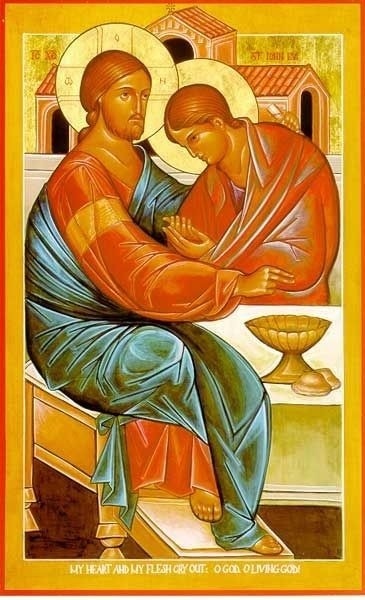
Icon of the Beloved Disciple from Mt. Angel Abbey

Icon of the Beloved Disciple from Mt. Angel Abbey – the inscription reads “My heart and my flesh cry out: O God, O living God!”

When he established the heavens, I was there,
when he drew a circle on the face of the deep,
when he made firm the skies above,
when he established the fountains of the deep,
when he assigned to the sea its limit,
so that the waters might not transgress his command,
when he marked out the foundations of the earth,
then I was beside him, like a master worker;
and I was daily his delight, rejoicing before him always.
(Proverbs 8:27-30)

Powerful Seeking

John’s gospel shines with both power and intimacy.

Jesus crackles with energy, turning water into wine, driving the moneychangers from the Temple, confounding learned and pious Nicodemus, speaking with a foreign woman, and healing with a word (whether the beggar by the pool wants it or not). And that’s only in the first five chapters of the story.

Jesus’ power radiates as clearly as his love and concern for people.

The man born blind, healed by Jesus’ touch and by a compress of mud (how like God’s own touch, forming mud and clay into the first human), is driven out of the synagogue by the religious leaders. But the story doesn’t end there, and John provides the key to understanding it fully.

“Jesus heard that they had driven him out, and when he had found him …” (John 9:35).

Jesus the power of God, whom John has come to understand is the same Word who was with God in the beginning, seeks out those who are hurting in order to effect their healing. He seeks out those who are estranged in order to effect their reconciliation.

As Reynolds Price writes in Incarnation: Contemporary Writers on the New Testament, the Gospel of John “says in the clearest voice we have the sentence that mankind craves from stories — The Maker of all things loves and wants me.”

Intimate Sending

John, the disciple whom Jesus loved, writes from a position of intimate knowledge. It is he who reclines next to Jesus at the Last Supper.

From within that close embrace, John sees both the betrayal Jesus suffers and the love that he demonstrates in washing the disciples’ feet and sending them out to serve one another.

Because today’s Feast of St. John falls on a Friday, in Morning Prayer we have the added poignancy of the Prayer for Mission that captures this intimate sending:

Lord Jesus Christ, you stretched out your arms of love on the hard wood of the cross that everyone might come within the reach of your saving embrace: So clothe us in your Spirit that we, reaching forth our hands in love, may bring those who do not know you to the knowledge and love of you; for the honor of your Name. Amen. (BCP 101)

Daily His Delight

Jesus, the Word of God, was with God at creation and was “daily his delight.” At the Incarnation, “God did not send the Son into the world to condemn the world, but in order that the world might be saved through him” (John 3:17).

John, the Beloved Disciple, who was close to Jesus’ heart and “daily his delight,” wrote his Gospel “so that you may come to believe that Jesus is the Messiah, and that through believing you may have life in his name” (John 20:31).

And you? The disciple whom Jesus loves?

You who have come within the reach of Jesus’ saving embrace and are “daily his delight,” how will you reach forth your hands in love to bring those who do not know Jesus into the knowledge and love of him?

Beginning the Office

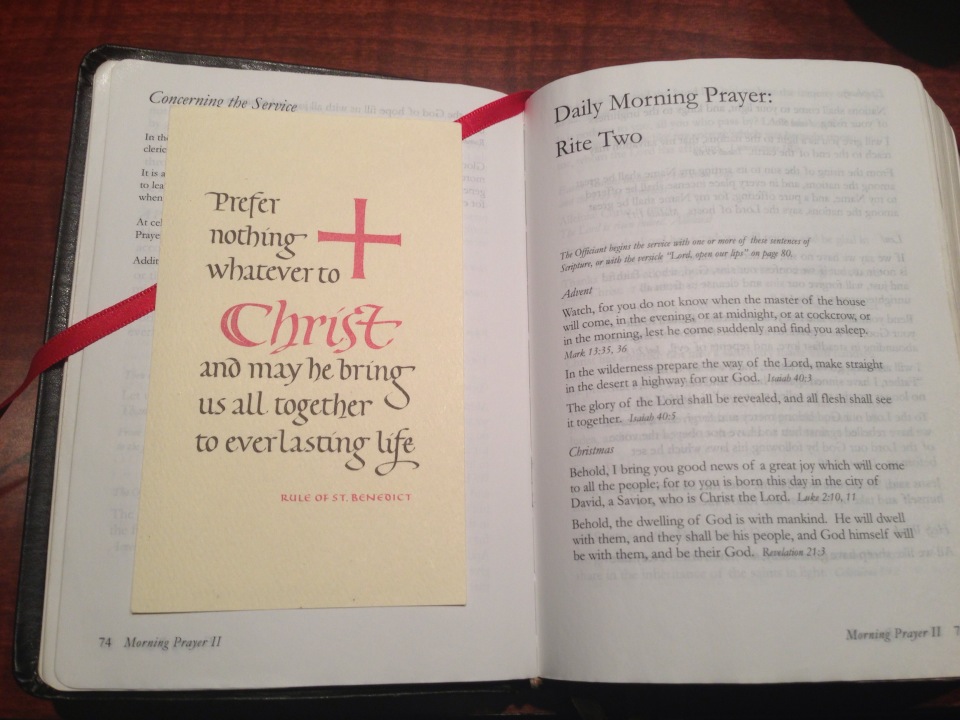
Prefer Nothing to Christ

Yesterday we prepared to say the Office by finding our place in the Book of Common Prayer and marking various places in the prayer book and Bible for easy reference.

Today we will begin the Office, looking at the opening sentences, the Confession of Sin, the Invitatory and Psalter.

Tomorrow we will look at the Lessons and Canticles, and the next day at the Prayers.

Where to begin?

The proper beginning of Morning Prayer is the opening sentences on BCP 80: “Lord, open our lips. / And our mouth shall proclaim your praise.”

At Evening Prayer (and other offices throughout the day), the opening sentences are “O God, make speed to save us. / O Lord, make haste to help us.” (BCP 117).

You’ll notice, though, that there are several pages of material printed before those opening sentences. You may choose to begin the Office with a seasonal sentence from Scripture and/or the Confession of Sin.

Seasonal Sentences

Look at BCP 75-78. You’ll see four pages of Scripture verses chosen to fit the seasons of the Church Year.

You might choose to begin the Office with one of these sentences in order to give your prayers the “flavor” of the season. This is especially helpful to distinguish seasons like Advent and Christmas, Lent and Easter, from the long “ordinary” seasons after Epiphany and Pentecost.

Since it’s Advent now, you might choose to begin with “Watch, for you do not know when the master of the house will come …” (BCP 75). Over the next four weeks, you might change it up a little by using one of the other two choices.

Confession of Sin

Look at BCP 79. The italics at the very top of the page are called rubrics. They are directions telling you what to do next.

In this case, the rubrics say, The following Confession of Sin may be said; or the Office may continue at once with “Lord, open our lips” (BCP 79).

“May” is an important word in the rubrics, and it means what it says. You don’t have to say the Confession every time you say the Office; you may say it.

Many people who say both Morning and Evening Prayer choose to say the Confession only in the evening.

In this somewhat more penitential season of Advent, and certainly in the season of Lent, it may seem right to say the Confession at every Office. Again, the choice helps us focus on the season of the Church Year and its emphases.

At any rate, if you’re saying the Office alone, you can omit the introduction to the Confession and simply start, “Most merciful God …”

When you say the absolution at the top of BCP 80, change the pronouns from “you” to “us” — you’ll see the rubrics there to remind you.

The Invitatory and Psalter

Everything we’ve said so far is optional, remember. You could simply begin the Office here on BCP 80 with “Lord, open our lips.”

It’s customary to make a sign of the cross with your thumb over your lips when you say “Lord, open our lips” at Morning Prayer and to make the regular sign of the cross at the sentence “O God, make speed to save us” at the other offices.

Here’s how it goes:

Lord, + open our lips.
And our mouth shall proclaim your praise.
Glory to the Father, and to the Son, and to the Holy Spirit:
as it was in the beginning, is now, and will be for ever. Amen.
Alelluia.

Pause here for breath while we talk about …

The Invitatory Psalm

The Office begins with a selection from the Psalter, which you looked up in the Daily Office Lectionary and marked with a bookmark. Before you say those Psalms, however, you say the Invitatory (or opening) Psalm.

There are two Invitatory Psalms, called Venite and Jubilate after the first word of the Psalm in Latin: “Come” and “Be joyful,” respectively.

Because the Venite is commonly used all the time as the Invitatory, you might like to use the Jubilate during Advent and Lent, just to set the season apart a little. There’s also a special canticle called Pascha nostrum, or “Christ our Passover,” that’s meant for use during Easter.

Again you’ll notice some optional material on BCP 80-82 before the Invitatory Psalms are printed. These are antiphons, or refrains, which you may use in order to give a seasonal flavor to the Venite or Jubilate, which you say every day.

So today, saying the Jubilate might go something like this:

Our King and Savior now draws near: Come let us adore him.

Be joyful in the Lord, all you lands; *
serve the Lord with gladness
and come before his presence with a song.

Know this: The Lord himself is God; *
he himself has made us, and we are his;
we are his people and the sheep of his pasture.

Enter his gates with thanksgiving;
go into his courts with praise; *
give thanks to him and call upon his Name.

For the Lord is good;
his mercy is everlasting; *
and his faithfulness endures from age to age.

Our King and Savior now draws near: Come let us adore him.

The Psalm or Psalms Appointed

The Office continues with the Psalms appointed for the morning or evening.

You may say the “Glory to the Father” at the end of all the Psalms, or at the end of each individual Psalm.

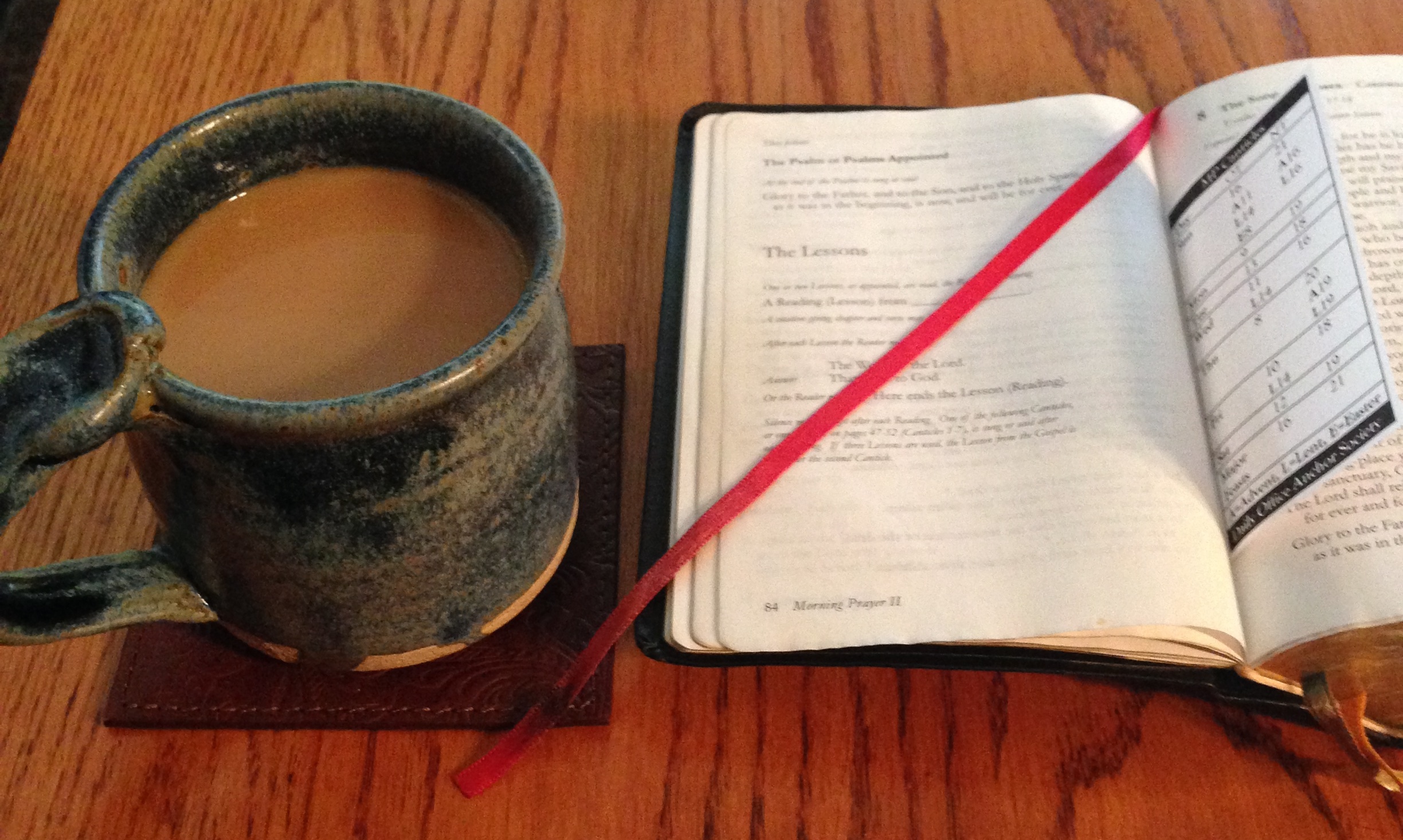
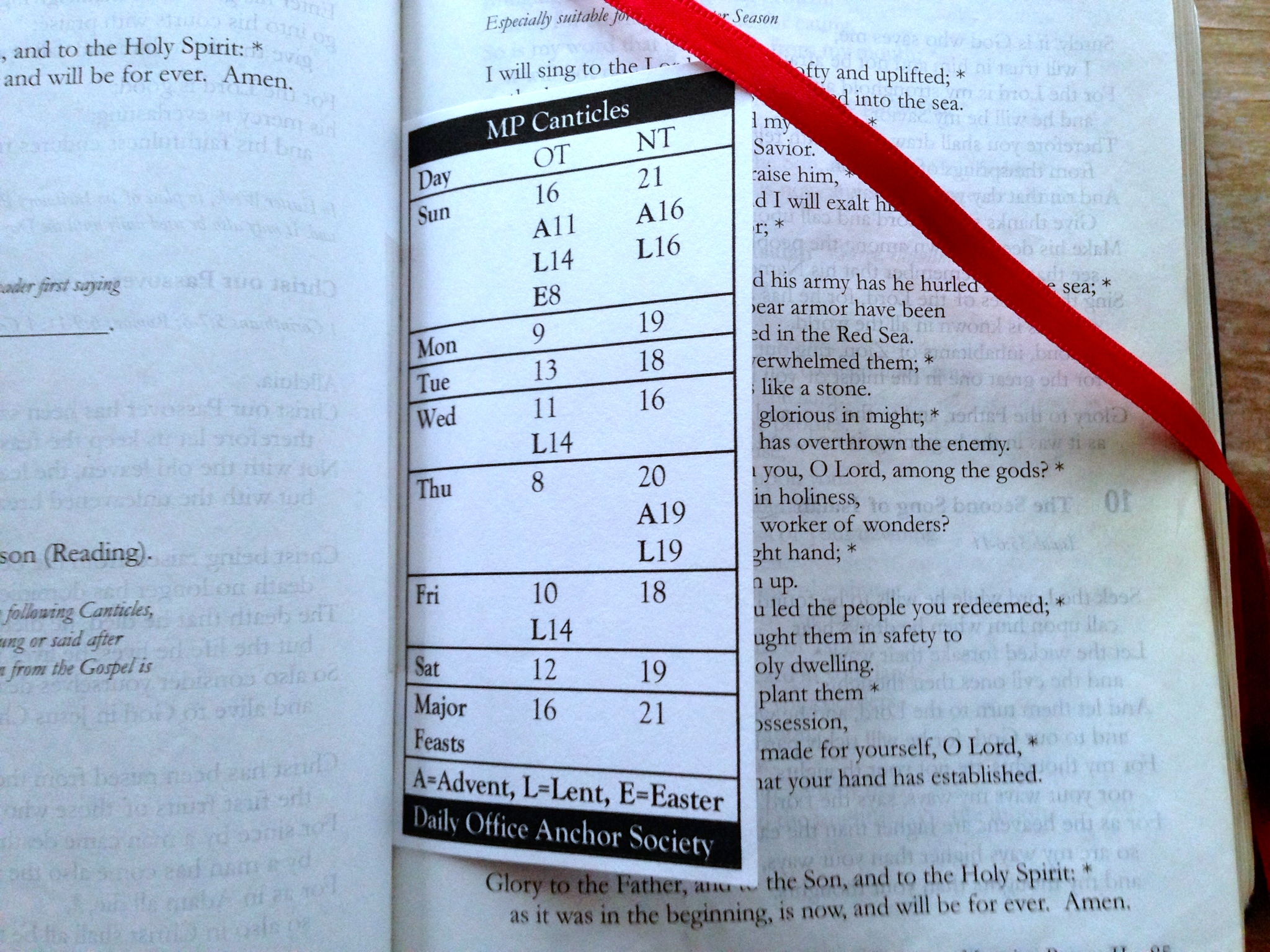
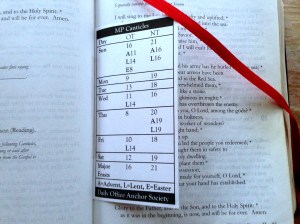
Before you turn to the Psalms, though, let me suggest that you refer to the Table of Canticles that you printed out from the Resources page and taped here at BCP 84. Move your Morning Prayer bookmark or ribbon to mark the canticle assigned to follow the first reading.

Today is Monday, for example, so Canticle 9 is appointed to follow the OT reading.
IMG_0008

If you take a moment now to mark it, you can read the Psalms, then turn directly to the OT lesson, then when you come back here, you can continue on with the Office very smoothly.

What you’re doing with your Morning Prayer bookmark or ribbon is holding your place in the service as you turn to the other resources you need for the Office: the Psalms, the Scripture readings, the Collects and other prayers.

We’ll look in more detail at the Lessons and the Canticles tomorrow morning.

Until then, I hope the Office is beginning to feel a bit more manageable. Every blessing!