
Tag Archives: Morning Prayer

That which God has purposed

But if you call yourself a Jew and rely on the law and boast of your relation to God and know his will and determine what is best because you are instructed in the law, and if you are sure that you are a guide to the blind, a light to those who are in darkness, a corrector of the foolish, a teacher of children, having in the law the embodiment of knowledge and truth, you, then, that teach others, will you not teach yourself? (Romans 2:17-21)

There is a serious vein running through today’s lessons from Jeremiah and Isaiah through to Paul and Christ.

Jeremiah recounts God’s judgment on God’s people and on Jerusalem. “The whole land shall be a desolation; yet I will not make a full end. Because of this the earth shall mourn, and the heavens above grow black; for I have spoken, I have purposed; I have not relented nor have I turned back” (Jer. 4:27-28).

God’s judgment is terrible, and he is unrelenting.

Except then comes the Canticle, the Second Song of Isaiah (Isa. 55:6-11), with its familiar words of reassurance:

For as rain and snow fall from the heavens
and return not again, but water the earth,
Bringing forth life and giving growth,
seed for sowing and bread for eating,
So is my word which goes forth from my mouth;
it will not return to me empty,
But it will accomplish that which I have purposed,
and prosper in that for which I sent it.

Christians, of course, read these words in the light of Christ the Word who “goes forth from God,” so to speak, and who accomplishes what God purposes.

What God purposes, we know from our vantage point post-Easter, is not desolation but restoration. God has “relented” once for all in Christ and continues to be present to us through the Holy Spirit, advocate and guide. How can we forget what God has done for us, has won for us, in Christ?

This is what frustrates Paul so much in his letter to the Romans. He basically asks, “Are you turning away from grace and back to the judgment under the law which cannot save?”

His question resonates with the prophets’ words. Are we turning away from restoration and teaching desolation? Are we preaching grace or sin?

Of course, it’s not an either/or thing. Grace freely given comes with a consciousness of sin. When I have been forgiven, I am acutely aware of exactly what I have done wrong. But the message from my forgiver — whether it’s my wife or the priest pronouncing God’s absolution on Sunday — is restoration, not condemnation.

Where in our lives do we still reflect a spirit of judgment, faces set in a disapproving frown? Where do we still dwell on faults more than freedom, quick to relay dirt and to dismiss others’ pain? Where do we still fail to preach the message of good news that animated Jesus and Paul and our forebears in this life in Christ?

Even worse, where does our judgmentalism and obsession with rectitude cause “the Name of God to be blasphemed” because of us (Rom. 2:24)? It’s happening all around us as people turn away from angry so-called “Christianity.” God forbid!

Like rain falling from the heavens is God’s grace falling on us, on all of us who “have no power in ourselves to help ourselves,” in the words of next Sunday’s Collect. What God has purposed is our restoration, our reconciliation with God, and our reaching out in love to the people around us.

What we can be sure of is that God’s word will prosper in us, will teach us, as we live out God’s restoring mission.

Can anybody play the drums?

20130225-065137.jpg

In 1973, during The Who’s concert at the Cow Palace in San Francisco, drummer Keith Moon collapsed twice after overdosing on tranquilizers and brandy. Guitarist Pete Townshend finally stepped to the mike and asked the crowd, “Can anybody play the drums?”

In fact, someone could. Who fan Scot Halpin, 19 years old, was right in the front row, and his friend’s frantic yelling caught the eye of the concert promoter, who had him brought up on stage.

+ + + + +

Go back about 1,940 years. The apostles are in Jerusalem, having just witnessed Jesus’ ascension. They realize they need to regroup and move forward, and in order to do so they need to replace Judas.

Matthias is the one who gets called up to the big stage. He’s been a follower all along, says Peter, “one of the men who has accompanied us during all the time that the Lord Jesus went in and out among us” (Acts 1:21).

What happened next was the rush of the Holy Spirit on the day of Pentecost. Surely Matthias was as unprepared as all of the apostles for the power of that moment and the change it brought to his life.

+ + + + +

St. Matthias has a day on the Church’s calendar, which is cool, but Rolling Stone magazine named Scot Halpin “Best Pick-Up Player of the Year” in 1973.

What practice do you need so that you’ll be ready to step onstage when your time comes?

Fit persons for the ministry

JRM+ DeKoven Center

For the choice of fit persons for the ministry

O God, you led your holy apostles to ordain ministers in every place: Grant that your Church, under the guidance of the Holy Spirit, may choose suitable persons for the ministry of Word and Sacrament, and may uphold them in their work for the extension of your kingdom; through him who is the Shepherd and Bishop of our Souls, Jesus Christ our Lord, who lives and reigns with you and the Holy Spirit, one God, for ever and ever. Amen. (BCP 256)

+ + + + +

Today is one of the Spring Ember Days, which fall on the Wednesday, Friday, and Saturday after the First Sunday in Lent. If you look on BCP 256, you’ll see there are three Collects appointed For the Ministry (Ember Days).

On Wednesday, you might pray the first Collect, for “all who are now called to any ministry.” Today you might pray, as above, that the Church may choose “suitable persons for the ministry of Word and Sacrament.” And tomorrow, Saturday, the Collect bids us pray “for all members of [God’s] holy Church.”

+ + + + +

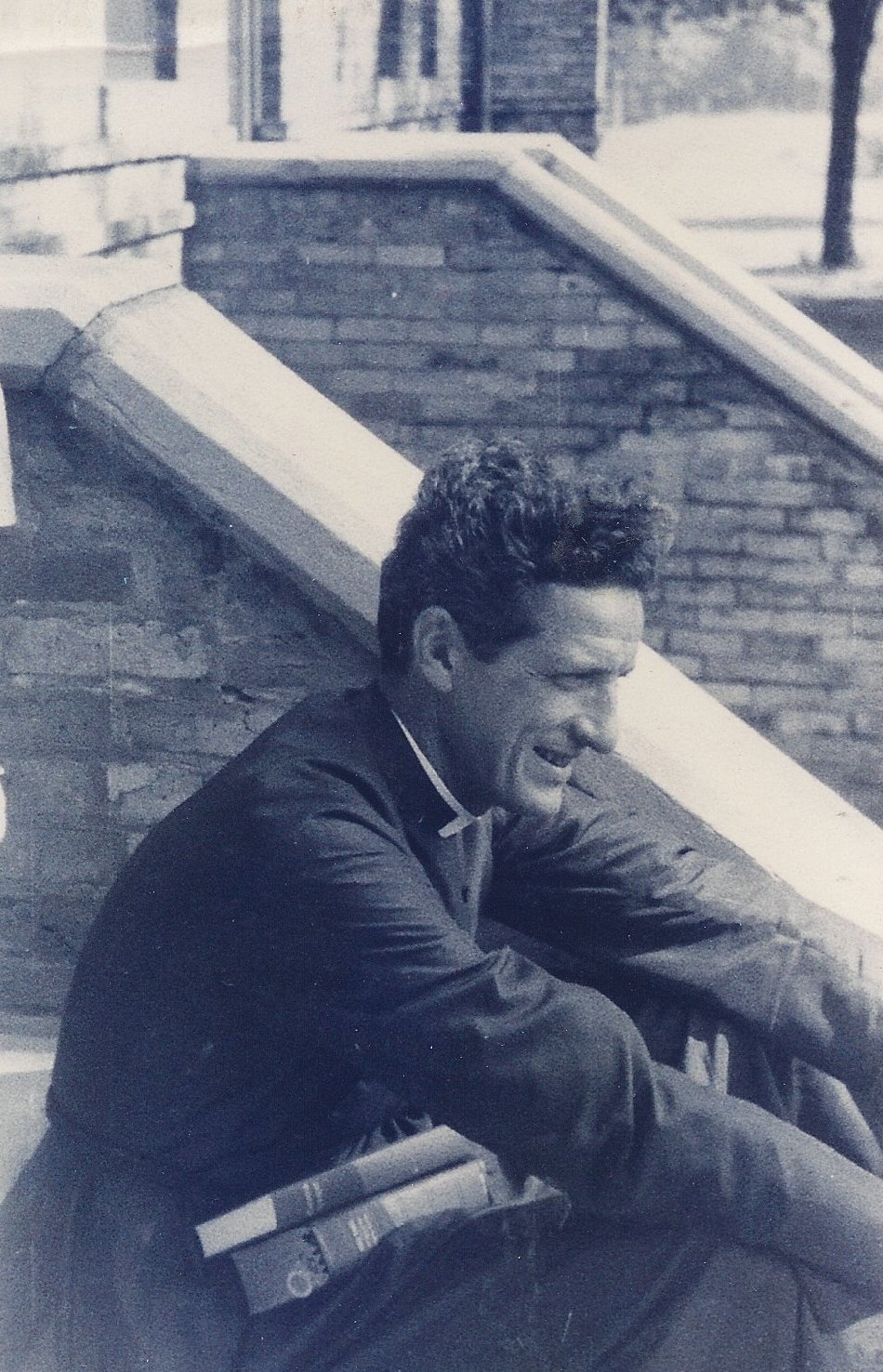
My grandfather, J. Rodger McColl, is pictured above. He grew up at St. Martin’s Church on the west side of Chicago, attended Western Theological Seminary (later Seabury-Western) in the 1930s, was the chaplain at the Chapel of St. John the Divine in Champaign-Urbana, Illinois in the 1940s, and served as rector of St. Augustine’s in Wilmette, Illinois in the early 1950s.

He was a fit person for the ministry of Word and Sacrament, even though that ministry ended in heartbreak for my family. He was deposed from the priesthood after having an affair with a woman in his parish, and sent to New York City — ostensibly to work for the National Church, but really to avoid scandal. He died in 1954, very shortly after arriving in New York, and it was discovered that he had a massive brain tumor. My grandmother (and later, my aunt) tried in vain to have him reinstated, but the Church denied their pleas. My grandmother was cut off from his pension, and I believe she never darkened the door of a church again. In the files of the Episcopal Church, there is only one piece of paper about him — it is as if he never existed.

There is no doubt that he should have been removed from his ministry; I taught for nearly 15 years on preventing sexual misconduct in church settings, and I believe that we must be clear and firm about protecting people from harm.

But people are never just one thing, never one-dimensional cardboard characters.

The day after he died, my grandmother received a postcard from one of his former parishioners with the following poem:

Prayer for Rodger – Remembering my First Confession

O flawless Christ,
redeem this man
whose gentle hand
briefly held the bleak world back;
whose cool clasp steadied, encouraged,
and retrieved me
from the beaten edge
of oft-repeated sins;
whose constant gaze
upon Thy face
gave forth such a light,
Earth’s curtain lifted,
and there, all-bright,
was heaven.
Find him
the peace he found for me. Amen.

Pray during these Ember Days that the Church may find persons fit for the ministry because of their constant gaze on Christ and suitable because of their steady, encouraging gentleness. Pray, too, that we may uphold them, sinners just like we are, in the redeeming work God calls them to.

Hasten the coming of your kingdom

kingdom-of-heaven2

O God, you have made of one blood all the peoples of the earth, and sent your blessed Son to preach peace to those who are far off and to those who are near: Grant that people everywhere may seek after you and find you; bring the nations into your fold; pour out your Spirit upon all flesh; and hasten the coming of your kingdom; through Jesus Christ our Lord. Amen. (BCP 100)

Morning Prayer on Thursdays has a baptismal flavor.

After the Old Testament reading on Thursdays, we say or sing Canticle 8: The Song of Moses, in which we praise God for saving the people of Israel at the Red Sea. For Christians, the Exodus story is especially linked with the Easter Vigil and baptism.

At the Vigil, we retell the Exodus story and make it our own, singing in the Exsultet that “this is the night when Christ broke the bonds of death and hell.” The Easter Vigil has been, since the earliest days of the church, the time when new Christians are baptized.

The Prayer for Mission above reflects that same baptismal emphasis. It is our prayer that everyone will come through the waters of salvation, that everyone will enjoy new life, that everyone will be filled with God’s spirit, that God’s kingdom, already here in part, will become fully realized.

The writer of the letter to the Hebrews describes the kingdom as “sabbath rest” in the passage appointed for today. He suggests that the way is still open for us to enter into God’s rest, to enjoy life and peace in the kingdom of God.

He writes, quoting Psalm 95, “Today, if you hear his voice, do not harden your hearts” (Heb. 4:7). Every day we begin Morning Prayer with that same sense of urgency.

Come on in, the water is fine! Bring your friends, too! Don’t wait — jump on in!

God hates nothing God has made

Pinned Insects

Collect for Ash Wednesday

Almighty and everlasting God, you hate nothing you have made and forgive the sins of all who are penitent: Create and make in us new and contrite hearts, that we worthily lamenting our sins and acknowledging our wretchedness, may obtain of you, the God of all mercy, perfect remission and forgiveness; through Jesus Christ our Lord, who lives and reigns with you and the Holy Spirit, one God, for ever and ever. Amen. (BCP 217)

+ + + + +

Since late last year, following a serious lack of judgment at a company event, I have been on a disciplinary plan at work and have been seeing a counselor through our Employee Assistance Program.

Having my failings made visible is really uncomfortable — the first image that comes to my mind is an insect pinned to a board — but the process of dealing with the issues openly and with help from other people has led to some long-overdue changes in my life.

The writer of the letter to the Hebrews speaks of discipline in the reading appointed for today.

Endure trials for the sake of discipline … [God] disciplines us for our good, in order that we may share his holiness. Now, discipline always seems unpleasant at the time, but later it yields the peaceful fruit of righteousness to those who have been trained by it (Hebrews 12:7, 10-11).

On Ash Wednesday, we rehearse the heart of the Christian message about sin and forgiveness.

God hates nothing God has made, even though we fall short of the mark again and again.

When we confess our sins and get them out in the open, when we allow others to help us deal with our failings, we open ourselves up to receive from “the God of all mercy, perfect remission and forgiveness.”

Having received forgiveness, having been trained by discipline (not just once, but as often as it takes!), we in turn extend that forgiveness to those around us.

Yes, we are mortal — ashes to ashes, dust to dust — but we are God’s. “He himself has made us, and we are his” (Jubilate, BCP 83).

God hates nothing God has made, and God forgives the sins of all who are penitent.

Unworthy as I am, you will save me,
in accordance with your great mercy,
and I will praise you without ceasing all the days of my life.
For all the powers of heaven sing your praises,
and yours is the glory to ages of ages. Amen.
(Canticle 14, BCP 91)


Children of promise and purpose

20130206-062146.jpg

He promised to show mercy to our fathers
and to remember his holy covenant.
This was the oath he swore to our father Abraham,
to set us free from the hands of our enemies,
Free to worship him without fear,
holy and righteous in his sight
all the days of our life.
(Canticle 16, BCP 92)

In the passage from Paul’s letter to the Galatians appointed for this morning, the apostle quotes the same passage we read today from the Book of Isaiah.

The prophet uses the image of a childless woman being blessed with children to symbolize Israel’s restoration to God’s favor. Paul extends the metaphor, widening the circle to include “children of the promise,” that is, the Gentiles (Gal. 4:23).

Like Isaac, who was born as a sign of God’s promise to Abraham, the Gentiles are also heirs of that promise. Paul’s extended argument is to remind the Galatians that their hope rests on God’s promise, not on observance of the law. Or, as he puts it elsewhere, “since all have sinned and fall short of the glory of God, they are now justified by his grace as a gift, through the redemption that is in Christ Jesus” (Romans 3:23-24).

In the Collect for Grace, usually read on Wednesday mornings, we not only thank God for bringing us “in safety to this new day” but also go on to ask that he “direct us to the fulfilling of [his] purpose; through Jesus Christ our Lord” (BCP 100).

We seek to be “holy and righteous in God’s sight” because of our gratitude at being children of the promise. We then go on to use the gifts God has given us as children of purpose, whose mission is to bring ever more people within the reach of Christ’s saving embrace.

Until Christ is formed in you

At last night’s awards dinner for our sales team, our newly-hired VP introduced himself and invited us to connect what we do with people. When we keep in mind the people we ultimately serve, he said, we will do our work with passion.

My company sells software to hospitals that helps eliminate wasted time and motion and ultimately ensures that people who need a bed can get into it sooner. Whenever we hear the siren of an ambulance — as we did, coincidentally, in the middle of our VP’s address to us — we can call to mind our purpose.

My little children, for whom I am again in the pain of childbirth until Christ is formed in you, I wish I were present with you now and could change my tone, for I am perplexed about you. (Galatians 4:19-20)

One of the reasons Paul’s letters are still such a powerful inspiration some 2,000 years later is the very human voice that shines through. Paul may be boastful, but he is completely dedicated to the task of nurturing his children in faith.

His letter to the Galatians is a window into the mind of a man perplexed that the Galatians seem to be forgetting the freedom he preached in Christ. They are turning back to their old ways, and he cannot rest “until Christ is formed in them.”

What purpose keeps you from resting until the people you serve receive what they need?

If the Son makes you free

Lord, you now have set your servant free
to go in peace as you have promised;
For these eyes of mine have seen the Savior,
whom you have prepared for all the world to see:
A Light to enlighten the nations,
and the glory of your people Israel.
(Nunc dimittis, BCP 120)

The Scripture readings appointed for Morning Prayer on this Feast of the Presentation of Our Lord Jesus Christ in the Temple (that’s a mouthful!) all point to the freedom represented by the infant son of Mary and Joseph.

The Psalmist takes us back to the perennial complaint: “Why are you so full of heaviness, O my soul, and why are you so disquieted within me?” (Ps. 42:1).

Both Hannah’s song (1 Samuel 2) and Zechariah’s song (Canticle 16, BCP 92) point to a child as the symbol of God’s saving action in the world.

In Hannah’s song, sung in her joy after she has become pregnant, God is the one who “makes poor and makes rich, he brings low, he also exalts. He raises up the poor from the dust; he lifts up the needy from the ash-heap, to make them sit with princes and inherit a seat of honor” (1 Sam. 2:7-8).

Zechariah, the father of John the Baptist, sings a song to God and to his infant son: “You, my child, shall be called a prophet of the Most High, for you will go before the Lord to prepare his way, to give his people knowledge of salvation by the forgiveness of their sins” (BCP 92).

And the one presented in the Temple this day?

As an adult, Jesus invites the Jews who had believed in him to understand that the truth will set them free. The Son, the true Son of God, has come to set all people free from their slavery to sin. Our souls no longer need be heavy. We will know salvation by the forgiveness of our sins.

“So if the Son makes you free, you will be free indeed” (John 8:36).

That’s a promise worth singing about!

To listen as those who are taught

For my thoughts are not your thoughts, *
nor your ways my ways, says the Lord.
For as the heavens are higher than the earth, *
    so are my ways higher than your ways,
    and my thoughts than your thoughts. (Canticle 10, BCP 86)

I’m something of a professional know-it-all.

My job is to be the “expert,” helping the sales executives of my company by articulating a vision of patient flow in hospitals and demonstrating how our solutions have helped our clients achieve impressive outcomes.

I’m very good at what I do, and I have been doing it for nearly ten years with this company, both as a client and as a member of the sales team.

In that ten years, though, the company has added many new capabilities, acquired new technologies, and recruited lots of new people who bring their expertise into the mix. Frankly, it’s fun to have so many cool things to present on and talk about.

However, it’s often hard for us “know-it-alls” to become students again. It’s very easy to become so invested in the way you articulate your vision that you can’t hear new ideas. I struggle especially to really listen to how new leaders in the company articulate their vision of what we do.

Copyright Mark Anderson www.andertoons.com

Isaiah the prophet describes this conundrum beautifully:

The Lord GOD has given me the tongue of a teacher, that I may know how to sustain the weary with a word. Morning by morning he wakens — wakens my ear to listen as those who are taught. The Lord GOD has opened my ear, and I was not rebellious, I did not turn backward. (Isaiah 50:4-5)

For me, this lesson has immediate import. I will be spending all of next week in meetings of our national sales team, where we will be learning about new product offerings and how they integrate (or will integrate) with our current solutions. We’ll even spend a day visiting a client hospital to hear how they use our solutions every day.

I’ll need to “listen as those who are taught” and resist the impulse to “turn backward” into the familiar content I know so well. Many of the people that I hear from next week that will not follow my usual script.

If I can listen carefully, then my new presentations will bear new fruit and my new demonstrations will “accomplish that which I purpose” (to continue Isaiah’s thought in Canticle 10).

Who might you need to listen to this week, setting aside your own ideas so that you can take in a new word? What will keep you from doing this?

No armor needed on the Way of the Cross

Armor_Small

He was oppressed, and he was afflicted,
yet he did not open his mouth;
like a lamb that is led to the slaughter,
and like a sheep that before its shearers is silent,
so he did not open his mouth.
(Isaiah 53:7)

It took less than 50 years after the crucifixion of Jesus — the Prince of Peace, the sacrificial Lamb foretold by Isaiah — for the martial language to creep back into the church’s vocabulary.

By the time of the letter to the Ephesians, written somewhere between 62-95 AD, we have this exhortation to believers to “put on the whole armor of God.” Now granted, this is spiritual armor we’re talking about — the belt of truth, the breastplate of righteousness, the shoes of the gospel of peace, the shield of faith, the helmet of salvation, and the sword of the Spirit (Ephesians 6:14-17). As a metaphor, the image works beautifully to depict discipline and confidence in the spiritual life.

But do you hear the difference?

Jesus went to his death unprotesting, silent before the slaughter. His followers in Ephesus, less than 50 years later, are being urged into an aggressive posture, armed to wage war “not against enemies of blood and flesh, but against the rulers, against the authorities, against the cosmic powers of this present darkness, against the spiritual forces of evil in the heavenly places” (Eph. 6:12).

How much longer, though, until this spiritual aggression is turned against “enemies of blood and flesh”?

Church history tells the story; just 300 more years. In 385, Priscillian, the bishop of Avila, became the first Christian to be executed for heresy by the (Christian) Roman authorities — the church finally had the power of the state behind it to enforce its will.

By a perversion of justice he was taken away.
Who could have imagined his future?
For he was cut off from the land of the living,
stricken for the transgression of my people.
(Isaiah 53:8)

I hear such anger in our religious discourse today that it worries me.

Religious leaders and believers alike denounce other Christians with such violence, and are so heated in their demands that society conform to their desires, that I wonder if our lust for the heat and noise of battle has made us lose our taste for “that peace which the world cannot give” (BCP 123).

I wonder if we have become totally deaf to the silent voice of the crucified Christ urging us to follow him in the way of the cross, which is “none other than the way of life and peace” (BCP 99).