
Tag Archives: Morning Prayer

It’s still beautiful

Local Hero

The film Local Hero is the story of a Texas oilman sent to Scotland to buy a fishing village so his company can put up a refinery. As the villagers dream about becoming millionaires, the oilman begins to fall in love with the peace and quiet.

The oilman’s Scottish partner, Danny, is also falling in love. Marina is a mysterious figure, a lovely marine biologist with an enigmatic manner.

After the ceilidh celebrating the conclusion of the deal, Danny and Marina are out on the beach looking at the Northern Lights.

Danny: Holy mackerel! What’s happening?
Marina: That’s just the Northern Lights, Aurora Borealis. High-energy protons spilling over into our atmosphere. They get through the magnetic shield where it’s weak, at the poles.
Danny: It’s still beautiful, I don’t care what you call it. How often does this happen?
Marina: Any old time, although it’s best when the sun’s active. That gets the solar wind up and that’s where the protons come from.
Danny: You say the darnedest things, Marina.

We have another Danny in today’s Daily Office readings, and he’s the one saying to God, “You say the darnedest things.”

I heard but could not understand, so I said, “My lord, what shall be the outcome of these things?” He said, “Go your way, Daniel, for the words are to remain secret and sealed until the time of the end. Many shall be purified, cleansed, and refined, but the wicked shall continue to act wickedly. None of the wicked shall understand, but those who are wise shall understand.” (Daniel 12:8-10)

From our Easter perspective we know the meaning behind the signs. As Julian of Norwich says of Christ, “Know it well; love was his meaning.”

It’s easy to get tangled up and confused in speculations about dates and times and the mechanics of how God acts in history. It’s easy to lose sight of the meaning — God’s love for us, reaching down and remembering us “in our low estate” (Psalm 136:23).

As our first Danny says, “It’s still beautiful, I don’t care what you call it.”

Can these bones live?

20130404-061327.jpg

The Old Testament reading for Morning Prayer today comes from the book of Ezekiel, the “dry bones” story that we heard just a few nights ago during the Great Vigil of Easter.

Ezekiel is led in a vision to a valley full of bones, and God tells him to prophesy to the bones. Bones come together, sinews knit them up, flesh covers them, but there is no breath in them.

God commands again, and breath enters the bodies, “and they lived, and stood on their feet, a vast multitude” (Ezekiel 37:10).

God ends by saying “And you shall know that I am the Lord, when I open your graves, and bring you up from your graves, O my people. I will put my spirit within you, and you shall live, and I will place you on your own soil; then you shall know that I, The Lord, have spoken and will act, says the Lord” (37:14).

I couldn’t help thinking of the skeleton warriors from the movie Jason and the Argonauts, created so memorably by Ray Harryhausen in early stop-motion animation.

However, these fighting skeletons are not the living people of Ezekiel’s vision. We call it the “dry bones” story, but it’s really the “reborn people” story. That’s why it’s part of our Easter Vigil readings each year.

It seems to me that too many of us get stuck halfway — we are dried up, but we can at least move and fight and defend ourselves, and we are terrible to each other.

However, we are called to more, much more. Through the gift of God’s Spirit, we can live as reborn people, not just as dry bones.

Heavenly Father, in you we live and move and have our being: We humbly pray you so to guide and govern us by your Holy Spirit, that in all the cares and occupations of this life we may not forget you, but may remember that we are ever walking in your sight; through Jesus Christ our Lord. Amen. (BCP 100)

Christ our Passover

Painting by Mark Lawrence

Jesus Christ the Lamb of God + Painting by Mark Lawrence

Christ our Passover   Pascha nostrum

Alleluia. Christ our Passover has been sacrificed for us;
therefore let us keep the feast,
Not with the old leaven, the leaven of malice and evil,
but with the unleavened bread of sincerity and truth. Alleluia.

Christ being raised from the dead will never die again;
death no longer has dominion over him.
The death that he died, he died to sin, once for all;
but the life he lives, he lives to God.
So also consider yourselves dead to sin,
and alive to God in Jesus Christ our Lord. Alleluia.

Christ has been raised from the dead,
the first fruits of those who have fallen asleep.
For since by a man came death,
by a man has come also the resurrection of the dead.
For as in Adam all die,
so also in Christ shall all be made alive. Alleluia. (BCP 83)

The means of grace and the hope of glory

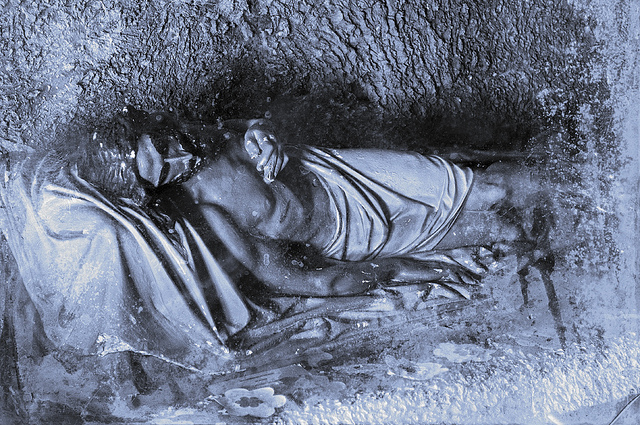
Christ in the Tomb. Image based on a sculpture found at the Shrine of Our Lady of Sorrows in Starkenburg, Missouri. Photo by Mark S. Abeln.

Jesus is dead.

The cross has done its work. Jesus is dead.

His secret followers have laid him in a tomb. Jesus is dead.

Today there is nothing but prayer, Sabbath prayer to the God of creation.

Today “the whole creation waits with eager longing” (Rom. 8:19) to be set free from its bondage to decay.

The cross, “the means of grace,” has done its work, but for today there is only “the hope of glory” (BCP 100).

Today there is only the tomb.

Jesus is dead.

So knit thou our friendship up

Draw Us In the Spirit’s Tether (Percy Dearmer)

Draw us in the Spirit’s tether;
For when humbly, in thy name,
Two or three are met together,
Thou art in the midst of them:
Alleluya! Alleluya! Touch we now thy garment’s hem.

As the brethren used to gather
In the name of Christ to sup,
Then with thanks to God the Father
Break the bread and bless the cup,
Alleluya! Alleluya! So knit thou our friendship up.

All our meals and all our living
Make us sacraments of thee,
That by caring, helping, giving,
We may true disciples be.
Alleluya! Alleluya! We will serve thee faithfully.

In The Spirit of Early Christian Thought (Yale 2003), Robert Louis Wilken suggests that Christian theology begins, first of all, with the disciples’ experience of meeting the Risen Christ in the shared meal of bread and wine.

Through his passion, death, and resurrection Jesus overcomes death and reconciles us to God. In communion with one another, we disciples find ourselves living a new life in Christ.

In the services of Holy Week, we “knit our friendship up” with Christ by immersing ourselves in his last days of self-offering love. I invite you to enter into the events around the Last Supper this Maundy Thursday “as the brethren used to gather in the name of Christ to sup.”

May this communion strengthen your friendship with the Risen Christ.

Confident of the glory

The psalmist captures perfectly how we feel when we discover we are not in agreement on a particular issue, or that we are even working at cross purposes. We feel betrayed and deceived.

For had it been an adversary who taunted me,
then I could have borne it;
or had it been an enemy who vaunted himself against me,
then I could have hidden from him.

But it was you, a man after my own heart,
my companion, my own familiar friend.

We took sweet counsel together,
and walked with the throng in the house of God.
(Psalm 55:13-15)

How can someone I thought I knew think so differently from me? If we don’t share these attitudes or opinions, what do we actually have in common?

Holy Week teaches us exactly what we have in common — the passion, death, and glorious resurrection of Jesus Christ which opens to us the way of everlasting life.

Like us, Jesus had men and women after his own heart, companions, familiar friends. One betrayed him, one denied him, most of them abandoned him, and they all hid in fear when they heard he had died.

Like the disciples, forgiven for their failings by the Risen Lord, we now share in Christ’s reconciling mission and are clothed by the Holy Spirit to reach forth our hands in love and to bring those who do not know Christ into the knowledge and love of Christ (see BCP 101).

Like the disciples and Christians ever since, we “take sweet counsel together” but disagree on what we’re supposed to do next. Share the good news with Jews only, or with Gentiles, too? Require circumcision or not? Men only as teachers and leaders, or women, too? Keep the kosher food laws or not? Couch the gospel in Jewish terms or translate it into Greek philosophical terms? Become the state religion or keep being persecuted? For 2,000 years we have taken sweet counsel together and disagreed on what to do next.

Paul writes to the Philippians to encourage them not to “worry about anything, but in everything by prayer and supplication with thanksgiving let your requests be made known to God” (4:6).

When we take sweet counsel with God and with one another, we are reminded what we share in common. We are reminded that our disagreements and our partial understanding and our personal agendas pale in the face of the glory that is revealed through Christ’s suffering, death, and resurrection.

We do not have to worry — Christ is our confidence. It’s not a zero-sum game; we can embrace “whatever is true, whatever is honorable, whatever is just, whatever is pure, whatever is pleasing, whatever is commendable, if there is any excellence, and if there is anything worthy of praise” (Phil. 4:8).

When we take sweet counsel together, we may come to understand a surprising truth. Through Christ, God is continually working a new thing. Not with the power of the state, but through weakness. Not with military might or the rule of law, but by the will of the Father. Not angry over our betrayal, but forgiving even his torturers. Not condemning the weak, but giving us the Holy Spirit and sending us out in his Name.

Collect for Wednesday in Holy Week

Lord God, whose blessed Son gave his body to be whipped and his face to be spit upon: Give us grace to accept joyfully the sufferings of the present time, confident of the glory that shall be revealed; through Jesus Christ your Son our Lord, who lives and reigns with you and the Holy Spirit, one God, for ever and ever. Amen. (BCP 220)

God’s wheat, ground by the teeth of wild beasts

20130314-031452.jpg

In his spirited defense during the early brackets in Lent Madness, the Rev. David Sibley wrote this about Ignatius of Antioch, an early Bishop of Rome:

“Ignatius’ letter to the Romans expressed his firm desire to be led to his martyrdom, begging the church in Rome to let him be ‘food for the wild beasts… God’s wheat… ground by the teeth of wild beasts, so that I may prove to be pure bread’ (Rom 4:1). Around AD 115, Ignatius was granted his wish, as he was martyred in the coliseum, given over to the teeth of lions.”

In my insomnia this morning, I was thinking of the election of Pope Francis and of the extraordinary challenge he faces as the spiritual leader of more than half the world’s Christians. As quickly as a puff of white smoke, he has become not only a source of guidance and a focus of reverence, but also a lightning rod for controversy, anger, and ridicule.

Exercising spiritual leadership at any level — you don’t have to be Pope! — can feel like being “ground by the teeth of wild beasts.” It is a terrible responsibility to educate the faithful, minister to the sick, reconcile the estranged, lead the congregation in worship, and feed the hungry, and if you’re honest about your own failings you’ll know how unprepared you are.

How appropriate is Psalm 69, appointed for Morning Prayer today!

O God, you know my foolishness,
and my faults are not hidden from you.

Let not those who hope in you be put to shame through me, Lord God of hosts;
let not those who seek you be disgraced because of me, O God of Israel.
(Ps. 69:6-7)

Here’s what puts Ignatius’ martyrdom, Francis’ new role as Bishop of Rome, and our own ministries with those among whom we live, and work, and worship into perspective: We are not the bread of life. Jesus is.

We may be “God’s wheat,” but the “living bread that came down from heaven” (John 6:51) is Jesus himself. What we can do — all we can do — is give “our selves, our souls and bodies” fully to the task at hand. We unite our offering to his in order to become through him the Body of Christ, the Bread of Heaven.

God grant that we may all offer solid food, nourishing bread, faithful witness to those whom God calls us to serve.

Teach your children well

I am at HIMSS, the annual meeting and trade show for healthcare IT, meeting clients and colleagues both in my company’s booth and after the day’s show is ended.

Yesterday I reconnected with a friend and former colleague, who shared with me a recent experience of “house church” when he and his wife told the parable of Jesus and the rich young man (Luke 18:18-30), and their children reenacted the story. The 18-month old played Peter, naturally, tugging on Jesus’ sleeve: “But what about us, Lord?”

The psalmist this morning underscores the importance of teaching the faith to our children:

That which we have heard and known,
and what our fathers have told us,
we will not hide from their children.

We will recount to generations to come
the praiseworthy deeds and the power of the Lord,
and the wonderful works he has done.
(Psalm 78:3-4)

At the Lenten Retreat I recently attended, Phyllis Tickle spoke of how the Biblical story is told in tent and synagogue and Temple. For Jews, the destruction of the Temple in 70 AD focused their faith and practice on the synagogue and home.

She suggested that as the institutional church (Christianity’s Temple) is becoming less prominent in people’s lives, it becomes even more important to share the stories of faith in small groups (synagogue) and at home (in the tent).

Even during difficult times — times of persecution or the loss of cherished traditions — the people of God recount the praiseworthy deeds and the power of the Lord so that their children will learn about the faith.

It was entirely appropriate, then, that the Canticle following the Old Testament lesson this morning was drawn from the Song of the Three Young Men, who though they were thrown into Nebuchadnezzar’s fiery furnace, sang songs of praise to God (Daniel 3).

Their song, recounted in the Apocryphal book known as the Prayer of Azariah, has formed part of the Church’s daily prayers for centuries now (Canticles 12 and 13 in our BCP).

Glory to you, Lord God of our fathers;
you are worthy of praise; glory to you.
Glory to you for the radiance of your holy Name;
we will praise you and highly exalt you for ever.
(BCP 90)

Whatever your circumstances may be, share your praise of God with your children so they will learn about the praiseworthy deeds and the power of the Lord.

Putting away all earthly anxieties

Sabbath Manifesto

A Collect for Saturdays

O God, who after the creation of the world rested from all your works and sanctified a day of rest for all your creatures: Grant that we, putting away all earthly anxieties, may be duly prepared for the service of your sanctuary, and that our rest here upon earth may be a preparation for the eternal rest promised to your people in heaven; through Jesus Christ our Lord. Amen. (BCP 99)

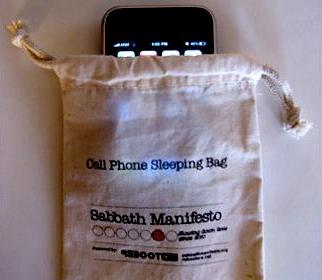
Today, apparently, is the National Day of Unplugging sponsored by the Sabbath Manifesto, whose “cell phone sleeping bag” is pictured above. The Sabbath Manifesto promotes ten principles for a weekly day of rest, starting with “Avoid Technology.”

Sunday — even though some Christians refer to it as the Sabbath — is pretty much a work day for me, starting at 7 am with preparations for the 8 am service at St. Thomas and ending after our Education for Ministry session wraps up around 2:30 pm. That means Saturday bears the brunt of weekend tasks.

I don’t know about you, but I have nine things on my to-do list for today, and five of them will require me to be on the web or pulling together a presentation or writing something (this blog post is one, so that will leave four more).

If I’m honest with myself, though, only one item on my list actually requires me to use the computer. Gotta fill out the expense reports for work so I’ll get reimbursed! The rest I could actually do more quietly, by reading and writing and thinking.

And if I’m really honest with myself, I could have done my expense reports on Thursday night at the hotel.

It’s the whole “putting away all earthly anxieties” thing that’s really tough, isn’t it? If we’re not anxious about something, we worry that we’re slacking. If we’re not connected, we worry that we’re missing something. If we can’t stare at the shiny screen, we’re anxious that we won’t know how to amuse ourselves.

One of my first bosses is an excellent writer, especially gifted at writing personal thank-you notes. One of his idiosyncracies is to use the word “eager” instead of the word “anxious.” Try it yourself sometime, as I have done for years now, and you’ll see a subtle difference.

Rather than being anxious, why not be eager? Why not put away your anxieties and give your eagerness a chance to play, at least one day a week?

I’m going to try it today. Seriously, right after I finish my expense report.

Merciful promise beyond all measure

genuflectOne of the niceties of the Daily Office during Lent is that Canticle 14: A Song of Penitence is appointed to be read on Sunday, Wednesday, and Friday mornings and on Monday evenings.

See the canticle itself on BCP 90, the table of when canticles are to be read on BCP 144, and handy versions of the tables to place in your prayer book on the Resources page of this blog.

Canticle 14 comes from the Prayer of Manasseh, one of the books in the Apocrypha. These are books which were in the Hebrew Scriptures around the time of Christ and used by Christians from the beginning.

The apocryphal books still commonly appear interleaved among the Old Testament books in Roman Catholic Bibles. In some Protestant Bibles, they are separated into a section called the Apocrypha and located between the Old and New Testaments. In most Protestant Bibles today, however, they are omitted entirely.

But I digress.

The reason I like this canticle so much is what it teaches us about penitence during this season of Lent.

All things quake with fear at your presence;
they tremble because of your power.
But your merciful promise is beyond all measure;
it surpasses all that our minds can fathom.

The God who “made the heavens and the earth, with all their vast array” is the “same Lord whose property is always to have mercy” (BCP 337). The character of God is goodness toward God’s creation.

The loveliest line in the canticle comes next:

And now, O Lord, I bend the knee of my heart,
and make my appeal, sure of your gracious goodness.
I have sinned, O Lord, I have sinned,
and I know my wickedness only too well.

Consciousness of God’s grace comes with a consciousness of our own sinfulness. It is entirely appropriate for us to “bend the knee of our heart.” However, our sin is not the point, and dwelling on (or wallowing in) our sin is not what God desires.

For you, O Lord, are the God of those who repent,
and in me you will show forth your goodness.
Unworthy as I am, you will save me,
in accordance with your great mercy,
and I will praise you without ceasing all the days of my life.

What a wonderful prayer to make four times a week during Lent! What a wonderful witness to the world, our repentance and our praise of God’s goodness.

The prayer book rubrics drily note that the Canticle is suitable for “other penitential occasions,” too. I invite you to spend some time reflecting on the Canticle or reading the Prayer of Manasseh, bending the knee of your heart, and then praising God for “merciful promise beyond all measure.”