
Tag Archives: AA

Out of the depths

74585-From-the-bottom-of-the-well_view


Glory to you, Lord God of our fathers; *
you are worthy of praise; glory to you.
Glory to you for the radiance of your holy Name; *
we will praise you and highly exalt you for ever.

Glory to you in the splendor of your temple; *
on the throne of your majesty, glory to you.
Glory to you, seated between the Cherubim; *
we will praise you and highly exalt you for ever.

Glory to you, beholding the depths; *
in the high vault of heaven, glory to you.
Glory to you, Father, Son, and Holy Spirit; *
we will praise you and highly exalt you for ever.

I’m not sure these were the exact words Joseph said to himself as he looked up from the bottom of the pit his brothers had thrown him into (Genesis 37:12-24).

It’s kind of strange that they’re the words we say (Canticle 13) right after we read that lesson from Genesis at Morning Prayer today.

But it’s also kind of appropriate, this juxtaposition between the bottom of the pit and God’s glory, especially during the season of Lent.

Lent makes us mindful how far we are from the glory God intends for us.

Lent reminds us in Paul’s words that “not many of you were wise by human standards, not many were powerful, not many were of noble birth. But God chose what is foolish in the world to shame the wise; God chose what is weak in the world to shame the strong” (1 Cor. 1:26-27).

This particular Lent reminds me, as I work the steps in my recovery process, that I “could not manage [my] own [life]; that probably no human power could have relieved [my problem]; that God could and would if He were sought” (Big Book 60).

The collect we usually read on Tuesday mornings also feels especially appropriate when we consider God’s goodness — God’s choosing us — in the face of our own sin and the predicaments we find ourselves in.

A Collect for Peace

O God, the author of peace and lover of concord, to know you is eternal life and to serve you is perfect freedom: Defend us, your humble servants, in all assaults of our enemies; that we, surely trusting in your defense, may not fear the power of any adversaries; through the might of Jesus Christ our Lord. Amen. (BCP 99)

Step Four on Ash Wednesday

genuflect

Then I acknowledged my sin to you,
and did not conceal my guilt.
I said, “I will confess my transgressions to the LORD.”
Then you forgave me the guilt of my sin.

(Psalm 32:5-6)

A couple of weeks ago my AA sponsor and I knelt together as I prayed that God would “relieve me of the bondage of self, that I may better do his will … and take away my difficulties, that my victory over them may bear witness to those I would help of Thy power, Thy love, and Thy way of life” (Big Book 63).

This prayer of abandonment to God’s will is what AA calls Step Three and what the Book of Common Prayer calls in the Ash Wednesday liturgy “a right beginning of our repentance, and a mark of our mortal nature” (BCP 265).

Today Lent begins, and for me a very particular process of self-examination and repentance.

I have reached the point in my recovery where it’s time to begin Step Four — to conduct a “searching and fearless moral inventory” of myself — and then to take Step Five, to admit to God, to myself, and to another human being the exact nature of my wrongs.

Though I have been in the Church all my life, I am beginning to understand for myself the wisdom of traditional practices like Confession, what the Book of Common Prayer calls Reconciliation of a Penitent (BCP 447). We need at times to write down what we’ve done wrong, to say it out loud to another person, and to hear from them our Lord’s assurance of forgiveness.

Lent is a particularly appropriate time for this hard and holy work, and I am embracing it gladly as my main observance this year.

And now, O Lord, I bend the knee of my heart,
and make my appeal, sure of your gracious goodness.
(Canticle 14, BCP 91)

Whatever you may decide to do to mark this Lent, I invite you to take it seriously but joyfully.

I invite you, therefore, in the name of the Church, to the observance of a holy Lent, by self-examination and repentance; by prayer, fasting, and self-denial; and by reading and meditating on God’s holy Word. And, to make a right beginning of repentance, and as a mark of our mortal nature, let us now kneel before the Lord, our maker and redeemer (BCP 265).

You who remind the Lord

Church-Circle-Graphic

You who remind the Lord, take no rest,
and give him no rest
until he establishes Jerusalem
and makes it renowned throughout the earth.
(Isaiah 62:6b-7)

As the meeting ends, we all stand and form a circle, joining hands in a moment of silence.

“Whose Father?”

“Our Father …” we begin to pray.

+ + + + +

As the Eucharistic Prayer draws to a close, the priest looks out over the congregation: “And now, as our Savior Christ has taught us, we are bold to say …”

“Our Father …”

+ + + + +

Morning and evening, after the Psalms, after the readings and canticles, after the Apostles’ Creed, we begin the Prayers by saying:

“Our Father …”

+ + + + +

We “who remind the Lord” take no rest.

We give him no rest, our Father in heaven, and that’s the way he wants it.

We ask him to be faithful to his promises, and he will.

Listen:

“You have promised through your well-beloved Son that where two or three are gathered together in his name, you will be in the midst of them” (BCP 102).

“Come unto me, all ye that travail and are heavy laden, and I will refresh you” (BCP 332).

“We came to understand that we … could not manage our own lives … but that God could and would if He were sought” (Blue Book 60).

+ + + + +

A Collect for Grace

O Lord God, almighty and everlasting Father, you have brought us in safety to this new day: Preserve us with your mighty power, that we may not fall into sin, nor be overcome by adversity; and in all we do, direct us to the fulfilling of your purpose; through Jesus Christ our Lord. Amen. (BCP 100)


Searching and fearless

Step Four
Made a searching and fearless moral inventory of ourselves.

“We want to find exactly how, when, and where our natural desires have warped us. We wish to look squarely at the unhappiness this has caused others and ourselves. By discovering what our emotional deformities are, we can move toward their correction … Without a searching and fearless moral inventory, most of us have found that the faith which really works in daily living is still out of reach” (12 Steps and 12 Traditions).

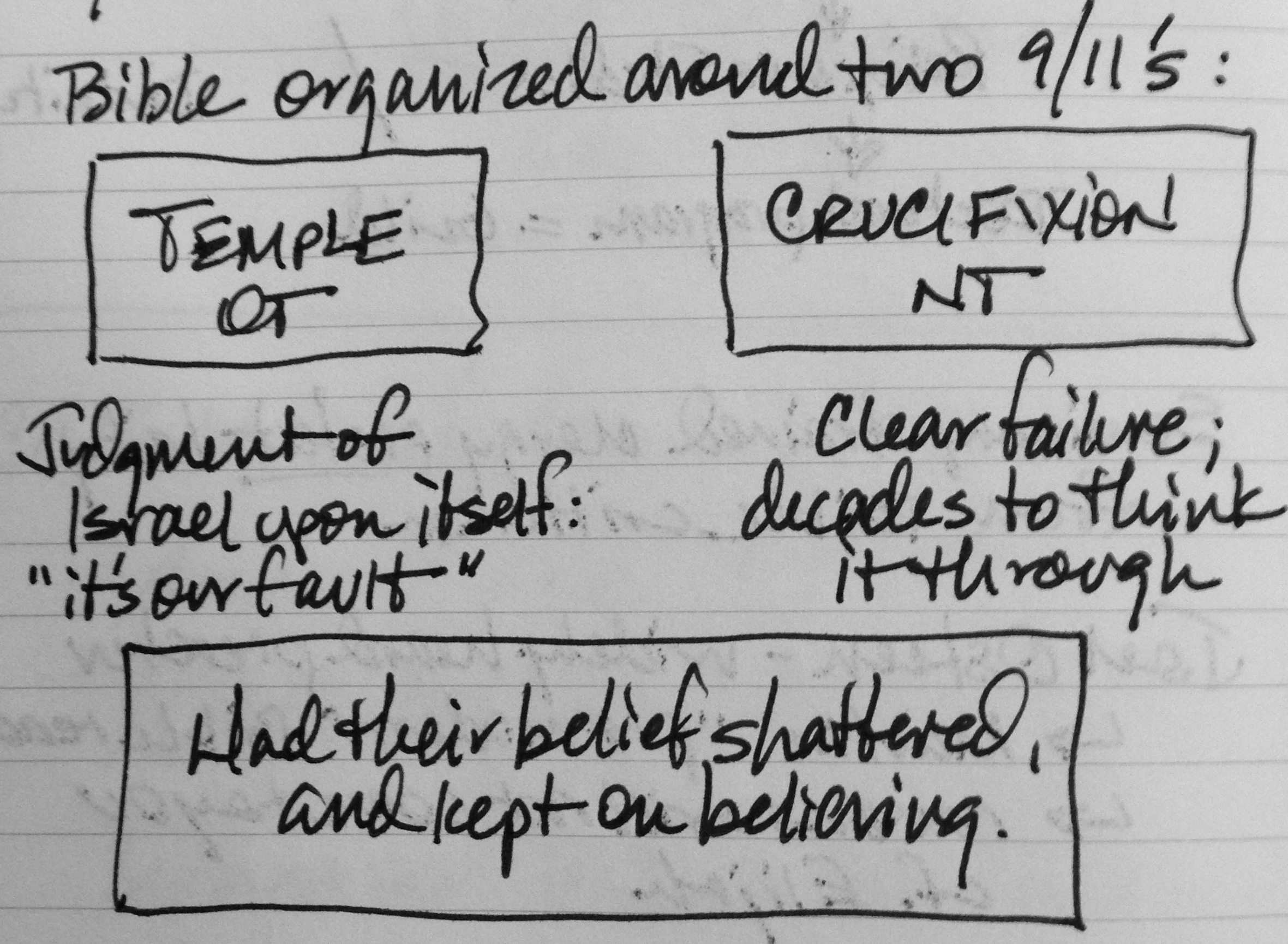
Notes from the first session of John Dally's "This Dangerous Book: Strategies for Teaching the Bible" at Seabury.

Notes from the first session of John Dally’s “This Dangerous Book: Strategies for Teaching the Bible” at Seabury.

Three weeks ago, I wrote about one of the central ideas from the class I am taking at Seabury this fall: that the Bible is organized around two 9/11’s.

The Hebrew Bible, in particular, came into its present shape after the destruction of the Temple and the exile into Babylon. John Dally suggests that Israel’s judgment upon themselves is that “it’s our fault.”

So mortals ate the bread of angels;
he provided for them food enough.

But they did not stop their craving,
though the food was still in their mouths.

Whenever he slew them, they would seek him,
and repent, and diligently search for God.

But they flattered him with their mouths
and lied to him with their tongues.

Their heart was not steadfast toward him,
and they were not faithful to his covenant.

(Psalm 78:25-37 passim)

Perhaps the Hebrew Bible is also, to use the language of the 12 Steps, Israel’s “searching and fearless moral inventory.”

Step Four concludes with this reminder: “Therefore, thoroughness ought to be the watchword when taking inventory. In this connection, it is wise to write out our questions and answers. It will be an aid to clear thinking and honest appraisal. It will be the first tangible evidence of our complete willingness to move forward.”

What the priest Ezra and the people are doing in this morning’s reading from the Book of Nehemiah is repenting of their sins and laying before God and each other their written confession:

You have been just in all that has come upon us, for you have dealt faithfully and we have acted wickedly; our kings, our officials, our priests, and our ancestors have not kept your law or heeded the commandments and the warnings that you gave them …. Because of all this we make a firm agreement in writing, and on that sealed document are inscribed the names of our officials, our Levites, and our priests. (Nehemiah 9:33-34, 38)

In a larger sense, the whole of the Hebrew Bible is the written confession of the people of God regarding their failure and their renewed desire to live as God intends, the “tangible evidence of their complete willingness to move forward.”

It is difficult to commit to a “searching and fearless moral inventory,” but I also draw comfort knowing that I am by no means alone in my struggles, that others have found a way forward into a “faith that really works in daily living.”

How do your prayers and your reading of Scripture both challenge and comfort you today?

Come to a sober and right mind

A friend spoke to me earlier this week about sobriety. He said, “What we really have is a daily reprieve contingent on the maintenance of our spiritual condition.”

I now know that he was quoting from the Big Blue Book of Alcoholics Anonymous, but those words spoke volumes to me about the difference between duty and grace.

The duty of “maintaining our spiritual condition” is at the heart of programs like AA — and I’m beginning to understand how hard and serious that work is in every life.

The gift, the grace of a daily reprieve, is what sobriety represents.

I have often thought of my struggles to maintain a regular discipline of prayer — or any discipline of any kind, for that matter.  Like Paul, “I do not understand my own actions. I do not do what I want, but the very thing I hate” (1 Cor. 7:15).

My friend has me thinking differently today.

What if the daily prayer, the day without drinking, the day without shopping (or whatever else it may be), is not a burdensome duty to fail at yet again — but is actually the gift of rest for a moment?

The work is hard enough without making grace and rest a duty, too.

“Come unto me, all who travail and are heavy laden, and I will refresh you,” says our Lord (Matt. 11:28).

Come to a sober and right mind as you maintain your spiritual condition.

Come to a daily reprieve.