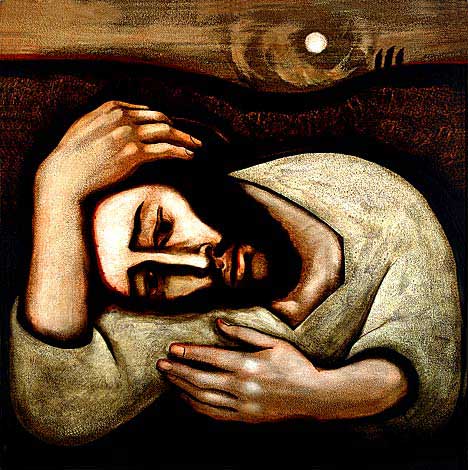
Tempted but the truth is discovered

Your hand will lay hold upon all your enemies; *
your right hand will seize all those who hate you.
You will make them like a fiery furnace *
at the time of your appearing, O LORD;
You will swallow them up in your wrath, *
and fire shall consume them. (Psalm 21:8-10)

It’s so tempting, isn’t it? To want victory in the same terms as our “enemies” enjoy it. To believe that victory means power and control over others.

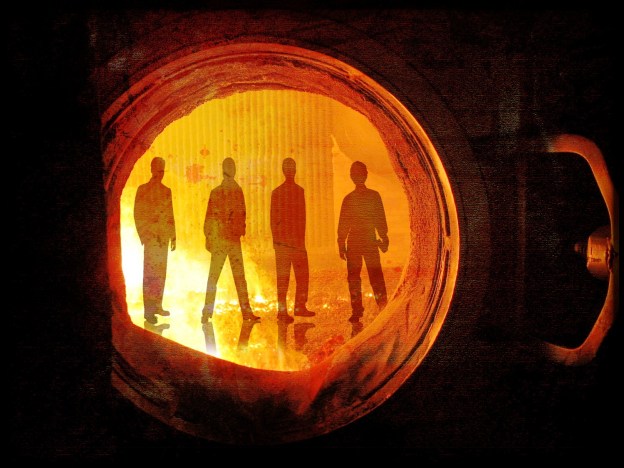
Immediately after we read Psalms 20 and 21, we finally reach the climax of the opening chapters of the Book of Daniel that we’ve been reading all week. Shadrach, Meshach, and Abednego, Daniel’s Hebrew companions at the court of the king of Babylon, refuse to worship the great gold statue that Nebuchadnezzar has erected, so they are thrown into a fiery furnace.

The Book of Daniel probably came later in the compilation of the Hebrew Bible — it seems to reflect a post-Exile sensibility — but I’m tempted to believe that the Psalmist is wishing to have victory like the Babylonian king, victory that everyone can see, victory that burns up his enemies.

After our reading from the Book of Daniel, we respond with Canticle 12, appointed for Saturday mornings (BCP 144). Canticle 12 is known by three names: “A Song of Creation,” the Latin first line Benedicite, omnia opera Domini, and the descriptive title Song of the Three Young Men.

Yes, those three young men. What were Shadrach, Meshach, and Abednego doing in the fiery furnace? They were praising the God of creation.

Glorify the Lord, you angels and all powers of the Lord, *
O heavens and all waters above the heavens.
Sun and moon and stars of the sky, glorify the Lord, *
praise him and highly exalt him for ever.

Glorify the Lord, every shower of rain and fall of dew, *
all winds and fire and heat.
Winter and Summer, glorify the Lord, *
praise him and highly exalt him for ever. (BCP 88)

The mighty king of Babylon is astonished. His power has no effect on these young men. It even looks like they are walking around in the furnace with a fourth figure. An angel?

He yells at them, “Come out, come here!”

And the satraps, the prefects, the governors, and the king’s counselors gathered together and saw that the fire had not had any power over the bodies of those men; the hair of their heads was not singed, their tunics were not harmed, and not even the smell of fire came from them. Nebuchadnezzar said, “Blessed be the God of Shadrach, Meshach, and Abednego, who has sent his angel and delivered his servants who trusted in him. They disobeyed the king’s command and yielded up their bodies rather than serve and worship any god except their own God. (Daniel 3:27-30)

What is victory?

Is it burning your enemies up in a fiery furnace? Is it winning control? Is it having power and prestige?

Or is it praising God in all circumstances? Is it yielding up your body rather than serve any power but God?

The three young men seem to know the answer. Jesus, meeting the devil in the wilderness after his baptism, seems to answer temptation in the same way.

Truth is, for us whose faith is formed by the Hebrew Bible and given flesh in Jesus and powered by the Spirit, victory means yielding ourselves, not lording over others.

Truth is, victory is “to worship the Lord [our] God, and serve only him” (Luke 4:8).

Deep gloom enshrouds the peoples

Arise, shine, for your light has come, *
and the glory of the Lord has dawned upon you.
For behold, darkness covers the land; *
deep gloom enshrouds the peoples.
But over you the Lord will rise, *
and his glory will appear upon you. (Isaiah 60:1-3; BCP 87)

Yesterday evening, my Twitter feed and then the news filled with images and video of Walter Scott being shot so casually by North Charleston police officer Michael Slager.

Meanwhile, back on NCIS (Tuesday night is NCIS night) the usual storyline unfolds, and Gibbs very casually shoots the arms dealer who has killed a Marine; as often happens on NCIS, the show ends with an emotional appeal for gifts in memory of fallen Marines.

On NCIS: New Orleans, a hostage situation unfolds, met with the entirely understandable armoring of the FBI and a Navy SWAT team.

Through the gloom, the evening starts to feels like the Gospel accounts of the crucifixion — the Roman Empire says  “force wins,” the religious people say “it’s better for one person to die for the country,” the criminal gets taken down, and protests over his death are met with a carefully crafted story and an extra layer of security: “Otherwise, his disciples may go and steal him away” (Matthew 27:62-66).

It’s so hard to proclaim Easter when it’s gloomy like this. It’s so hard not to retreat, not to try to close out the news.

Alienation

But it gets better.

This morning in my Facebook feed, a friend shared a link to a reflection by New Jersey relationship columnist Anthony D’ambrosio on marriage and divorce.

One of the five reasons D’ambrosio cites “why marriage just doesn’t work anymore” is our alienation from each other because of all the devices and screens that surround us (I chuckle as I read in the living room; I can hear my wife tapping away on her laptop in the kitchen).

I can also hear the disciples walking on the Emmaus road shaking their heads in dismay. “It wasn’t supposed to be like this. We had high hopes.”

Communion

The stranger who joins them, and who accepts their polite invitation to a meal, opens the eyes of their faith in the way he breaks and blesses the bread (Luke 24:13-35).

O God, whose blessed Son made himself known to his disciples in the breaking of bread: Open the eyes of our faith, that we may behold him in all his redeeming work; who lives and reigns with you, in the unity of the Holy Spirit, one God, now and for ever. Amen. (BCP 223)

Perhaps simpler gestures of communion will pierce the deep gloom that enshrouds us.

Perhaps seeing each other through the eyes of faith — not as dangerous criminals, not as armed storm troopers, not as self-absorbed people pushing each other away on purpose — perhaps seeing each other is the first step to seeing the Risen Lord.

“Over you the Lord will rise,” says Isaiah, “and his glory will appear upon you.” Perhaps if we make time and space (and a place) to sit with each other, we will have a chance truly to see each other.

Give us eyes to see each other, O Lord, not to look past each other. Give us pause before we alienate one another again. Give us hunger to share a meal with each other, and in our breaking bread together to see you with us.

Exsultet Redux

(To be hummed quietly to oneself in the days following the Easter blowout)

Relax now, heavenly hosts and choirs of angels,
and give your trumpets a vacation
after the victory of our mighty King.

Relax and breathe now, all the round earth,
quiet with a glorious splendor,
for darkness has been vanquished by our eternal King.

Relax and be glad now, Mother Church,
and let your holy courts, in peace and quiet,
reflect on the saving of your people.

All you who rest near this intimate and holy flame,
pray with me to God the Almighty
for the grace to live in worthy praise of this great light
through Jesus Christ his Son our Lord,
who lives and rests with him,
in the stillness of the Holy Spirit,
one God, for ever and ever. Amen.

Christ our Passover

Alleluia. The Lord is risen indeed: Come let us adore him. Alleluia.

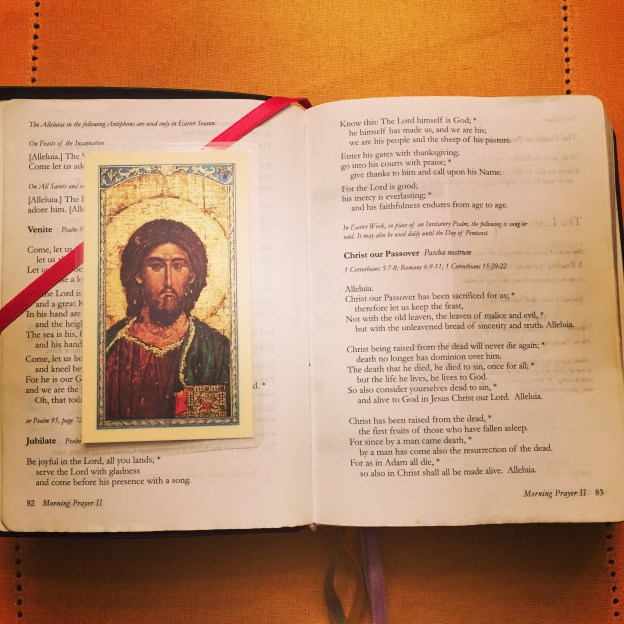
Morning Prayer during the 50 days of the Easter season may begin with the Easter antiphon and the canticle “Christ our Passover” instead of the Venite.

It’s a lovely way to mark these 50 days — one-seventh of the Church Year — as a sort of Sunday to the rest of the week.

Alleluia. The Lord is risen indeed: Come let us adore him. Alleluia.

Christ our Passover Pascha nostrum

Alleluia.
Christ our Passover has been sacrificed for us;
therefore let us keep the feast,
Not with the old leaven, the leaven of malice and evil,
but with the unleavened bread of sincerity and truth. Alleluia.

Christ being raised from the dead will never die again;
death no longer has dominion over him.
The death that he died, he died to sin, once for all;
but the life he lives, he lives to God.
So also consider yourselves dead to sin,
and alive to God in Jesus Christ our Lord. Alleluia.

Christ has been raised from the dead, the first fruits of those who have fallen asleep.
For since by a man came death,
by a man has come also the resurrection of the dead.
For as in Adam all die,
so also in Christ shall all be made alive. Alleluia. (BCP 83)

Putting away all earthly anxieties

As the body of Jesus lies wrapped in grave clothes in the tomb on this Saturday, we “praise and highly exalt” God for the earth and its creatures:

Let the earth glorify the Lord, *
praise him and highly exalt him for ever.
Glorify the Lord, O mountains and hills,
and all that grows upon the earth, *
praise him and highly exalt him for ever.

Glorify the Lord, O springs of water, seas, and streams, *
O whales and all that move in the waters.
All birds of the air, glorify the Lord, *
praise him and highly exalt him for ever.

Glorify the Lord, O beasts of the wild, *
and all you flocks and herds.
O men and women everywhere, glorify the Lord, *
praise him and highly exalt him for ever. (BCP 89)

As God incarnate, made man in the person of Jesus, occupies the last part of creation — death itself — we pray on this Holy Saturday that we, “putting away all earthly anxieties” (BCP 99), may be prepared for the service of God’s sanctuary.

From “the vast expanse of interstellar space, galaxies, suns, the planets in their courses, and this fragile earth, our island home” (BCP 370) to the microorganisms in the soil of the tomb, from the largest blue whale (“that Leviathan”) to the smallest child newly born, all creation is God’s sanctuary.

Every part of it has been made holy, not only by God’s creating it, but by God’s inhabiting it.

Paul writes that “the creation waits with eager longing for the revealing of the children of God; for the creation was subjected to futility, not of its own will but by the will of the one who subjected it, in hope that the creation itself will be set free from its bondage to decay and will obtain the freedom of the glory of the children of God” (Romans 8:19-21).

Even the darkest night, even the fear of death, even the silent cry of loneliness, all of the creation’s “bondage to decay” and all of our earthly anxieties have been redeemed, made holy by God’s inhabiting them.

The Song of the Redeemed  Magna et mirabilia
Revelation 15:3-4

O ruler of the universe, Lord God,
great deeds are they that you have done, *
surpassing human understanding.
Your ways are ways of righteousness and truth, *
O King of all the ages.

Who can fail to do you homage, Lord,
and sing the praises of your Name? *
for you only are the Holy One.
All nations will draw near and fall down before you, *
because your just and holy works have been revealed.

Glory to the Father, and to the Son, and to the Holy Spirit:
as it was in the beginning, is now, and will be for ever. Amen.

Kings and priests and friends | Sermon for Good Friday

Kings

Isaiah says of the Suffering Servant,

Kings shall shut their mouths because of him; for that which had not been told them they shall see, and that which they had not heard they shall contemplate. (Isaiah 52:15)

We heard last night the refrain “Servants are not greater than their master” (John 13:16). Consider some of the servants of the king – the Roman emperor and the imperial government – in this Passion Gospel:

  • The detachment of soldiers – who coordinated with the Temple police in a tactical raid to arrest Jesus
  • Pilate – the governor of Judea, who bowed to political pressure and for expediency released a convicted killer and sentenced an innocent man to death
  • The soldiers at the headquarters – who beat and taunted and humiliated an innocent man, parading him around in a purple robe and crowning him with thorns
  • The emperor himself – whose hold on power depended on brutal, efficient force and military might
  • The soldiers at the cross – who shared their sour wine with Jesus and who did not break his legs to hasten his cruel death, because he was dead already.

“Kings shall shut their mouths because of him; for that which had not been told them they shall see.”

Priests

Since the law has only a shadow of the good things to come and not the true form of these realities, it can never, by the same sacrifices that are continually offered year after year, make perfect those who approach …. And every priest stands day after day at his service, offering again and again the same sacrifices that can never take away sins. (Hebrews 10:1, 11)

We heard last night the refrain “Servants are not greater than their master.” Consider some of the servants of the Temple hierarchy in this Passion Gospel:

  • The police from the chief priests – who came with lanterns and torches and weapons (and a SWAT team of Roman soldiers) to arrest Jesus; who bound him and took him to …
  • Annas, the father-in-law of Caiaphas – who questioned Jesus, who had his police strike him for blasphemy, who had him bound as though he were dangerous.
  • Caiaphas, the high priest – who “advised that it was better to have one person die for the people.”
  • The chief priests – who complained “Do not write ‘King of the Jews,’ but ‘This man said ‘I am King of the Jews.’” and who shouted to Pilate “We have no king but the emperor!”

Kings and priests, priests and kings …. upholding the law, administering the law, enforcing the rule of law, executing the sentences of the law.

“[The law] can never, by the same sacrifices that are continually offered year after year, make perfect those who approach.”

Friends

Kings and priests …. and friends.

We heard last night the refrain “Servants are not greater than their master.”

But Jesus went on to say more, after he had shared a meal with us, after he had washed our feet as an example, and after his betrayer had gone out from among us.

“I do not call you servants any longer, for servants do not know what the master is doing; but I have called you friends” (John 15:15).

Br. David Vryhof writes in the Society of St. John the Evangelist’s online meditation today that:

We are invited to take our stand at the foot of the Cross, joining the small company of Jesus’ friends who are already gathered there. We stand there together, under a dark and threatening sky, to witness the suffering of our Savior, to be with him in his hour of immense pain and desperate need.

Consider the small company of Jesus’ friends:

  • Peter – whose early-morning bluster and swordplay in the garden earned him a silent rebuke from Jesus, who was undone by a servant girl’s questions, who denied his friend before the sun even came up, but whose confession would become the rock on which Christ would build his Church.
  • Mary – who with her sister and two other Marys stood at the foot of the cross, all of them pierced through the heart for the son and master they had loved, but whose faithfulness meant they would be first witnesses to his resurrection.
  • The disciple Jesus loved – who could not only bear witness, but who could bear up his friend’s mother in her grief, laying her head on his breast just as he laid his head on Jesus’ breast at the table last night.
  • Joseph of Arimathea and Nicodemus – who had much to fear from the chief priests and the council, but who stayed firm in their resolve to do their part.

“Kings shall shut their mouths at him,” for his gentle power undoes their shows of force, and “priests by their sacrifices can never take away sins,” for their law of might betrays their true allegiance.

But let us – the small company of Jesus’ friends, the Master’s friends – “hold fast to the confession of our hope without wavering, for he who has promised is faithful” (Hebrews 10:23).

We Wish to See Jesus | Sermon for Tuesday in Holy Week

Among those who went up to worship at the festival were some Greeks. They came to Philip, who was from Bethsaida in Galilee, and said to him, “Sir, we wish to see Jesus.” Philip went and told Andrew; then Andrew and Philip went and told Jesus.

At the time of Jesus, most Jews spoke Greek, and the Hebrew Bible was translated into Greek in a version called the Septuagint. 

“Greeks,” though, is the term the Gospel writers usually use not for non-Jews or residents of Greece, but instead for Greek-speaking (and often non-Palestinian) Jews and also for “God-fearers,” those who were not Jewish but who attended synagogue services and practiced the faith as best as they could. 

Stephen the Deacon was a Hellenistic, or Greek-speaking Jew; Cornelius the Roman centurion was a Gentile and probably a God-fearer.

But what do you think these Greeks wanted to see? Who do you think the “God fearers” were looking for?

Paul says that “Jews demand signs and Greeks desire wisdom,” but what Jesus says to the Greeks who come looking sounds foolish.

Unless a grain of wheat falls into the earth and dies, it remains just a single grain; but if it dies, it bears much fruit.

Jesus first talks about the pattern of his life – the dying and rising, the self-emptying which is central to his ministry. He links that dying and rising to his work of salvation on the cross.

He says, “And I, when I am lifted up from the earth, will draw all people to myself.” His dying on the cross will accomplish not only his rising to new life, but bear fruit in ours, too.

The pattern of dying and rising doesn’t make any sense. The dying doesn’t fit with the triumphal entry into Jerusalem that just happened right before our reading; it doesn’t fit with hailing Jesus as the coming King, the Messiah who “remains forever,” according to the Hebrew Bible.

What do you mean? the crowd asks Jesus.

Jesus answers them with another odd image: 

The light is with you for a little longer. Walk while you have the light, so that the darkness may not overtake you.

Several times during his ministry, Jesus has said something like this:

“You always have the poor with you, but you do not always have me” – he said that just last night at dinner with Lazarus and Mary. His feet probably still smelled of Mary’s costly perfume as he rode into the city on the back of a donkey.

“While the bridegroom is with them, his friends rejoice” – he said that early in his ministry when he was questioned about why his disciples didn’t properly observe some Sabbath regulations.

While we have Jesus with us, everything is different and the old rules don’t seem to apply anymore.

So Jesus’ dying and rising is the pattern for his life, and his presence makes a difference to his friends.

On Saturday night – after our “way of the cross” has led us with Jesus to supper with his friends and his betrayal by one of them; to his agonized prayer in the garden and to his arrest; and to his crucifixion and his death – on Saturday night the darkness of our church will be split by a single candle flame.

I’ll sing, “The light of Christ!”

And you’ll respond, “Thanks be to God!”

You see, dying and rising is the pattern. Good Friday comes, but so does Easter. Self-sacrificing, daily dying to self, is necessary, but it leads to resurrection life. The darkness comes, we no longer see our friend Jesus, but ultimately the light of Christ prevails.

This is the Gospel message that Stephen and the other Greek-speaking followers of the Way witnessed to, many of them with their lives. 

This is the Gospel that Paul carried to the Hellenistic world, to the actual “Greeks” and Romans and other Gentiles, and eventually, down the long centuries to us.

Many centuries before Jesus was born, the people of Israel were taken into exile in Babylon. Though many returned to the land, many more remained in the Diaspora – no longer speaking Hebrew, but speaking Greek like their neighbors.

“It is too light a thing,” said God upon his people’s return, “that you should be my servant to raise up the tribes of Jacob and to restore the survivors of Israel; I will give you as a light to the nations, that my salvation may reach to the end of the earth.”

The restoration, the enlightenment, the resurrection life is not for keeping. It’s for sharing.

And you see, we still “walk while we have the light.”

“The darkness has not overcome it,” says John, and with the Spirit in our midst we always have the light of Christ with us, so the darkness will not overtake us.

Jesus’ dying and rising is the pattern for his life, and his presence makes all the difference to us – his friends.

By our dying and rising, by the pattern of our lives, we walk in the light, witnessing to the light of Christ in us and sharing it with “all the nations.”

May the Greeks who come looking always see Jesus when they encounter us …

An audio version of this sermon can be found at St. Thomas’ YouTube page:

http://youtu.be/JoE1b_qa0Ok

Rehearsing the whole of the faith

Jesus said to his disciples, “These are my words that I spoke to you while I was still with you– that everything written about me in the law of Moses, the prophets, and the psalms must be fulfilled.” Then he opened their minds to understand the scriptures, and he said to them, “Thus it is written, that the Messiah is to suffer and to rise from the dead on the third day, and that repentance and forgiveness of sins is to be proclaimed in his name to all nations, beginning from Jerusalem. You are witnesses of these things.” (Luke 24:48).

Picture the scene in Jerusalem in the late fourth century:

“Immediately a throne is placed for the bishop in the major church, the Matryrium …. The bishop [teaches them the law] in this way: beginning with Genesis and going through the whole of Scripture during these forty days, expounding first its literal meaning and then explaining the spiritual meaning. In the course of these days everything is taught not only about the Resurrection but concerning the body of the faith. This is called catechetics” (134*).

These are the words of Egeria, a Spanish woman who spent a year in Jerusalem on pilgrimage and wrote letters home about everything she saw and how the Church in Jerusalem worshiped.

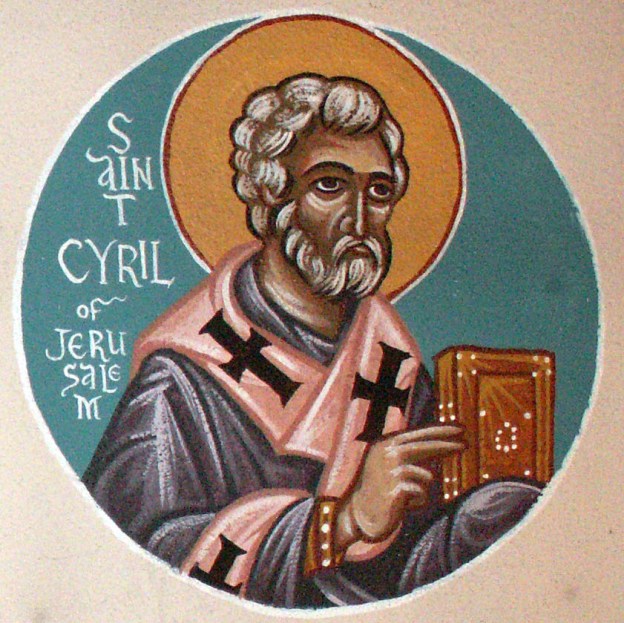
It’s entirely possible that the bishop she saw on the throne teaching the catechumens (those who were preparing for baptism at the Great Vigil of Easter) was Cyril himself.

Cyril taught his fellow-Christians about living in the way of the cross, about repentance and forgiveness, dying and rising, and he helped develop the doctrines that became the Nicene Creed.

Cyril wrote about the way of the cross in his Catechetical Instructions, saying that “Jesus never sinned; yet he was crucified for you. Will you refuse to be crucified for him, who for your sake was nailed to the cross? You are not the one who gives the favor; you have received one first. For your sake he was crucified on Golgotha. Now you are returning his favor; you are fulfilling your debt to him” (136).

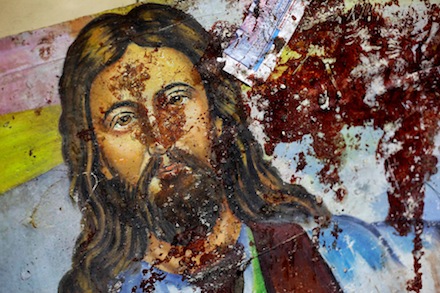
Christians then and now walk in the way of the cross during Holy Week, putting ourselves imaginatively in the places where Jesus himself was arrested, carried his cross, stumbled and fell, and was crucified. We will observe Stations of the Cross in Solidarity with the Persecuted Church at St. Thomas on Palm Sunday and three times on Good Friday.

The pattern of dying and rising that we rehearse through Holy Week and Easter is the pattern of the Gospel and of life in Christ.

We learn through experience that repentance and forgiveness are the way forward in relationships, that falling and rising again move us toward deeper union with God and each other, that our failing and falling lead us into greater dependence on God “who so loved the world that he gave his only-begotten Son to the end that none should perish, but have everlasting life” (John 3:16).

Sometimes it’s the Church that teaches us this pattern, but often it’s a mentor or support group or teacher or 12-Step program.

Jesus himself not only teaches but embodies this pattern. “Then he opened [the disciples’] minds to understand the scriptures, and he said to them, ‘Thus it is written, that the Messiah is to suffer and rise from the dead on the third day, and that repentance and forgiveness of sins is to be proclaimed in his name to all nations, beginning from Jerusalem. You are witnesses of these things’” (Luke 24:45-48).

Cyril and the believers in Jerusalem kept Holy Week by walking the Way of the Cross from place to place in Jerusalem, from the Martyrium to Golgotha, from the Mount of Olives to the Holy Sepulchre, and Cyril spent his time and energy with catechumens, “opening their minds to understand the scriptures.”

He taught them that “in learning and professing the faith, you must accept and retain only the Church’s present tradition, confirmed as it is by the Scriptures. Although not everyone is able to read the Scriptures … we have gathered together the whole of the faith in a few concise articles … this summary of the faith was not composed at any human whim; the most important sections were chosen from the whole Scripture to consitute and complete a comprehensive statement of the faith” (447).

So as we prepare ourselves to walk the Way of the Cross during Holy Week …

As we reflect on the falling and failing in our lives and see God at work to redeem and raise us …

As we open each other’s minds to understand the Scriptures …

Let’s follow Cyril’s example “in learning and professing the faith,” and let’s also join Cyril and Egeria and our fellow pilgrims in rehearsing “the whole of the faith in a few concise articles.”

+ + + + +

The Nicene Creed

We believe in one God,
the Father, the Almighty,
maker of heaven and earth,
of all that is, seen and unseen.

We believe in one Lord, Jesus Christ,
the only Son of God,
eternally begotten of the Father,
God from God, Light from Light,
true God from true God,
begotten, not made,
of one Being with the Father.
Through him all things were made.
For us and for our salvation
he came down from heaven:
by the power of the Holy Spirit
he became incarnate from the Virgin Mary,
and was made man.
For our sake he was crucified under Pontius Pilate;
he suffered death and was buried.
On the third day he rose again
in accordance with the Scriptures;
he ascended into heaven
and is seated at the right hand of the Father.
He will come again in glory to judge the living and the dead,
and his kingdom will have no end.

We believe in the Holy Spirit, the Lord, the giver of life,
who proceeds from the Father and the Son.
With the Father and the Son he is worshiped and glorified.
He has spoken through the Prophets.
We believe in one holy catholic and apostolic Church.
We acknowledge one baptism for the forgiveness of sins.
We look for the resurrection of the dead,
and the life of the world to come. Amen. (BCP 358)

* Page numbers for the passages from Cyril and Egeria refer to J. Robert Wright’s Readings for the Daily Office From the Early Church (Church Publishing, 1991, 2013).

Friday the 13th

It’s definitely a modern invention, the claim that Friday the 13th is inauspicious because Jacques de Molay and the Knights Templar were arrested in France on Friday, October 13, 1307.

Even so, I’ll play on the connection with that story and today’s readings from Morning Prayer.

I can’t help thinking today of Christians and others imprisoned for their faith, persecuted because of their religion, or driven from their homes to live as refugees, as so many are today.

I can’t help praying for the teenage boys a friend just texted me about, the older killed in a car accident this morning, the younger in critical condition in the hospital. Their suffering and their parents’ grief and fear are dark prisons.

You have put my friends far from me; you have made me to be abhorred by them; *
I am in prison and cannot get free.
My sight has failed me because of trouble; *
LORD, I have called upon you daily; I have stretched out my hands to you.
Do you work wonders for the dead? *
will those who have died stand up and give you thanks?
Will your loving-kindness be declared in the grave? *
your faithfulness in the land of destruction?
Will your wonders be known in the dark? *
or your righteousness in the country where all is forgotten?
But as for me, O LORD, I cry to you for help; *
in the morning my prayer comes before you. (Psalm 88:9-14)

Pray for all whose faith is abused for financial gain; whose loyalty is rewarded with political murder; whose life is thrown away by those seeking power or control.

Pray for those whose faith is tested by tragedy, pain, and fear.

But if we have died with Christ, we believe that we will also live with him. We know that Christ, being raised from the dead, will never die again; death no longer has dominion over him. The death he died, he died to sin, once for all; but the life he lives, he lives to God. So you also must consider yourselves dead to sin and alive to God in Christ Jesus. (Romans 6:8-11)

But remember, too, that even in the middle of persecution, flight, and abuse; even in the face of tragedy and pain; even on this particular Friday in the middle of Lent, Scripture reminds us that death is not the end of the story.

We are nearing Holy Week, when we remember Jesus’ willing sacrifice, his dying and rising, the way of the cross that is the pattern for our own lives of faith.

We are nearing Good Friday, the Friday that makes all others “good,” even the ones that land on the 13th of the month.

And we hear echoes this morning in Paul’s letter to the Romans of the canticle Christ our Passover (BCP 83) that we will sing throughout the coming season of Easter.

A Collect for Fridays

Almighty God, whose most dear Son went not up to joy but first he suffered pain, and entered not into glory before he was crucified: Mercifully grant that we, walking in the way of the cross, may find it none other than the way of life and peace; through Jesus Christ our Lord. Amen. (BCP 99)

Solidarity with the persecuted Church

The Catholic Herald in the UK recently published Maronite Archbishop Samir Nassar’s reflections as A Way of the Cross in solidarity with the persecuted Church. Archbishop Samir is the Maronite Archbishop of Damascus, and he serves as Episcopal Shepherd of the Syrian Commission for the Family.

Here, for the convenience of any who may wish to use this Way of the Cross in their parishes this Lent, is a booklet (gently adapted) and formatted for double-sided printing on US Letter size paper (8.5″ x 11″).

It is offered in hopes that, as we journey toward Jerusalem this Lent and Easter in solidarity with our persecuted sisters and brothers in the Church throughout the world, we may together bear witness to the power of the cross to overcome death and the grave, and to open to us all the resurrection life of Jesus Christ our Lord.