You know all the prayers. You are God.

Neil Gaiman recounts this small scene in his stunning story titled, “The Man Who Forgot Ray Bradbury.”

A poor man found himself in a forest as night fell, and he had no prayer-book to say his evening prayers.

So he said, “God, who knows all things, I have no prayer-book, and I do not know any prayers by heart. But you know all the prayers. You are God. So this is what I’m going to do: I’m going to say the alphabet, and I will let you put the words together.”

In the “Sunday’s Readings” article in this week’s issue of The Living Church, the authors speak of the glory of God who is beyond all our words:

The consistent theme of [Trinity Sunday]’s readings is the glory of God: a glory so deep and so rich that even the exalted poetry of Psalm 29 only scratches the surface. Wise theologians have said before that we will spend the rest of eternity learning about God and never exhausting the topic, because God is infinite and we are not.

Perhaps, like Gaiman’s narrator, we find ourselves grasping only the “dictionary-shaped hole on the shelf” rather than the words.

Perhaps, at the end, that is enough.

As Trinity Sunday approaches, I urge you to listen to Gaiman’s lovely story and join him in saying:

“Dear God, hear my prayer …

A

B

C

D

E

F

G

…”

The leaves of the tree are for the healing of the nations

Then the angel showed me the river of the water of life, bright as crystal, flowing from the throne of God and of the Lamb through the middle of the street of the city. On either side of the river is the tree of life with its twelve kinds of fruit, producing its fruit each month; and the leaves of the tree are for the healing of the nations. Nothing accursed will be found there any more. But the throne of God and of the Lamb will be in it, and his servants will worship him; they will see his face, and his name will be on their foreheads. And there will be no more night; they need no light of lamp or sun, for the Lord God will be their light, and they will reign for ever and ever. (Rev. 22:1-5)

Bible as Canon

The Bible as canon, according to John Dally of Bexley Seabury, provides a narrative arc offering salvation by helping us understand our place in the universe.

My notes from the first of three sessions of Fr. Dally’s “This Dangerous Book: Strategies for Teaching the Bible” are reproduced below.

The canonical story is organized into four parts: the creation of the world, the creation of Israel, the creation of the Church, and the end of the world.

The story begins in perfection, moves through imperfection, and ends in perfection.

Creation of the World

The creation of the world is characterized by intimacy, purpose, and naming.

The Lord God formed human beings and breathed life into us, invited us to name every other living creature, and walked in the garden with us at the time of the evening breeze (Gen. 3:8).

However, sin enters the story when Adam and Eve eat of the tree of the knowledge of good and evil. We were under the illusion of need, the illusion that the garden and the intimacy and the purpose were not enough.

Humankind is “cursed” by having to leave the garden and earn the knowledge that we stole.

Creation of Israel

Following the catastrophe of the Exile into Babylon, the people of Israel looked back over their history and came to understand their origins in the Exodus from Egypt.

During the Exodus, God freed the Hebrews from slavery and made them a chosen people in special relationship with him. God gave them the Law to guide them in that relationship.

Over time, the people of Israel came to desire a kingdom and anointed first Saul, then David, then Solomon as their kings.

The Temple — built eventually by King Solomon — grew in importance as evidence of God’s presence and as the focus of religious practice.

The simple relationship of covenant with God was not enough. Israel labored under the illusion of need and created a Kingdom and a Temple.

Creation of the Church

Jesus came in opposition to both the Temple and the Kingdom, and the catastrophe of the Cross revealed the depth of their violence.

Jesus spoke of living in direct relationship with God, praying in secret (intimacy with God), and giving away the knowledge that the kingdom of God is at hand.

The Temple fails to bring knowledge of God, and its hierarchy exploits the poor. Likewise, the Kingdom of the world (in Jesus’ time, the Roman Empire) rules through military might and exploitative power.

As the Church becomes linked with the Roman Empire under Constantine, Temple and Kingdom become one. The Church continues to obscure the believer’s direct relationship with God and to exploit the poor.

End of the World

The story begins in a garden, but it ends in a city.

The Kingdom and the Temple (which were never God’s idea) are taken up into “the holy city, the new Jerusalem,” but John says that “I saw no temple in the city, for its temple is the Lord God Almighty and the Lamb” (Rev. 21:22).

In the center of the city are the river and the tree of life, just like in the garden … only this time, “the leaves of the tree are for the healing of the nations.”

The perfect creation of the Garden is restored to perfection in the City, and humans are reconciled to God.

“The throne of God and of the Lamb will be in it, and his servants will worship him; they will see his face, and his name will be on their foreheads.”

2013-10-12 16.14.55-2

Enough, and more than enough

Today is, so to speak, a “patronal feast” of this blog, since this is one of three times in the two-year Daily Office lectionary that Hebrews 6:19 is read.

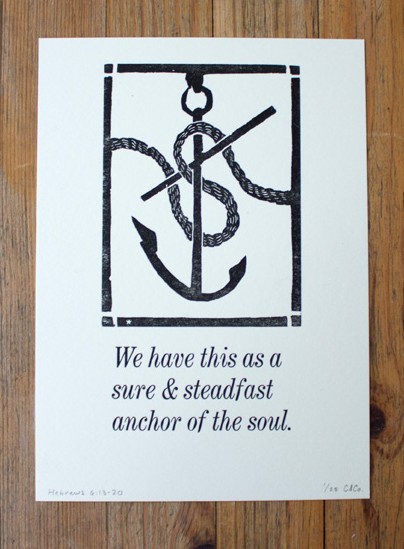
We have this hope, a sure and steadfast anchor of the soul.

That verse, however, is only one part of the origin story of the “Daily Office Anchor Society.”

The name was first used as a tongue-in-cheek description following a retreat for newly-ordained GenX clergy held at the DeKoven Center in Racine, Wisconsin many (increasingly many) years ago.

At one point in the weekend we all realized that each of us had received at our ordinations a copy of the leather-bound, slipcased Daily Office Book along with the well-meaning expectation that of course “you’ll be saying the Offices every day now.”

Dave Walker’s “Cartoon Church” from the Church Times paints a pretty good picture of what we were up against.

That expectation of piety, coupled with virtually no exposure to the Offices (how often does *your* church have Evensong, huh?), we all experienced as an anchor dragging us down.

Being a card-carrying member of the “Daily Office Anchor Society” was not really a good thing.

The leather-bound, slipcased Daily Office Book, displayed on our shelves but rarely used, became a visible symbol of our failure to meet expectations — other people’s expectations, the Church’s expectations, and our own.

Daily Office Book

These days, nearly 20 years later, I no longer feel that the Daily Office represents a weight of expectation, a letter of law or institutional requirement against which I am judged.

Praying the Daily Office is instead a portable practice (I use a leather-bound BCP and Bible, but you could use the Forward Day by Day app on your iPhone) that allows me to participate in the Church’s ceaseless prayer and to “travel light” like the seventy disciples that Jesus sent out in today’s Gospel passage.

After this the Lord appointed seventy others and sent them on ahead of him in pairs to every town and place where he himself intended to go. He said to them, “The harvest is plentiful, but the laborers are few; therefore ask the Lord of the harvest to send out laborers into his harvest. Go on your way. See, I am sending you out like lambs into the midst of wolves. Carry no purse, no bag, no sandals; and greet no one on the road. Whatever house you enter, first say, ‘Peace to this house!’ And if anyone is there who shares in peace, your peace will rest on that person; but if not, it will return to you. (Luke 10:1-6)

There is a sense of lightness, I think, that is the fruit of time spent in Jesus’ presence.

The seventy found, even though they had no supplies (no buildings, no tools, none of the stuff we usually haul around with us), that their relationship with Jesus was enough — and more than enough.

It’s this sense of lightness, I think, that the recent Memorial to the Church seeks to recall us to.

The Episcopal Church has enough, and more than enough, if it accepts the call:

To recommit itself to the spiritual disciplines [Daily Office, Eucharist, etc.] at the core of our common life, to go into our neighborhoods boldly with church planters and church revitalizers, and to restructure our church for the mission God is laying before us today.

The seventy returned to Jesus with joy, exclaiming over the power they had been able to tap into. “Lord, in your name even the demons submit to us!”

I have found in my own life, through experiences of loss and grace and through practices of recovery that build hope — what Richard Rohr calls the “coded Gospel” — that my relationship with Jesus is enough.

The Daily Office, for me, is the way I spend time in Jesus’ presence most mornings so that for the rest of the day I can travel lightly into my neighborhood and hold lightly my expectations about what success looks like.

In this way, the Office serves me as a “sure and steadfast anchor” connecting me to Jesus, who is my hope.

How do you stay connected to Jesus? What builds hope in your life? What helps you to set aside expectations and find that you have enough, and more than enough?

The spiritual disciplines at the core

As a practitioner and promoter of one of “the spiritual disciplines at the core of our common life,” in fact the first-named of those disciplines (see BCP 13), I have endorsed the Memorial to the Church found here. I urge you all to do likewise.

The Memorial also calls upon the church to go into our neighborhoods boldly and to restructure our church for the mission God has in mind for us.

The Daily Office is a portable discipline (I use a prayer book/Bible combo, but you could show your neighbor the Forward Day by Day app on your iPhone), and praying it means living in the “big, exciting room” of the Scriptures, the “house built on rock” (Matthew 7:24).

NT Wright on Scripture in worship | A big, exciting room we come in and inhabit

I couldn’t possibly agree more with N.T. Wright’s comments in this five-minute video on Scripture in worship from Glenn Packiam’s Mystery of Faith Blog.

With attention to what we are doing, we are fortunate in our “gentle Anglican liturgy”  — in the morning and evening offices and in the Holy Eucharist — “to inhabit the world of Scripture” just as Wright describes:

What one is doing is turning Scripture into a world where you come in and live, a big exciting room that you come in and inhabit.

Wright gently bemoans how the public reading of Scripture is too often sidelined in worship. He even describes being invited to preach at a “modern-style” service and at the last minute being asked, “Would you like a Scripture reading?”

The public reading of Scripture is itself the primary act of worship. It is not conveying information to the congregation; it’ll do that as well, but it does that as the byproduct … of celebrating the mighty acts of God.

And so what do we do in this “big exciting room that you come in and inhabit”?

When you have built this great house of praise and worship, which is the scriptural story surrounded with the psalms and the prayers of the people of God, then you turn it into intercession, because you’re now living in a room where intercession makes sense.

I’m reminded here of what the founder of the Society of St. John the Evangelist, Fr. Richard Meux Benson, says about praying for others:

As we approach God on their behalf we carry the thought of them into the very being of eternal Love, and as we go into the being of him who is eternal Love, so we learn to love whatever we take with us there.

In the first half of the video, Wright has actually been describing the Daily Office, a point that I think might have been lost on his listeners, because he then goes on to clarify that the same thing is happening in the Eucharist.

I am grateful to Packiam and his colleagues for sharing this short glimpse of Wright’s deep, lifelong meditation on Scripture.

However, I find Packiam’s comment as he introduces the clip so poignant:

It is precisely because Prof. Wright is an ‘outsider’ to our modern worship world that his thoughts may be helpful. He may see things we miss. What he chose to address was the absence of Scripture in worship.

Here as elsewhere in his books and videos, I think N.T. Wright is explaining historic Christian worship from the “inside,” especially when he calls it “an act of humility, a way of saying ‘I’m not making this up as I go along.’ It’s a gift from the whole worldwide church, and I inhabit it gratefully.”

The public reading of Scripture — and especially the pattern we have inherited in the Daily Office — is a gift from the worldwide church, indeed, and I inhabit it gratefully. I hope you do, too.

Pay attention to how you listen (and look)

For while they live among his works, they keep searching, and they trust in what they see, because the things that are seen are beautiful. (Wisdom 13:7)

The writer of the book of Wisdom expresses a theme common to our discussion of science and faith.

Either the amazing beauty of millions of galaxies testifies to the creative power of God, or the distant stars bear mute witness to the emptiness and loneliness of our plight.

It matters how you look.

For the Wisdom writer, those who “live among his works” but who are “still searching” haven’t looked closely enough or carefully enough.

They’ve seen the beauty of creation, but haven’t recognized the Creator.

They’ve clicked on the image in this post, the most detailed image ever compiled of the Andromeda Galaxy (M31). Perhaps they’ve noticed that it contains 1.5 billion pixels, but they haven’t comprehended “the bright immensities” (Hymn 459) that span what little we can see of the universe — more than 14 billion light years back into time.

The Wisdom writer goes on to wonder, “If they had the power to know so much that they could investigate the world, how did they fail to find sooner the Lord of these things?” (Wisdom 13:9).

In the Gospel passage appointed for this morning, Jesus has just gotten through explaining the parable of the sower to his disciples (spoiler alert: they didn’t get it) and is trying another example on them, the parable of the lamp under a jar.

Jesus interrupts himself — I picture him rolling his eyes at a bewildered James and John (the “dunderheads” as John the evangelist calls them) — and says “Pay attention to how you listen; for to those who have, much more will be given; and from those who do not have, even what they seem to have will be taken away” (Luke 8:18).

Pay attention to how you listen.

When they come to him and say, “Your mother and your brothers are standing outside” and he replies “my mother and my brothers are those who hear the word of God and do it,” then pay attention to hearing the word of God.

When you are in trouble and cry out that everything is hopeless, and Jesus replies “Where is your faith?” — then pay attention to the Word of God himself!

It matters how you listen, and it matters to whom you listen.

In the middle of a swirling storm, in the howling wind and the snap and strain of the lines, in the cries of the disciples pulling at the oars, Jesus speaks softly and the storm responds in kind.

In the tug and pull of relationships Jesus says “notice,” and the lines of the family are redrawn. And in the real anxieties and worries of your life, Jesus says “just a little faith is enough.”

Even in the rendering of starlight that you’re looking at on your smartphone, God the “maker of heaven and earth, of all that is, seen and unseen,” says “Here I am.”

So pay attention to how you listen (and look).

I am small and of little account … come and see

I am “in between jobs” for the second time in 18 months.

Because I had so much free time during Lent, I think, I have been dwelling a lot on the notion of “smallness.”

Perhaps it’s time to get off the road and work closer to home. Perhaps it’s time for me to shift my ambitions, to discern what few things I must do instead of chasing all of the things I could do.

Perhaps it’s time to put down roots instead of spreading wings.

Perhaps this frame of mind that I’m in caused the words of Psalm 119 to strike me so powerfully this morning: “I am small and of little account.”

Your word has been tested to the uttermost, *
and your servant holds it dear.
I am small and of little account, *
yet I do not forget your commandments.
Your justice is an everlasting justice *
and your law is the truth.
Trouble and distress have come upon me, *
yet your commandments are my delight.
The righteousness of your decrees is everlasting; *
grant me understanding, that I may live. (Psalm 119:140-144)

We don’t know much about Philip beyond what we read in today’s Gospel lesson, and we can’t even sort out who the biblical James really was — talk about obscurity!

Philip found Nathanael and said to him, “We have found him about whom Moses in the law and also the prophets wrote, Jesus son of Joseph from Nazareth.” Nathanael said to him, “Can anything good come out of Nazareth?” Philip said to him, “Come and see.” (John 1:45-46)

But that simple invitation from an obscure follower turns everything around. Philip invites Nathanael to know Jesus, and Nathanael, “an Israelite in whom there is no guile,” comes to love Jesus.

That simple invitation to “come and see” also echoes in two of the Friday prayers in the Daily Office.

Every Friday morning, we ask God to “mercifully grant that we, walking in the way of the cross, may find it none other than the way of life and peace” (BCP 99).

Come and see, says Jesus to his disciples. Follow me in the way of the cross. “Trouble and distress” may come upon you, but I am with you, he says. You will find life and peace with me.

I would guess that most of us who pray the Office regularly also pray this Prayer for Mission on Fridays, too:

Lord Jesus Christ, you stretched out your arms of love on the hard wood of the cross that everyone might come within the reach of your saving embrace: So clothe us in your Spirit that we, reaching forth our hands in love, may bring those who do not know you to the knowledge and love of you; for the honor of your Name. Amen. (BCP 101)

The way of the cross that we follow with Jesus is not only suffering, but also compassion. The Spirit we share with Jesus not only draws us in to intimacy, but also leads us out to embrace.

Here, we pray that we may extend the same invitation to others that Christ extends to us. We pray that we, small as we are, “may bring those who do not know [Christ] to the knowledge and love of [Christ].”

I don’t know what Philip and James expected when they began to follow Jesus. I don’t know what to expect in the next stage of my work and ministry. But I look forward to finding out.

How is God calling you to “come and see” what’s next in your life?

More like a literary festival, really

A nearby church posted this message on their sign last week.

Seems to me that the presence they describe would be less of an author signing and more like a literary festival, really.

Point/Counterpoint

The Priestly editor and the Deuteronomic editor will discuss their project to finally get the early history of God’s people (now available in a five-volume set called The Pentateuch) in order after their return from exile. They share stories of their uneasy collaboration and editorial disagreements with flashes of humor.

Israel Did What Was Wrong

They will be joined by their colleague the Deuteronomic Historian, who will discuss the ups and downs of Israel’s relationship with neighboring cultures. All six volumes are now available in paperback: Joshua, Judges, 1 Samuel, 2 Samuel, 1 Kings, and 2 Kings.

Protest singer, he’s singin’ a protest song

The Major Prophets Ezekiel and Daniel (feat. The Three Isaiahs) will headline a panel discussion and karaoke session entitled “The Suffering Servant: Wheel in the Sky Keeps on Burnin’ While the Lion Sleeps Tonight.” Jeremiah requests lamentations only at karaoke.

The minor prophets Hosea, Joel, Amos (“I hate, I despise your festivals”), Obadiah, Jonah, Micah, Nahum, Habakkuk, Zephaniah, Haggai, Zechariah, and Malachi, disgusted by the commercialism and frivolity of the event, will appear outside the festival grounds in a dramatic reenactment of Israel’s harlotry (NSFW).

Rebuilding the Walls

Ezra and Nehemiah, with special guest the Chronicler, will describe the monumental task of rebuilding that faced the exiles upon their return from Babylon.

I Write the Songs That Make the Whole World Sing

The Psalmist (“Call me David”) will talk about the challenge of writing church music about both the love of God and human frustration with pain and suffering.

50 Shades of Grey

The couple featured in the Song of Songs (rated M for Mature Content) will share their honeymoon photos and videos. 18+ only, please.

Pithy Sayings

Don’t forget to follow the “men of Hezekiah,” who will share their images and uplifting quotes from the Proverbs of Solomon on both Instagram and Facebook throughout the festival.

We’re From the Philosophy Department

Landowner Job will join Qoheleth, Ecclesiastical Professor of Philosophy, and give his first-person account of losing everything and finding God. Prof. Q, lyricist for the Byrds (“To everything, turn, turn, turn”) will offer reflections on the vanity of striving.

A reception will follow — everyone’s invited to eat, drink, and be merry!

Storytellers’ Hour

Don’t miss Jonah and his tragicomic “Fish Tales of Nineveh.”

Esther will tell the story of how Purim came to be such a great party (spoiler alert: Haman gets it in the end), and Ruth is guaranteed to bring a smile to your face with “How to Win a Man and Get Along Great With Your Ex-Mother-in-Law.”

Remainders

The Maccabees will thrill audiences of all ages with their stories of hardship and courage during the war over the Temple. Free menorahs and dreidels to the first 100 kids.

Ben Sirach and his fellow Wisdom writer “Anonymous” will read from their books, accompanied by Ben Sidran and his fellow jazz pianists (set list TBD).

From the Good News Department

Writers Matthew and Mark are joined by Dr. Luke (whose two-volume history is now available in audiobook form) to share their perspectives on Jesus and to discuss similarities and differences in their work.

Here’s Your Sign

Gospel writer John will discuss his approach to the life of Jesus and talk about the “signs” he weaves throughout his account.

Free wine tasting.

 My Baby, He Wrote Me a Letter

Megastar author Paul (“I Don’t Want to Boast”) of Tarsus will talk about the churches he founded and the leading apostles who owe everything to him, if he does say so himself.

Several other minor litterati will join Paul each day of the festival. Check the schedule for appearances by James, Peter, and John.

Coffee Talk

He brews. Get it? Hebrews!

Seriously, join the author over coffee to ask your questions about “this hope, a sure and steadfast anchor for the soul.”

Leaving Laodicea

Join John of Patmos as he describes the mystical visions he saw while vacationing on Patmos. “Hunter J. Thompson’s got nothin’ on me!” exclaims the author of the final book to be featured in our festival.


The Lord is near; be patient and hope in him

I am at the annual NAMI Wisconsin conference, hearing from speakers about mental illness and the peer-to-peer support which is the hallmark of NAMI’s recovery approach. Helping people experience recovery — living well with mental illness — builds hope.

One of this morning’s psalms resonates with my own experience of recovery.

The LORD is faithful in all his words *
and merciful in all his deeds.
The LORD upholds all those who fall; *
he lifts up those who are bowed down.
The eyes of all wait upon you, O LORD, *
and you give them their food in due season.
You open wide your hand *
and satisfy the needs of every living creature.
The LORD is righteous in all his ways *
and loving in all his works.
The LORD is near to those who call upon him, *
to all who call upon him faithfully.
He fulfills the desire of those who fear him; *
he hears their cry and helps them.
The LORD preserves all those who love him, *
but he destroys all the wicked.
My mouth shall speak the praise of the LORD; *
let all flesh bless his holy Name for ever and ever. (Psalm 145:14-22)

“The Lord upholds all those who fall; he lifts up those who are bowed down … the Lord is near to those who call upon him.” These assurances build hope in us as we share our stories of God’s faithfulness in our own times of trouble.

The writer Jesus son of Sirach (whose book the church calls Ecclesiasticus), describes the internal attitude I try to have as I work my own recovery each day.

Accept whatever befalls you, and in times of humiliation be patient. For gold is tested in the fire, and those found acceptable, in the furnace of humiliation. Trust in him, and he will help you; make your ways straight, and hope in him. (Ecclus. 2:4-6)

The slogans of recovery, like “One Day at a Time,” and the teachings of our Christian faith echo Sirach’s timeless human wisdom.

Accept whatever befalls you. What is, is. Accept that things are the way they are without becoming “restless, irritable, and discontented.”

Be patient. One of our speakers yesterday suggested that patience is a fruit of practicing mindfulness in every situation, and that mindfulness is really being present to what is actually happening.

Make your ways straight. At the men’s breakfast and Bible study I attend on Thursdays, we spoke this week about how our lives are to be lived in response to God’s grace. We do not earn grace; but in gratitude we make changes in order to stay in God’s way.

The short reading from the Acts of the Apostles exemplifies the simple faithfulness that is to characterize our new life — whether it’s life in recovery, life in Christ, or both.

Then after completing their mission Barnabas and Saul returned to Jerusalem and brought with them John, whose other name was Mark. Now in the church at Antioch there were prophets and teachers: Barnabas, Simeon who was called Niger, Lucius of Cyrene, Manaen a member of the court of Herod the ruler, and Saul. While they were worshiping the Lord and fasting, the Holy Spirit said, “Set apart for me Barnabas and Saul for the work to which I have called them.” Then after fasting and praying they laid their hands on them and sent them off. (Acts 12:25–13:3)

Notice how John, whose other name was Mark, is simply present with Barnabas and Saul. Notice how he doesn’t figure in the action at Antioch — it’s Barnabas and Saul who are made apostles.

Mark must have been practicing mindfulness throughout that time, though, paying attention to the new life in Christ. Eventually, his insights bore fruit in the gospel account that bears his name.

The Lord is near to those who call upon him, who call upon him faithfully.

In times of humiliation, be patient.

Make your ways straight, and hope in him.

Collect for St. Mark

Almighty God, by the hand of Mark the evangelist you have given to your Church the Gospel of Jesus Christ the Son of God: We thank you for this witness, and pray that we may be firmly grounded in its truth; through Jesus Christ our Lord, who lives and reigns with you and the Holy Spirit, one God, for ever and ever. Amen.

Having the Son of God

And this is the testimony: God gave us eternal life, and this life is in his Son. Whoever has the Son has life; whoever does not have the Son of God does not have life. (1 John 5:11-12)

What does it mean to “have” the Son?

Does it mean saying particular things about Jesus? Reciting particular creeds of the Church?

Does it mean arguing about religion? Imposing religious laws on people?

Does it mean wearing certain Christian t-shirts? Wearing certain ecclesiastical robes? Having a certain hairstyle? Wearing a certain hat?

Does it mean reading special prayers? Making up special prayers? Singing special music?

+ + + + +

What might it mean to “have” life?

Might it mean owning up to our own faults? Admitting our own mistakes?

Might it mean praising God for the way things are? Thanking God for what is?

Might it mean receiving forgiveness? Giving forgiveness?

Might it mean serving God? Might it mean being served by God?

Love (III)

Love bade me welcome: yet my soul drew back,
Guilty of dust and sin.
But quick-eyed Love, observing me grow slack
From my first entrance in,
Drew nearer to me, sweetly questioning
If I lacked anything.

“A guest,” I answered, “worthy to be here”:
Love said, “You shall be he.”
“I, the unkind, ungrateful? Ah, my dear,
I cannot look on thee.”
Love took my hand, and smiling did reply,
“Who made the eyes but I?”

“Truth, Lord; but I have marred them; let my shame
Go where it doth deserve.”
“And know you not,” says Love, “who bore the blame?”
“My dear, then I will serve.”
“You must sit down,” says Love, “and taste my meat.”
So I did sit and eat.

-George Herbert