Trinity Sunday

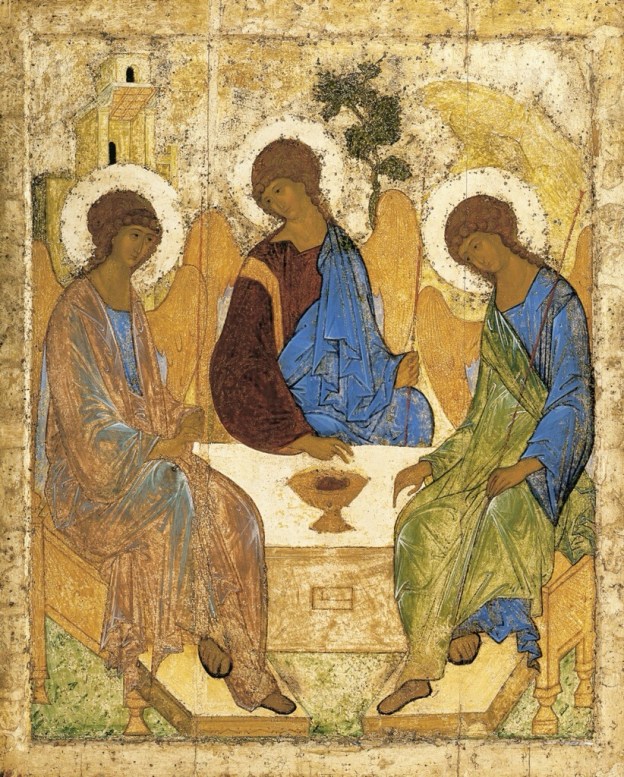
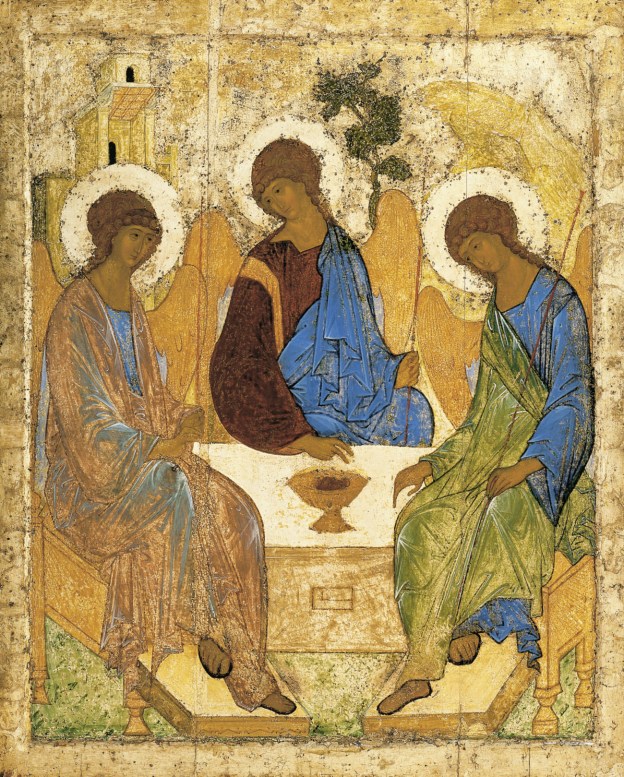
Rublev

One day, God walked in, pale from the grey steppe,
slit-eyed against the wind, and stopped,
said, Colour me, breathe your blood into my mouth.

I said, Here is the blood of all our people,
these are their bruises, blue and purple,
gold, brown, and pale green wash of death.

These (god) are the chromatic pains of flesh,
I said, I trust I shall make you blush,
O I shall stain you with the scars of birth

For ever, I shall root you in the wood,
under the sun shall bake you bread
of beechmast, never let you forth

To the white desert, to the starving sand.
But we shall sit and speak around
one table, share one food, one earth.

-Rowan Williams

Open invitation, no barriers

There’s an interesting thread unfolding on Twitter today about Choral Evensong.

The conversation started in response to this thoughtful post by Gerry Lynch on Episcopal Cafe.

People laud the benefits or rue the disadvantages of Choral Evensong based on their understanding of “participation.”

Participation

Is listening to lovely choral music participating?

Is being a choir member participating?

What if you are a paid singer? Does that count?

These are all intriguing questions, but I’m not interested in them, really.

I am interested in the Daily Office — Morning and Evening Prayer especially — as a form of worship that is an open invitation with no barriers to lay participation.

Open invitation, no barriers

You see, the Holy Eucharist, the proper service of public worship on the Lord’s Day, requires a bishop or priest to celebrate, and Communion is properly shared by the baptized.

Anyone can officiate at the Daily Office, on the other hand, and there is no requirement that those joining in the prayers be baptized.

There’s a lot of buzz in evangelical circles about “seeker services,” and many places like St. Mark’s Cathedral in Portland attract people to services like Compline.

What if we offered the Daily Office in our churches with an open invitation for anyone to join us in prayer “that we may be bound together by [God’s] Holy Spirit in the communion of all [God’s] saints” (BCP 122)?

Our daily prayer is not only Choral Evensong, though when it is, it’s glorious.

More importantly, our daily prayer is ours to do and ours to share — with an open invitation and no barriers.

In all we do, direct us

Collect for Grace

O Lord God, almighty and everlasting Father, you have brought us in safety to this new day: Preserve us with your mighty power, that we may not fall into sin, nor be overcome by adversity; and in all we do, direct us to the fulfilling of your purpose; through Jesus Christ our Lord. Amen. (BCP 100)

Members of Christ’s body

Paul writes to the church in Ephesus about the power, the giftedness we have received through our participation in the dying and rising of Christ, symbolized by our baptism:

“The gifts he gave were that some would be apostles, some prophets, some evangelists, some pastors and teachers, to equip the saints for the work of ministry, for building up the body of Christ, until all of us come to the unity of the faith and of the knowledge of the Son of God, to maturity, to the measure of the full stature of Christ” (Eph. 4:11-13).

Not just a faithful remnant 

With the Ephesians, we are no longer just a faithful remnant, like “whoever is left in Zion and remains in Jerusalem [and] will be called holy” (Isa. 4:3).

Instead, we are called to “the measure of the full stature of Christ,” to a much larger vision of ministry to the whole world. As we sing in Canticle 11 this morning:

Nations will stream to your light, *
and kings to the brightness of your dawning.
Your gates will always be open; *
by day or night they will never be shut. (BCP 87)

We are not secure within the walls of the city, but welcoming to those who would come in.

We are no longer left behind, separate from the world, but sent out into it.

Certainly not anxious neighbors 

And out in the world, we ought to be recognizably different from the anxious neighbors Jesus meets in today’s Gospel (Matt. 8:28-34).

Too often, we respond just like the townspeople. “Why are you helping those dirty, wild, Gerasenes?”

“And, wait a minute,” say the swineherds, “those are my pigs!”

“You’re upsetting everything! This was such a quiet neighborhood until you came along; we were secure and separate.”

Instead, we ought to look for and recognize God’s purpose at work, for we are a whole community of gifted, grace-filled ministers being directed, in all we do, to the fulfilling of that purpose.

My beloved: Where does the story begin?

Then Jesus came from Galilee to John at the Jordan, to be baptized by him. John would have prevented him, saying, “I need to be baptized by you, and do you come to me?” But Jesus answered him, “Let it be so now; for it is proper for us in this way to fulfill all righteousness.” Then he consented. And when Jesus had been baptized, just as he came up from the water, suddenly the heavens were opened to him and he saw the Spirit of God descending like a dove and alighting on him. And a voice from heaven said, “This is my Son, the Beloved, with whom I am well pleased.” (Matthew 3:13-17)

My beloved, with whom I am well pleased

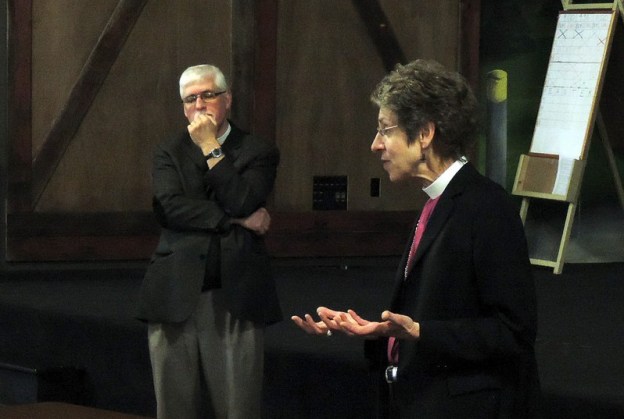
The day before Matt Gunter’s ordination as the Bishop of Fond du Lac, he and the clergy of the diocese met with Presiding Bishop Katharine Jefferts Schori.

She began our time together by inviting us to reflect on this passage and on our own identity as God’s beloved.

I’ve written before about my own experience serving at the altar with my father, who called me his beloved and told me he was well pleased with me.

My own father said it plainly to me: I am his beloved. Still, I wonder why it seems so hard to believe I am God’s beloved.

Where do we begin the story?

As clergy, we had just gone through Holy Week and celebrated Easter with our parishes. We had just recounted Jesus’ crucifixion and were still pondering his resurrection.

Bishop Katharine asked the question of us: Where do we begin the story?

Do we begin with our sinfulness, for which Jesus paid the price? Do we begin with our identity as God’s beloved, for whom God would do anything, even die on a cross?

Sin is a crucial — crux is the Latin word for cross — part of the story. But is it the beginning of the story?

We reflected on the question, each of us answering it in our own heart.

But I still wonder, why is it easier to think the story starts with our sin than to think it starts with our being beloved?

You, my child

On Wednesday mornings we sing Canticle 16, the song of another father to his beloved child, John.

You, my child, shall be called the prophet of the Most High, *
for you will go before the Lord to prepare his way,
To give his people knowledge of salvation *
by the forgiveness of their sins.
In the tender compassion of our God *
the dawn from on high shall break upon us,
To shine on those who dwell in darkness and the
shadow of death, *
and to guide our feet into the way of peace. (BCP 93)

May you know God’s tender compassion today and always, know yourself to be God’s beloved.

That’s where the story begins, and that’s where God wants it to end.
Undefended, humble, and alive to God

Christ our Passover

Alleluia. Christ our Passover has been sacrificed for us; *
therefore let us keep the feast,
Not with the old leaven, the leaven of malice and evil, *
but with the unleavened bread of sincerity and truth. Alleluia.

Christ being raised from the dead will never die again; *
death no longer has dominion over him.
The death that he died, he died to sin, once for all; *
but the life he lives, he lives to God.
So also consider yourselves dead to sin, *
and alive to God in Jesus Christ our Lord. Alleluia.

Christ has been raised from the dead, *
the first fruits of those who have fallen asleep.
For since by a man came death, *
by a man has come also the resurrection of the dead.
For as in Adam all die, *
so also in Christ shall all be made alive. Alleluia. (BCP 83)

Victory through sacrifice

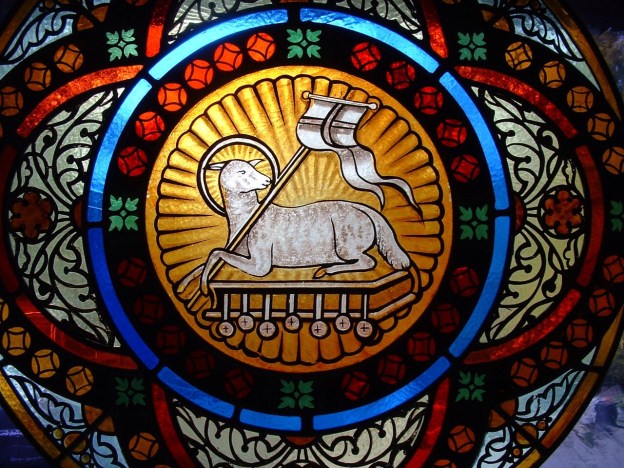
In early Christian art, Christ is often depicted as a Passover lamb, sometimes flanked by twelve other lambs representing the apostles.

By the Middle Ages, it was more common to show the lamb holding a banner or pennant symbolizing the resurrection. This is the image commonly known as the “Agnus Dei,” Latin for Lamb of God.

The Agnus Dei is a symbol of victory through sacrifice.

“Christ our Passover has been sacrificed for us” we say when we break the bread at the Eucharist. “Christ being raised from the dead will never die again” we sing at Morning Prayer throughout Easter.

Surely trusting in God’s defense

In the Collect for Peace, which we pray on Tuesday mornings, we ask God to “Defend us, your humble servants, in all assaults of our enemies; that we, surely trusting in your defense, may not fear the power of any adversaries; through the might of Jesus Christ our Lord” (BCP 99).

We do not ask to be delivered from assaults; we ask to be defended in assaults.

And we pray that we may not fear any other power, because of the might — the sacrificial, self-offering mighty power — of Jesus Christ, the Lamb that was slain.

As we “consider ourselves dead to sin, and alive to God in Jesus Christ our Lord” we can embrace the same self-giving love that Jesus demonstrated.

Undefended, humble, and alive to God, we need not fear any adversaries. Alleluia!

Harden not your hearts

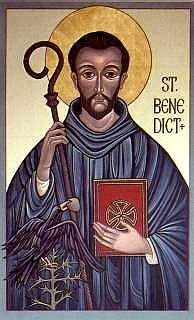
Let us then rise at length, since the Scripture arouseth us, saying: “It is now the hour for us to rise from sleep” (Rom. 13:11); and having opened our eyes to the deifying light, let us hear with awestruck ears what the divine voice, crying out daily, doth admonish us, saying: “Today, if you shall hear his voice, harden not your hearts” (Ps. 95:8).    -Rule of Benedict, Prologue

St. Benedict begins his Rule by inviting his monks to listen for the voice of God and not to harden their hearts to what God is doing in their lives.

His wise advice has endured for the last 1500 years.

Our own Anglican/Episcopal spirituality has roots in the orderliness and balance of Benedict’s Rule, in the notion of a way of life that prescribes “nothing harsh, nothing burdensome” but which is also pursued as “a school of the Lord’s service.”

The pattern of our Daily Office definitely bears traces of Benedict’s hand, especially visible in our saying the Venite (Ps. 95:1-7) as an Invitatory Psalm nearly every day.

That’s just as Benedict prescribed in the way he laid out the 150 Psalms to be recited by his monks during the Daily Office every week.

Our Old Testament reading today tells the backstory to Psalm 95. The Israelites are groaning that Moses has brought them into the desert to die. “Why did you bring us out of Egypt, to kill us and our children and livestock with thirst?” (Exod. 17:3).

After God has him strike the rock and causes water to flow, Moses calls the place Massah and Meribah (Test and Quarrel) because of the Israelites’ complaining.

The full text of Psalm 95, including the last few verses, is appointed to be read on Friday mornings during Lent as a special reminder of our tendency to grumble that the Lord is not giving us what we want — a complaint that flies in the face of the water flowing from the rock right in front of us.

“Today, if you shall hear his voice, harden not your hearts.”

A goodly heritage

What if the “goodly heritage” (Psalm 16:6) that we have from Athanasius, Bishop of Alexandria (d. 373), whose feast we celebrate today, is not a rule requiring intellectual assent but an approach inviting mystical contemplation?

For like as we are compelled by the Christian verity to acknowledge every Person by himself to be both God and Lord,
So are we forbidden by the Catholic Religion, to say, There be three Gods, or three Lords.
The Father is made of none, neither created, nor begotten.
The Son is of the Father alone, not made, nor created, but begotten.
The Holy Ghost is of the Father and of the Son, neither made, nor created, nor begotten, but proceeding.
So there is one Father, not three Fathers; one Son, not three Sons; one Holy Ghost, not three Holy Ghosts.
And in this Trinity none is afore, or after other; none is greater, or less than another;
But the whole three Persons are co-eternal together and co-equal.
So that in all things, as is aforesaid, the Unity in Trinity and the Trinity in Unity is to be worshipped.
He therefore that will be saved must thus think of the Trinity. (BCP 864)

The Athanasian Creed, composed in the midst of swirling controversies about the nature of God, the person of Jesus, and the authority of the Church, certainly reads like a legal document, setting out terms and conditions for salvation.

“He therefore that will be saved must thus think of the Trinity.”

But what if the focus here is more on the word “think” than on the word “thus”?

What if we let Athanasius’ bewildering, “incomprehensible” creed instead serve as an invitation to meditate on the God revealed in Scripture, on the life and ministry of Jesus, on the enduring power of the Spirit in our lives?

There is rich fruit for reflection here, solid food for the Christian life, a “goodly heritage” on which to build our own life of faith and seeking after God.

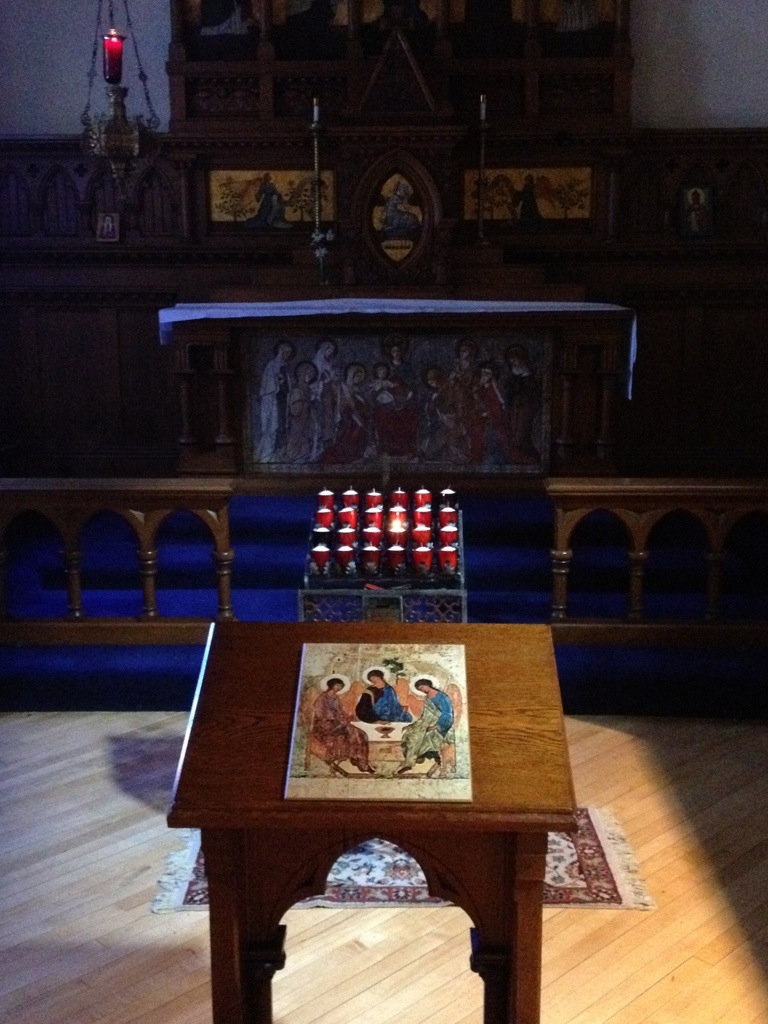
The St. Augustine Chapel at the Cathedral of St. Paul in Fond du Lac, Wisconsin

The St. Augustine Chapel at the Cathedral of St. Paul in Fond du Lac, Wisconsin

Not long after Athanasius’ time, another great thinker in the early Church, Augustine of Hippo (d. 430), wrote about “faith seeking understanding.”

Our goodly heritage is filled with examples of people not only placing their faith in God and their trust in Jesus’ saving power, but also using their minds to explore what relationship with God might mean for us and the world around us.

To be further clothed

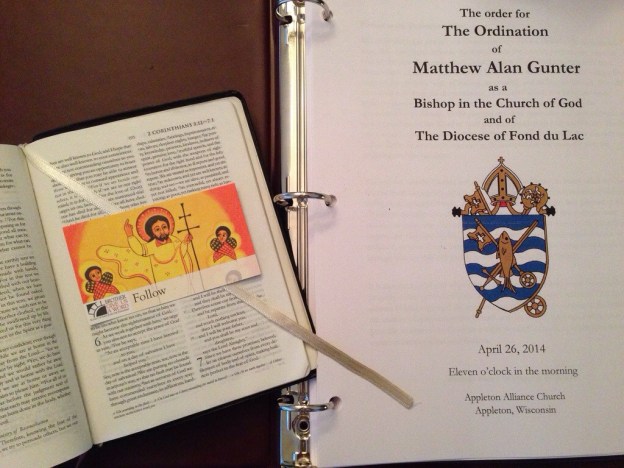
All is in order for the ordination and consecration of Matthew Gunter as the Eighth Bishop of Fond du Lac.

At the rehearsal yesterday afternoon, we practiced helping Matt put on his new vestments. Some are familiar to him already — stole and chasuble — but some will feel awkward and uncomfortable at first.

Which way round does the miter go?

We wish not to be unclothed, but to be further clothed, so that what is mortal may be swallowed up in life. He who has prepared us for this very thing is God, who has given us the Spirit as a guarantee. (1 Cor. 5:4b-5)

Almighty and everlasting God, by whose Spirit the whole body of your faithful people is governed and sanctified: Receive our supplications and prayers which we offer before you for all members of your holy Church, that in their vocation and ministry they may truly and devoutly serve you; through our Lord and Savior Jesus Christ. Amen. (BCP 100)

We will all be changed

Listen, I will tell you a mystery! We will not all die, but we will all be changed, in a moment, in the twinkling of an eye, at the last trumpet. For the trumpet will sound, and the dead will be raised imperishable, and we will be changed. For this perishable body must put on imperishability, and this mortal body must put on immortality. When this perishable body puts on imperishability, and this mortal body puts on immortality, then the saying that is written will be fulfilled: “Death has been swallowed up in victory.” (1 Cor. 15:51-54)

Lay claim to Jesus

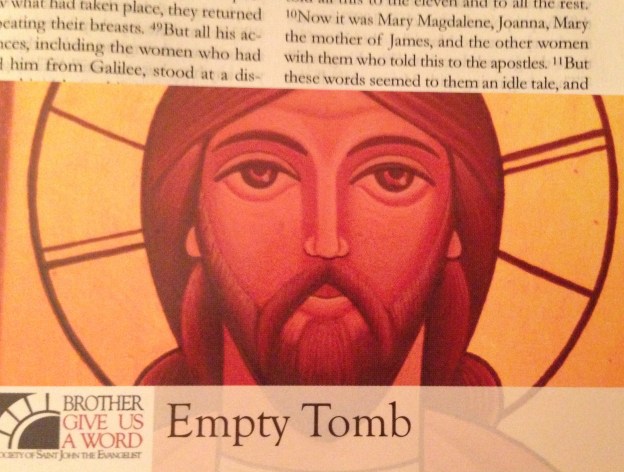
Br. James Koester offers this reflection today for Brother, Give Us a Word:

It is our time to lay claim, not just to the message of the Cross but of the Empty Tomb as well. Now is the time for us to lay claim to hope and health and life. Now is our time to lay claim to Jesus.

We will all be changed

“Hope and health and life” all describe change.

We hope for something better, something as yet unseen but witnessed by others. Like the apostles, we worry that it might be “an idle tale,” too good to be true, but over time the undeniable change in others builds hope in us.

Health is more than the absence of illness; it’s the embrace of wholeness. Where in Lent we often practice giving up things that are bad for us, perhaps in Easter we can embrace the One who is good for us — Jesus, the Son who “has life in himself” (John 5:26).

Living in Jesus is like being invited to step through a doorway with him. It’s as if we have been in the tomb, too, and we see the light shining brighter as we duck through the opening, as we are reborn, into larger life.


Bearing witness to victory

The last enemy to be destroyed is death. For “God has put all things in subjection under his feet.” But when it says, “All things are put in subjection,” it is plain that this does not include the one who put all things in subjection under him. When all things are subjected to him, then the Son himself will also be subjected to the one who put all things in subjection under him, so that God may be all in all. (1 Cor. 15:26-28)

Flying our flag

At the parish I serve, St. Thomas Church in Menasha, WI, our rector’s sermon on Easter Day urged us, in the face of other people’s grief and loss, not to tell them what they should believe about the resurrection, but instead simply to “fly your own flag” of witness.

This is wisdom for so many situations.

People struggling with substance abuse, dealing with issues of mental illness, in despair at the loss of a job, or grieving at the death of a loved one, may not be able to look to God directly and may resent being told what to believe.

But perhaps seeing our flag, hearing our simple witness, will “give them courage and hope in their troubles” (BCP 389).

Like Mary Magdalene, whose banner might simply read “I have seen the Lord” (John 20:18), we bring hope into other people’s lives by bearing witness to the possibility of victory.

Victory

Br. David Vryhof, whose meditation is shared today at Brother, Give Us a Word, reflects on the healing power of looking to God:

Jesus embodies that death-defeating, life-giving power, and even an evil force bent on destruction and death cannot overcome his strength to save and heal. Do not give in to despair. Look to God and believe.

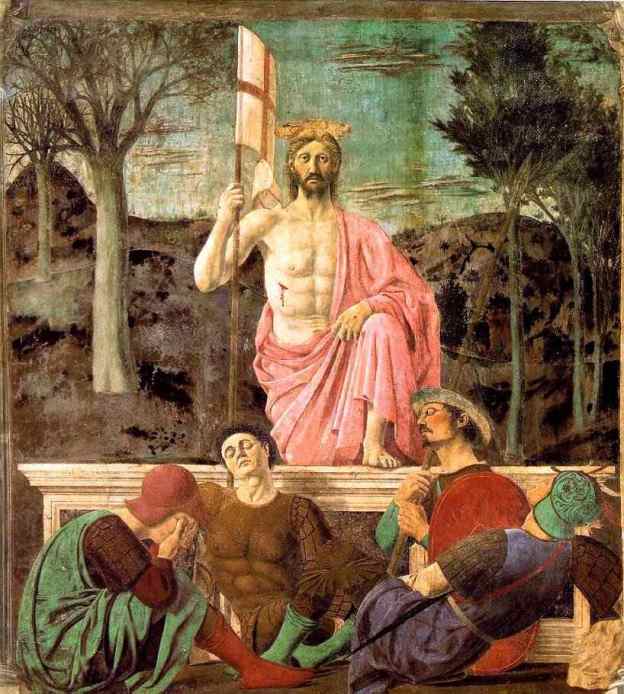
In the picture Resurrection by Pierro della Francesca, the central image my rector used in his sermon, we see Christ rising from the tomb and planting his flag of victory over death and the grave.

Perhaps our own flags of witness — “I have seen the Lord” — are what the people around us need to see in order for them to believe that victory can be theirs, too.