A window on the whole

“Facing the Canon” is a lengthy, but lovely interview with NT (Tom) Wright.

At 15:00 or so, in response to a question about how we should read the Bible “properly,” he responds by saying “we should be reading the whole Bible all the time, but that’s difficult as it’s a very long book.”

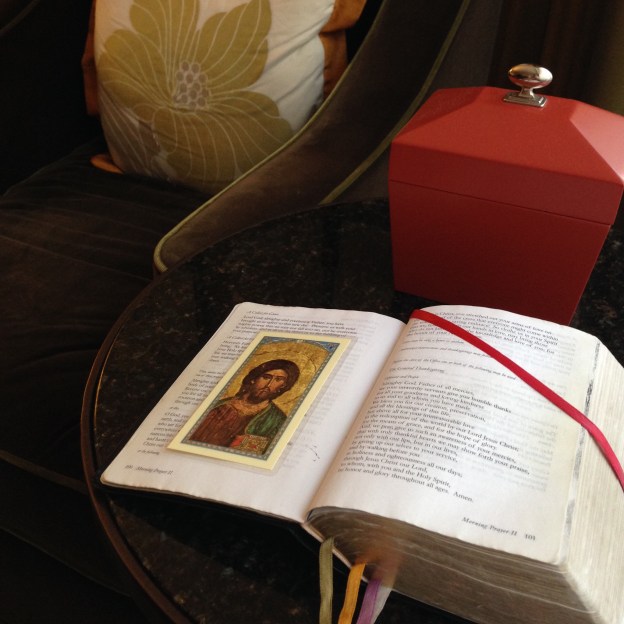
He then points to the Anglican practice of the Daily Office as an approach to the task. Each short passage we read — morning and evening, day after day — is a window, as it were, on the whole Bible story.

The place of God’s dwelling

At the Advisory Board Company, we teach a course called “Leading Amidst Uncertainty.”

In one of my favorite moments we suggest to leaders, as they must respond personally to the anxiety arising from uncertainty, that they regularly pause to breathe.

This timeless wisdom is not copyrighted, and it’s free for anyone at any time.

We go on to suggest making time for reflection in whatever way may work best — go outside for a walk or exercise to clear your head, schedule five minutes of nothing on your calendar to regroup, or eat lunch away from your desk to find clarity.

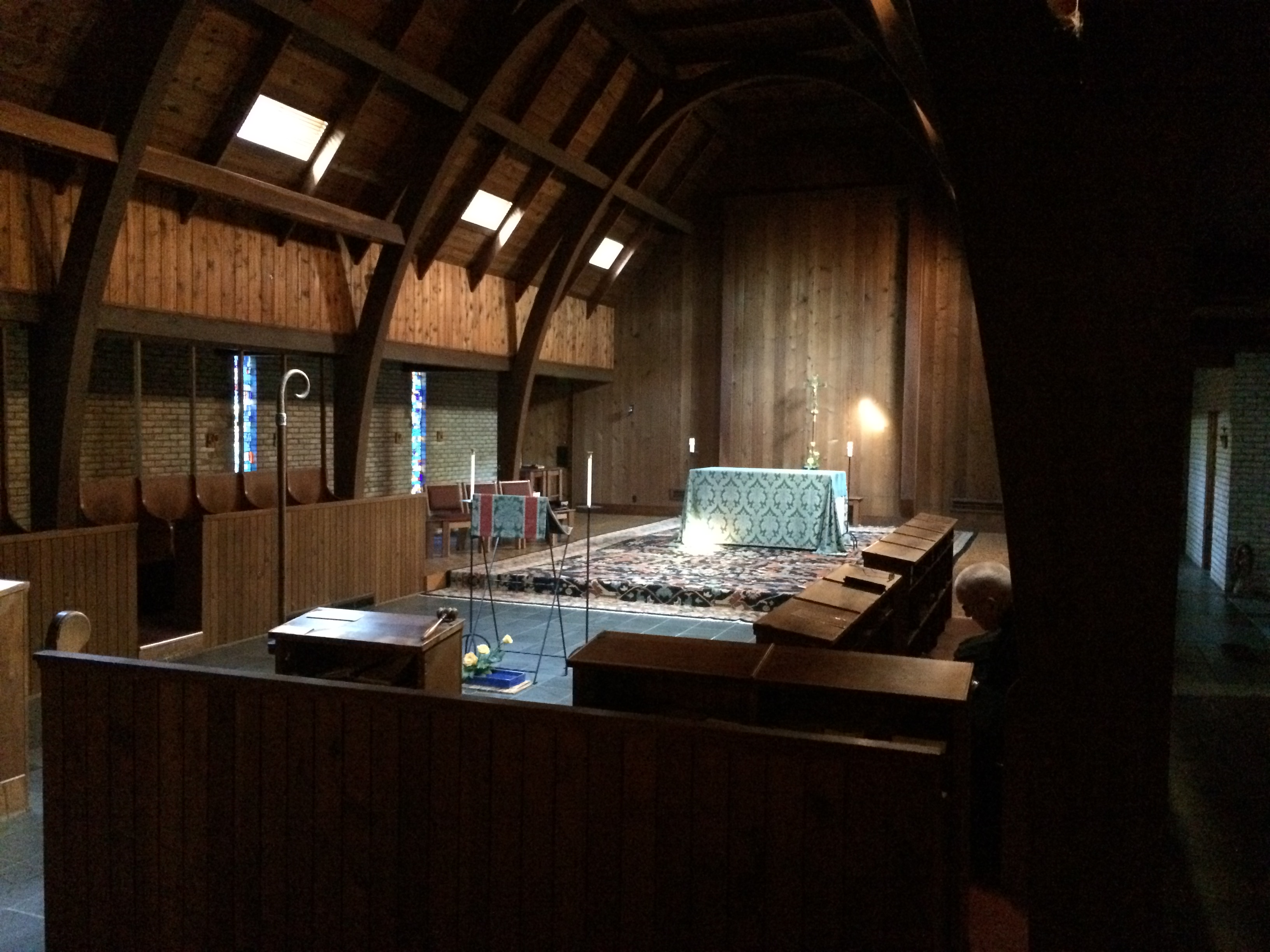
My teaching brought me to Kalamazoo, Michigan this week, so I took advantage of being just 30 minutes away to stop in for a visit this afternoon at St. Gregory’s Abbey in Three Rivers.

St. Gregory’s is a Benedictine Abbey in the Episcopal Church. I have been a confrater, or associate, of the abbey for at least 20 years but have rarely visited. It must be 10 years since my last visit.

Before vespers I had some time to sit quietly in the sun, to pet one of the Abbey cats, and to have tea with the monks and with another guest, the Rt. Rev. Ed Little, Bishop of Northern Indiana.

The Abbey Church is one of the loveliest I know, and vespers in that quiet place redolent of incense is truly peaceful.

St. Gregory's Abbey Church

Vespers in St. Gregory’s Abbey Church

The chapter appointed for this evening (a short Scripture passage) is also a personal favorite of mine:

See what love the Father has given us, that we should be called children of God; and that is what we are. The reason the world does not know us is that it did not know him. Beloved, we are God’s children now; what we will be has not yet been revealed. What we do know is this: when he is revealed, we will be like him, for we will see him as he is (1 John 3:1-2).

I am grateful for a couple of hours today in “the place of God’s dwelling” — or at least one particular place — and for the pause to breathe.

Ferguson and our Christian faith

Today the Episcopal Church commemorates Jonathan Myrick Daniels, a seminarian killed during the civil rights protests in Selma, Alabama in 1965.

Daniels died protecting a girl from a man pointing a shotgun at her. He took the blast meant for her, and was killed instantly.

The pictures today from Ferguson, Missouri make it look like not much has changed in the last 50 years.

Today, protestors are lined up against police armed with automatic weapons, tear gas, and the kind of military vehicles made near where I live.

I believe we Christians (perhaps especially in America) must always strive to remember that we serve in the name of Jesus, an innocent man who was killed during a time of protest and civil disturbance by the military occupiers of his country.

Looking again at pictures like this, we may also have to think again about which side we’re standing on.

Collect for Jonathan Myrick Daniels

O God of justice and compassion, you put down the proud and the mighty from their place, and lift up the poor and afflicted: We give you thanks for your faithful witness Jonathan Myrick Daniels, who, in the midst of injustice and violence, risked and gave his life for another; and we pray that we, following his example, may make no peace with oppression; through Jesus Christ the just one: who lives and reigns with you and the Holy Spirit, one God, for ever and ever.

Those who bring good news

There is no distinction between Jew and Greek; the same Lord is Lord of all and is generous to all who call on him. For, “Everyone who calls on the name of the Lord shall be saved.” But how are they to call on one in whom they have not believed? And how are they to believe in one of whom they have never heard? And how are they to hear without someone to proclaim him? And how are they to proclaim him unless they are sent? As it is written, “How beautiful are the feet of those who bring good news!” (Romans 10:12-15)

Beautiful Feet

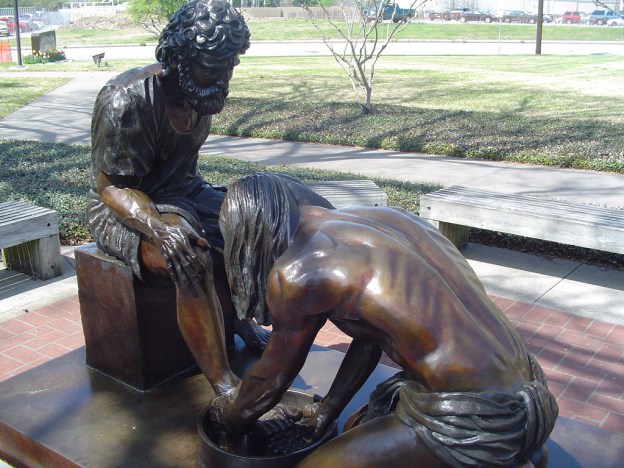
We Christians know that our feet were made beautiful by Jesus himself, who on the
night before he died …

“took off his outer robe, and tied a towel around himself. Then he poured water into a basin and began to wash the disciples’ feet and to wipe them with the
towel that was tied around him …. After he had washed their feet, had put on
his robe, and had returned to the table, he said to them, ‘Do you know what I
have done to you? You call me Teacher and Lord—and you are right, for that is
what I am. So if I, your Lord and Teacher, have washed your feet, you also
ought to wash one another’s feet. For I have set you an example, that you also
should do as I have done to you. Very truly, I tell you, servants are not greater
than their master, nor are messengers greater than the one who sent them”
(John 13).

Everyone who calls on the name of the Lord

Peter certainly isn’t “greater than the one who sends him”; in fact, Peter is the
patron saint of leaping before you look.

Peter answered him, “Lord, if it is you, command me to come to you on the
water.” He said, “Come.” So Peter got out of the boat, started walking on the
water, and came toward Jesus. But when he noticed the strong wind, he became
frightened, and beginning to sink, he cried out, “Lord, save me!” Jesus
immediately reached out his hand and caught him, saying to him, “You of little
faith, why did you doubt?” (Matthew 14:28-31).

Joseph, on the other hand, doesn’t doubt. He has always known he was his father
Israel’s favorite – he has the “coat with long sleeves,” the coat of many colors to
remind him. It’s left out of our reading this morning, but Joseph wasn’t the easiest to get along with – he kept dreaming that his brothers, and even his father and mother, were bowing down to him. Even so, when his jealous older brothers saw their chance and sold him into slavery, his faith in God remained strong.

Joseph’s faith is remembered and his story retold in this morning’s psalm:

He sent a man before them, *
Joseph, who was sold as a slave.
They bruised his feet in fetters; *
his neck they put in an iron collar.
Until his prediction came to pass, *
the word of the LORD tested him.
The king sent and released him; *
the ruler of the peoples set him free.
He set him as a master over his household,*
as a ruler over all his possessions,
To instruct his princes according to his will*
and to teach his elders wisdom. (Psalm 105:17-22)

Joseph is an example of endurance, of embracing his new role as servant to Potiphar,
of integrity when falsely accused and sent to prison, and of reliance on God to
interpret Pharaoh’s dreams. Pharaoh recognizes Joseph’s exemplary character and
puts him in charge of his house and the whole land of Egypt.

Much later, when Joseph is about 45 years old, when the famine he predicted has
struck the land and his older brothers come to Egypt in search of food, Joseph’s faith leads him to bless them instead of cursing them – to be a messenger of good news.

Messengers of good news

“Everyone who calls on the name of the Lord shall be saved.” But how are they to call on one in whom they have not believed? And how are they to believe in one of whom they have never heard? And how are they to hear without someone to proclaim him? And how are they to proclaim him unless they are sent? As it is written, “How beautiful are the feet of those who bring good news!”

There’s a wonderful backwards series of sentences in Paul’s letter this morning:
“How are they to call on – to believe in – to hear – to proclaim – unless they are
sent?”

We have been sent – by our baptism into Christ’s body, by the washing of our feet
that Thursday night on Jerusalem, by our participation in his death and resurrection,
by the empowering of his Holy Spirit – we have been sent to proclaim good news.

We proclaim the simple message of the Gospel: that Jesus is Lord, and that
“everyone who calls upon the name of the Lord shall be saved.”

There’s nothing more to it than that. The good news is simple.

And we are simple, like Peter, mindful of our own doubt and sin, but grateful for
God’s power to save us and for the gift of a new spirit.

Like Peter said “not my feet only, but wash my hands and my head,” we proclaim the
good news “not only with our lips, but in our lives, by giving up ourselves to [God’s] service” (BCP 101).

The good news is not just what we say, but how we live.

We are like Joseph, mindful that we are beloved, but resolved to live with integrity.
When others are in trouble, even if what they do hurts us, we have it in our power to
bless and not curse. When others are hurting, most of us have plenty to spare, and
our generosity speaks volumes about God’s grace.

The good news is simple: Jesus is Lord, and “everyone who calls upon the name of
the Lord shall be saved.”

We are sent to proclaim the good news by word and deed.

The rest is not up to us

We cannot control what other people hear.

I’ve just spent weeks learning how to teach a course for physicians, nurses, and hospital administrators on “Leading Change” – a course that underscores that very point. People receive what we say to them filtered through many layers of perception. We can tailor our message to reach people better, but we cannot control what they hear.

We cannot convince people to believe.

Any of you who have tried to have a political “discussion” on Facebook know how well that works. We’re called to witness to new life and transformation, more than we are called to deploy proofs of logic. We cannot reason people into risking the leap of faith.

And, we cannot make people call upon the name of the Lord.

The ISIS fighters in Iraq are trying to do that at gunpoint and at the tip of the sword. They are preaching hate, not love. Our own Christian history is also full of too many examples of forced conversions and coercive use of power. We cannot make people into Christians; we
must invite them to join us.

Beloved, we are sent to proclaim a much simpler good news, free from force or
distinction or coercion – “the same Lord is Lord of all and is generous to all who call upon him” – and to proclaim it by word and deed.

So, this week …

Like Peter, let Jesus draw you outside of your comfort zone into something that feels
a little risky.

Like Joseph, proclaim good news in a way that goes beyond righteousness and into
material help.

I am taking my own advice here – like Peter, I feel that I need to step “outside the
boat” in my prayer life, to risk leaving some of the familiarity and comfort of the
Daily Office and to spend more time silently resting in Jesus’ presence. I have to trust that his hand will be there to catch me, and I do trust him.

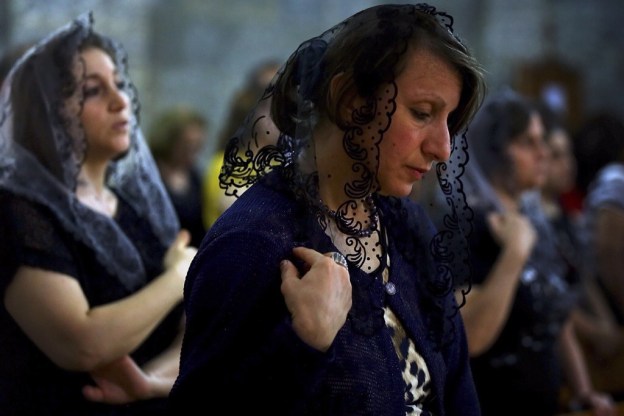
Like Joseph, I am also feeling that I need to go beyond praying for Christians who are being persecuted in Iraq and do something more direct to help them. So I have given a donation to Canon Andrew White, the “Vicar of Baghdad,” and his work at St. George’s Anglican Church in Baghdad through his Foundation for Relief and Reconciliation in the Middle East.

How is God sending you this week? How will you risk stepping outside the boat?
How will you go beyond prayer and into action to help those who suffer?

Trust that Jesus’ strong hand will catch you if you falter, trust that you have enough to share with others in need, trust that your feet, your hands and your head have been washed by our humble Lord. Trust that the rest is in his hands.

“How beautiful are the feet of those who bring good news!”

Amen.

Being ambushed

Strap your sword upon your thigh, O mighty warrior,
in your pride and in your majesty.
Ride out and conquer in the cause of truth
and for the sake of justice. (Psalm 45:3-4)

In this morning’s reading from the book of Joshua, we have the story of the ambush of the city of Ai by the people of Israel. Joshua gives a sign, and the plan goes into action.

When Joshua and all Israel saw that the ambush had taken the city and that the smoke of the city was rising, then they turned back and struck down the men of Ai. And the others came out from the city against them; so they were surrounded by Israelites, some on one side, and some on the other; and Israel struck them down until no one was left who survived or escaped. (Joshua 8:21-22)

It’s a pretty straightforward description of the Israelites’ false retreat successfully drawing out the people from the city, then surprising them with a rearguard cutting the people of Ai off so they could not return to safety.

The only thing that keeps the ambush of Ai from being plain history is that the Israelites attribute their winning to the Lord’s leading.

In the Gospel passage appointed for today, we have the story of a different ambush.

While Jesus was still speaking, Judas, one of the twelve, arrived; with him was a large crowd with swords and clubs, from the chief priests and the elders of the people. Now the betrayer had given them a sign, saying, “The one I will kiss is the man; arrest him.” (Matt. 26:47-48)

Again, at the agreed signal, the victim is drawn out and encircled, and the ambush succeeds. But in a plot twist no one expects, Jesus doesn’t resist. “Put your sword back into its place,” he says, “for all who take the sword will die by the sword” (Matt. 26:52). He is taken from the garden by the religious authorities, and he is put to death as a criminal.

The only thing that keeps the arrest in the Garden of Gethsemane from being plain history is that generations of Christians have attributed their living to the Lord’s dying.

The mystery that Jesus reveals is that God does not lead us in ambushing others. God invites us, rather, to follow Jesus, the “Lamb that was slain,” in being ambushed, not “trusting in our own righteousness, but in [God’s] manifold and great mercies” (BCP 337).

A Song to the Lamb (Dignus es)
Revelation 4:11; 5:9-10, 13

Splendor and honor and kingly power *
are yours by right, O Lord our God,
For you created everything that is, *
and by your will they were created and have their being;

And yours by right, O Lamb that was slain, *
for with your blood you have redeemed for God,
From every family, language, people, and nation, *
a kingdom of priests to serve our God.

And so, to him who sits upon the throne, *
and to Christ the Lamb,
Be worship and praise, dominion and splendor, *
for ever and for evermore.

All this has come upon us

A Collect for Peace

Most holy God, the source of all good desires, all right judgments, and all just works: Give to us, your servants, that peace which the world cannot give, so that our minds may be fixed on the doing of your will, and that we, being delivered from the fear of all enemies, may live in peace and quietness; through the mercies of Christ Jesus our Savior. Amen. (BCP 123)

Peace which the world cannot give

The psalmist laments that “all this has come upon us” and prays to the Lord for help:

All this has come upon us; *
yet we have not forgotten you,
nor have we betrayed your covenant.

Our heart never turned back, *
nor did our footsteps stray from your path;

Though you thrust us down into a place of misery, *
and covered us over with deep darkness.

If we have forgotten the Name of our God, *
or stretched out our hands to some strange god,

Will not God find it out? *
for he knows the secrets of the heart.

Indeed, for your sake we are killed all the day long; *
we are accounted as sheep for the slaughter.

Awake, O Lord! why are you sleeping? *
Arise! do not reject us for ever.

Why have you hidden your face *
and forgotten our affliction and oppression?

We sink down into the dust; *
our body cleaves to the ground.

Rise up, and help us, *
and save us, for the sake of your steadfast love. (Psalm 44:17-26)

In this lament, two “generations” of the children of Israel have expressed their desire for God’s peace in the middle of difficulty and in the face of enemies.

The Jews, who had prayed the Psalms in worship for at least 1,000 years before the time of Christ, were joined in that song by the Christians who, some 2,000 years ago, retained the Psalms in their daily worship and taught them to Gentile converts who had begun to follow the Way.

It’s sobering to think that the Psalms have been sung, until this week, by Christians in Mosul for 1,700 of the last 2,000 years.

Abraham and his children for ever

Another of the songs that Christians sing in their evening worship is the Magnificat, or the Song of Mary (BCP 119).

In the Magnificat, Mary’s words echo those of Hannah from 1 Samuel 2. Both women look to God to “show the strength of his arm” and to “scatter the proud in their conceit.”

Luke’s Gospel (where the Magnificat comes from) and his Book of Acts are focused on the spread of the church throughout the world.

In his telling, Mary’s song broadens in scope from God lifting up the “lowly” and looks toward the glorious day when all will be free to worship God without fear, “Abraham and his children for ever.”

It is also sobering this week to realize that the children of Abraham — Jews, Christians, and Muslims — continue to pray for peace for themselves in difficulty but to live as enemies of each other.

Prayer for Mission

O God and Father of all, whom the whole heavens adore: Let the whole earth also worship you, all nations obey you, all tongues confess and bless you, and men and women everywhere love you and serve you in peace; through Jesus Christ our Lord. Amen. (BCP 124)

Though we Christians pray “through Jesus Christ our Lord,” our prayer is that all men and women everywhere may love and serve the God and Father of all in peace.

All this has come upon us; may we all turn back to God.

Holy, good, and peaceful

That this evening may be holy, good, and peaceful,
We entreat you, O Lord. (BCP 122)

Today I am grateful.

I was fortunate to spend a couple of holy hours this morning with three people who are in a process of vocational discernment.

We reflected on the promises made by all Christians in the Baptismal Covenant (BCP 304) and the promises made by those being ordained as bishops (BCP 518), priests (BCP 531), and deacons (BCP 543).

We also shared which qualities — from any or all of those promises — we see operating in each other’s lives. It was both affirming and eye-opening.

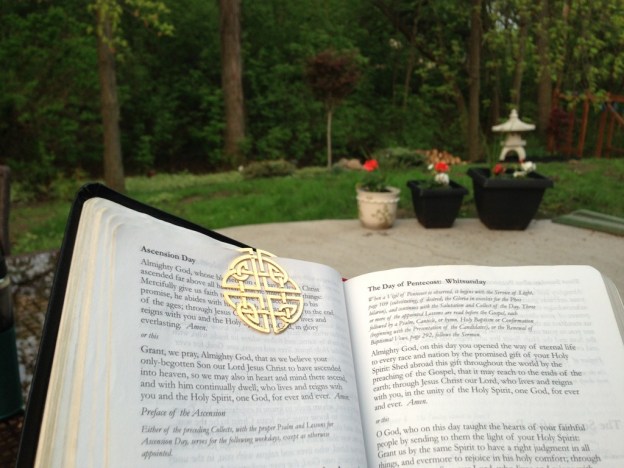
This afternoon, Lovely Wife and I have been reading and dozing on our patio, enjoying the sound of birdsong and the breezes through our Japanese garden. It’s been a good Sabbath afternoon.

And even though I’m not watching the news, I am mindful of the blessing of peace that we enjoy.

Pray for those “who go so heavily while the enemy oppresses [them]” (Psalm 42), and work to make God’s peace come alive for all.

In a besieged city

At Morning Prayer today (I was onboard an airplane, as usual) we read Psalm 31, one of the most poignant psalms of confidence in God in the face of difficulty.

Blessed be the Lord!
For he has shown me the wonders of his love in a besieged city (Psalm 31:21)

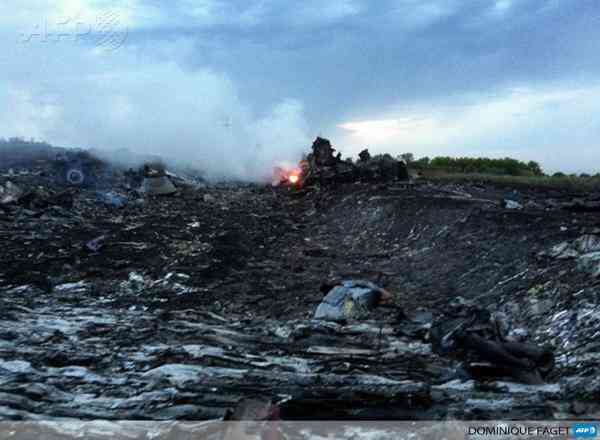
The news of Malaysian Airlines Flight 17, of war in the Ukraine and the Middle East, makes the notion of a besieged city real — at least as far as we can imagine it from newspaper photos and headlines.

But where are those who are actually besieged — whose loved ones died in the crash, whose homes are being destroyed by war — where are they to find hope?

On the Mystery of the Incarnation

It’s when we face for a moment
the worst our kind can do, and shudder to know
the taint in our own selves, that awe
cracks the mind’s shell and enters the heart:
not to a flower, not to a dolphin,
to no innocent form
but to this creature vainly sure
it and no other is god-like, God
(out of compassion for our ugly
failure to evolve) entrusts,
as guest, as brother,
the Word.

Denise Levertov

Hope is not something that simply exists. Hope is something we create as we share our presence, our stories of falling and rising, with those who are struggling.

We build hope as we encourage one another — not only by listening but by acting. We must not only grieve, we must also work to eliminate the violence and greed that destroys people’s lives.

In our case, it is Christ — guest, brother, Word — who inspires us to serve and helps us bring hope into a besieged city.

Prayer for Mission

Lord Jesus Christ, you stretched out your arms of love on the hard wood of the cross that everyone might come within the reach of your saving embrace: So clothe us in your Spirit that we, reaching forth our hands in love, may bring those who do not know you to the knowledge and love of you; for the honor of your Name. Amen. (BCP 101)

Lord, when was it?

Then the righteous will answer him, “Lord, when was it that we saw you hungry and gave you food, or thirsty and gave you something to drink? And when was it that we saw you a stranger and welcomed you, or naked and gave you clothing? And when was it that we saw you sick or in prison and visited you?” And the king will answer them, “Truly I tell you, just as you did it to one of the least of these who are members of my family, you did it to me.” (Matthew 25:37-40)

We citizens of the United States may certainly disagree on how the country should be managed, and how our tax dollars should be spent, and what priorities should be reflected in the national budget. Our country is organized in a way that encourages checks and balances, that requires at least some give and take, that assumes some compromise with other points of view.

Healthy debate is a strength of our country, and the freedom to disagree is an important right we should cherish.

Similarly, in the church, we do not always have to agree on how the church should be managed, how our tithes and offerings should be spent, what priorities should be reflected in the parish or diocesan budget. The Episcopal Church (to which I belong) is even organized at a national level along the same bicameral lines as the House and Senate. Our structure encourages debate, requires give and take, assumes some compromise with other points of view.

And yet.

There are some things that we as Christians simply must agree on, some things that are so clear that they really brook no argument.

Caring for the poor, the sick, the naked, the hungry and thirsty, the stranger and the prisoner are right there at the top of the list.

Even speaking in a parable, Jesus’ point is crystal clear — we are to care for the poor because they are members of God’s family. Period. What we do for the poor we do for God. Period.

We are citizens of the United States, it’s true. But we are also (and first) members of God’s kingdom.

How caring for the poor should be managed, how our offerings and tax dollars should be spent, how that care is made a priority in our church’s budget and in the the national budget is open to debate and compromise.

That it must be a priority is clear, at least for us who are members of God’s kingdom.

Collect of the Day

O Lord, mercifully receive the prayers of your people who call upon you, and grant that they may know and understand what things they ought to do, and also may have grace and power faithfully to accomplish them; through Jesus Christ our Lord, who lives and reigns with you and the Holy Spirit, one God, now and for ever. Amen. (BCP 231)