
Category Archives: Daily Office

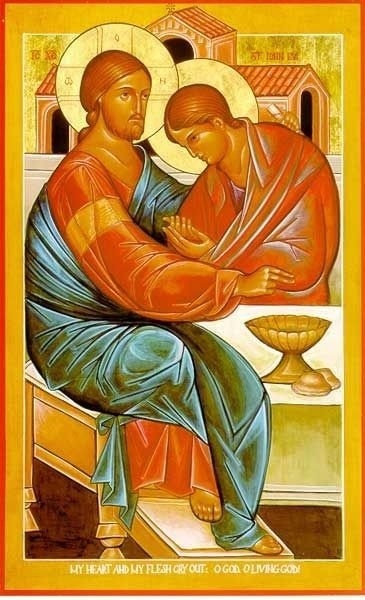
I am small and of little account … come and see

I am “in between jobs” for the second time in 18 months.

Because I had so much free time during Lent, I think, I have been dwelling a lot on the notion of “smallness.”

Perhaps it’s time to get off the road and work closer to home. Perhaps it’s time for me to shift my ambitions, to discern what few things I must do instead of chasing all of the things I could do.

Perhaps it’s time to put down roots instead of spreading wings.

Perhaps this frame of mind that I’m in caused the words of Psalm 119 to strike me so powerfully this morning: “I am small and of little account.”

Your word has been tested to the uttermost, *
and your servant holds it dear.
I am small and of little account, *
yet I do not forget your commandments.
Your justice is an everlasting justice *
and your law is the truth.
Trouble and distress have come upon me, *
yet your commandments are my delight.
The righteousness of your decrees is everlasting; *
grant me understanding, that I may live. (Psalm 119:140-144)

We don’t know much about Philip beyond what we read in today’s Gospel lesson, and we can’t even sort out who the biblical James really was — talk about obscurity!

Philip found Nathanael and said to him, “We have found him about whom Moses in the law and also the prophets wrote, Jesus son of Joseph from Nazareth.” Nathanael said to him, “Can anything good come out of Nazareth?” Philip said to him, “Come and see.” (John 1:45-46)

But that simple invitation from an obscure follower turns everything around. Philip invites Nathanael to know Jesus, and Nathanael, “an Israelite in whom there is no guile,” comes to love Jesus.

That simple invitation to “come and see” also echoes in two of the Friday prayers in the Daily Office.

Every Friday morning, we ask God to “mercifully grant that we, walking in the way of the cross, may find it none other than the way of life and peace” (BCP 99).

Come and see, says Jesus to his disciples. Follow me in the way of the cross. “Trouble and distress” may come upon you, but I am with you, he says. You will find life and peace with me.

I would guess that most of us who pray the Office regularly also pray this Prayer for Mission on Fridays, too:

Lord Jesus Christ, you stretched out your arms of love on the hard wood of the cross that everyone might come within the reach of your saving embrace: So clothe us in your Spirit that we, reaching forth our hands in love, may bring those who do not know you to the knowledge and love of you; for the honor of your Name. Amen. (BCP 101)

The way of the cross that we follow with Jesus is not only suffering, but also compassion. The Spirit we share with Jesus not only draws us in to intimacy, but also leads us out to embrace.

Here, we pray that we may extend the same invitation to others that Christ extends to us. We pray that we, small as we are, “may bring those who do not know [Christ] to the knowledge and love of [Christ].”

I don’t know what Philip and James expected when they began to follow Jesus. I don’t know what to expect in the next stage of my work and ministry. But I look forward to finding out.

How is God calling you to “come and see” what’s next in your life?

The Lord is near; be patient and hope in him

I am at the annual NAMI Wisconsin conference, hearing from speakers about mental illness and the peer-to-peer support which is the hallmark of NAMI’s recovery approach. Helping people experience recovery — living well with mental illness — builds hope.

One of this morning’s psalms resonates with my own experience of recovery.

The LORD is faithful in all his words *
and merciful in all his deeds.
The LORD upholds all those who fall; *
he lifts up those who are bowed down.
The eyes of all wait upon you, O LORD, *
and you give them their food in due season.
You open wide your hand *
and satisfy the needs of every living creature.
The LORD is righteous in all his ways *
and loving in all his works.
The LORD is near to those who call upon him, *
to all who call upon him faithfully.
He fulfills the desire of those who fear him; *
he hears their cry and helps them.
The LORD preserves all those who love him, *
but he destroys all the wicked.
My mouth shall speak the praise of the LORD; *
let all flesh bless his holy Name for ever and ever. (Psalm 145:14-22)

“The Lord upholds all those who fall; he lifts up those who are bowed down … the Lord is near to those who call upon him.” These assurances build hope in us as we share our stories of God’s faithfulness in our own times of trouble.

The writer Jesus son of Sirach (whose book the church calls Ecclesiasticus), describes the internal attitude I try to have as I work my own recovery each day.

Accept whatever befalls you, and in times of humiliation be patient. For gold is tested in the fire, and those found acceptable, in the furnace of humiliation. Trust in him, and he will help you; make your ways straight, and hope in him. (Ecclus. 2:4-6)

The slogans of recovery, like “One Day at a Time,” and the teachings of our Christian faith echo Sirach’s timeless human wisdom.

Accept whatever befalls you. What is, is. Accept that things are the way they are without becoming “restless, irritable, and discontented.”

Be patient. One of our speakers yesterday suggested that patience is a fruit of practicing mindfulness in every situation, and that mindfulness is really being present to what is actually happening.

Make your ways straight. At the men’s breakfast and Bible study I attend on Thursdays, we spoke this week about how our lives are to be lived in response to God’s grace. We do not earn grace; but in gratitude we make changes in order to stay in God’s way.

The short reading from the Acts of the Apostles exemplifies the simple faithfulness that is to characterize our new life — whether it’s life in recovery, life in Christ, or both.

Then after completing their mission Barnabas and Saul returned to Jerusalem and brought with them John, whose other name was Mark. Now in the church at Antioch there were prophets and teachers: Barnabas, Simeon who was called Niger, Lucius of Cyrene, Manaen a member of the court of Herod the ruler, and Saul. While they were worshiping the Lord and fasting, the Holy Spirit said, “Set apart for me Barnabas and Saul for the work to which I have called them.” Then after fasting and praying they laid their hands on them and sent them off. (Acts 12:25–13:3)

Notice how John, whose other name was Mark, is simply present with Barnabas and Saul. Notice how he doesn’t figure in the action at Antioch — it’s Barnabas and Saul who are made apostles.

Mark must have been practicing mindfulness throughout that time, though, paying attention to the new life in Christ. Eventually, his insights bore fruit in the gospel account that bears his name.

The Lord is near to those who call upon him, who call upon him faithfully.

In times of humiliation, be patient.

Make your ways straight, and hope in him.

Collect for St. Mark

Almighty God, by the hand of Mark the evangelist you have given to your Church the Gospel of Jesus Christ the Son of God: We thank you for this witness, and pray that we may be firmly grounded in its truth; through Jesus Christ our Lord, who lives and reigns with you and the Holy Spirit, one God, for ever and ever. Amen.

Having the Son of God

And this is the testimony: God gave us eternal life, and this life is in his Son. Whoever has the Son has life; whoever does not have the Son of God does not have life. (1 John 5:11-12)

What does it mean to “have” the Son?

Does it mean saying particular things about Jesus? Reciting particular creeds of the Church?

Does it mean arguing about religion? Imposing religious laws on people?

Does it mean wearing certain Christian t-shirts? Wearing certain ecclesiastical robes? Having a certain hairstyle? Wearing a certain hat?

Does it mean reading special prayers? Making up special prayers? Singing special music?

+ + + + +

What might it mean to “have” life?

Might it mean owning up to our own faults? Admitting our own mistakes?

Might it mean praising God for the way things are? Thanking God for what is?

Might it mean receiving forgiveness? Giving forgiveness?

Might it mean serving God? Might it mean being served by God?

Love (III)

Love bade me welcome: yet my soul drew back,
Guilty of dust and sin.
But quick-eyed Love, observing me grow slack
From my first entrance in,
Drew nearer to me, sweetly questioning
If I lacked anything.

“A guest,” I answered, “worthy to be here”:
Love said, “You shall be he.”
“I, the unkind, ungrateful? Ah, my dear,
I cannot look on thee.”
Love took my hand, and smiling did reply,
“Who made the eyes but I?”

“Truth, Lord; but I have marred them; let my shame
Go where it doth deserve.”
“And know you not,” says Love, “who bore the blame?”
“My dear, then I will serve.”
“You must sit down,” says Love, “and taste my meat.”
So I did sit and eat.

-George Herbert

Tempted but the truth is discovered

Your hand will lay hold upon all your enemies; *
your right hand will seize all those who hate you.
You will make them like a fiery furnace *
at the time of your appearing, O LORD;
You will swallow them up in your wrath, *
and fire shall consume them. (Psalm 21:8-10)

It’s so tempting, isn’t it? To want victory in the same terms as our “enemies” enjoy it. To believe that victory means power and control over others.

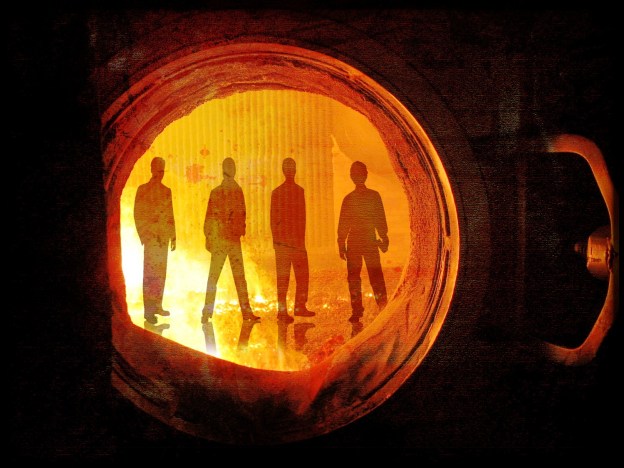
Immediately after we read Psalms 20 and 21, we finally reach the climax of the opening chapters of the Book of Daniel that we’ve been reading all week. Shadrach, Meshach, and Abednego, Daniel’s Hebrew companions at the court of the king of Babylon, refuse to worship the great gold statue that Nebuchadnezzar has erected, so they are thrown into a fiery furnace.

The Book of Daniel probably came later in the compilation of the Hebrew Bible — it seems to reflect a post-Exile sensibility — but I’m tempted to believe that the Psalmist is wishing to have victory like the Babylonian king, victory that everyone can see, victory that burns up his enemies.

After our reading from the Book of Daniel, we respond with Canticle 12, appointed for Saturday mornings (BCP 144). Canticle 12 is known by three names: “A Song of Creation,” the Latin first line Benedicite, omnia opera Domini, and the descriptive title Song of the Three Young Men.

Yes, those three young men. What were Shadrach, Meshach, and Abednego doing in the fiery furnace? They were praising the God of creation.

Glorify the Lord, you angels and all powers of the Lord, *
O heavens and all waters above the heavens.
Sun and moon and stars of the sky, glorify the Lord, *
praise him and highly exalt him for ever.

Glorify the Lord, every shower of rain and fall of dew, *
all winds and fire and heat.
Winter and Summer, glorify the Lord, *
praise him and highly exalt him for ever. (BCP 88)

The mighty king of Babylon is astonished. His power has no effect on these young men. It even looks like they are walking around in the furnace with a fourth figure. An angel?

He yells at them, “Come out, come here!”

And the satraps, the prefects, the governors, and the king’s counselors gathered together and saw that the fire had not had any power over the bodies of those men; the hair of their heads was not singed, their tunics were not harmed, and not even the smell of fire came from them. Nebuchadnezzar said, “Blessed be the God of Shadrach, Meshach, and Abednego, who has sent his angel and delivered his servants who trusted in him. They disobeyed the king’s command and yielded up their bodies rather than serve and worship any god except their own God. (Daniel 3:27-30)

What is victory?

Is it burning your enemies up in a fiery furnace? Is it winning control? Is it having power and prestige?

Or is it praising God in all circumstances? Is it yielding up your body rather than serve any power but God?

The three young men seem to know the answer. Jesus, meeting the devil in the wilderness after his baptism, seems to answer temptation in the same way.

Truth is, for us whose faith is formed by the Hebrew Bible and given flesh in Jesus and powered by the Spirit, victory means yielding ourselves, not lording over others.

Truth is, victory is “to worship the Lord [our] God, and serve only him” (Luke 4:8).

Deep gloom enshrouds the peoples

Arise, shine, for your light has come, *
and the glory of the Lord has dawned upon you.
For behold, darkness covers the land; *
deep gloom enshrouds the peoples.
But over you the Lord will rise, *
and his glory will appear upon you. (Isaiah 60:1-3; BCP 87)

Yesterday evening, my Twitter feed and then the news filled with images and video of Walter Scott being shot so casually by North Charleston police officer Michael Slager.

Meanwhile, back on NCIS (Tuesday night is NCIS night) the usual storyline unfolds, and Gibbs very casually shoots the arms dealer who has killed a Marine; as often happens on NCIS, the show ends with an emotional appeal for gifts in memory of fallen Marines.

On NCIS: New Orleans, a hostage situation unfolds, met with the entirely understandable armoring of the FBI and a Navy SWAT team.

Through the gloom, the evening starts to feels like the Gospel accounts of the crucifixion — the Roman Empire says  “force wins,” the religious people say “it’s better for one person to die for the country,” the criminal gets taken down, and protests over his death are met with a carefully crafted story and an extra layer of security: “Otherwise, his disciples may go and steal him away” (Matthew 27:62-66).

It’s so hard to proclaim Easter when it’s gloomy like this. It’s so hard not to retreat, not to try to close out the news.

Alienation

But it gets better.

This morning in my Facebook feed, a friend shared a link to a reflection by New Jersey relationship columnist Anthony D’ambrosio on marriage and divorce.

One of the five reasons D’ambrosio cites “why marriage just doesn’t work anymore” is our alienation from each other because of all the devices and screens that surround us (I chuckle as I read in the living room; I can hear my wife tapping away on her laptop in the kitchen).

I can also hear the disciples walking on the Emmaus road shaking their heads in dismay. “It wasn’t supposed to be like this. We had high hopes.”

Communion

The stranger who joins them, and who accepts their polite invitation to a meal, opens the eyes of their faith in the way he breaks and blesses the bread (Luke 24:13-35).

O God, whose blessed Son made himself known to his disciples in the breaking of bread: Open the eyes of our faith, that we may behold him in all his redeeming work; who lives and reigns with you, in the unity of the Holy Spirit, one God, now and for ever. Amen. (BCP 223)

Perhaps simpler gestures of communion will pierce the deep gloom that enshrouds us.

Perhaps seeing each other through the eyes of faith — not as dangerous criminals, not as armed storm troopers, not as self-absorbed people pushing each other away on purpose — perhaps seeing each other is the first step to seeing the Risen Lord.

“Over you the Lord will rise,” says Isaiah, “and his glory will appear upon you.” Perhaps if we make time and space (and a place) to sit with each other, we will have a chance truly to see each other.

Give us eyes to see each other, O Lord, not to look past each other. Give us pause before we alienate one another again. Give us hunger to share a meal with each other, and in our breaking bread together to see you with us.

Christ our Passover

Alleluia. The Lord is risen indeed: Come let us adore him. Alleluia.

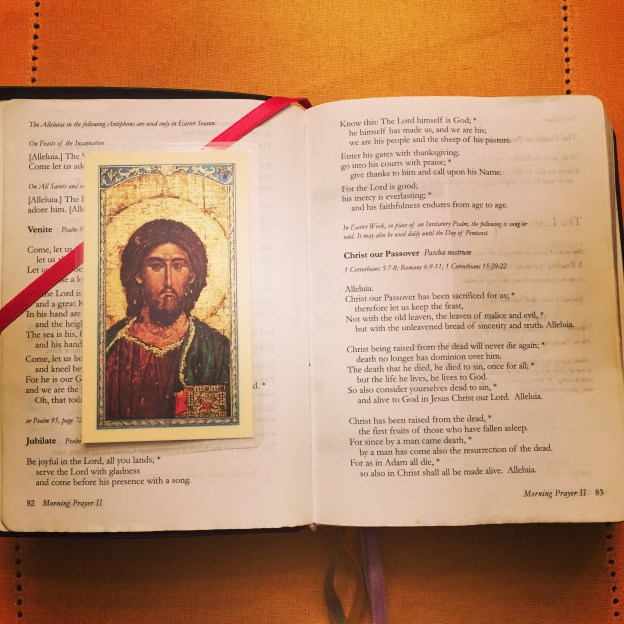
Morning Prayer during the 50 days of the Easter season may begin with the Easter antiphon and the canticle “Christ our Passover” instead of the Venite.

It’s a lovely way to mark these 50 days — one-seventh of the Church Year — as a sort of Sunday to the rest of the week.

Alleluia. The Lord is risen indeed: Come let us adore him. Alleluia.

Christ our Passover Pascha nostrum

Alleluia.
Christ our Passover has been sacrificed for us;
therefore let us keep the feast,
Not with the old leaven, the leaven of malice and evil,
but with the unleavened bread of sincerity and truth. Alleluia.

Christ being raised from the dead will never die again;
death no longer has dominion over him.
The death that he died, he died to sin, once for all;
but the life he lives, he lives to God.
So also consider yourselves dead to sin,
and alive to God in Jesus Christ our Lord. Alleluia.

Christ has been raised from the dead, the first fruits of those who have fallen asleep.
For since by a man came death,
by a man has come also the resurrection of the dead.
For as in Adam all die,
so also in Christ shall all be made alive. Alleluia. (BCP 83)

Putting away all earthly anxieties

As the body of Jesus lies wrapped in grave clothes in the tomb on this Saturday, we “praise and highly exalt” God for the earth and its creatures:

Let the earth glorify the Lord, *
praise him and highly exalt him for ever.
Glorify the Lord, O mountains and hills,
and all that grows upon the earth, *
praise him and highly exalt him for ever.

Glorify the Lord, O springs of water, seas, and streams, *
O whales and all that move in the waters.
All birds of the air, glorify the Lord, *
praise him and highly exalt him for ever.

Glorify the Lord, O beasts of the wild, *
and all you flocks and herds.
O men and women everywhere, glorify the Lord, *
praise him and highly exalt him for ever. (BCP 89)

As God incarnate, made man in the person of Jesus, occupies the last part of creation — death itself — we pray on this Holy Saturday that we, “putting away all earthly anxieties” (BCP 99), may be prepared for the service of God’s sanctuary.

From “the vast expanse of interstellar space, galaxies, suns, the planets in their courses, and this fragile earth, our island home” (BCP 370) to the microorganisms in the soil of the tomb, from the largest blue whale (“that Leviathan”) to the smallest child newly born, all creation is God’s sanctuary.

Every part of it has been made holy, not only by God’s creating it, but by God’s inhabiting it.

Paul writes that “the creation waits with eager longing for the revealing of the children of God; for the creation was subjected to futility, not of its own will but by the will of the one who subjected it, in hope that the creation itself will be set free from its bondage to decay and will obtain the freedom of the glory of the children of God” (Romans 8:19-21).

Even the darkest night, even the fear of death, even the silent cry of loneliness, all of the creation’s “bondage to decay” and all of our earthly anxieties have been redeemed, made holy by God’s inhabiting them.

The Song of the Redeemed  Magna et mirabilia
Revelation 15:3-4

O ruler of the universe, Lord God,
great deeds are they that you have done, *
surpassing human understanding.
Your ways are ways of righteousness and truth, *
O King of all the ages.

Who can fail to do you homage, Lord,
and sing the praises of your Name? *
for you only are the Holy One.
All nations will draw near and fall down before you, *
because your just and holy works have been revealed.

Glory to the Father, and to the Son, and to the Holy Spirit:
as it was in the beginning, is now, and will be for ever. Amen.

Friday the 13th

It’s definitely a modern invention, the claim that Friday the 13th is inauspicious because Jacques de Molay and the Knights Templar were arrested in France on Friday, October 13, 1307.

Even so, I’ll play on the connection with that story and today’s readings from Morning Prayer.

I can’t help thinking today of Christians and others imprisoned for their faith, persecuted because of their religion, or driven from their homes to live as refugees, as so many are today.

I can’t help praying for the teenage boys a friend just texted me about, the older killed in a car accident this morning, the younger in critical condition in the hospital. Their suffering and their parents’ grief and fear are dark prisons.

You have put my friends far from me; you have made me to be abhorred by them; *
I am in prison and cannot get free.
My sight has failed me because of trouble; *
LORD, I have called upon you daily; I have stretched out my hands to you.
Do you work wonders for the dead? *
will those who have died stand up and give you thanks?
Will your loving-kindness be declared in the grave? *
your faithfulness in the land of destruction?
Will your wonders be known in the dark? *
or your righteousness in the country where all is forgotten?
But as for me, O LORD, I cry to you for help; *
in the morning my prayer comes before you. (Psalm 88:9-14)

Pray for all whose faith is abused for financial gain; whose loyalty is rewarded with political murder; whose life is thrown away by those seeking power or control.

Pray for those whose faith is tested by tragedy, pain, and fear.

But if we have died with Christ, we believe that we will also live with him. We know that Christ, being raised from the dead, will never die again; death no longer has dominion over him. The death he died, he died to sin, once for all; but the life he lives, he lives to God. So you also must consider yourselves dead to sin and alive to God in Christ Jesus. (Romans 6:8-11)

But remember, too, that even in the middle of persecution, flight, and abuse; even in the face of tragedy and pain; even on this particular Friday in the middle of Lent, Scripture reminds us that death is not the end of the story.

We are nearing Holy Week, when we remember Jesus’ willing sacrifice, his dying and rising, the way of the cross that is the pattern for our own lives of faith.

We are nearing Good Friday, the Friday that makes all others “good,” even the ones that land on the 13th of the month.

And we hear echoes this morning in Paul’s letter to the Romans of the canticle Christ our Passover (BCP 83) that we will sing throughout the coming season of Easter.

A Collect for Fridays

Almighty God, whose most dear Son went not up to joy but first he suffered pain, and entered not into glory before he was crucified: Mercifully grant that we, walking in the way of the cross, may find it none other than the way of life and peace; through Jesus Christ our Lord. Amen. (BCP 99)

Solidarity with the persecuted Church

The Catholic Herald in the UK recently published Maronite Archbishop Samir Nassar’s reflections as A Way of the Cross in solidarity with the persecuted Church. Archbishop Samir is the Maronite Archbishop of Damascus, and he serves as Episcopal Shepherd of the Syrian Commission for the Family.

Here, for the convenience of any who may wish to use this Way of the Cross in their parishes this Lent, is a booklet (gently adapted) and formatted for double-sided printing on US Letter size paper (8.5″ x 11″).

It is offered in hopes that, as we journey toward Jerusalem this Lent and Easter in solidarity with our persecuted sisters and brothers in the Church throughout the world, we may together bear witness to the power of the cross to overcome death and the grave, and to open to us all the resurrection life of Jesus Christ our Lord.

Avoid stupid controversies

Can anything good come out of Nazareth? (John 1:46)

Nathanael might have been reading Philip’s status update on Facebook, for all we can tell. His reply sure sounds like the snarky comments we post when we read something we don’t agree with.

The dismissive behavior we display on Facebook and Twitter is really nothing new; in the second-century letter to Titus (c. 110 AD) we hear the writer’s strong warning to Christians against the kind of behavior we engage in so often, a verse worth memorizing because it stands the test of time.

Avoid stupid controversies … (Titus 3:9)

But why? The writer expands on his idea. “Avoid stupid controversies, genealogies, dissensions, and quarrels about the law, for they are unprofitable and worthless.”

Worthless

Arguing about stupid Episcopal Church controversies, trying to prove a point by citing the canons, stirring up partisan passion about how misguided the leaders at 815 are, debating who’s right and who’s wrong — none of these things communicate the inspiring truth about what God is doing in the world.

And it’s not just our internal church controversies that are stupid.

You don’t have to have an opinion about every story, every commentary on the evening news. You don’t even have to watch the news.

Your compelling evidence, exhaustively cited, won’t change the mind of that guy on Twitter. Besides which, no one wants to read your 57 nested tweets on the same subject (unless it’s #AddAWordRuinAMovie or #LentMadness).

Your dismissive comments on Facebook about Obama or Bush, gun control or transgender rights, Palestine or Israel, Guy Fieri or Anthony Bourdain — and your obsessive sharing of political posts (left or right) do not change anyone’s mind.

Usually, they just make you look like a jerk.

Unprofitable

Not only is it a waste of time to engage in stupid controversies, it doesn’t actually help.

How does your arguing reflect the God we Christians worship, who hates nothing he has made and forgives the sins of all who are penitent (BCP 264)?

How do your opinions demonstrate your “new and contrite heart” and the humility of one who remembers “that you are dust, and to dust you shall return”?

How does your evidence against someone point to the God of all mercy and the “perfect remission and forgiveness” he offers for everyone?

How do your dismissive comments acknowledge your own “wretchedness”?

Pro tip: They don’t. Srsly.

Eager, not anxious

On Saturday mornings, we pray “that we, putting away all earthly anxieties, may be duly prepared for the service of [God’s] sanctuary” (BCP 99).

We are anxious about so many things, and the news cycle and social media feed that anxiety. We feel like we have to be up-to-date, have to weigh in, have to have an opinion on everything.

What if we were instead eager for one thing?

What if we were eager to rest in God’s grace, so freely given to us, so freely shared with everyone?

What if we were eager to share that grace ourselves?

What if instead of arguing, we tried listening? Instead of offering opinions, we shared experiences? Instead of listing the evidence against, we tried hearing the evidence for? Instead of dismissing, we tried admitting?

What if we admitted other people into the rest we share? What if we admitted them into the sanctuary?

What if, instead of Nathanael’s snarky “Can anything good come from there?” we offered our humble invitation: “Come and see”?