

Category Archives: Daily Office

Keep praying and reading anyway

20130224-061723.jpg

The great saints and ancient prophets frequently experienced the alternation of up and down, joy and sorrow … If the great saints are exposed to such variations, we who are poor and weak should not be discouraged if our spiritual life fails to be uniformly ecstatic. The Holy Spirit gives and takes according to his own divine purpose. I have never met anyone so religious and devout that he has not felt occasionally some withdrawing of grace. (Thomas à Kempis, The Imitation of Christ)

I talked with two of my parishioners last week about Bible reading and the Daily Office.

Both confessed that they had recently struggled because it “doesn’t seem like I’m getting anything out of it.” One added, “I should feel something each time I read the Bible, right?”

I think this is one of the hardest issues facing people who want to observe a discipline like the Daily Office.

We have been led to believe in the ecstatic experience. Our Sunday worship is often geared to a fever pitch, and in our urgency to promote Bible reading, we are breathless about the benefits.

Truth is, though, the benefits of daily Bible reading and a practice like the Daily Office are cumulative benefits. It takes time to let the prayers of the Church and the words of Scripture soak into your mind and heart.

It takes time to understand the shape of the Biblical story, the grand sweep of salvation history and the details of Jesus’ life and ministry.

Some days, you just won’t feel like praying. You’ll be too busy, too tired, too distracted. Keep praying anyway.

Some days, the Bible passage you read will leave you thinking, “Is that all there is?” Keep reading anyway.

Other days, you will find yourself lingering over a canticle or collect, touched by its beauty and by God’s grace. Pause and savor your connection to God and to Christians around the world, then keep praying.

Other days, you’ll find yourself caught up in the drama of the prophets or the story of the apostles, swept up in their passion for the kingdom of God. Enjoy it, and keep reading.

Our spiritual lives may not be “uniformly ecstatic,” but we can rest assured that God’s purposes will be at work in us as we spend time praying with the Church and reading Scripture with the Holy Spirit.

All who stand by night in the house of the Lord

20130223-055140.jpg

Therefore, if you would not fall, cease never in your intent, but beat evermore on this cloud of unknowing that is betwixt you and your God with a sharp dart of longing love, and be loathe to think on anything less than God. (The Cloud of Unknowing, 14th c.)

I am attending the Annual Lenten Retreat at the DeKoven Center in Racine, Wisconsin, led this year by Phyllis Tickle.

The topic of the retreat is “the Observant Christian: Pilgrims of the Emergence.”

While the content of Phyllis’ talks will be primarily on Emergence Christianity, the weekend is shaped by the practice of “fixed-hour prayer” using the offices she compiled in a series of volumes titled The Divine Hours. She organizes the prayers appointed for each season and day of the week so that you do not have to flip back and forth in a breviary but can more easily pray the offices.

The brief passage above from the Cloud of Unknowing is contained in the office of the Night Watch for today.

Whether you are awake before dawn on purpose or restless from being in an unfamiliar place, when you pray the Night Watch you join with all “who stand by night in the house of the Lord” (Ps. 134).

It is good to be back in this particular “house of the Lord,” a place that figures heavily in my own spiritual geography. I look forward to the next couple of days spent with Phyllis and my fellow-pilgrims.

Fit persons for the ministry

JRM+ DeKoven Center

For the choice of fit persons for the ministry

O God, you led your holy apostles to ordain ministers in every place: Grant that your Church, under the guidance of the Holy Spirit, may choose suitable persons for the ministry of Word and Sacrament, and may uphold them in their work for the extension of your kingdom; through him who is the Shepherd and Bishop of our Souls, Jesus Christ our Lord, who lives and reigns with you and the Holy Spirit, one God, for ever and ever. Amen. (BCP 256)

+ + + + +

Today is one of the Spring Ember Days, which fall on the Wednesday, Friday, and Saturday after the First Sunday in Lent. If you look on BCP 256, you’ll see there are three Collects appointed For the Ministry (Ember Days).

On Wednesday, you might pray the first Collect, for “all who are now called to any ministry.” Today you might pray, as above, that the Church may choose “suitable persons for the ministry of Word and Sacrament.” And tomorrow, Saturday, the Collect bids us pray “for all members of [God’s] holy Church.”

+ + + + +

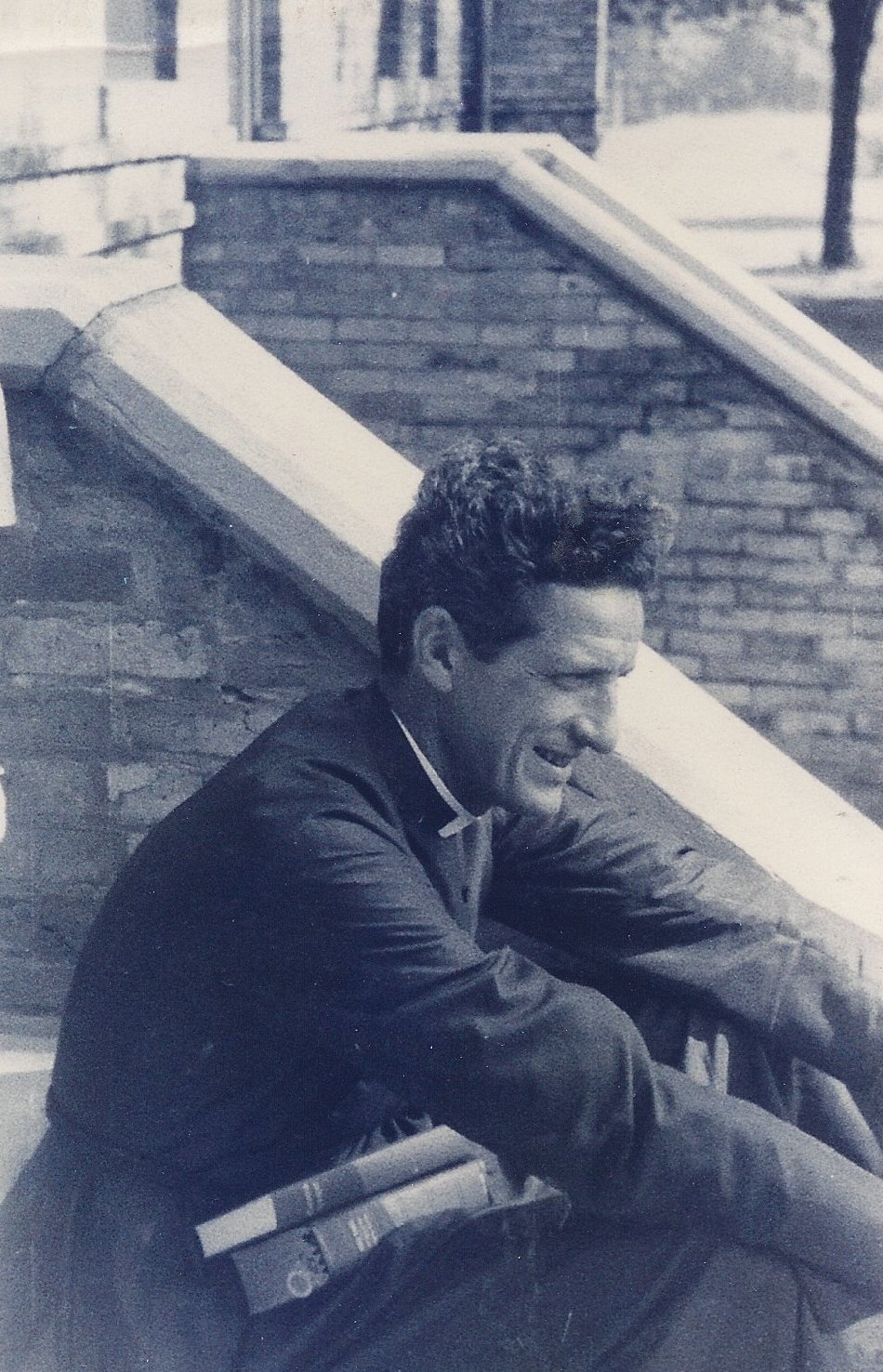
My grandfather, J. Rodger McColl, is pictured above. He grew up at St. Martin’s Church on the west side of Chicago, attended Western Theological Seminary (later Seabury-Western) in the 1930s, was the chaplain at the Chapel of St. John the Divine in Champaign-Urbana, Illinois in the 1940s, and served as rector of St. Augustine’s in Wilmette, Illinois in the early 1950s.

He was a fit person for the ministry of Word and Sacrament, even though that ministry ended in heartbreak for my family. He was deposed from the priesthood after having an affair with a woman in his parish, and sent to New York City — ostensibly to work for the National Church, but really to avoid scandal. He died in 1954, very shortly after arriving in New York, and it was discovered that he had a massive brain tumor. My grandmother (and later, my aunt) tried in vain to have him reinstated, but the Church denied their pleas. My grandmother was cut off from his pension, and I believe she never darkened the door of a church again. In the files of the Episcopal Church, there is only one piece of paper about him — it is as if he never existed.

There is no doubt that he should have been removed from his ministry; I taught for nearly 15 years on preventing sexual misconduct in church settings, and I believe that we must be clear and firm about protecting people from harm.

But people are never just one thing, never one-dimensional cardboard characters.

The day after he died, my grandmother received a postcard from one of his former parishioners with the following poem:

Prayer for Rodger – Remembering my First Confession

O flawless Christ,
redeem this man
whose gentle hand
briefly held the bleak world back;
whose cool clasp steadied, encouraged,
and retrieved me
from the beaten edge
of oft-repeated sins;
whose constant gaze
upon Thy face
gave forth such a light,
Earth’s curtain lifted,
and there, all-bright,
was heaven.
Find him
the peace he found for me. Amen.

Pray during these Ember Days that the Church may find persons fit for the ministry because of their constant gaze on Christ and suitable because of their steady, encouraging gentleness. Pray, too, that we may uphold them, sinners just like we are, in the redeeming work God calls them to.

Hasten the coming of your kingdom

kingdom-of-heaven2

O God, you have made of one blood all the peoples of the earth, and sent your blessed Son to preach peace to those who are far off and to those who are near: Grant that people everywhere may seek after you and find you; bring the nations into your fold; pour out your Spirit upon all flesh; and hasten the coming of your kingdom; through Jesus Christ our Lord. Amen. (BCP 100)

Morning Prayer on Thursdays has a baptismal flavor.

After the Old Testament reading on Thursdays, we say or sing Canticle 8: The Song of Moses, in which we praise God for saving the people of Israel at the Red Sea. For Christians, the Exodus story is especially linked with the Easter Vigil and baptism.

At the Vigil, we retell the Exodus story and make it our own, singing in the Exsultet that “this is the night when Christ broke the bonds of death and hell.” The Easter Vigil has been, since the earliest days of the church, the time when new Christians are baptized.

The Prayer for Mission above reflects that same baptismal emphasis. It is our prayer that everyone will come through the waters of salvation, that everyone will enjoy new life, that everyone will be filled with God’s spirit, that God’s kingdom, already here in part, will become fully realized.

The writer of the letter to the Hebrews describes the kingdom as “sabbath rest” in the passage appointed for today. He suggests that the way is still open for us to enter into God’s rest, to enjoy life and peace in the kingdom of God.

He writes, quoting Psalm 95, “Today, if you hear his voice, do not harden your hearts” (Heb. 4:7). Every day we begin Morning Prayer with that same sense of urgency.

Come on in, the water is fine! Bring your friends, too! Don’t wait — jump on in!

The Word who is trustworthy

[A bishop] must have a firm grasp of the word that is trustworthy in accordance with the teaching, so that he may be able both to preach with sound doctrine and to refute those who contradict it. (Titus 1:9)

The Episcopal Diocese of Fond du Lac, where I serve as a deacon, is preparing to elect a new bishop. Our bishop, Russ Jacobus, has announced his retirement, and the Standing Committee is working on a diocesan profile so share with those who are eventually nominated. The election will take place in October.

Already this year, we have had several survey days for members of the diocese to discuss what is required (and desired) in a bishop, and what is required of each of us as members of Christ’s Body, the Church.

“Having a firm grasp of the word that is trustworthy …” is an awfully good place to start.

One of the particular treasures of the Daily Office is that it soaks you in Scripture. You can’t help it — as you follow the Daily Office lectionary, you read all 150 Psalms every seven weeks, the New Testament in the course of a year, and the Old Testament over the course of two years.

But even more than that, in the Daily Office you read Scripture in the context of worship, in the context of prayer, in the context of a living relationship with Jesus, the Word who himself is trustworthy.

“I myself have seen and have testified that this is the Son of God,” says John the Baptist in tonight’s Gospel reading (John 1:34).

It’s not just bishops who need to be able to “preach with sound doctrine.” All of us bear witness to the love we have known in Jesus, the love revealed on every page of the Scriptures and in every canticle and collect of the Daily Office.

I have seen and have testified to the Word who is trustworthy. You can trust him, too.

God hates nothing God has made

Pinned Insects

Collect for Ash Wednesday

Almighty and everlasting God, you hate nothing you have made and forgive the sins of all who are penitent: Create and make in us new and contrite hearts, that we worthily lamenting our sins and acknowledging our wretchedness, may obtain of you, the God of all mercy, perfect remission and forgiveness; through Jesus Christ our Lord, who lives and reigns with you and the Holy Spirit, one God, for ever and ever. Amen. (BCP 217)

+ + + + +

Since late last year, following a serious lack of judgment at a company event, I have been on a disciplinary plan at work and have been seeing a counselor through our Employee Assistance Program.

Having my failings made visible is really uncomfortable — the first image that comes to my mind is an insect pinned to a board — but the process of dealing with the issues openly and with help from other people has led to some long-overdue changes in my life.

The writer of the letter to the Hebrews speaks of discipline in the reading appointed for today.

Endure trials for the sake of discipline … [God] disciplines us for our good, in order that we may share his holiness. Now, discipline always seems unpleasant at the time, but later it yields the peaceful fruit of righteousness to those who have been trained by it (Hebrews 12:7, 10-11).

On Ash Wednesday, we rehearse the heart of the Christian message about sin and forgiveness.

God hates nothing God has made, even though we fall short of the mark again and again.

When we confess our sins and get them out in the open, when we allow others to help us deal with our failings, we open ourselves up to receive from “the God of all mercy, perfect remission and forgiveness.”

Having received forgiveness, having been trained by discipline (not just once, but as often as it takes!), we in turn extend that forgiveness to those around us.

Yes, we are mortal — ashes to ashes, dust to dust — but we are God’s. “He himself has made us, and we are his” (Jubilate, BCP 83).

God hates nothing God has made, and God forgives the sins of all who are penitent.

Unworthy as I am, you will save me,
in accordance with your great mercy,
and I will praise you without ceasing all the days of my life.
For all the powers of heaven sing your praises,
and yours is the glory to ages of ages. Amen.
(Canticle 14, BCP 91)


Children of promise and purpose

20130206-062146.jpg

He promised to show mercy to our fathers
and to remember his holy covenant.
This was the oath he swore to our father Abraham,
to set us free from the hands of our enemies,
Free to worship him without fear,
holy and righteous in his sight
all the days of our life.
(Canticle 16, BCP 92)

In the passage from Paul’s letter to the Galatians appointed for this morning, the apostle quotes the same passage we read today from the Book of Isaiah.

The prophet uses the image of a childless woman being blessed with children to symbolize Israel’s restoration to God’s favor. Paul extends the metaphor, widening the circle to include “children of the promise,” that is, the Gentiles (Gal. 4:23).

Like Isaac, who was born as a sign of God’s promise to Abraham, the Gentiles are also heirs of that promise. Paul’s extended argument is to remind the Galatians that their hope rests on God’s promise, not on observance of the law. Or, as he puts it elsewhere, “since all have sinned and fall short of the glory of God, they are now justified by his grace as a gift, through the redemption that is in Christ Jesus” (Romans 3:23-24).

In the Collect for Grace, usually read on Wednesday mornings, we not only thank God for bringing us “in safety to this new day” but also go on to ask that he “direct us to the fulfilling of [his] purpose; through Jesus Christ our Lord” (BCP 100).

We seek to be “holy and righteous in God’s sight” because of our gratitude at being children of the promise. We then go on to use the gifts God has given us as children of purpose, whose mission is to bring ever more people within the reach of Christ’s saving embrace.

Until Christ is formed in you

At last night’s awards dinner for our sales team, our newly-hired VP introduced himself and invited us to connect what we do with people. When we keep in mind the people we ultimately serve, he said, we will do our work with passion.

My company sells software to hospitals that helps eliminate wasted time and motion and ultimately ensures that people who need a bed can get into it sooner. Whenever we hear the siren of an ambulance — as we did, coincidentally, in the middle of our VP’s address to us — we can call to mind our purpose.

My little children, for whom I am again in the pain of childbirth until Christ is formed in you, I wish I were present with you now and could change my tone, for I am perplexed about you. (Galatians 4:19-20)

One of the reasons Paul’s letters are still such a powerful inspiration some 2,000 years later is the very human voice that shines through. Paul may be boastful, but he is completely dedicated to the task of nurturing his children in faith.

His letter to the Galatians is a window into the mind of a man perplexed that the Galatians seem to be forgetting the freedom he preached in Christ. They are turning back to their old ways, and he cannot rest “until Christ is formed in them.”

What purpose keeps you from resting until the people you serve receive what they need?

If the Son makes you free

Lord, you now have set your servant free
to go in peace as you have promised;
For these eyes of mine have seen the Savior,
whom you have prepared for all the world to see:
A Light to enlighten the nations,
and the glory of your people Israel.
(Nunc dimittis, BCP 120)

The Scripture readings appointed for Morning Prayer on this Feast of the Presentation of Our Lord Jesus Christ in the Temple (that’s a mouthful!) all point to the freedom represented by the infant son of Mary and Joseph.

The Psalmist takes us back to the perennial complaint: “Why are you so full of heaviness, O my soul, and why are you so disquieted within me?” (Ps. 42:1).

Both Hannah’s song (1 Samuel 2) and Zechariah’s song (Canticle 16, BCP 92) point to a child as the symbol of God’s saving action in the world.

In Hannah’s song, sung in her joy after she has become pregnant, God is the one who “makes poor and makes rich, he brings low, he also exalts. He raises up the poor from the dust; he lifts up the needy from the ash-heap, to make them sit with princes and inherit a seat of honor” (1 Sam. 2:7-8).

Zechariah, the father of John the Baptist, sings a song to God and to his infant son: “You, my child, shall be called a prophet of the Most High, for you will go before the Lord to prepare his way, to give his people knowledge of salvation by the forgiveness of their sins” (BCP 92).

And the one presented in the Temple this day?

As an adult, Jesus invites the Jews who had believed in him to understand that the truth will set them free. The Son, the true Son of God, has come to set all people free from their slavery to sin. Our souls no longer need be heavy. We will know salvation by the forgiveness of our sins.

“So if the Son makes you free, you will be free indeed” (John 8:36).

That’s a promise worth singing about!