Category Archives: Daily Office

Beloved, we are God’s children now

20130116-061532.jpg

See what love the Father has given us, that we should be called children of God; and that is what we are. The reason the world does not know us is that it did not know him. Beloved, we are God’s children now; what we will be has not yet been revealed. What we do know is this: when he is revealed, we will be like him, for we will see him as he is. And all who have this hope in him purify themselves, just as he is pure …. This is how we know what love is: Jesus Christ laid down his life for us. And we ought to lay down our lives for our brothers and sisters. If anyone has material possessions and sees a brother or sister in need but has no pity on them, how can the love of God be in that person? Dear children, let us not love with words or speech but with actions and in truth.
(1 John 3:1-3; 16-18)

I taught sexual misconduct prevention in the Dioceses of Chicago and Milwaukee from the beginning of the Church Insurance Company’s mandates about 20 years ago. This passage from the First Letter of John formed part of the prayer I used to open training sessions for more than a dozen years.

The first year of training was really tough and stressful — the sexual abuse of children is a subject no one wants to talk about, but clergy and vestry and lay leaders were required to attend training, and (frankly) the training was pretty awful. It was heavy on statistics and risk and insurance riders and mandated reporting and penalties. Every time I taught, the tension in the room was so palpable that I ended up with a crippling headache.

Sometime in that first year of trainings, though, I came across the new Rule of the Society of St. John the Evangelist, an Episcopal monastic order in Cambridge, MA. It was (at the time) a fresh, new rewriting of the Society’s original Rule. As I read it more deeply, I came to understand that the SSJE Rule is really an extended meditation on right relationship.

That understanding transformed the way I taught. Rather than teaching about our failures (or potential failures), my colleagues and I began to articulate a vision for what right relationship with young people and adults might look like. “If we do ministry in the light,” one priest observed, “then attempts at secrecy or abuse stand out by contrast.”

“Beloved, we are now God’s children.” As God’s children, how should we live with one another?

Aiming for right relationship doesn’t mean that we are already perfect, but it does mean that when we fail, we recommit ourselves to the high standard. “See what love the Father has given us, that we should be called children of God … and we ought to lay down our lives for our brothers and sisters.”

+ + + + +

Gracious God, you see your children growing up in an unsteady and confusing world: Give us calm strength and patient wisdom as we bring them up, that we may guard them from harm, and teach them to love whatever is just, and true, and good; following the example of our Lord and Savior Jesus Christ. Amen.
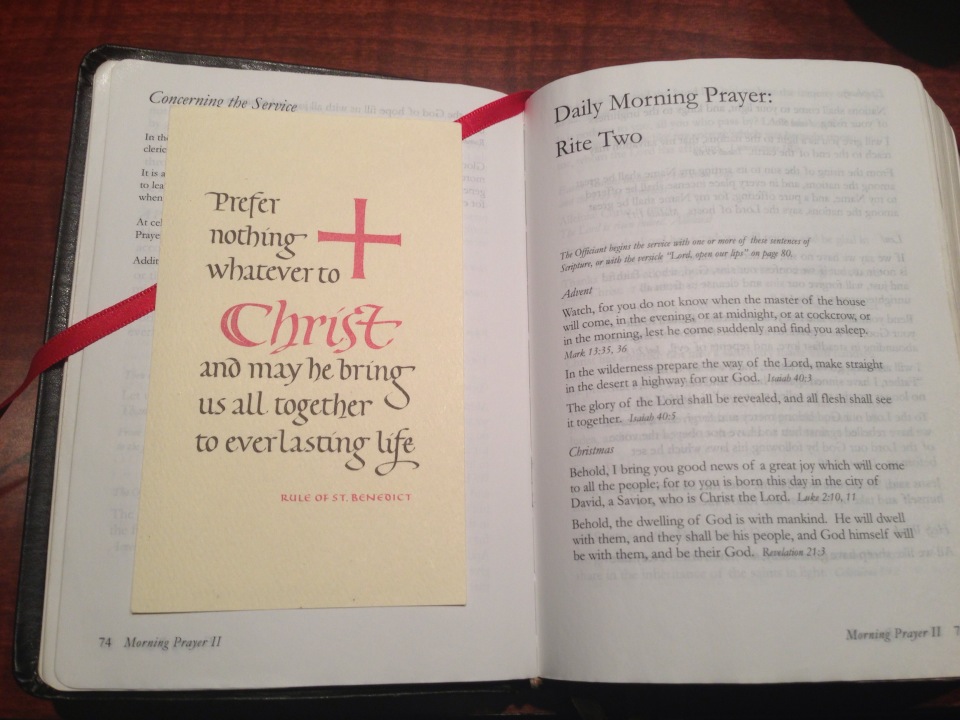

Prefer nothing whatever to Christ

Prefer Nothing to Christ

A member of my parish offers reflections on his Healing Journey Daily Blog on Facebook, and I appreciate his post yesterday from Oswald Chambers reflecting on Paul’s insight into Christ and his determination to “know nothing among you except Christ, and him crucified” (1 Cor 2:2).

Chambers says, “The lasting characteristic of a spiritual man is the ability to understand correctly the meaning of the Lord Jesus Christ in his life, and the ability to explain the purposes of God to others. The overruling passion of his life is Jesus Christ. Whenever you see this quality in a person, you get the feeling that he is truly a man after God’s own heart” (My Utmost for His Highest).

One of the lenses that helps me find insight into Christ is the Prayer Book pattern of orderly prayer — especially the Daily Offices — which was inspired in large part by the monastic pattern established by Benedict in the sixth century.

“Prefer nothing whatever to Christ,” says Benedict, “and may he lead us all together into everlasting life” (Rule 72). The Rule, the pattern of prayer, study, and work that Benedict established for his monks, was intended to free them from distractions and enable them to focus on worshiping God.

In a similar way, the Prayer Book pattern of Daily Offices and weekly Eucharist is intended to shape our lives and help us maintain our focus on the face of Christ in the face of a very distracting world. It doesn’t matter whether you use the Prayer Book itself or the online offices from Forward Movement or Mission St. Clare or some other daily devotional; all of them promote the same rhythmic, steady, daily approach to prayer.

If our guides are doing their work — Chambers or Benedict or the Prayer Book or any other guide — they help us understand how Christ is present in our lives right now, and they encourage us to share that insight with others.

May we prefer nothing whatever to Christ, and may he lead us all into everlasting life. Amen.

Cast your fate to the wind

After an early alarm and the drive to Norfolk International Airport, I was able to catch a breath in the Starbuck’s before going through security. This was part of the background music to Morning Prayer today.

Vince Guaraldi is a favorite of mine, and this song, “Cast Your Fate to the Wind,” dovetailed nicely with the reading from Acts.

“Now when they saw the boldness of Peter and John and realized they were uneducated and ordinary men, they were amazed and recognized them as companions of Jesus” (Acts 4:13). It’s the boldness of their act, healing a man in the name of Jesus, that makes them recognizable.

They recount to their friends what has happened, not just the healing but their testimony before the chief priests and the elders, and “when they had prayed, the place in which they gathered together was shaken; and they were all filled with the Holy Spirit and spoke the word of God with boldness” (Acts 4:31).

The apostles and their friends cast their fate to the wind — that is, to the mighty Spirit of God that hovered over the waters of creation and was now blowing through their lives — and that Holy Spirit not only inspired them to boldness but also made them recognizable friends of Jesus.

Why not cast your fate to the wind, to the Spirit of God, today? What bold act will make you a recognizable friend of Jesus?

It’s still beautiful

Local Hero

The film Local Hero is the story of a Texas oilman sent to Scotland to buy a fishing village so his company can put up a refinery. As the villagers dream about becoming millionaires, the oilman begins to fall in love with the peace and quiet.

The oilman’s Scottish partner, Danny, is also falling in love. Marina is a mysterious figure, a lovely marine biologist with an enigmatic manner.

After the ceilidh celebrating the conclusion of the deal, Danny and Marina are out on the beach looking at the Northern Lights.

Danny: Holy mackerel! What’s happening?
Marina: That’s just the Northern Lights, Aurora Borealis. High-energy protons spilling over into our atmosphere. They get through the magnetic shield where it’s weak, at the poles.
Danny: It’s still beautiful, I don’t care what you call it. How often does this happen?
Marina: Any old time, although it’s best when the sun’s active. That gets the solar wind up and that’s where the protons come from.
Danny: You say the darnedest things, Marina.

We have another Danny in today’s Daily Office readings, and he’s the one saying to God, “You say the darnedest things.”

I heard but could not understand, so I said, “My lord, what shall be the outcome of these things?” He said, “Go your way, Daniel, for the words are to remain secret and sealed until the time of the end. Many shall be purified, cleansed, and refined, but the wicked shall continue to act wickedly. None of the wicked shall understand, but those who are wise shall understand.” (Daniel 12:8-10)

From our Easter perspective we know the meaning behind the signs. As Julian of Norwich says of Christ, “Know it well; love was his meaning.”

It’s easy to get tangled up and confused in speculations about dates and times and the mechanics of how God acts in history. It’s easy to lose sight of the meaning — God’s love for us, reaching down and remembering us “in our low estate” (Psalm 136:23).

As our first Danny says, “It’s still beautiful, I don’t care what you call it.”

Can these bones live?

20130404-061327.jpg

The Old Testament reading for Morning Prayer today comes from the book of Ezekiel, the “dry bones” story that we heard just a few nights ago during the Great Vigil of Easter.

Ezekiel is led in a vision to a valley full of bones, and God tells him to prophesy to the bones. Bones come together, sinews knit them up, flesh covers them, but there is no breath in them.

God commands again, and breath enters the bodies, “and they lived, and stood on their feet, a vast multitude” (Ezekiel 37:10).

God ends by saying “And you shall know that I am the Lord, when I open your graves, and bring you up from your graves, O my people. I will put my spirit within you, and you shall live, and I will place you on your own soil; then you shall know that I, The Lord, have spoken and will act, says the Lord” (37:14).

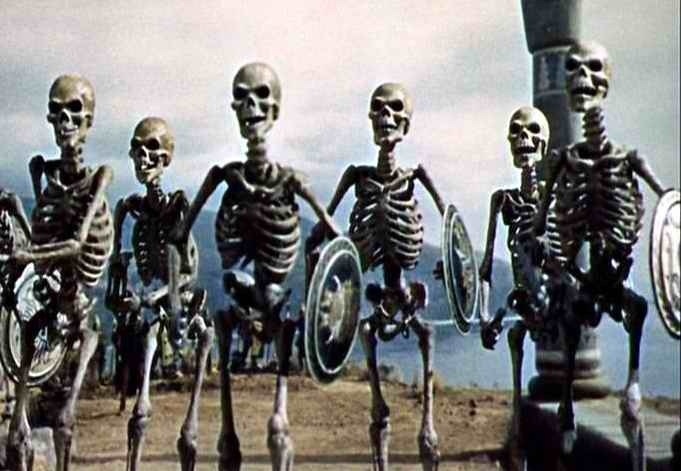
I couldn’t help thinking of the skeleton warriors from the movie Jason and the Argonauts, created so memorably by Ray Harryhausen in early stop-motion animation.

However, these fighting skeletons are not the living people of Ezekiel’s vision. We call it the “dry bones” story, but it’s really the “reborn people” story. That’s why it’s part of our Easter Vigil readings each year.

It seems to me that too many of us get stuck halfway — we are dried up, but we can at least move and fight and defend ourselves, and we are terrible to each other.

However, we are called to more, much more. Through the gift of God’s Spirit, we can live as reborn people, not just as dry bones.

Heavenly Father, in you we live and move and have our being: We humbly pray you so to guide and govern us by your Holy Spirit, that in all the cares and occupations of this life we may not forget you, but may remember that we are ever walking in your sight; through Jesus Christ our Lord. Amen. (BCP 100)

Walk this way

Though the Lord may give you the bread of affliction, yet your Teacher will not hide himself any more, but your eyes shall see your Teacher. And when you turn to the right or when you turn to the left, your ears shall hear a word behind you, saying, “This is the way; walk in it.” (Isaiah 30:20-21)

Acolytes

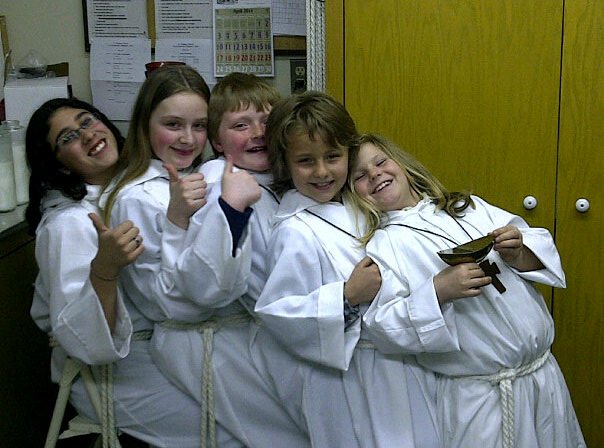
At the Great Vigil of Easter this year, one of our youngest acolytes graduated from boat-bearer to crucifer.

The Great Vigil, as I’m sure you know, is one of the most complicated services of the Church Year. Everything’s backwards!

The crucifer doesn’t go first; the deacon does. The torches don’t follow the crucifer; they follow the Paschal Candle. The altar party doesn’t sit up in the sanctuary; they sit in the front pews.

However, she wasn’t nervous at all. Our acolyte master was right behind her during the entire service, giving her gentle guidance about where to go next and reassuring her that she was doing a great job.

She came and found me in the sacristy on Easter morning, excited to ask when she could serve as crucifer again. “And next time, could I do it mostly by myself? But, you know, with someone to remind me in case I need it?”

“This is the way,” says our Teacher Jesus, the Risen Christ. “Walk in it.”

Christ our Passover

Painting by Mark Lawrence

Jesus Christ the Lamb of God + Painting by Mark Lawrence

Christ our Passover   Pascha nostrum

Alleluia. Christ our Passover has been sacrificed for us;
therefore let us keep the feast,
Not with the old leaven, the leaven of malice and evil,
but with the unleavened bread of sincerity and truth. Alleluia.

Christ being raised from the dead will never die again;
death no longer has dominion over him.
The death that he died, he died to sin, once for all;
but the life he lives, he lives to God.
So also consider yourselves dead to sin,
and alive to God in Jesus Christ our Lord. Alleluia.

Christ has been raised from the dead,
the first fruits of those who have fallen asleep.
For since by a man came death,
by a man has come also the resurrection of the dead.
For as in Adam all die,
so also in Christ shall all be made alive. Alleluia. (BCP 83)

Rejoice now!

Exsultet at Holy Communion

This is the night, when you brought our fathers, the children of Israel,
out of bondage in Egypt, and led them through the Red Sea on dry land.

This is the night, when all who believe in Christ
are delivered from the gloom of sin,

and are restored to grace and holiness of life.

This is the night, when Christ broke the bonds of death and hell,
and rose victorious from the grave.

+ + + + +

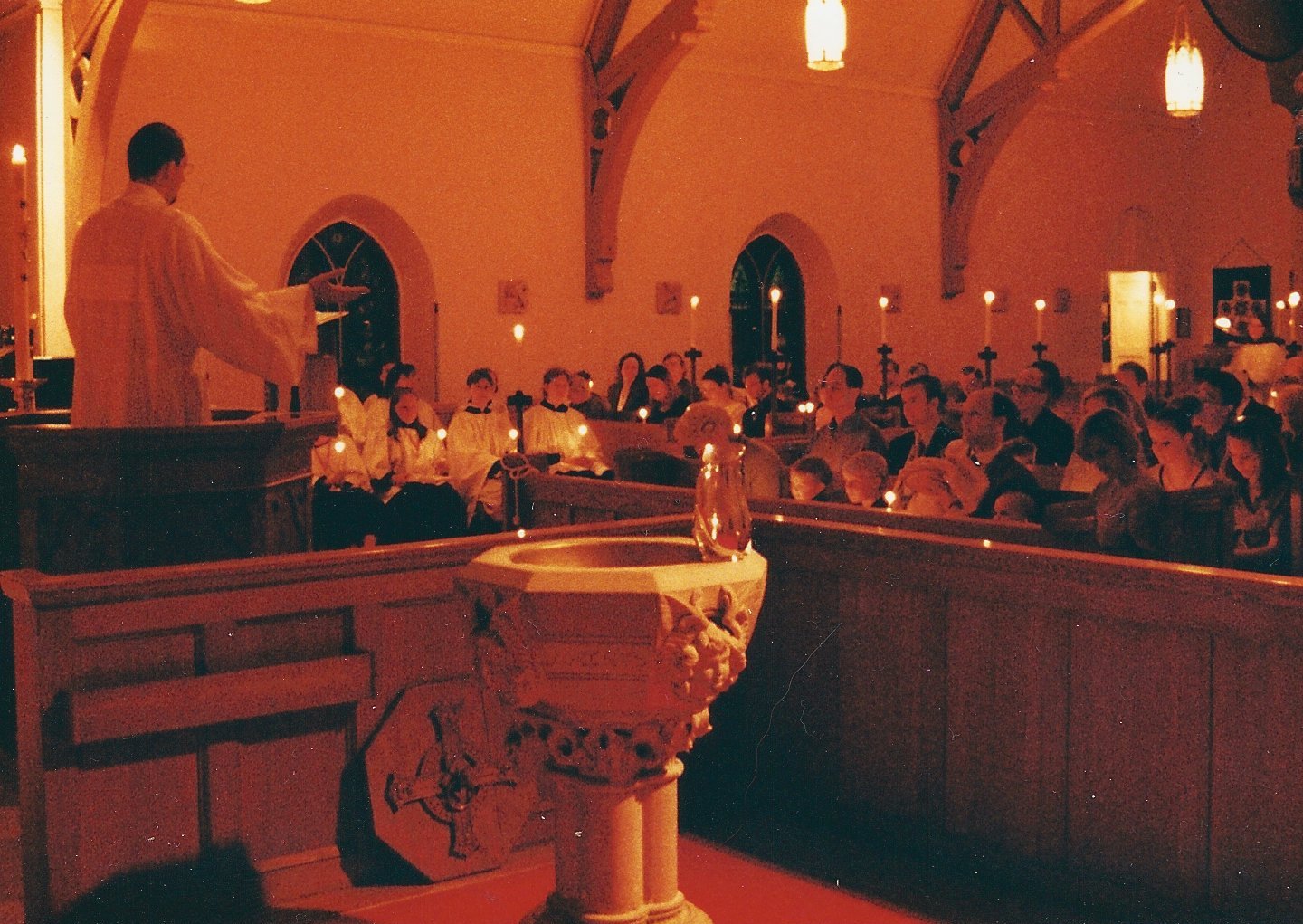
At the Great Vigil of Easter tonight, we will renew our Baptismal Vows (BCP 292) in much the same fashion as early catechumens “handed back the creed” before their baptism in a series of questions and answers with the bishop, who had taught them in a series of sermons in the weeks leading up to Easter.

After the vigil readings and their questioning, the catechumens were led to the baptismal pool and immersed three times “in the Name of the Father, and of the Son, and of the Holy Spirit.” They were then anointed with oil, clothed in a garment of white linen, and brought back into the church to receive communion for the first time. According to Robert Louis Wilken, “At their first Eucharist they received a cup of milk and honey, and during Easter Week they attended services in their white garments” (Spirit of Early Christian Thought 39).

That same spirit of joy permeates both the Eucharist and the Daily Office not just tonight and tomorrow, but throughout the Great 50 Days of Easter.

Not only do we adorn the Eucharist with white vestments and altar hangings, we also sing Alleluias throughout the service.

Not only do we begin and end the Office with Alleluias, we also say the Invitatory canticle “Christ our Passover” (BCP 83) every morning, and we “hand back the creed” — the Apostles’ Creed — as a daily reminder of our dying and rising with Christ and our baptismal unity with the apostles.

+ + + + +

How holy is this night, when wickedness is put to flight,
and sin is washed away.

It restores innocence to the fallen, and joy to those who mourn.
It casts out pride and hatred, and brings peace and concord.

How blessed is this night, when earth and heaven are joined,
and we are reconciled to God.

The means of grace and the hope of glory

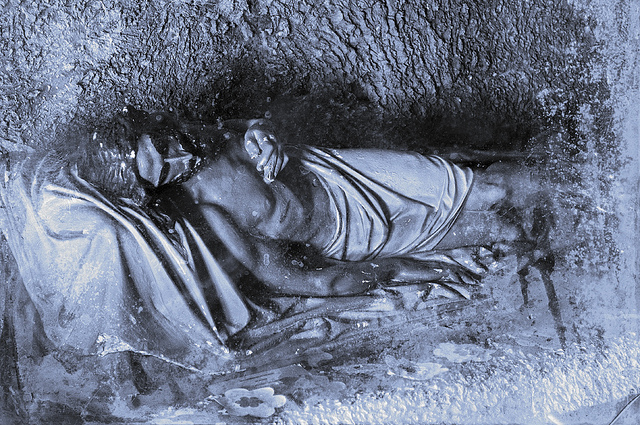
Christ in the Tomb. Image based on a sculpture found at the Shrine of Our Lady of Sorrows in Starkenburg, Missouri. Photo by Mark S. Abeln.

Jesus is dead.

The cross has done its work. Jesus is dead.

His secret followers have laid him in a tomb. Jesus is dead.

Today there is nothing but prayer, Sabbath prayer to the God of creation.

Today “the whole creation waits with eager longing” (Rom. 8:19) to be set free from its bondage to decay.

The cross, “the means of grace,” has done its work, but for today there is only “the hope of glory” (BCP 100).

Today there is only the tomb.

Jesus is dead.

So knit thou our friendship up

Draw Us In the Spirit’s Tether (Percy Dearmer)

Draw us in the Spirit’s tether;
For when humbly, in thy name,
Two or three are met together,
Thou art in the midst of them:
Alleluya! Alleluya! Touch we now thy garment’s hem.

As the brethren used to gather
In the name of Christ to sup,
Then with thanks to God the Father
Break the bread and bless the cup,
Alleluya! Alleluya! So knit thou our friendship up.

All our meals and all our living
Make us sacraments of thee,
That by caring, helping, giving,
We may true disciples be.
Alleluya! Alleluya! We will serve thee faithfully.

In The Spirit of Early Christian Thought (Yale 2003), Robert Louis Wilken suggests that Christian theology begins, first of all, with the disciples’ experience of meeting the Risen Christ in the shared meal of bread and wine.

Through his passion, death, and resurrection Jesus overcomes death and reconciles us to God. In communion with one another, we disciples find ourselves living a new life in Christ.

In the services of Holy Week, we “knit our friendship up” with Christ by immersing ourselves in his last days of self-offering love. I invite you to enter into the events around the Last Supper this Maundy Thursday “as the brethren used to gather in the name of Christ to sup.”

May this communion strengthen your friendship with the Risen Christ.