
Author Archives: Rodger Patience

Unknown's avatar

About Rodger Patience

I am an Episcopal priest, and I am a person in recovery. My aim is to build hope in everything I do.

Can these bones live?

20130404-061327.jpg

The Old Testament reading for Morning Prayer today comes from the book of Ezekiel, the “dry bones” story that we heard just a few nights ago during the Great Vigil of Easter.

Ezekiel is led in a vision to a valley full of bones, and God tells him to prophesy to the bones. Bones come together, sinews knit them up, flesh covers them, but there is no breath in them.

God commands again, and breath enters the bodies, “and they lived, and stood on their feet, a vast multitude” (Ezekiel 37:10).

God ends by saying “And you shall know that I am the Lord, when I open your graves, and bring you up from your graves, O my people. I will put my spirit within you, and you shall live, and I will place you on your own soil; then you shall know that I, The Lord, have spoken and will act, says the Lord” (37:14).

I couldn’t help thinking of the skeleton warriors from the movie Jason and the Argonauts, created so memorably by Ray Harryhausen in early stop-motion animation.

However, these fighting skeletons are not the living people of Ezekiel’s vision. We call it the “dry bones” story, but it’s really the “reborn people” story. That’s why it’s part of our Easter Vigil readings each year.

It seems to me that too many of us get stuck halfway — we are dried up, but we can at least move and fight and defend ourselves, and we are terrible to each other.

However, we are called to more, much more. Through the gift of God’s Spirit, we can live as reborn people, not just as dry bones.

Heavenly Father, in you we live and move and have our being: We humbly pray you so to guide and govern us by your Holy Spirit, that in all the cares and occupations of this life we may not forget you, but may remember that we are ever walking in your sight; through Jesus Christ our Lord. Amen. (BCP 100)

Walk this way

Though the Lord may give you the bread of affliction, yet your Teacher will not hide himself any more, but your eyes shall see your Teacher. And when you turn to the right or when you turn to the left, your ears shall hear a word behind you, saying, “This is the way; walk in it.” (Isaiah 30:20-21)

Acolytes

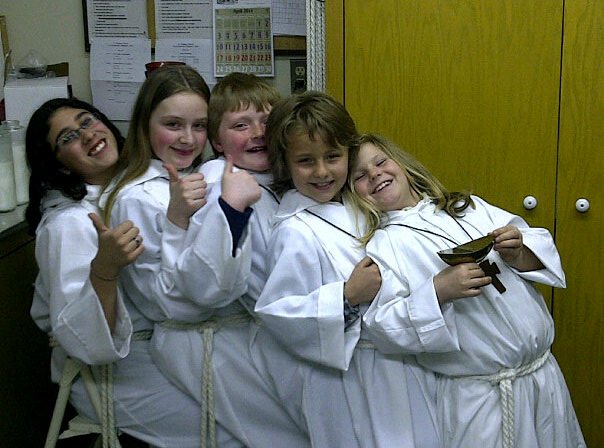
At the Great Vigil of Easter this year, one of our youngest acolytes graduated from boat-bearer to crucifer.

The Great Vigil, as I’m sure you know, is one of the most complicated services of the Church Year. Everything’s backwards!

The crucifer doesn’t go first; the deacon does. The torches don’t follow the crucifer; they follow the Paschal Candle. The altar party doesn’t sit up in the sanctuary; they sit in the front pews.

However, she wasn’t nervous at all. Our acolyte master was right behind her during the entire service, giving her gentle guidance about where to go next and reassuring her that she was doing a great job.

She came and found me in the sacristy on Easter morning, excited to ask when she could serve as crucifer again. “And next time, could I do it mostly by myself? But, you know, with someone to remind me in case I need it?”

“This is the way,” says our Teacher Jesus, the Risen Christ. “Walk in it.”

Christ our Passover

Painting by Mark Lawrence

Jesus Christ the Lamb of God + Painting by Mark Lawrence

Christ our Passover   Pascha nostrum

Alleluia. Christ our Passover has been sacrificed for us;
therefore let us keep the feast,
Not with the old leaven, the leaven of malice and evil,
but with the unleavened bread of sincerity and truth. Alleluia.

Christ being raised from the dead will never die again;
death no longer has dominion over him.
The death that he died, he died to sin, once for all;
but the life he lives, he lives to God.
So also consider yourselves dead to sin,
and alive to God in Jesus Christ our Lord. Alleluia.

Christ has been raised from the dead,
the first fruits of those who have fallen asleep.
For since by a man came death,
by a man has come also the resurrection of the dead.
For as in Adam all die,
so also in Christ shall all be made alive. Alleluia. (BCP 83)

Rejoice now!

Exsultet at Holy Communion

This is the night, when you brought our fathers, the children of Israel,
out of bondage in Egypt, and led them through the Red Sea on dry land.

This is the night, when all who believe in Christ
are delivered from the gloom of sin,

and are restored to grace and holiness of life.

This is the night, when Christ broke the bonds of death and hell,
and rose victorious from the grave.

+ + + + +

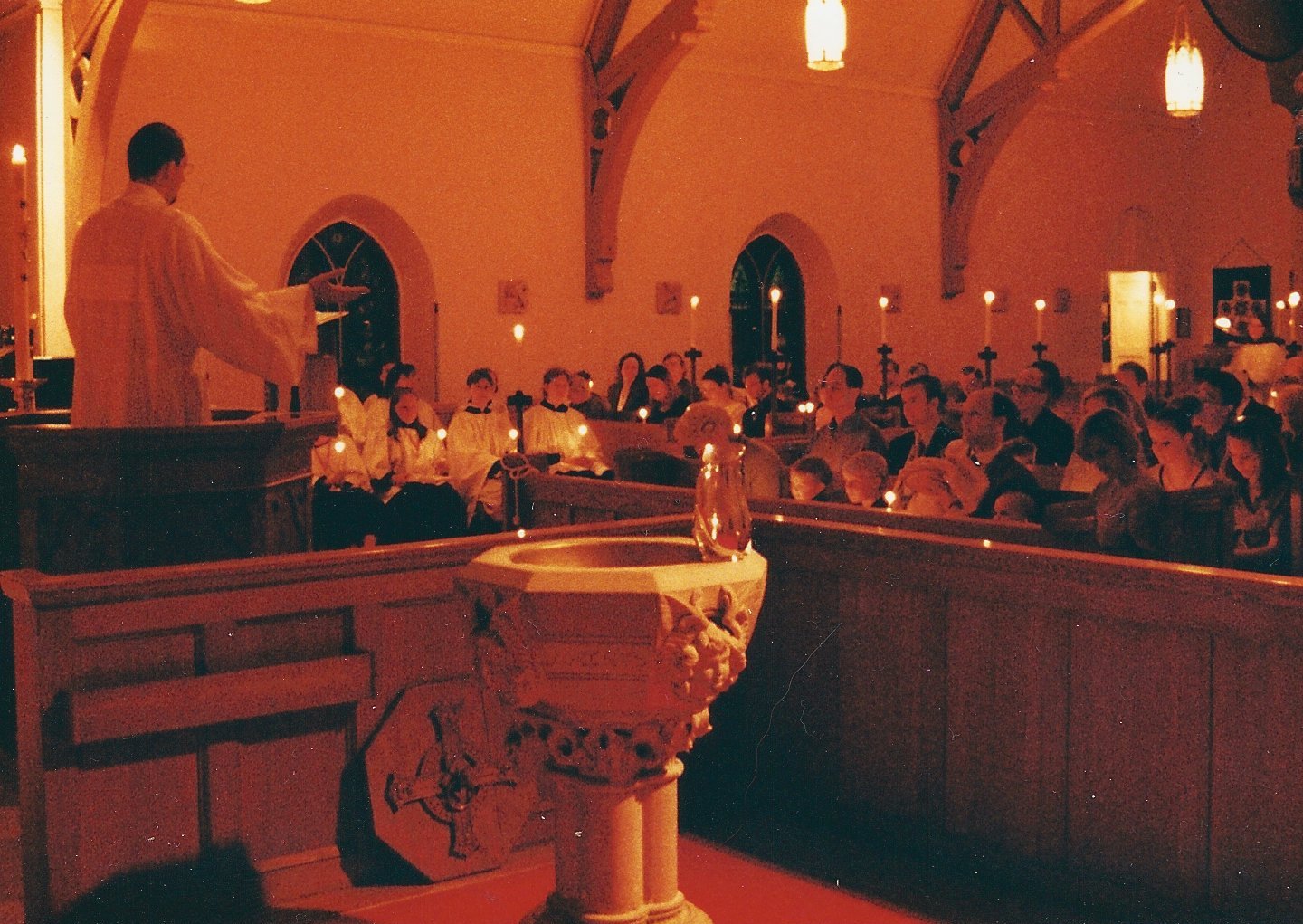
At the Great Vigil of Easter tonight, we will renew our Baptismal Vows (BCP 292) in much the same fashion as early catechumens “handed back the creed” before their baptism in a series of questions and answers with the bishop, who had taught them in a series of sermons in the weeks leading up to Easter.

After the vigil readings and their questioning, the catechumens were led to the baptismal pool and immersed three times “in the Name of the Father, and of the Son, and of the Holy Spirit.” They were then anointed with oil, clothed in a garment of white linen, and brought back into the church to receive communion for the first time. According to Robert Louis Wilken, “At their first Eucharist they received a cup of milk and honey, and during Easter Week they attended services in their white garments” (Spirit of Early Christian Thought 39).

That same spirit of joy permeates both the Eucharist and the Daily Office not just tonight and tomorrow, but throughout the Great 50 Days of Easter.

Not only do we adorn the Eucharist with white vestments and altar hangings, we also sing Alleluias throughout the service.

Not only do we begin and end the Office with Alleluias, we also say the Invitatory canticle “Christ our Passover” (BCP 83) every morning, and we “hand back the creed” — the Apostles’ Creed — as a daily reminder of our dying and rising with Christ and our baptismal unity with the apostles.

+ + + + +

How holy is this night, when wickedness is put to flight,
and sin is washed away.

It restores innocence to the fallen, and joy to those who mourn.
It casts out pride and hatred, and brings peace and concord.

How blessed is this night, when earth and heaven are joined,
and we are reconciled to God.

The means of grace and the hope of glory

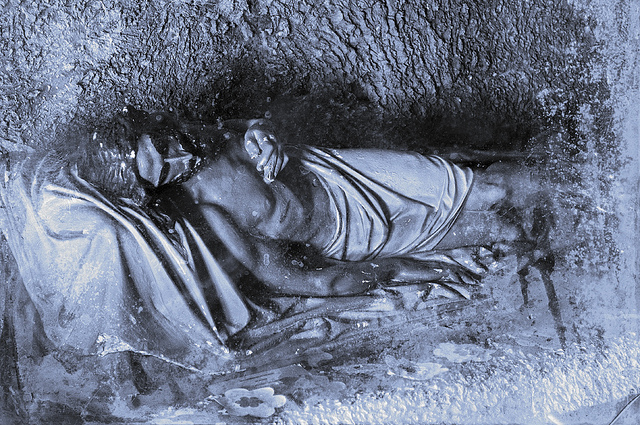
Christ in the Tomb. Image based on a sculpture found at the Shrine of Our Lady of Sorrows in Starkenburg, Missouri. Photo by Mark S. Abeln.

Jesus is dead.

The cross has done its work. Jesus is dead.

His secret followers have laid him in a tomb. Jesus is dead.

Today there is nothing but prayer, Sabbath prayer to the God of creation.

Today “the whole creation waits with eager longing” (Rom. 8:19) to be set free from its bondage to decay.

The cross, “the means of grace,” has done its work, but for today there is only “the hope of glory” (BCP 100).

Today there is only the tomb.

Jesus is dead.

So knit thou our friendship up

Draw Us In the Spirit’s Tether (Percy Dearmer)

Draw us in the Spirit’s tether;
For when humbly, in thy name,
Two or three are met together,
Thou art in the midst of them:
Alleluya! Alleluya! Touch we now thy garment’s hem.

As the brethren used to gather
In the name of Christ to sup,
Then with thanks to God the Father
Break the bread and bless the cup,
Alleluya! Alleluya! So knit thou our friendship up.

All our meals and all our living
Make us sacraments of thee,
That by caring, helping, giving,
We may true disciples be.
Alleluya! Alleluya! We will serve thee faithfully.

In The Spirit of Early Christian Thought (Yale 2003), Robert Louis Wilken suggests that Christian theology begins, first of all, with the disciples’ experience of meeting the Risen Christ in the shared meal of bread and wine.

Through his passion, death, and resurrection Jesus overcomes death and reconciles us to God. In communion with one another, we disciples find ourselves living a new life in Christ.

In the services of Holy Week, we “knit our friendship up” with Christ by immersing ourselves in his last days of self-offering love. I invite you to enter into the events around the Last Supper this Maundy Thursday “as the brethren used to gather in the name of Christ to sup.”

May this communion strengthen your friendship with the Risen Christ.

Confident of the glory

The psalmist captures perfectly how we feel when we discover we are not in agreement on a particular issue, or that we are even working at cross purposes. We feel betrayed and deceived.

For had it been an adversary who taunted me,
then I could have borne it;
or had it been an enemy who vaunted himself against me,
then I could have hidden from him.

But it was you, a man after my own heart,
my companion, my own familiar friend.

We took sweet counsel together,
and walked with the throng in the house of God.
(Psalm 55:13-15)

How can someone I thought I knew think so differently from me? If we don’t share these attitudes or opinions, what do we actually have in common?

Holy Week teaches us exactly what we have in common — the passion, death, and glorious resurrection of Jesus Christ which opens to us the way of everlasting life.

Like us, Jesus had men and women after his own heart, companions, familiar friends. One betrayed him, one denied him, most of them abandoned him, and they all hid in fear when they heard he had died.

Like the disciples, forgiven for their failings by the Risen Lord, we now share in Christ’s reconciling mission and are clothed by the Holy Spirit to reach forth our hands in love and to bring those who do not know Christ into the knowledge and love of Christ (see BCP 101).

Like the disciples and Christians ever since, we “take sweet counsel together” but disagree on what we’re supposed to do next. Share the good news with Jews only, or with Gentiles, too? Require circumcision or not? Men only as teachers and leaders, or women, too? Keep the kosher food laws or not? Couch the gospel in Jewish terms or translate it into Greek philosophical terms? Become the state religion or keep being persecuted? For 2,000 years we have taken sweet counsel together and disagreed on what to do next.

Paul writes to the Philippians to encourage them not to “worry about anything, but in everything by prayer and supplication with thanksgiving let your requests be made known to God” (4:6).

When we take sweet counsel with God and with one another, we are reminded what we share in common. We are reminded that our disagreements and our partial understanding and our personal agendas pale in the face of the glory that is revealed through Christ’s suffering, death, and resurrection.

We do not have to worry — Christ is our confidence. It’s not a zero-sum game; we can embrace “whatever is true, whatever is honorable, whatever is just, whatever is pure, whatever is pleasing, whatever is commendable, if there is any excellence, and if there is anything worthy of praise” (Phil. 4:8).

When we take sweet counsel together, we may come to understand a surprising truth. Through Christ, God is continually working a new thing. Not with the power of the state, but through weakness. Not with military might or the rule of law, but by the will of the Father. Not angry over our betrayal, but forgiving even his torturers. Not condemning the weak, but giving us the Holy Spirit and sending us out in his Name.

Collect for Wednesday in Holy Week

Lord God, whose blessed Son gave his body to be whipped and his face to be spit upon: Give us grace to accept joyfully the sufferings of the present time, confident of the glory that shall be revealed; through Jesus Christ your Son our Lord, who lives and reigns with you and the Holy Spirit, one God, for ever and ever. Amen. (BCP 220)

God’s wheat, ground by the teeth of wild beasts

20130314-031452.jpg

In his spirited defense during the early brackets in Lent Madness, the Rev. David Sibley wrote this about Ignatius of Antioch, an early Bishop of Rome:

“Ignatius’ letter to the Romans expressed his firm desire to be led to his martyrdom, begging the church in Rome to let him be ‘food for the wild beasts… God’s wheat… ground by the teeth of wild beasts, so that I may prove to be pure bread’ (Rom 4:1). Around AD 115, Ignatius was granted his wish, as he was martyred in the coliseum, given over to the teeth of lions.”

In my insomnia this morning, I was thinking of the election of Pope Francis and of the extraordinary challenge he faces as the spiritual leader of more than half the world’s Christians. As quickly as a puff of white smoke, he has become not only a source of guidance and a focus of reverence, but also a lightning rod for controversy, anger, and ridicule.

Exercising spiritual leadership at any level — you don’t have to be Pope! — can feel like being “ground by the teeth of wild beasts.” It is a terrible responsibility to educate the faithful, minister to the sick, reconcile the estranged, lead the congregation in worship, and feed the hungry, and if you’re honest about your own failings you’ll know how unprepared you are.

How appropriate is Psalm 69, appointed for Morning Prayer today!

O God, you know my foolishness,
and my faults are not hidden from you.

Let not those who hope in you be put to shame through me, Lord God of hosts;
let not those who seek you be disgraced because of me, O God of Israel.
(Ps. 69:6-7)

Here’s what puts Ignatius’ martyrdom, Francis’ new role as Bishop of Rome, and our own ministries with those among whom we live, and work, and worship into perspective: We are not the bread of life. Jesus is.

We may be “God’s wheat,” but the “living bread that came down from heaven” (John 6:51) is Jesus himself. What we can do — all we can do — is give “our selves, our souls and bodies” fully to the task at hand. We unite our offering to his in order to become through him the Body of Christ, the Bread of Heaven.

God grant that we may all offer solid food, nourishing bread, faithful witness to those whom God calls us to serve.

Be still and know that I am God

My God It's Full of Stars

The heavens declare the glory of God,
and the firmament shows his handiwork.

One day tells its tale to another,
and one night imparts knowledge to another.

Although they have no words or language,
and their voices are not heard,

Their sound has gone out into all lands,
and their message to the ends of the world.

(Psalm 19:1-4)

Another travel week begins on a Sunday evening, and this layover in the Detroit airport is just about the first chance I have had to catch my breath since last Sunday.

But for now, it’s good to be still, even for a few minutes.

It’s good to pause and reflect on a solid Sunday today: two Eucharists with healing services, another lively session of “Episcopal 101” after which a young man gave me a long, handwritten list of his questions for upcoming sessions, and a thoughtful Education for Ministry (EfM) session.

It’s good to remember the warm glow of conversation over a packed dinner table with friends last night.

It’s good to have finished some work yesterday morning and to have had a Saturday afternoon to read for a bit.

It’s good to be headed out to work again, headed to work with colleagues who are good at what they do and generous with their time.

The dark outside the airport window is full of stars, though I can’t see them right now. “The heavens declare the glory of God,” as do the myriad human encounters that fill our days.

For now, it’s good to be still, even for a few minutes.

Kindle our hearts and awaken hope

theideasmithy.com


Collect for the Presence of Christ

Lord Jesus, stay with us, for evening is at hand and the day is past; be our companion in the way, kindle our hearts, and awaken hope, that we may know you as you are revealed in Scripture and the breaking of bread. Grant this for the sake of your love. Amen. (BCP 124)

+ + + + +

When I travel, I am fortunate to travel with colleagues most of the time. We enjoy eating dinner together as we discuss the coming day’s meetings and demos.

Last night, however, the meal I shared with a sales executive and our vice president took on a holier tone.

One of the other sales executives in our region lost his 24-year old daughter in a car accident just over a week ago. As he and his family struggle with their grief, our VP has been close by to comfort his longtime friend. The company’s CEO and our President also visited him this week to demonstrate our concern and support for him.

Over dinner last night, our VP spoke about how God has been visibly present in our colleague’s life these past several days. His grief is forging in him a new resolve to make a difference, and his sense of God’s presence gives him hope that he can endure and honor his daughter’s memory.

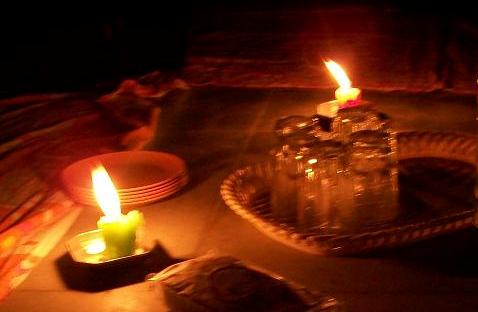
The circle of light over our dinner table, the low murmur of our voices as we talked, might just as well have been a candlelit church filled with the sound of praying.

+ + + + +

Keep watch, dear Lord, with those who work, or watch, or weep this night, and give your angels charge over those who sleep. Tend the sick, Lord Christ; give rest to the weary, bless the dying, soothe the suffering, pity the afflicted, shield the joyous; and all for your love’s sake. Amen. (BCP 124)