
Tag Archives: Recovery

12 Steps of Christmas | St. Stephen, deacon and martyr

Step Two – “Came to believe that a Power greater than ourselves could restore us to sanity.”

Morning Prayer for the Feast of St. Stephen, Deacon and Martyr, can be found here.

My heart trusts in him, and I have been helped

December 26, on the Western Christian calendar, is the feast of St. Stephen, one of the first martyrs who witnessed to his faith in Jesus as Lord even in the face of death by stoning.

Stephen’s story, told in Acts 6-7, is about trusting in a new revelation of God. In this case, the revelation is that Jesus himself was God and was the fulfillment of Jewish prophecy.

His witness, the sermon Stephen preached indicting the Sanhedrin (the religious leaders of Jerusalem) for opposing the Holy Spirit, is a reinterpretation of Jewish history that they cannot stand for.

Stephen’s trust in the Son of God and in this new revelation is so complete that he is not afraid to die. He is filled with a power greater than himself.

Higher Power

Many people I have met in AA meetings talk about how difficult it was for them to accomplish  Step Two.

They struggled to believe in, let alone acknowledge the existence of “a Power greater than ourselves” — which (with a capital P, of course) would seem to refer to the God of Christianity, especially of the Roman Catholic or Lutheran churches so prevalent where I live.

I did not have that particular struggle. As a person brought up in the church and serving for 20 years as an ordained minister, I have always trusted in the existence of God.

But I’m not sure I ever trusted God to “restore me to sanity.”

What really struck me about Step Two was its suggestion that the AA group itself might serve as one’s “Higher Power” as far as recovery goes. The point is, the group has wisdom that I don’t. In that sense, they are greater than I am.

I do well to listen to their counsel, to their stories of “experience, strength, and hope,” to their trust in a Higher Power, as I deal with my own issues.

The wisdom of tradition

There are clear ties here, in my mind, to the traditions of the church and the humility that we might be called to exercise in the face of 2,000 years of the lived experience of the saints.

St. Stephen, the first to demonstrate such a powerful faith, is often pictured holding up a church. Perhaps we are sustained, held up, by the faith of those who came before us.

perseverar-em-Jesus-3We are not the first believers to struggle in our faith, or to suffer because of our belief, or to doubt the presence of God in our lives. We are not the first to face ridicule, or to feel dryness in our prayers, or to question the dogmas that are being pushed on us.

Humility simply means admitting that we might have something to learn from believers who have wisdom that we don’t.

Putting away all earthly anxieties

But more is needed than just learning from the AA group or the church’s traditions if our Higher Power is to  “restore us to sanity.”

What shines through the stories of recovery I have heard is transformed lives. People talk about a whole new way of living that is not based on fear or addiction, but on gratitude and sobriety.

What is even more remarkable is the way people long in recovery maintain their poise even in the face of repeated trials and the need to “keep working the program.” Some even make the astonishing claim that hitting rock bottom was the best thing that ever happened to them.

In the face of struggles and doubts, people in the group “completely give themselves to this simple program” (Big Book 58) which is laid out in the remaining Steps.

It may not be quite the same as facing death by stoning, but practicing recovery — especially coming to believe that a Power greater than ourselves will restore us to sanity — seems to call forth from people a willingness to face difficult situations and people head on but without anxiety.

May we, like Stephen, give ourselves completely to this Power greater than ourselves in trust that we will be restored.

Collect of the Day

We give you thanks, O Lord of glory, for the example of the first martyr Stephen, who looked up to heaven and prayed for his persecutors to your Son Jesus Christ, who stands at your right hand; where he lives and reigns with you and the Holy Spirit, one God, in glory everlasting. Amen.

A Collect for Saturdays

Almighty God, who after the creation of the world rested from all your works and sanctified a day of rest for all your creatures: Grant that we, putting away all earthly anxieties, may be duly prepared for the service of your sanctuary, and that our rest here upon earth may be a preparation for the eternal rest promised to your people in heaven; through Jesus Christ our Lord. Amen.

12 Steps of Christmas | Christmas Day

Step One – “We admitted we were powerless over alcohol – that our lives had become unmanageable.”

Today’s service of Morning Prayer for Christmas Day can be found here.

Humility

“Who cares to admit complete defeat? Practically no one, of course.”

So begins the explanation of Step One of Alcoholics Anonymous in the book Twelve Steps and Twelve Traditions (21).

In my own case, the fall was both abrupt and literal — from a successful performance at a client event in the morning to a bruising, drunken fall in front of clients and colleagues on the marble floor of the hotel lobby that evening.

The next day I flew home knowing I would be fired, then waited, head in my hands, to tell my wife the news.

I had, through my drinking, lost a job I loved and any self-respect and self-confidence I had clung to in the face of growing concerns about my alcohol use.

“Once this stark fact is accepted,” says Step One, “our bankruptcy as going human concerns is complete” (21).

Imitating God in his lowliness

According to the Christian tradition, humanity generally was pretty much bankrupt and definitely in need of God when God decided to send his Son to live as one of us. That’s the background to the Christmas feast that we celebrate today.

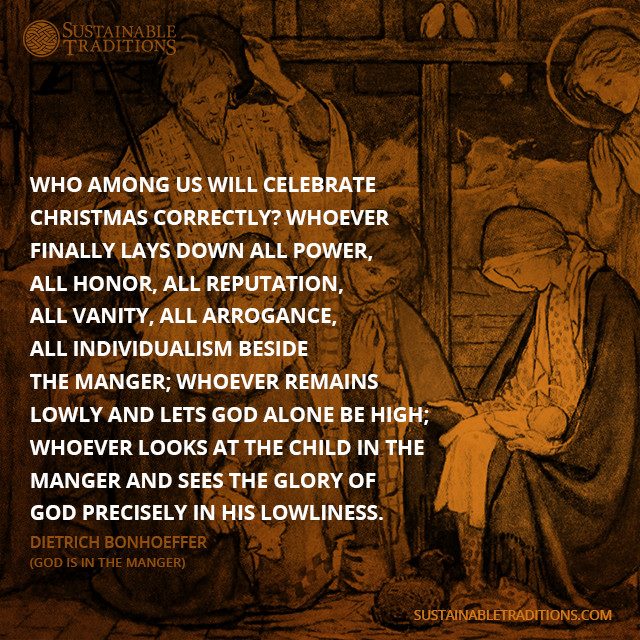
Dietrich Bonhoeffer, the German pastor and theologian, answers his own question: “Who among us will celebrate Christmas correctly?”

10338855_10154090783635681_7938564056947506578_n

Humility, to Bonhoeffer, means “laying down all power, all honor, all reputation, all vanity, all arrogance, all individualism beside the manger.” It means imitating God by remaining lowly.

This resonates with the way early Christians like Paul described Jesus:

who, though he was in the form of God,
did not regard equality with God
as something to be exploited, 
   but emptied himself,
taking the form of a slave,
being born in human likeness.
And being found in human form, 
    he humbled himself
and became obedient to the point of death—
even death on a cross. (Philippians 2:6-8)

“The glory of God precisely in his lowliness” is what we see in the manger at Christmas.

At Christmas God laid down all power, all honor, all reputation and became a human being, vulnerable just like us. Who are we to be anything but vulnerable like him?

Following Jesus in the way of the cross

This morning we have in Morning Prayer one of the juxtapositions that make the Daily Office such a rich source for reflection.

It is Christmas Day, and so in the first of the collects we speak of our gladness and joy and confidence in God.

Because it is also Friday, however, we immediately pray “that we, walking in the way of the cross, may find it none other than the way of life and peace.”

Collect of the Day

O God, you make us glad by the yearly festival of the birth of your only Son Jesus Christ: Grant that we, who joyfully receive him as our Redeemer, may with sure confidence behold him when he comes to be our Judge; who lives and reigns with you and the Holy Spirit, one God, now and for ever. Amen.

A Collect for Fridays

Almighty God, whose most dear Son went not up to joy but first he suffered pain, and entered not into glory before he was crucified: Mercifully grant that we, walking in the way of the cross, may find it none other than the way of life and peace; through Jesus Christ our Lord. Amen.
Humility is not a one-time admission that we get over and done with. Rather, it is an acceptance of our proper place in relationship to God and to other people, who may also be powerless, whose lives may also be unmanageable.

We do not remain bankrupt, however. The explanation of Step One continues: “Our admissions of personal powerlessness finally turn out to be the firm bedrock upon which happy and purposeful lives may be built” (21).

While we do begin to build purposeful lives again, we must also recognize that our daily experience will continue to involve suffering and frustration.

But that is the pattern of falling and rising that Jesus laid down throughout his whole life, from the most humble beginnings as a baby born in poverty, to his preaching and teaching, and to his trial and execution for a crime he did not commit. As Christians we are called to follow him in that pattern of life, that way of the cross.

Like practicing the Christian faith,

Practicing A.A.’s remaining eleven Steps means the adoption of attitudes and actions that almost no alcoholic who is still drinking can imagine taking. Who wishes to be rigorously honest and tolerant? Who wants to confess his faults to another and make restitution for harm done? Who cares anything about a Higher Power, let alone meditation and prayer? Who wants to sacrifice time and energy in trying to carry A.A.’s message to the next sufferer? No, the average alcoholic, self-centered in the extreme, doesn’t care for this prospect—unless he has to do these things in order to stay alive himself. (24)

God, mercifully grant that we, imitating your lowliness and following Jesus in the way of the cross, may find these 12 Steps none other than the way of life and peace; through Jesus Christ our Lord. Amen.
Through the Red Door | Clothed with joy

My post entitled “Clothed with joy” was featured yesterday on Through the Red Door, the blog of Recovery Ministries of the Episcopal Church.

Some of the material comes from reflections on this blog, but I appreciated the opportunity once again to draw a connection between common recovery practices like Steps 10 and 11 and the ancient wisdom of the Church in those areas.

“One day at a time,” says Alcoholics Anonymous. “Daily we begin again,” say the Benedictines.

I am grateful for the Daily Office as a framework for living each day, and for the recovery community which has revitalized my spiritual life.

Give it away entirely and come into the oasis

Many of you know that two years ago this week I acknowledged my addiction to alcohol and began living in recovery.

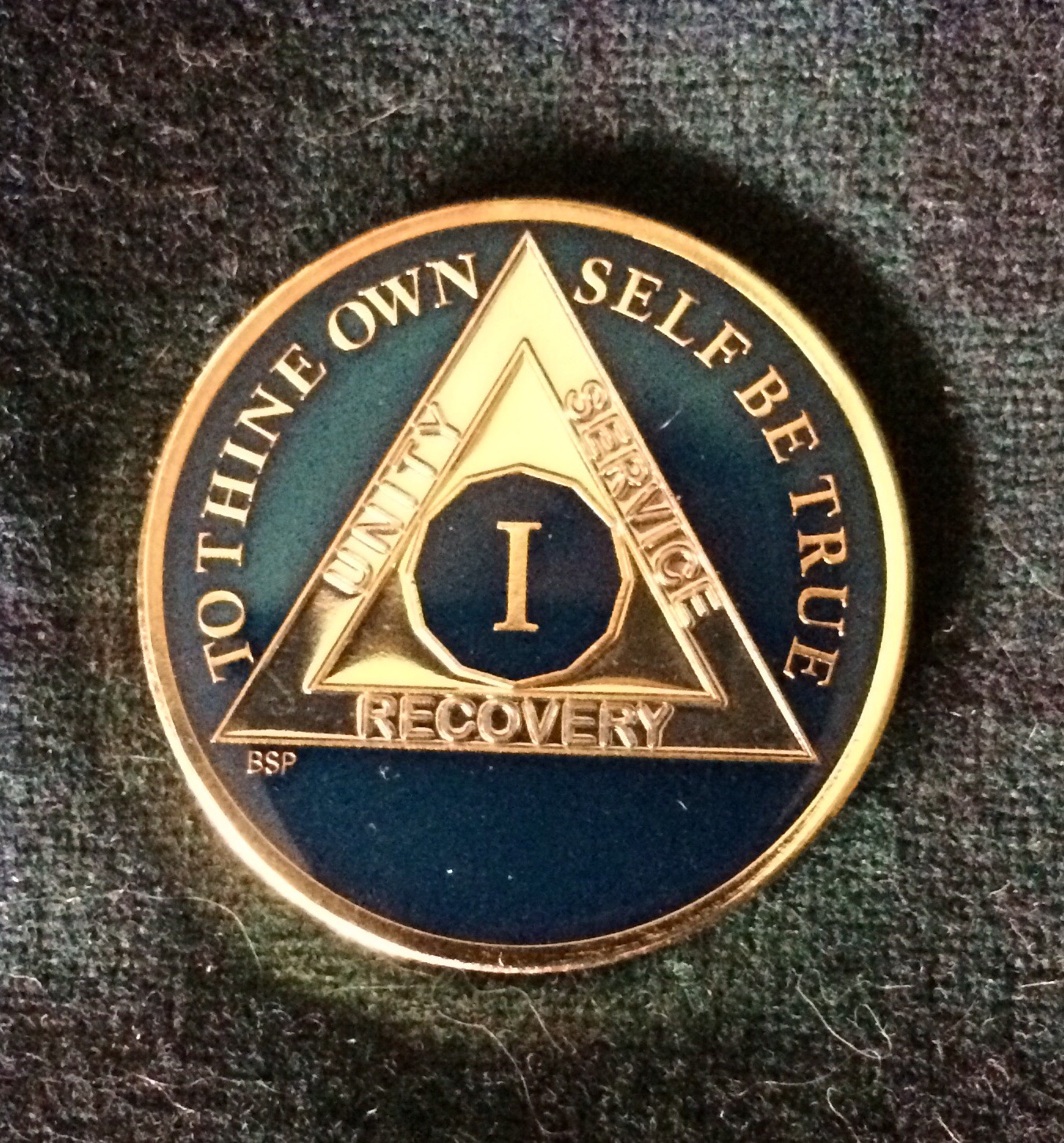
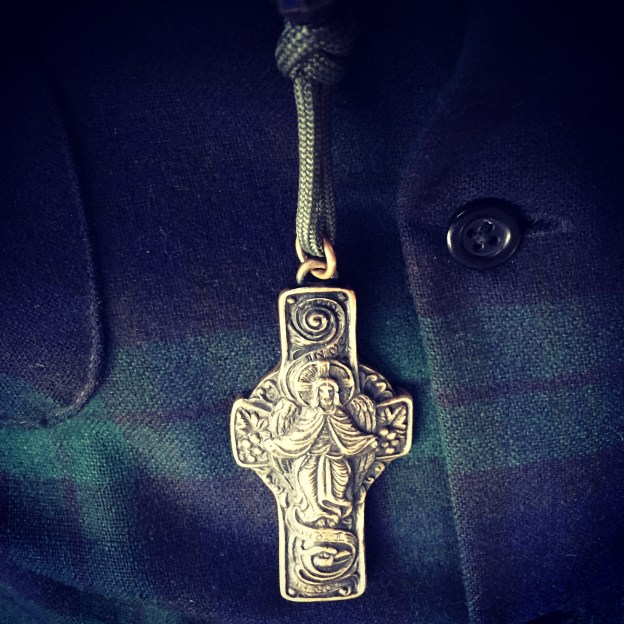
I carry a pocket medallion as a reminder of the grace I have received in recovery – grace far beyond my imagining. Most days, I have a sense of living in what a friend calls “the oasis” and AA refers to as “a daily reprieve … contingent on the maintenance of our spiritual condition” (Big Book 85).

IMG_1299.JPG

My prayer life, my practice of the Daily Office, the teaching I do and the conversations I have with colleagues and friends – all of it has been reinvigorated by what the Franciscan priest and teacher Richard Rohr calls in Breathing Under Water the “coded Gospel” of the 12 Steps.

You may not realize, though, that stopping drinking was only a small part of the work that I have had to do in recovery. In addition to the medallion in my pocket, I also wear a bracelet around my wrist, one of the last things I bought without my wife’s knowledge before losing my job.

2015-07-24 18.21.20

My addiction to spending and to indulging myself has been much, much harder to deal with – it’s the same struggle alcoholics face when they can’t stop thinking about their next drink.

You lack one thing

I think I know a little bit about how the “rich young man” felt after he found Jesus.

A man ran up and knelt before him, and asked him, “Good Teacher, what must I do to inherit eternal life?” Jesus said to him, “Why do you call me good? No one is good but God alone. You know the commandments …. “ He said to him, “Teacher, I have kept all these since my youth.” Jesus, looking at him, loved him and said, “You lack one thing; go, sell what you own, and give the money to the poor, and you will have treasure in heaven; then come, follow me.” When he heard this, he was shocked and went away grieving, for he had many possessions. (Mark 10:17-22)

You lack one thing …. you have many possessions.

Here’s where I think the rich young man realizes what the living God asks of each one of us. The living God asks for all of us.

The young man is looking for inspiration, but Jesus, who loves him, points to the one thing that really keeps him from God – the wealth he cannot imagine doing without.

“When he heard this, he was shocked and went away grieving.”

What a state he must have found himself in:

If I go forward, he is not there;
or backward, I cannot perceive him;
on the left he hides, and I cannot behold him;
I turn to the right, but I cannot see him.
God has made my heart faint;
the Almighty has terrified me;
If only I could vanish in darkness,
and thick darkness would cover my face! (Job 23:8-9,16-17)

The Almighty has terrified me

In our Old Testament lesson, Job has lost everything, and he does not yet have the answer that will help him remain faithful to God. The Almighty has terrifed him, and Job doesn’t yet understand that God loves him.

In the meantime, his friends and his wife, as Fr. Ralph reminded us last week, are giving him conflicting (and bad) advice. They can’t help him discover either God’s love or the one thing he lacks.

Unlike Job’s companions, however, my wife and my friends have given me good advice and steady support.

Their willingness to share love and to confront me about the things I lack has helped me do the hard work of staying steady in recovery.

  • A dear friend made sure I was “fearless and thorough from the very start” in admitting my failings.
  • A fellow deacon in another diocese helped me admit I needed to go to AA meetings and – laughing at how upside-down I had it – helped me understand that sobriety was an oasis, not a burden.
  • The first boss I had after losing my job, who has been sober for several years, gave me his 3-month sobriety medallion when I reached that milestone myself.
  • The guys in the Thursday morning breakfast and Bible study group here at St. Thomas drew me into their circle of support.
  • And my wife has cheerfully accommodated my being home and underfoot after nearly 10 years on the road, encouraging my new habits and being patient with my stumbling.

church-circle-graphicMy recovery – my new faith in this “coded Gospel” – really is something I have to work at every day. But what I have to work at most is not to do with drinking, but with spending money.

It’s a Pendleton, you idiot!

Sitting on the sofa watching TV one night a few months ago, I was in jeans and my favorite flannel shirt, and I thought “I really like this shirt; I should buy another one.”

A couple beats later, after that thought went away, a new one came in. “You’re an idiot; that’s a Pendleton shirt. It’ll last for 100 years. You’ll be dead before it wears out. You don’t need another one.”

“Oh, cool.”

Contentment is weird.

People in recovery are more used to being “restless, irritable, and discontented” (Big Book xxviii).

But when you’re content, it’s like you can just be, and everything is all right. Perhaps eternal life is like that – just being with God, living in an oasis.

What must I do?

“Teacher, what must I do to inherit eternal life?” asks the rich young man, who probably had several shirts.

Jesus loves him, and says, “You lack one thing … get rid of the thing that’s keeping you from God, whatever it is. Give it away entirely, and you’ll have treasure in heaven.”

For me, giving away my desire for a drink and giving away my desire to buy more things have together led me back to Jesus and to “a faith that really works in daily living” (12and12, 43).

What is the one thing you lack?

What might Jesus, who loves you, point to in your life? What’s the one thing that keeps you from God?

Is it money?

Food? Anger? Gossip?

Is it drinking or drugs or politics or something equally addictive?

Is it approval or being right or getting your way?

What are you holding onto so tightly that you can’t receive the treasure of heaven?

Give it away entirely, and enter the oasis!

Speaking of oases

The story of the rich young man reminds me of another favorite story, this one not from an oasis but from the Desert Fathers of 3rd century Egypt:

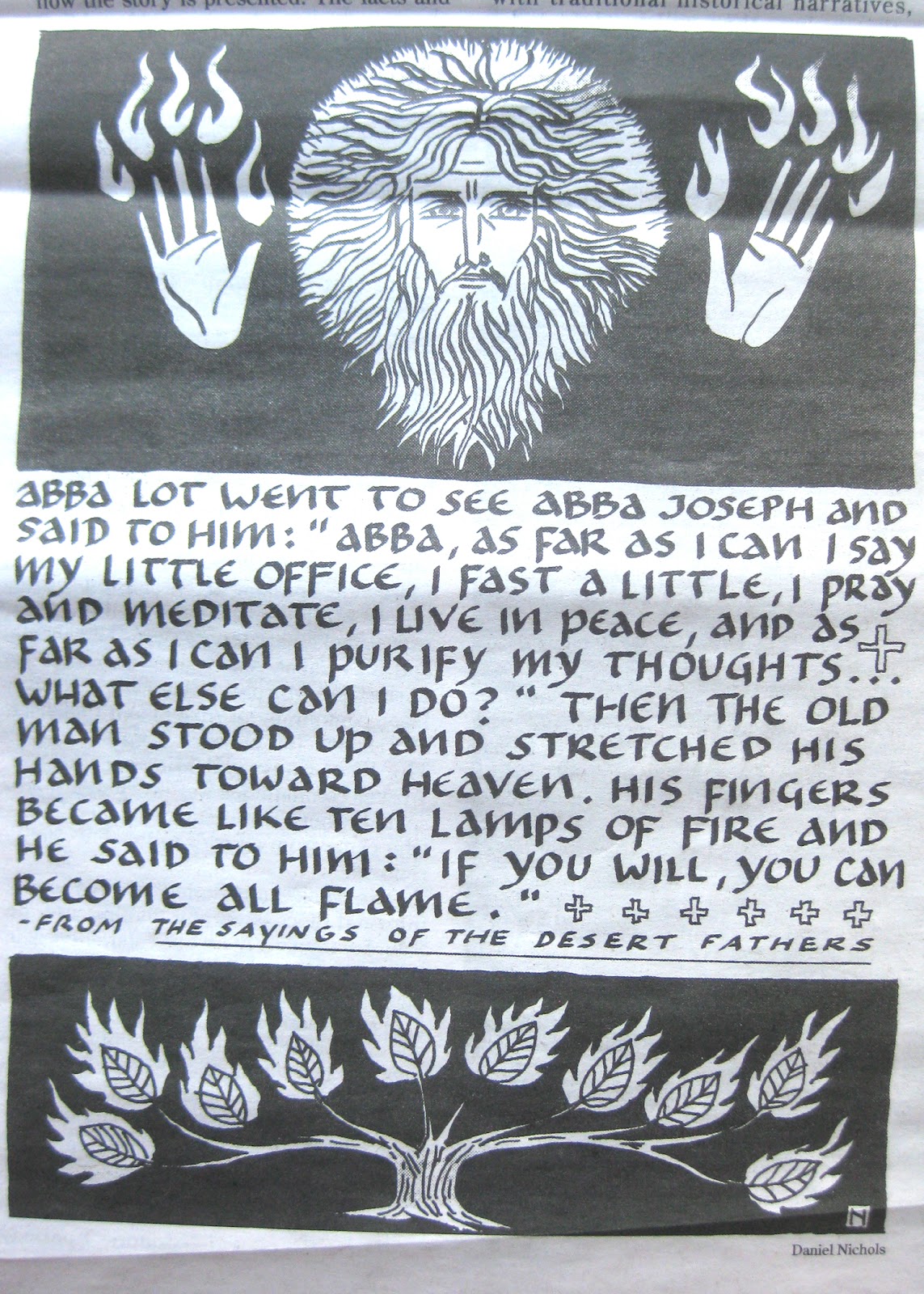
Abba Lot went to see Abba Joseph and said to him, “Abba as far as I can I say my little office, I fast a little, I pray and meditate, I live in peace and as far as I can, I purify my thoughts. What else can I do?”

 Then the old man stood up and stretched his hands towards heaven. His fingers became like ten lamps of fire and he said to him, “Why not become totally flame?”

abbas lot and joseph - all flameWhat’s the one thing you lack? What’s holding you back from God?

Why not give it away in order to find a faith that works, in order to find contentment?

Why not become totally flame?

Why not give it away entirely, and live now in the oasis with God?

Reclothe us in our rightful mind

Dear Lord and Father of mankind,
Forgive our foolish ways!
Reclothe us in our rightful mind,
In purer lives Thy service find,
In deeper reverence, praise.
-John Greenleaf Whittier

I reflected in my sermon yesterday that the unity we share as Christians comes not from group membership but from the individual relationship each of us has with the living Christ.

In him, we are united in one body, because each of us has known his forgiveness.

The words of this beautiful hymn came to my mind this morning, especially the phrase, “Reclothe us in our rightful mind.”

People in recovery from alcoholism often speak of the “stinking thinking” that is as much of a problem for the addict as the drink itself.

People practicing recovery and learning to live well with mental illness also know what it is to suffer from problems in the mind, medical conditions in the brain that make living such a struggle.

Forgiveness, for me, began with admitting how badly my drinking had affected me and those around me.

Forgiveness felt first like being stripped naked, being fully known, being seen in the unlovely state I was in.

The grace I have received in recovery — in the love of family and friends who looked with me, in the support of my church and recovery group who held me, in the reawakening of my appreciation for the Daily Office and the practices of the Christian life and of recovery that shape me — all of these feel like by grace I am being “reclothed in my rightful mind.”

And now another lovely hymn springs to my lips: “O to grace how great a debtor daily I’m constrained to be!” Where pride and frustration once colored my life, gratitude paints a different picture.

If you for a long time have “worn no clothes,” and feel like you’re living “not in a house but in the tombs” — like the Gerasene man whom Jesus healed in the story from the Gospels (and the source of the hymn) — know that in forgiveness and in recovery you, too, can be “found … sitting at the feet of Jesus, clothed and in [your] right mind” (Luke 8:35).

From Pravmir.com commentary on the healing of the demoniac by Metropolitan Anthony of Sourozh.

From Pravmir.com commentary on the healing of the demoniac by Metropolitan Anthony of Sourozh.

Reclothed in our rightful minds, we then find our fulfillment, as Whittier suggests, in trying to lead “purer lives” of “deeper reverence.”

Not that we are perfect by any means, but our service and praise show God how grateful we are and can offer hope to others who still suffer.

God looks on my loveliness with favor

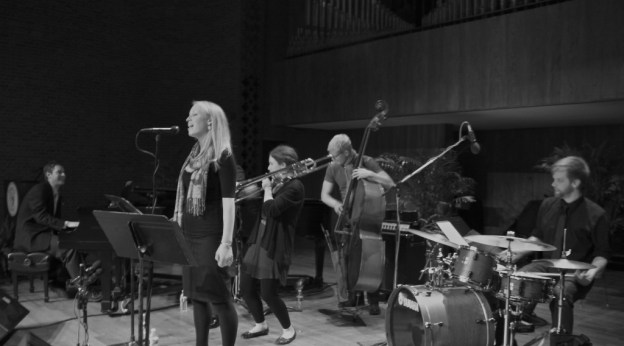
Apparently, Theodicy Jazz Collective played for the Friday morning Eucharist at the Episcopal Church’s General Convention in Salt Lake City.

I followed a link in the Acts 8 Moment’s Resurrection Report to check them out. What extraordinarily lovely music!

As I listened to their album Vespers, I was inspired to start sketching liturgical notes and outlines for “Breathing Under Water: A Jazz Vespers for Recovery.” I’d love to help create and bring a service like that to the Fox Cities, and my head began swirling with the possibilities.

But “The Magnificat” checked my stride (and my pride) and brought tears to my eyes.

My soul magnifies the Lord
my Spirit rejoices in God my Savior
my soul magnifies the Lord,
for God looks on my loveliness with favor.

Can it be true? God looks on my loveliness with favor? I sat stunned and grateful.

My experience of recovery has been an experience of grace, of admitting my own powerlessness and discovering that God pours out blessings on me as I follow “certain steps … which are suggested as a program of recovery” (Big Book 58-9).

I have found the prayers of the Daily Office transformed in the process, and now even more than ever, they serve to build my hope.

Theodicy Jazz Collective have brought me back into a state of grace this morning.

I hope that in their music you will hear that God looks on your loveliness with favor, too.

Longing to be clothed

You have turned my wailing into dancing;
you have put off my sack-cloth and clothed me with joy. (Psalm 30:12)

I carry on my person everywhere I go two talismans of my recovery. 

The first is a medallion celebrating my first year of sobriety. 

  
The second is a bracelet — the last thing I bought without telling my wife — that helps me remember I don’t need to spend money when I am feeling “restless, irritable, and discontented.”

  
But what recovery really looks like for me is the Pendleton shirt I’m wearing in this picture with my grandson. 

  
After I lost my job, I was at home a lot more often. I would usually wear jeans and a turtleneck and my favorite plaid shirt. 

I remember sitting on the couch one evening thinking, “I really like this shirt; I should buy another one.”

It took only a few seconds for my new inner voice to respond. “Don’t be an idiot. This is a Pendleton shirt, and it will last forever. You won’t outlive this shirt; you don’t need to buy another one.”

Paul writes that:

We do not lose heart. Even though our outer nature is wasting away, our inner nature is being renewed day by day …. in this tent we groan under our burden, because we wish not to be unclothed but to be further clothed” (2 Cor. 4:16, 5:4). 

Even though God is working in us to renew our inner nature, we may need reminders of that hidden process from time to time. 

How often? 

“One day at a time,” says AA. “Daily we begin again,” say the Benedictines. 

Even though we “wish not to be unclothed,” we may have to spend time being uncomfortably open and vulnerable — honestly sitting with our restlessness and our “stinking thinking” — before we can experience a new kind of peace and serenity.

Being content, being at peace, being calm — these are what it means to be “clothed with joy.”

May the God of hope fill us with all joy and peace in believing through the power of the Holy Spirit. Amen. (BCP 102)

The Lord is near; be patient and hope in him

I am at the annual NAMI Wisconsin conference, hearing from speakers about mental illness and the peer-to-peer support which is the hallmark of NAMI’s recovery approach. Helping people experience recovery — living well with mental illness — builds hope.

One of this morning’s psalms resonates with my own experience of recovery.

The LORD is faithful in all his words *
and merciful in all his deeds.
The LORD upholds all those who fall; *
he lifts up those who are bowed down.
The eyes of all wait upon you, O LORD, *
and you give them their food in due season.
You open wide your hand *
and satisfy the needs of every living creature.
The LORD is righteous in all his ways *
and loving in all his works.
The LORD is near to those who call upon him, *
to all who call upon him faithfully.
He fulfills the desire of those who fear him; *
he hears their cry and helps them.
The LORD preserves all those who love him, *
but he destroys all the wicked.
My mouth shall speak the praise of the LORD; *
let all flesh bless his holy Name for ever and ever. (Psalm 145:14-22)

“The Lord upholds all those who fall; he lifts up those who are bowed down … the Lord is near to those who call upon him.” These assurances build hope in us as we share our stories of God’s faithfulness in our own times of trouble.

The writer Jesus son of Sirach (whose book the church calls Ecclesiasticus), describes the internal attitude I try to have as I work my own recovery each day.

Accept whatever befalls you, and in times of humiliation be patient. For gold is tested in the fire, and those found acceptable, in the furnace of humiliation. Trust in him, and he will help you; make your ways straight, and hope in him. (Ecclus. 2:4-6)

The slogans of recovery, like “One Day at a Time,” and the teachings of our Christian faith echo Sirach’s timeless human wisdom.

Accept whatever befalls you. What is, is. Accept that things are the way they are without becoming “restless, irritable, and discontented.”

Be patient. One of our speakers yesterday suggested that patience is a fruit of practicing mindfulness in every situation, and that mindfulness is really being present to what is actually happening.

Make your ways straight. At the men’s breakfast and Bible study I attend on Thursdays, we spoke this week about how our lives are to be lived in response to God’s grace. We do not earn grace; but in gratitude we make changes in order to stay in God’s way.

The short reading from the Acts of the Apostles exemplifies the simple faithfulness that is to characterize our new life — whether it’s life in recovery, life in Christ, or both.

Then after completing their mission Barnabas and Saul returned to Jerusalem and brought with them John, whose other name was Mark. Now in the church at Antioch there were prophets and teachers: Barnabas, Simeon who was called Niger, Lucius of Cyrene, Manaen a member of the court of Herod the ruler, and Saul. While they were worshiping the Lord and fasting, the Holy Spirit said, “Set apart for me Barnabas and Saul for the work to which I have called them.” Then after fasting and praying they laid their hands on them and sent them off. (Acts 12:25–13:3)

Notice how John, whose other name was Mark, is simply present with Barnabas and Saul. Notice how he doesn’t figure in the action at Antioch — it’s Barnabas and Saul who are made apostles.

Mark must have been practicing mindfulness throughout that time, though, paying attention to the new life in Christ. Eventually, his insights bore fruit in the gospel account that bears his name.

The Lord is near to those who call upon him, who call upon him faithfully.

In times of humiliation, be patient.

Make your ways straight, and hope in him.

Collect for St. Mark

Almighty God, by the hand of Mark the evangelist you have given to your Church the Gospel of Jesus Christ the Son of God: We thank you for this witness, and pray that we may be firmly grounded in its truth; through Jesus Christ our Lord, who lives and reigns with you and the Holy Spirit, one God, for ever and ever. Amen.

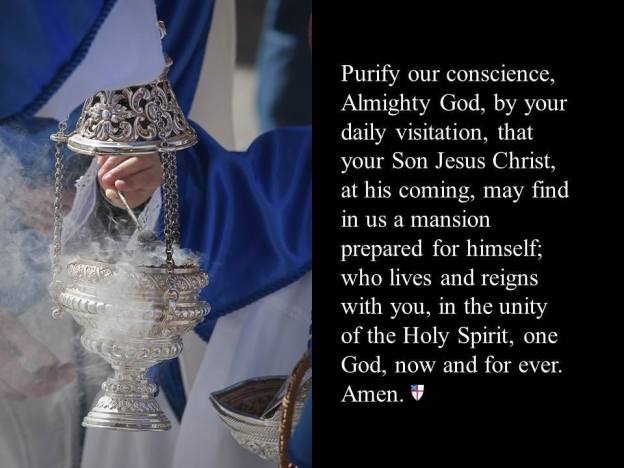
Daily visitation

How resonant that word, “daily.”

“Daily we begin again to put into practice the Lord’s teaching,” says the Rule of Benedict.

“One Day at a Time” say those of us in recovery.

Richard, Bishop of Chichester (1197-1253), is popularly credited with this prayer, made familiar both by Ralph Vaughn Williams and the musical Godspell:

Day by day,
Dear Lord, of thee three things I pray:
To see thee more clearly,
Love thee more dearly,
Follow thee more nearly,
Day by Day.

“The Holy Eucharist, the principal act of Christian worship on the Lord’s Day and other major feasts, and Daily Morning and Evening Prayer, as set forth in this Book, are the regular services appointed for public worship in this church,” says our own Book of Common Prayer (BCP 13).

May your daily visitation with the Lord be a source of blessing and strength, both this day and always.

Forgetful of the cleansing

For this very reason, you must make every effort to support your faith with goodness, and goodness with knowledge, and knowledge with self-control, and self-control with endurance, and endurance with godliness, and godliness with mutual affection, and mutual affection with love. For if these things are yours and are increasing among you, they keep you from being ineffective and unfruitful in the knowledge of our Lord Jesus Christ. For anyone who lacks these things is nearsighted and blind, and is forgetful of the cleansing of past sins. (2 Peter 1:5-9)

One of the first insights I had about the Daily Office after I entered recovery was that, even though the rubrics say the Confession of Sin is optional at the beginning of Morning Prayer (BCP 79), for me it is required.

It’s so easy for me to be “forgetful of the cleansing of past sins,” to press forward without remembering the hard-won lessons of my recovery and my new life.

It’s easy for me to start thinking things are fine, but how quickly I can slip back into the thoughts that led me into trouble in the first place. How little I really want to do what is good, how little I want to wait for anything, how little thought I give to anyone else, how little self-control I have!

The grace that filled me when I entered recovery, admitting my powerlessness and my need for God’s help, is the same kind of grace that is given to us in the sacrament of baptism.

It occurred to me today that we make our Confession of Sin and then say the Apostles’ Creed each morning so that we do not become “forgetful of the cleansing of past sins.”

The point is not to rehearse our past sins over and over — they have been forgiven, and we are made new in baptism. Rather, the point is to learn from our experience in order to better trust in the hope we have been given.

The point is to be mindful each day of our need for God, and each day to recommit ourselves to walking in the steps laid out for us.

Therefore, brothers and sisters, be all the more eager to confirm your call and election, for if you do this, you will never stumble. For in this way, entry into the eternal kingdom of our Lord and Savior Jesus Christ will be richly provided for you. (2 Peter 1:10-11)

A Collect for the Renewal of Life

O God, the King eternal, whose light divides the day from the night and turns the shadow of death into the morning: Drive far from us all wrong desires, incline our hearts to keep your law, and guide our feet into the way of peace; that, having done your will with cheerfulness while it was day, we may, when night comes, rejoice to give you thanks; through Jesus Christ our Lord. Amen. (BCP 99)