Tag Archives: Morning Prayer

They gave me vinegar to drink

IMG_0698


They gave me gall to eat;
and when I was thirsty they gave me vinegar to drink. (Ps. 69:23)

Sometimes I wonder at the Church’s obsession for getting the society around us to do what we want. We spend a lot of energy trying to get laws passed that guarantee our rights, that grant us certain privileges, that impose our ideals on others.

We don’t get that impulse from Jesus, whose words and actions led to his arrest, scourging, and crucifixion.

We don’t get it from Paul (much), since he positively glories in the hardships he has endured for the sake of the Gospel. “I will most gladly spend and be spent for you,” he writes in his second letter to the church in Corinth (2 Cor. 12:15).

In Canticle 10, appointed for this morning, we sing about God’s word, whom we would name Jesus:

So is my word which goes forth from my mouth;
it will not return to me empty.
But it will accomplish that which I have purposed,
and prosper in that for which I sent it. (BCP 87)

God’s purposes are accomplished precisely in the gall and vinegar, precisely in Jesus’ faithfulness to the way of the cross.

Why do we think it will be different for us? Why do we think in terms of legislating behavior instead of demonstrating faithfulness?

A Collect for Fridays

Almighty God, whose most dear Son went not up to joy but first he suffered pain, and entered not into glory before he was crucified: Mercifully grant that we, walking in the way of the cross, may find it none other than the way of life and peace; through Jesus Christ our Lord. Amen. (BCP 99)


 

First fruits and offerings

20130607-062733.jpg

The Lord brought us out of Egypt with a mighty hand and an outstretched arm, with a terrifying display of power, and with signs and wonders; and he brought us into this place and gave us this land, a land flowing with milk and honey. So now I bring the first of the fruit of the ground that you, O Lord, have given me. (Deut. 26:8-10)

Tithes and offerings are two different things.

The tithe, or “tenth,” is the giving of one’s first fruits back to God in gratitude. It is an objective giving — that is to say, tithing is meant to be done deliberately and first. Some people make their tithe the first check they write each month. Others set up an automatic payment. In either case, tithing is a deliberate, routine practice.

Offerings, on the other hand, are more subjective. Paul spends a fair amount of time in his letters talking about the offering he is taking up for the benefit of the church in Jerusalem, and we will read one such appeal tomorrow:

Each of you must give as you have made up your mind, not reluctantly or under compulsion, for God loves a cheerful giver. And God is able to provide you with every blessing in abundance, so that by always having enough of everything, you may share abundantly in every good work. (2 Cor. 9:7-8)

Offerings are free gifts, given generously as specific needs arise, and given out of our abundance.

Like most Americans, I’m pretty good at offerings. I’m ready to contribute when asked, whether it’s through a neighbor’s foundation or through Episcopal Relief and Development, or by donating to Goodwill or spending time to help with a fundraising event. When asked, I tend to rise to the occasion, and I think most people do, too.

Where I do not do well at all is in tithing — the objective offering of my money to God.

I have only tithed for brief periods in my life, and while I can easily offer the first fruits of my time (rising early for the last 20 years to say Morning Prayer, for example), I struggle to make the same routine offering of my money.

Let the lessons today sit with you as you think about your own relationship with money and with God.

How do you make routine giving a habit? How do you respond with offerings for specific needs? How might God’s generosity draw from your abundance in a new way?

Our heart is wide open to you

20130604-060449.jpg

All glorious is the princess as she enters;
her gown is cloth-of-gold.

In embroidered apparel she is brought to the king;
after her the bridesmaids follow in procession.

With joy and gladness they are brought,
and enter into the palace of the king.
(Psalm 45:14-16)

It’s a little hard to place ourselves in this picture.

To the Psalmist, we are the singer describing the scene at a royal wedding. To the Deuteronomist, we are God’s chosen people, set apart and soon to worship in a Temple in our own land.

To Paul, we are that Temple ourselves:

For we are the temple of the living God; as God said,
“I will live in them and walk among them,
and I will be their God,
and they shall be my people”
(2 Cor. 6:16)

The Church has also understood itself to be the bride in mystic union with Christ the Bridegroom.

Open your heart wide today to these images of glory and beauty and worship and relationship. What is your place in this picture?

An eternal weight of glory

20130601-084045.jpg

So we do not lose heart. Even though our outer nature is wasting away, our inner nature is being renewed day by day. For this slight momentary affliction is preparing us for an eternal weight of glory beyond all measure, because we look not at what can be seen but at what cannot be seen; for what can be seen is temporary, but what cannot be seen is eternal. (2 Cor. 4:16-18)

Silence is so accurate

20130531-100257.jpg

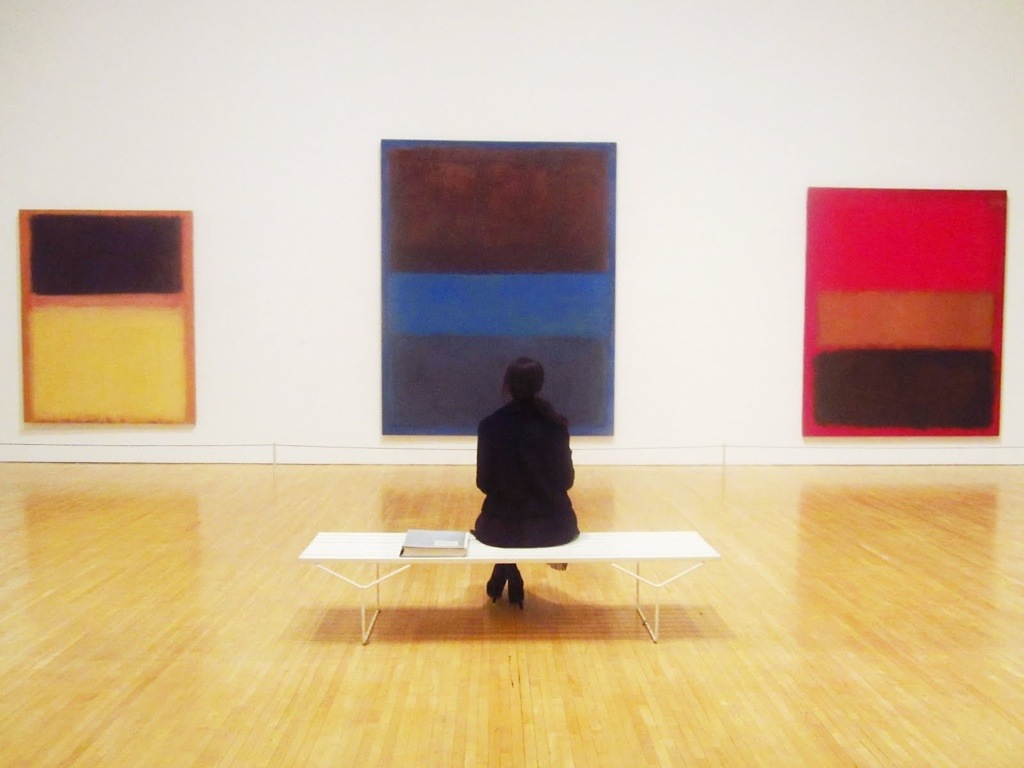
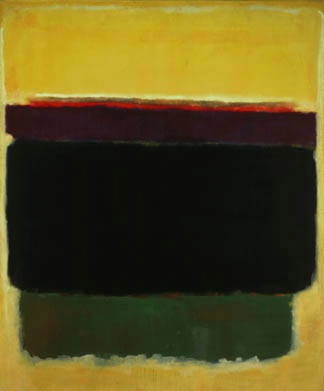
A Boston Globe article on the value of paying close, sustained attention to art as a way to combat digital distraction really struck me today, so I have decided to try a project during the month of June.

For 30 minutes each day, after I say Morning Prayer, I will look closely at a painting by Mark Rothko, whose abstract color paintings have always intrigued me.

According to the National Gallery of Art, Rothko largely abandoned conventional titles in 1947, sometimes resorting to numbers or colors in order to distinguish one work from another. The artist also … resisted explaining the meaning of his work. “Silence is so accurate,” he said, fearing that words would only paralyze the viewer’s mind and imagination.

I’m looking forward to both the seeing and the silence.

Photo by coco of cococozy.

Trinity Sunday

20130526-064647.jpg

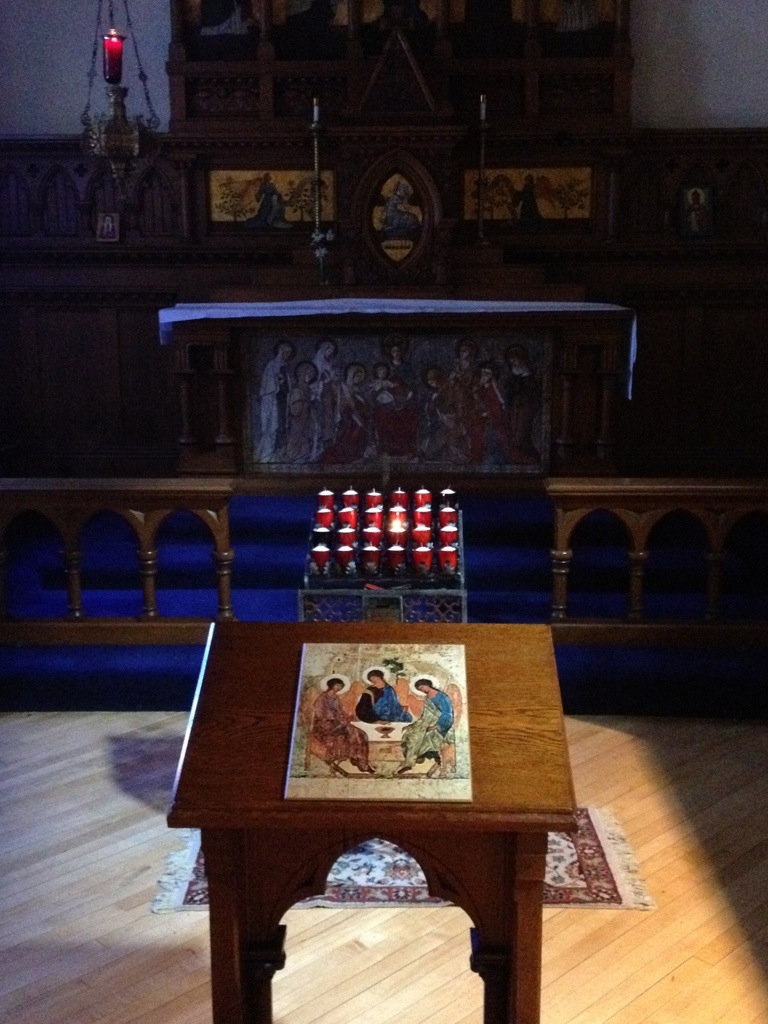
St. Augustine’s Chapel in the Cathedral Church of St. Paul, Fond du Lac

First Sunday after Pentecost: Trinity Sunday

O God, you have given to us your servants grace, by the confession of a true faith, to acknowledge the glory of the eternal Trinity, and in the power of your divine Majesty to worship the Unity: Keep us steadfast in this faith and worship, and bring us at last to see you in your one and eternal glory, O Father; who with the Son and the Holy Spirit live and reign, one God, for ever and ever. Amen. (BCP 228)

+ + + + +

I want to reflect not so much on the doctrine of the Trinity but on the method of Trinitarian faith.

It took more than 400 years of sustained practice and reflection before the Christian church articulated the doctrine of the Trinity. The Apostles’ Creed is first mentioned by Ambrose around 390; the Nicene Creed came after the Council of Nicaea in 325 and was revised by the Council of Constantinople in 381; Augustine wrote On the Trinity in 415; and the Athanasian Creed dates to sometime after the Council of Chalcedon in 451.

+ + + + +

From the beginning Christians gathered to pray daily (just as they had been doing as observant Jews), celebrated the Lord’s Supper, and ministered to those around them, making disciples through the power of the Spirit.

“No one has ever seen God,” writes the author of the Gospel of John. “It is God the only Son, who is close to the Father’s heart, who has made him known” (John 1:18).

“There is one body and one Spirit, just as you were called to the one hope of your calling, one Lord, one faith, one baptism, one God and Father of all, who is above all and through all and in all” (Ephesians 4:4-6).

“Jesus is Lord” rings the cry of faith; “We are one in the Spirit” say the apostles to Jew and Greek, slave and free, male and female; “How good it is to sing praises to our God” we pray every morning and every evening, joining our voices to the Psalmist’s (Ps. 147:1).

The doctrine of the Trinity is the attempt, however mathematical and philosophical it may be, to account for the lived experience of the Church, following the Lord Jesus in the power of God’s Spirit and in praise to the eternal Father — acknowledging the Trinity and worshiping the Unity.

Throughout the world the holy Church acclaims you:
Father, of majesty unbounded,
your true and only Son, worthy of all worship,
and the Holy Spirit, advocate and guide.

(Te Deum laudamus, BCP 95)

Always faithful to our mission

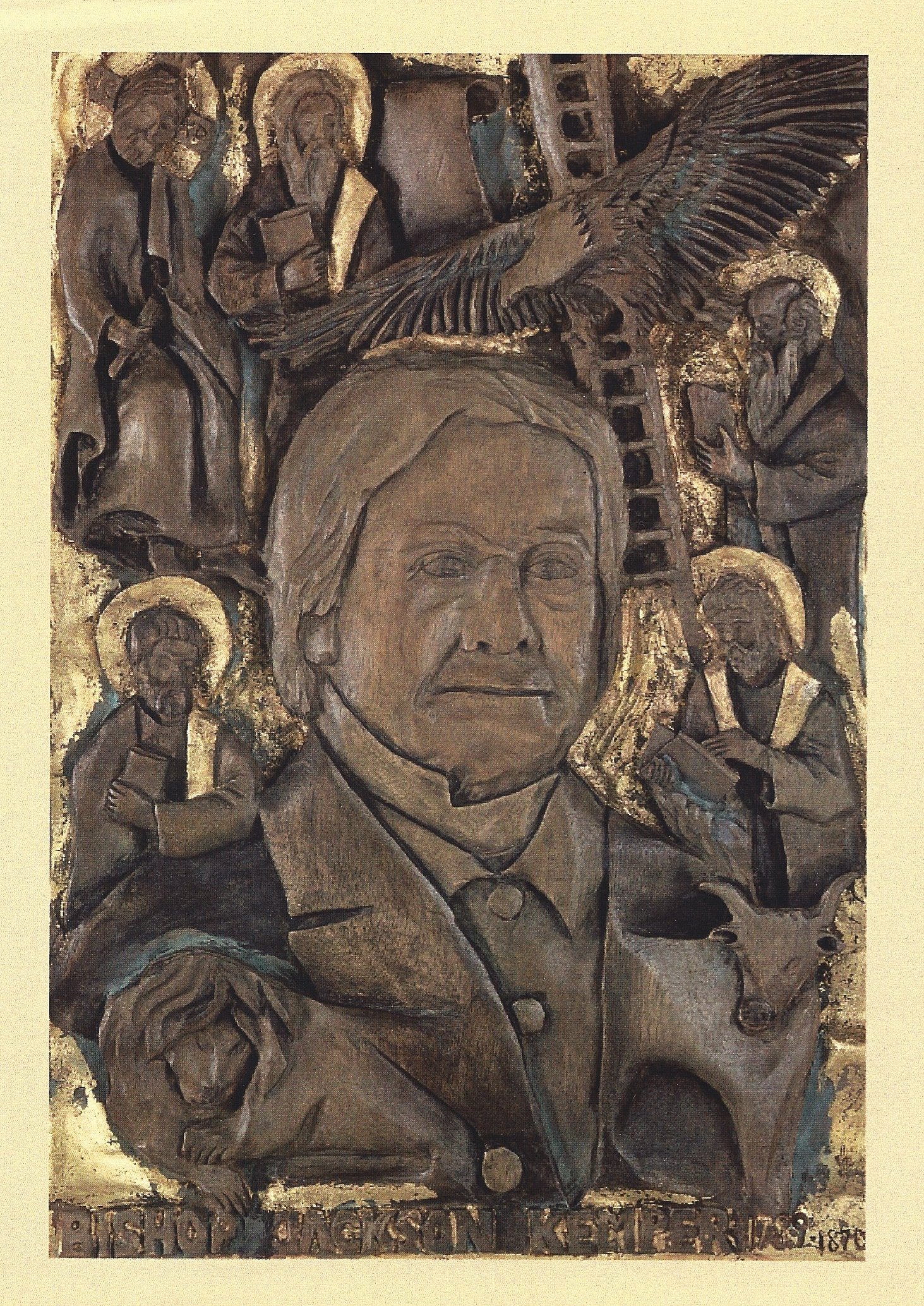
Icon of Jackson Kemper created for the Sesquicentennial of the Diocese of Milwaukee

Icon of Jackson Kemper created for the Sesquicentennial of the Diocese of Milwaukee

Prayer for Mission

Lord Jesus Christ, you stretched out your arms of love on the hard wood of the cross that everyone might come within the reach of your saving embrace: So clothe us in your Spirit that we, reaching forth our hands in love, may bring those who do not know you to the knowledge and love of you; for the honor of your Name. Amen. (BCP 101)

+ + + + +

Today, in addition to the Feast of Jackson Kemper, First Missionary Bishop of the Episcopal Church, we also observe the Ember Days, traditional days of prayer for all ministry, and especially for the ordained leaders of the church.

It’s a very appropriate serendipity, since Jackson Kemper was particularly concerned to ensure that there were clergy trained and suited for ministry in “the scattered settlements of the West.”

With James Lloyd Breck and others, he founded Nashotah House near Delafield, Wisconsin as a Benedictine community from which clergy would go out and minister to the surrounding area. With James DeKoven, he established Racine College, now the DeKoven Center, as a school emphasizing both education and worship in the “Ritualist” (Anglo-Catholic) style.

Jackson Kemper served as the first Bishop of Wisconsin from 1859 until his death, so all three dioceses in the state — Milwaukee, Fond du Lac, and Eau Claire — trace their beginnings to him.

The Episcopal Church in Wisconsin properly honors these “local saints” and their mission to “bring those who do not know Jesus to the knowledge and love of him.” That is the mission we all share to this day.

+ + + + +

For the Ministry (Ember Days)

O God, you led your holy apostles to ordain ministers in every place: Grant that your Church, under the guidance of the Holy Spirit, may choose suitable persons for the ministry of Word and Sacrament, and may uphold them in their work for the extension of your kingdom; through him who is the Shepherd and Bishop of our souls, Jesus Christ our Lord, who lives and reigns with you and the Holy Spirit, one God, for ever and ever. Amen. (BCP 256)

Our common life

20130523-060723.jpg

I had a Twitter exchange with a fellow Episcopalian, Brendan (@indybrendan), last night about the Daily Office.

He said he couldn’t get into Morning Prayer because he’s not a morning person, but he’d be glad to pray for me during Compline before he went to bed.

Megan (@revlucymeg) piped up and said, “that’s why we have a daily cycle — everyone takes an office,” and I promised I’d have Brendan’s back at Morning Prayer. This is how the Church fulfill’s St. Paul’s admonition to “pray without ceasing.”

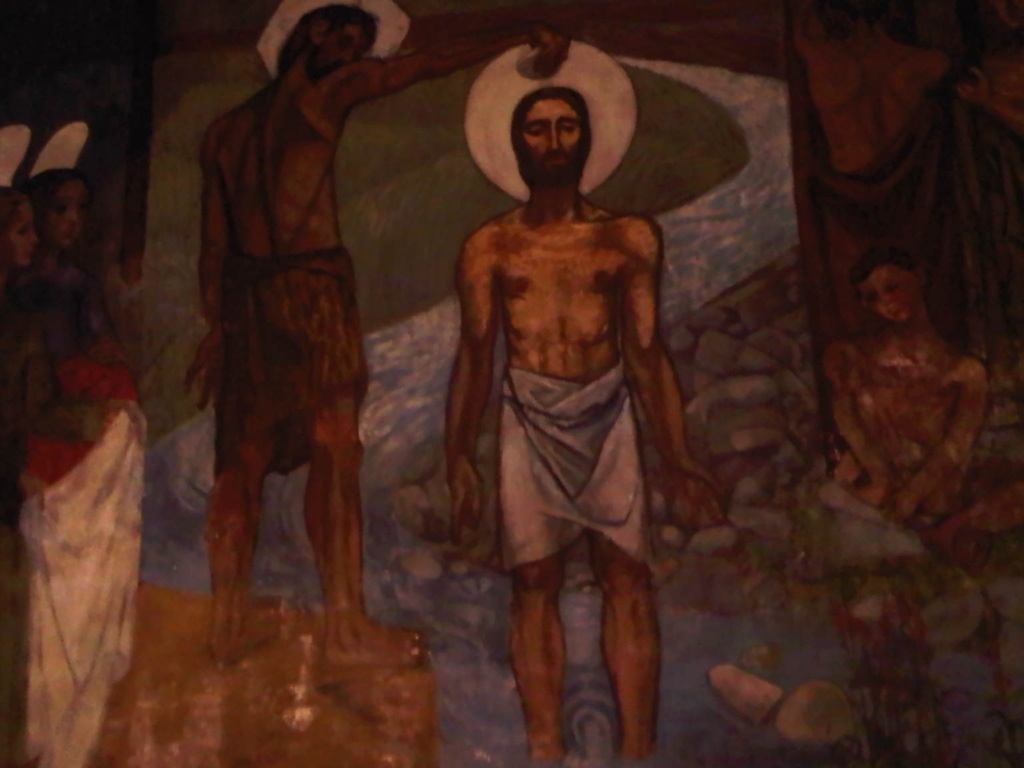
On Thursdays there’s a baptismal slant in Morning Prayer. Canticle 8 (BCP 85), appointed to follow the Old Testament lesson, recounts the Exodus — linked in Christian imagination to the Easter Vigil and baptism. The Collect for Guidance, customarily read on Thursdays, places our identity and our work in God, in whom “we live and move and have our being” (BCP 100). In the first Prayer for Mission on that same page we pray to our heavenly Father for “all members of your holy church, that in their vocation and ministry they may truly and devoutly serve you.”

I added this morning, in honor of Brendan, a favorite prayer from Compline that underscores our mutual dependence, not only as members of the Church united by Baptism, but also as creatures united by life on God’s round Earth.

O God, your unfailing providence sustains the world we live in and the life we live: Watch over those, both night and day, who work while others sleep, and grant that we may never forget that our common life depends upon each other’s toil; through Jesus Christ our Lord. Amen. (BCP 134)

Ordinary Time

Summer Offices

Now it’s finally summer, so to speak, in the Church Year.

After yesterday’s glorious Feast of Pentecost at St. Thomas — a gracious Rite I service of Holy Eucharist at 8 am, the final class of Episcopal 101 at 9 am, a Spirit-filled Rite II service of Holy Eucharist at 10 am, a “Bake Auction” where we raised $400 for camp scholarships (rhubarb pie is the clear favorite), followed by a double session of EfM and a Choral Evensong at All Saints’ and topped off by a quiet evening on patio and back porch — it felt really good this morning to keep it simple.

We’re back in Ordinary Time.

What this means in the Daily Office — Morning Prayer, especially — is that we pare back the Alleluias a bit, we switch from the Christ our Passover invitatory back to Venite or Jubilate, we turn in the lectionary to BCP 966 (Proper 2 — Week of the Sunday closest to May 18), and we begin the readings in the long, slow “green” season of the Church Year. There will be only a couple of interruptions to this steady flow until late November, about 26 weeks from now.

Half of the Church Year is filled with the seasonal feasts and fasts of Advent, Christmas, Epiphany, Lent, Easter, and Pentecost.

The other half, thank God, is Ordinary Time.

+ + + + +

O God, in the course of this busy life give us times of refreshment and peace; and grant that we may so use our leisure to rebuild our bodies and renew our minds, that our spirits may be opened to the goodness of your creation; through Jesus Christ our Lord. Amen. (BCP 825)

The Spirit renews the face of the earth

20130519-053601.jpg

Alleluia. The Spirit of the Lord renews the face of the earth:
Come let us adore him. Alleluia.

Now we have received not the spirit of the world, but the Spirit that is from God, so that we may understand the gifts bestowed on us by God (1 Cor. 2:12).

Alleluia. The Spirit of the Lord renews the face of the earth:
Come let us adore him. Alleluia.