
Tag Archives: Morning Prayer

12 Steps of Christmas | Introduction

Before we begin with Step One and Morning Prayer on Christmas Day, here’s a little background information about the Daily Office, the 12 Steps, and my plan for this series that you may find helpful.

About the Daily Office

From the beginning, Christians, like their Jewish forebears, have prayed at set times of the day. (See Acts 3:1, for example.)

Over the centuries, and especially with the rise of monastic communities, Christians gathered to pray as often as seven times a day (emulating Psalm 119:164).

That sevenfold monastic pattern was simplified during the Reformation, and in the Church of England became two “offices” of Morning and Evening Prayer.

The Roman Catholic Church may refer to these prayers as the Liturgy of the Hours, the Orthodox Churches may refer to them as divine services or divine offices, and the Episcopal Church (to which I belong) refers to them as the Daily Office.

Whatever differences there may be — in number of services, times of the day, selections from Scripture to be read at certain times — there is a basic pattern to the Daily Office that’s pretty common.

The Psalter – Reading from the Psalms has for centuries been the foundation of daily prayer.

In the Episcopal Church, the 150 psalms are read at Morning and Evening Prayer on a seven-week cycle.

The Lessons – Readings from the Hebrew Bible (or the Old Testament) and from the New Testament are next. In some churches, those readings are relatively short (maybe just a verse or two) and may be called “chapters.”

In the Episcopal Church, we have inherited a tradition of reading a lot of Scripture in the Daily Office. Over the course of two years, we read most of the Old Testament once and the whole New Testament twice.

The schedule of what Psalms and Scripture lessons are to be read on a particular day is called the “lectionary.”

The Prayers – Beginning with the Lord’s Prayer, we pray for our own needs and those of others and we give thanks to God for the blessings we enjoy.

In the Episcopal Church, there are special prayers called “collects” that set themes for every Sunday of the year, for days of the week, and for special occasions. At each office, we commonly read two or three of these collects.

About the 12 Steps

The 12 Steps of Alcoholics Anonymous, according to the history timeline on the AA website, date to 1938 and to the early experience of the first members.

They are “a group of principles, spiritual in their nature, which, if practiced as a way of life, can expel the obsession to drink and enable the sufferer to become happily and usefully whole.”

The 12 Steps were codified from the “Big Book” titled Alcoholics Anonymous, which also includes stories sharing members’ experience, strength, and hope.

You can read the 12 Steps in short form or in the longer form of the book Twelve Steps and Twelve Traditions.

About this blog

I’ve been praying the Daily Office for about 23 years now, since before my ordination as a deacon in the Episcopal Church, and I’ve been writing and teaching about it for many years.

I’ve only been practicing recovery for a little over two years now, since becoming sober in October 2013.

Three things really stand out for me as I compare the two practices:

The first thing that struck me about AA meetings is the regular reading and re-reading of the Big Book and of the “12 and 12.”

This constant return to the basic texts of AA has a lot in common with the practice of the Daily Office.

Year after year, season after season, week after week, “one day at a time,” the words of the basic texts — Bible or Big Book — soak into your imagination, and you begin a process of incorporating their wisdom into your daily living.

The second thing that I discovered is that both AA and the church talk about similar spiritual practices; we just call them by different names. For example, what AA calls a “daily self-inventory” the church calls “Confession of Sin.”

And third, both practices are done not because you feel like it, but because it’s time to do it.

We pray Morning Prayer each day at 6 am because that’s the time to do it; we go to an AA meeting on Friday evenings because that’s the time to do it. We can enjoy a “daily reprieve contingent on the maintenance of our spiritual condition” (Big Book 85).

The 12 Steps of Christmas

Each day during the 12 Days of Christmas, we will read one of the 12 steps and pray the Daily Office with its psalms and Bible lessons as appointed in the lectionary.

From the resonances between them, perhaps some wisdom will emerge that will help in our “spiritual awakening.”

I look forward to having you join me in the process for the next 12 days, and I invite you to share in the conversation by adding your comments.

Merry Christmas!
Saving health among all nations | Holy Cross Day

The people came to Moses and said, “We have sinned by speaking against the LORD and against you; pray to the LORD to take away the serpents from us.” So Moses prayed for the people. And the LORD said to Moses, “Make a poisonous serpent, and set it on a pole; and everyone who is bitten shall look at it and live.” So Moses made a serpent of bronze, and put it upon a pole; and whenever a serpent bit someone, that person would look at the serpent of bronze and live. (Numbers 21:7-9)

Keep this nation under your care

When Jesus says, “For God so loved the world that he gave his only Son, so that everyone who believes in him may not perish but may have eternal life” (John 3:16), it’s easy for us to forget that he isn’t wearing a rainbow wig and holding up a poster in a football stadium.

Jesus Saves 39014501

Jesus is not addressing American Christians and football fans. He is not suggesting we wear black “John 3:16” eye paint to Lambeau Field.

Instead, Jesus is deep in a private, nighttime conversation with Nicodemus, a “leader of the Jews” who is trying to understand what Jesus is doing and teaching in Jerusalem at the Passover.

Nicodemus recognizes that Jesus is from God, though the “cleansing of the Temple” — knocking over the tables of the moneychangers and driving them and the sacrificial animals out with a whip of cords — probably upset Nicodemus’ sense of order and respect.

In their quiet, late night conversation, he struggles with Jesus’ words about seeing and entering the kingdom of God — he is confused by the idea of being “born again” and “born from above” and “born of water and the Spirit.”

Jesus asks, “Are you a teacher of Israel, and you do not understand these things?”

Then he continues to teach Nicodemus about the kingdom of God and about salvation.

Let your way be known upon earth

Jesus builds on what he has just said about who can see and who can enter the kingdom of God.

No one has ascended into heaven except the one who descended from heaven, the Son of Man. And just as Moses lifted up the serpent in the wilderness, so must the Son of Man be lifted up, that whoever believes in him may have eternal life. “For God so loved the world that he gave his only Son, so that everyone who believes in him may not perish but may have eternal life. “Indeed, God did not send the Son into the world to condemn the world, but in order that the world might be saved through him (John 3:13-17).

He uses a strange image for the kingdom, reminding scholarly Nicodemus of a passage from the Book of Numbers about a mysterious cure. The people of Israel in the wilderness were sick, dying from venomous snake bites, but they were cured when they looked at a bronze serpent held up on a pole.

It would have been a particularly odd image, since the bronze serpent had later been destroyed by King Hezekiah (reigned 715-687 BC) during his reforms of the nation and its worship (2 Kings 18:4).

According to the Wikipedia article on him,

Hezekiah purified and repaired the Temple, purged its idols, and reformed the priesthood. In an effort to abolish what he considered idolatry from his kingdom, he destroyed the high places (or bamot) and “bronze serpent” (or “Nehushtan“), recorded as being made by Moses, which became an objects of idolatrous worship. In place of this, he centralized the worship of God at the Jerusalem Temple.

Several hundred years later, having just upset the business of the Jerusalem Temple, Jesus tells Nicodemus that the kingdom of heaven is like the bronze serpent people used to look to instead of going to the Temple as their leaders said they should.

Your saving health among all nations

In John’s Gospel, Jesus does signs — like the miracle at Cana and the cleansing of the Temple — and teaches about the kingdom of God. “We speak of what we know and testify to what we have seen,” he says.

When he refers to the bronze serpent, he makes a point to describe it being lifted up, just as the Son of Man will be lifted up.

Jesus is describing another sign — the ultimate sign — that will testify to his identity and open the kingdom of God to those who believe.

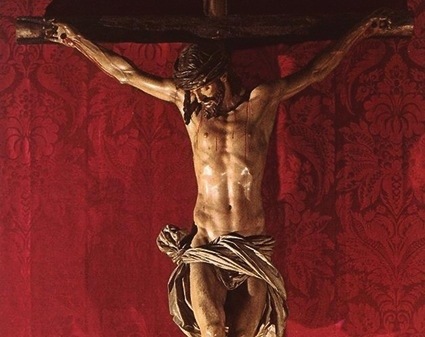
Like the bronze serpent brought healing (salvation) to those poisoned by snakebites, the sign of the Cross will bring eternal life and saving health to all who suffer.

No longer is the healing work of God limited to the people of Israel, no longer is salvation contained in the Temple at Jerusalem, but rather saving health is available to all who look on the Son of Man lifted up.

Collect of the Day

Almighty God, whose Son our Savior Jesus Christ was lifted high upon the cross that he might draw the whole world to himself: Mercifully grant that we, who glory in the mystery of our redemption, may have grace to take up our cross and follow him; who lives and reigns with you and the Holy Spirit, one God, in glory everlasting. Amen.

These trees are prayers

In this morning’s email, Richard Rohr shares a poem by Rabindranath Tagore:

Silence my soul, these trees are prayers.
I asked the tree, “Tell me about God”;
then it blossomed.

Rohr continues: “Now look around you, wherever you are, and find something of beauty. Sit in spacious silence, observing without words or judgment. Let this beauty teach you the mystery of Incarnation, of God’s indwelling presence in all creation.”

St. Mary the Virgin

Today is one of the feasts on the church calendar centering on the “mystery of Incarnation,” on God becoming human and sharing our lives in the person of Jesus.

His mother, Mary, plays a central role in this mystery. Her “yes” to God makes room for all sorts of blossoming.
2015-08-15 08.17.13Like Hannah, who sings that “the barren has borne seven” and the needy are raised up from the ash heap (1 Samuel 2:5-8), Mary sings of God lifting up the lowly and filling the hungry with good things (Luke 1:52-53).

Something new is bearing fruit in the world just as it is in her womb.

And in Jesus’ first sign, the miracle at the wedding in Cana, it’s Mary who puts the fruit of her womb on the spot and urges him to provide the fruit of the vine, overflowing amounts of wine for the feast, good wine that gladdens the heart.

Blossoming in place

Like many who pray the Daily Office, I have a favorite place to pray, a place that gladdens my heart.

From my chair on our porch I look out on our backyard, a Japanese garden with a screen of trees in the ravine behind it.

2015-08-15 06.37.59Looking at the trees in my garden, I “ponder these things in my heart” like Mary.

What trees bear witness to your prayers?

What place helps your heart to blossom? How does the place where you pray help bring Jesus to life again in you?

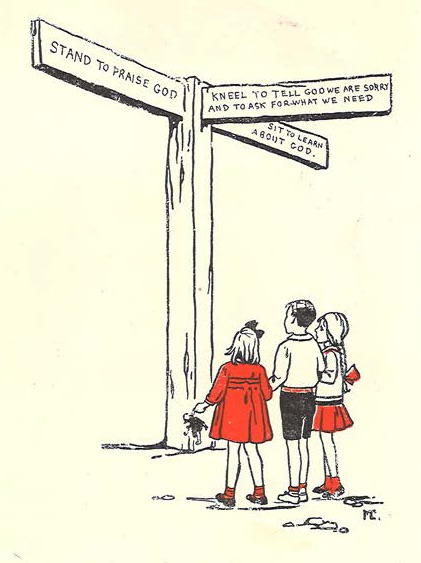
A Child’s Guide to Morning Prayer

Follow the link to discover A Child’s Guide to Morning Prayer (1954) from the Society for the Propagation of Christian Knowledge, or SPCK, gently illustrated by Margaret Chester.

Essentially you will find the same pattern in the Daily Office of the Episcopal Church today, though there are a few more options for canticles, and a bit more variety in the Collects. On this site, you will find several Resources to help you navigate the Offices more easily.

Thanks to Fr. Tony Clavier of the Episcopal Diocese of Springfield, for bringing this charming book to my attention.

Enjoy! And better yet, share it with a child you know!

Deep gloom enshrouds the peoples

Arise, shine, for your light has come, *
and the glory of the Lord has dawned upon you.
For behold, darkness covers the land; *
deep gloom enshrouds the peoples.
But over you the Lord will rise, *
and his glory will appear upon you. (Isaiah 60:1-3; BCP 87)

Yesterday evening, my Twitter feed and then the news filled with images and video of Walter Scott being shot so casually by North Charleston police officer Michael Slager.

Meanwhile, back on NCIS (Tuesday night is NCIS night) the usual storyline unfolds, and Gibbs very casually shoots the arms dealer who has killed a Marine; as often happens on NCIS, the show ends with an emotional appeal for gifts in memory of fallen Marines.

On NCIS: New Orleans, a hostage situation unfolds, met with the entirely understandable armoring of the FBI and a Navy SWAT team.

Through the gloom, the evening starts to feels like the Gospel accounts of the crucifixion — the Roman Empire says  “force wins,” the religious people say “it’s better for one person to die for the country,” the criminal gets taken down, and protests over his death are met with a carefully crafted story and an extra layer of security: “Otherwise, his disciples may go and steal him away” (Matthew 27:62-66).

It’s so hard to proclaim Easter when it’s gloomy like this. It’s so hard not to retreat, not to try to close out the news.

Alienation

But it gets better.

This morning in my Facebook feed, a friend shared a link to a reflection by New Jersey relationship columnist Anthony D’ambrosio on marriage and divorce.

One of the five reasons D’ambrosio cites “why marriage just doesn’t work anymore” is our alienation from each other because of all the devices and screens that surround us (I chuckle as I read in the living room; I can hear my wife tapping away on her laptop in the kitchen).

I can also hear the disciples walking on the Emmaus road shaking their heads in dismay. “It wasn’t supposed to be like this. We had high hopes.”

Communion

The stranger who joins them, and who accepts their polite invitation to a meal, opens the eyes of their faith in the way he breaks and blesses the bread (Luke 24:13-35).

O God, whose blessed Son made himself known to his disciples in the breaking of bread: Open the eyes of our faith, that we may behold him in all his redeeming work; who lives and reigns with you, in the unity of the Holy Spirit, one God, now and for ever. Amen. (BCP 223)

Perhaps simpler gestures of communion will pierce the deep gloom that enshrouds us.

Perhaps seeing each other through the eyes of faith — not as dangerous criminals, not as armed storm troopers, not as self-absorbed people pushing each other away on purpose — perhaps seeing each other is the first step to seeing the Risen Lord.

“Over you the Lord will rise,” says Isaiah, “and his glory will appear upon you.” Perhaps if we make time and space (and a place) to sit with each other, we will have a chance truly to see each other.

Give us eyes to see each other, O Lord, not to look past each other. Give us pause before we alienate one another again. Give us hunger to share a meal with each other, and in our breaking bread together to see you with us.

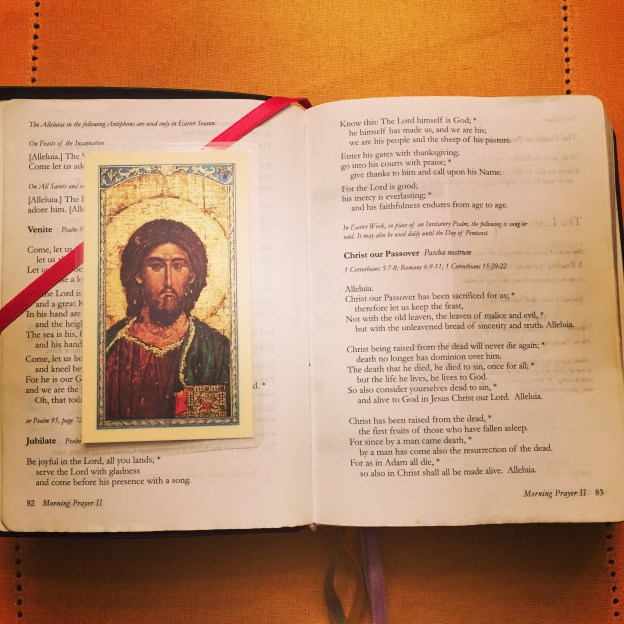
Christ our Passover

Alleluia. The Lord is risen indeed: Come let us adore him. Alleluia.

Morning Prayer during the 50 days of the Easter season may begin with the Easter antiphon and the canticle “Christ our Passover” instead of the Venite.

It’s a lovely way to mark these 50 days — one-seventh of the Church Year — as a sort of Sunday to the rest of the week.

Alleluia. The Lord is risen indeed: Come let us adore him. Alleluia.

Christ our Passover Pascha nostrum

Alleluia.
Christ our Passover has been sacrificed for us;
therefore let us keep the feast,
Not with the old leaven, the leaven of malice and evil,
but with the unleavened bread of sincerity and truth. Alleluia.

Christ being raised from the dead will never die again;
death no longer has dominion over him.
The death that he died, he died to sin, once for all;
but the life he lives, he lives to God.
So also consider yourselves dead to sin,
and alive to God in Jesus Christ our Lord. Alleluia.

Christ has been raised from the dead, the first fruits of those who have fallen asleep.
For since by a man came death,
by a man has come also the resurrection of the dead.
For as in Adam all die,
so also in Christ shall all be made alive. Alleluia. (BCP 83)

Avoid stupid controversies

Can anything good come out of Nazareth? (John 1:46)

Nathanael might have been reading Philip’s status update on Facebook, for all we can tell. His reply sure sounds like the snarky comments we post when we read something we don’t agree with.

The dismissive behavior we display on Facebook and Twitter is really nothing new; in the second-century letter to Titus (c. 110 AD) we hear the writer’s strong warning to Christians against the kind of behavior we engage in so often, a verse worth memorizing because it stands the test of time.

Avoid stupid controversies … (Titus 3:9)

But why? The writer expands on his idea. “Avoid stupid controversies, genealogies, dissensions, and quarrels about the law, for they are unprofitable and worthless.”

Worthless

Arguing about stupid Episcopal Church controversies, trying to prove a point by citing the canons, stirring up partisan passion about how misguided the leaders at 815 are, debating who’s right and who’s wrong — none of these things communicate the inspiring truth about what God is doing in the world.

And it’s not just our internal church controversies that are stupid.

You don’t have to have an opinion about every story, every commentary on the evening news. You don’t even have to watch the news.

Your compelling evidence, exhaustively cited, won’t change the mind of that guy on Twitter. Besides which, no one wants to read your 57 nested tweets on the same subject (unless it’s #AddAWordRuinAMovie or #LentMadness).

Your dismissive comments on Facebook about Obama or Bush, gun control or transgender rights, Palestine or Israel, Guy Fieri or Anthony Bourdain — and your obsessive sharing of political posts (left or right) do not change anyone’s mind.

Usually, they just make you look like a jerk.

Unprofitable

Not only is it a waste of time to engage in stupid controversies, it doesn’t actually help.

How does your arguing reflect the God we Christians worship, who hates nothing he has made and forgives the sins of all who are penitent (BCP 264)?

How do your opinions demonstrate your “new and contrite heart” and the humility of one who remembers “that you are dust, and to dust you shall return”?

How does your evidence against someone point to the God of all mercy and the “perfect remission and forgiveness” he offers for everyone?

How do your dismissive comments acknowledge your own “wretchedness”?

Pro tip: They don’t. Srsly.

Eager, not anxious

On Saturday mornings, we pray “that we, putting away all earthly anxieties, may be duly prepared for the service of [God’s] sanctuary” (BCP 99).

We are anxious about so many things, and the news cycle and social media feed that anxiety. We feel like we have to be up-to-date, have to weigh in, have to have an opinion on everything.

What if we were instead eager for one thing?

What if we were eager to rest in God’s grace, so freely given to us, so freely shared with everyone?

What if we were eager to share that grace ourselves?

What if instead of arguing, we tried listening? Instead of offering opinions, we shared experiences? Instead of listing the evidence against, we tried hearing the evidence for? Instead of dismissing, we tried admitting?

What if we admitted other people into the rest we share? What if we admitted them into the sanctuary?

What if, instead of Nathanael’s snarky “Can anything good come from there?” we offered our humble invitation: “Come and see”?

Bearing and being changed

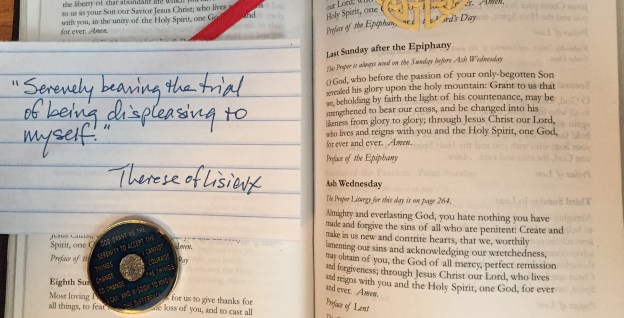
In one of the talks in the online course related to his book Breathing Under Water: Spirituality and the Twelve Steps, Richard Rohr describes the process of recovery in the words of Thérèse of Lisieux:

Serenely bearing the trial of being displeasing to myself.

And listen to Joan Chittister on the centenary of Thomas Merton’s birth:

What Merton calls us to do as part of this slow but fulfilling process [of spiritual development] depends on the raw and ruthless debunking of the self to the self that is the ground of humility.

In these last days of Epiphany, we approach the season of Lent, a season that the Church invites us to observe “by special acts of discipline and self-denial,” and we pray:

That we, beholding by faith the light of [Jesus’] countenance, may be strengthened to bear our cross, and be changed into his likeness from glory to glory (BCP 217).

Being displeasing to ourselves is not the point; being raw and ruthless in our debunking of ourselves is not the point.

Being changed into Jesus’ likeness is. Being changed from glory to glory is.

Lent is the season where we deliberately turn our gaze toward the crucified and risen Christ of Easter, the one to whom John the Baptist points us in this morning’s Gospel reading (John 1:19-28). But in Lent we are also made more keenly aware of “every weight and the sin that clings so closely” (Hebrews 12:1).

We commit ourselves once more in Lent to the helpful practices of the faith, knowing with the ancient Israelites that “if we diligently observe this entire commandment before the Lord our God, we will be in the right (Deut. 6:25). But on Ash Wednesday and throughout Lent we are also reminded of “our self-indulgent appetites and ways” (BCP 268).

Thérèse of Lisieux offers powerful wisdom in this situation, for we find our serenity in bearing our trials and continually returning to God’s pleasure in us. “Grant me the serenity to accept the things I cannot change,” we pray.

Merton’s words ring true, too, for desiring abundant life in God, we can be ruthless in ridding ourselves of everything that holds us back. “Grant me the courage to change the things I can,” we pray.

And finally, it is only with our gaze on “God the only Son, who is close to the Father’s heart” (John 1:18) that we have a prayer of receiving “the wisdom to know the difference.”

God, grant me the serenity to accept the things I cannot change;
the courage to change the things I can;
and the wisdom to know the difference.

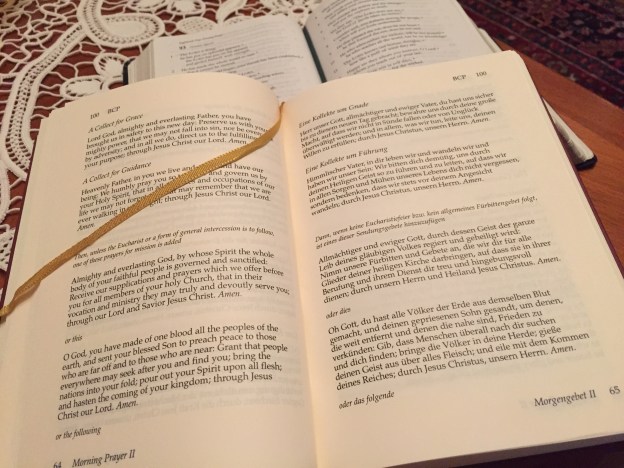
All the peoples of the earth / Aller Völker der Erde

Oh Gott, du hast aller Völker der Erde aus demselben Blut gemacht, und deinen gepriesenen Sohn gesandt, um denen, die weit entfernt und denen die nahe sind, Frieden zu verkünden: Gib, dass Menschen überall nach dir suchen und dich finden; bringe die Völker in deine Herde; gieße deinen Geist aus über alles Fleisch; und eile mit dem Kommen deines Reiches; durch Jesus Christus, unsern Herrn. Amen.

This is one of the familiar prayers for mission in Morning Prayer, but its plea takes on new meaning when one prays for “all the peoples of the earth” in a different language.

In this Christmas season especially, it’s important to remember that God became human for all of us, that God shares the flesh that we all share.

I’m grateful during this trip to Germany for the work of the Convocation of American Churches in Europe, which has translated portions of the Book of Common Prayer into Italian, French, Spanish, and German.

Praying the Daily Office (das Gebet der Tagzeiten) in German means, for me, slowing down and paying attention to the words of the prayers in a new way.

What practice might you embrace during these 12 days of Christmas that will encourage you to slow down and “ponder all these things” in a new way?

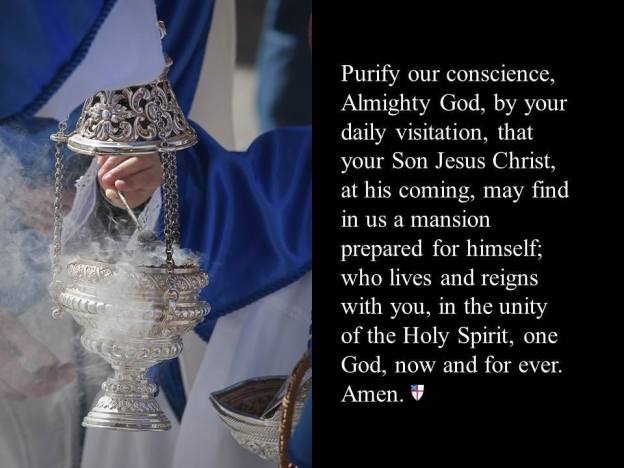
Daily visitation

How resonant that word, “daily.”

“Daily we begin again to put into practice the Lord’s teaching,” says the Rule of Benedict.

“One Day at a Time” say those of us in recovery.

Richard, Bishop of Chichester (1197-1253), is popularly credited with this prayer, made familiar both by Ralph Vaughn Williams and the musical Godspell:

Day by day,
Dear Lord, of thee three things I pray:
To see thee more clearly,
Love thee more dearly,
Follow thee more nearly,
Day by Day.

“The Holy Eucharist, the principal act of Christian worship on the Lord’s Day and other major feasts, and Daily Morning and Evening Prayer, as set forth in this Book, are the regular services appointed for public worship in this church,” says our own Book of Common Prayer (BCP 13).

May your daily visitation with the Lord be a source of blessing and strength, both this day and always.