Tag Archives: Morning Prayer

Not neglecting to meet together …

And let us consider how to provoke one another to love and good deeds, not neglecting to meet together, as is the habit of some, but encouraging one another, and all the more as you see the Day approaching. (Heb. 10:24-25)

Today I will be attending the Annual Convention of the Episcopal Diocese of Fond du Lac.

The day begins with Morning Prayer, during which the Deans will be commissioned. In between business sessions, Bishop Jacobus will deliver his pastoral address in the context of Noonday Prayer.

It is good to pray the Offices with others, in part because you realize that even when you pray the Office by yourself, as most of us do, you are not truly al0ne.

A Prayer of St. Chrysostom

Almighty God, you have given us grace at this time with one accord to make our common supplication to you; and you have promised through your well-beloved Son that when two or three are gathered together in his Name, you will be in the midst of them: Fulfill now, O Lord, our desires and petitions as may be best for us; granting us in this world knowledge of your truth, and in the age to come life everlasting. Amen. (BCP 102)

Red-Letter Days

20121018-125413.jpg

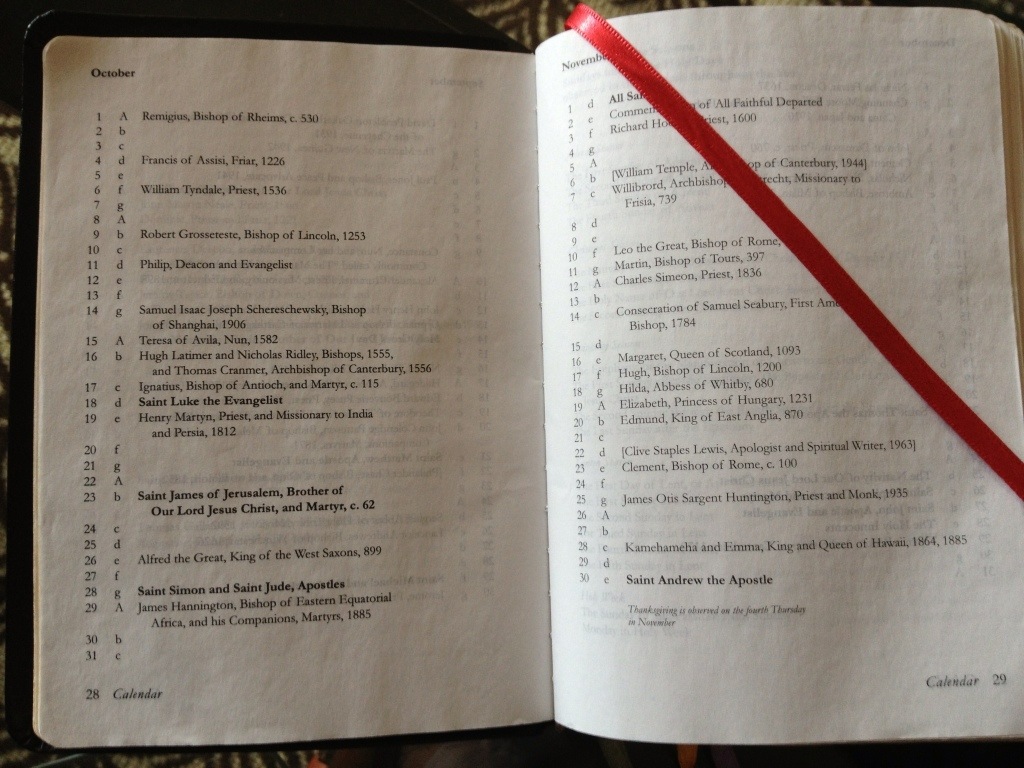
In my post this morning I reflected on the lessons appointed for the Thursday after Proper 23, having completely missed the fact that today is actually the Feast of St. Luke the Evangelist.

Perhaps if the Calendar in the front of the Book of Common Prayer still printed the Major Feasts in red (the origin of the term “red-letter days) I might have caught it. The current prayer book (see above) is a bit more subtle.

I probably wouldn’t have caught it, anyway, since my early-morning, barely-caffeinated routine has me turning first to the bookmarked Daily Office Lectionary, 961 pages away from the Calendar page for October, and then marking psalms and readings with the appropriate ribbons.

Oh well, there’s always Evening Prayer. I’ll have a chance to erase the black mark soon enough.

20121018-080815.jpg

In the Daily Office, several themes recur on particular days each week.

On Sundays we rejoice in Christ’s resurrection, on Saturdays we relax in God’s creation, on Fridays we remember Christ’s sacrifice on the cross. The collects appointed for those three days (BCP 98-99, 123) draw the themes out fairly obviously.

It’s a little more subtle, but on Thursdays we can discern a baptismal theme. The canticle suggested for use after the first lesson on Thursday mornings is the Song of Moses (BCP 85). The story of the Exodus is linked in the Christian mind with the Easter Vigil, and therefore with Baptism. For that reason, the Song of Moses is also to be used on Sunday mornings throughout Easter season.

Today’s readings center on two characters in peril on the sea.

Jonah, who has survived being in the belly of the whale (baptism by ingestion?), finally gets around to his mission, preaching to the people of Nineveh.

Paul’s confidence in God reassures the sailors that they will survive the violent storm and the shipwreck. Note that Paul also celebrates the Eucharist with them, the breaking and blessing of bread that follows Baptism.

We are baptized into Christ’s life, and each week we can remember, relax, and rejoice in God’s saving grace.

Continuous, if marginal, improvement

In the morning, Lord, you hear my voice;
early in the morning I make my appeal and watch for you. (Psalm 5:3)

I grow weary because of my groaning;
every night I drench my bed
and flood my couch with tears. (Psalm 6:6)

The company I work for is the leader in patient flow automation — improving patient care and hospital operations by making data more visible, smoothing out communication, and coordinating the efforts of employees in every area of the hospital.

We provide enormous amounts of data — dashboards to help you see in the moment whether you’re on track, standard reports in more than 90 flavors to help you drill down into the details and uncover roadblocks, and a custom reporting solution that will even email you the report automatically.

Our best clients have literally transformed their health systems by streamlining their patient flow, taking care of hundreds more patients every month in the same number of beds they have always had.

But, here’s the thing.

A few of our clients never look at the reports. They try to do their work without knowing what to expect. They make the same mistakes over and over again because they can’t see the pattern. They end up acting like every day is a crisis, when most days they will simply need to discharge some patients and admit some more, just like they do every day.

Think of the Daily Office as your dashboard, as your daily report.

“Early in the morning” and every evening,” as the Psalmist says, you can check in and see how you’re doing. Early in the morning you can remind yourself of the direction you want to take, and every evening you can take stock of where you strayed. In Morning Prayer you begin the day with the praise of God on your lips, and at Evening Prayer the words of confession bring the day to a close.

Using reports in your work, using the Daily Office, is not a magic bullet. You won’t necessarily change overnight, but you won’t change at all if you’re not paying attention. Continuous, if marginal, improvement is the order of the day.

For Guidance

Direct us, O Lord, in all our doings with your most gracious favor, and further us with your continual help; that in all our works begun, continued, and ended in you, we may glorify your holy Name, and finally, by your mercy, obtain everlasting life; through Jesus Christ our Lord. Amen. (BCP 832)

Patterns of life

“Praying the Office just every once in a while isn’t enough. It has to become a discipline. That doesn’t mean that if you miss it once you’re lost or anything, but its power lies in the force of habits. Habits of mind, habits of devotion, habits of thought. That’s what transforms us—patterns of life.”

From a longer address on the Daily Office and the Anglo-Catholic social conscience at Derek Olsen’s blog.

Seven times a day will I praise you

When I read the verse from Psalm 119 this morning (164), the word “seven” reminded me of a favorite hymn — King of Glory, King of Peace — with words by George Herbert:

Seven whole days, not one in seven,
I will praise thee;
In my heart, though not in heaven,
I can raise thee

Small it is, in this poor sort
To enroll thee;
E’en eternity’s too short
To extol thee.

-George Herbert

And here’s a video of the hymn being sung at Washington National Cathedral.

Be merciful, just as your Father is merciful

My heart recoils within me; my compassion grows warm and tender. I will not execute my fierce anger; I will not again destroy Ephraim; for I am God and no mortal, the Holy One in your midst, and I will not come in wrath. (Hosea 11:8-9)

In the Gospel appointed for today, we hear Jesus in the Sermon on the Mount telling us to love our enemies.

“If you love those who love you, what credit is that to you?” he asks. “Even sinners do the same.”

“But love your enemies, do good, and lend, expecting nothing in return. Your reward will be great, and you will be children of the Most High; for he is kind to the ungrateful and the wicked. Be merciful, just as your Father is merciful” (Luke 6:35-36).

Popular sentiment on Facebook and elsewhere these days runs more like this — if someone doesn’t like you, don’t keep them in your life. If someone disagrees with you, unfriend them or block their posts. Love those who love you.

But we are called to “a still more excellent way,” as Paul would describe it (1 Cor. 13). We are called to see clearly what people are up to, and to love them still. We are called to engage, not to disengage, and to be merciful to others with the warm and tender compassion of God.

Church Geek Note:

Today on the church calendar we commemorate William Tyndale and Miles Coverdale, translators of the Bible (1536, 1569). Just a year after Tyndale was executed for heresy (for daring to translate the New Testament into English), Coverdale completed the work and the Matthew Bible was published in 1537 in England. The Psalter from Coverdale’s Great Bible of 1539 was used in the English Book of Common Prayer in 1549 and 1662, and (with many revisions over the years) in American Prayer Books through 1928.

Our current Psalter is a translation directly from the Hebrew that takes advantage of 400 years of biblical scholarship. However, Marion Hatchett writes in his Commentary on the American Prayer Book that “the rhythmic expression which characterized Coverdale’s work has been preserved. So that the psalms may be congruent with the services in traditional language, the vocabulary has been largely restricted to that available to Coverdale” (551).

Almighty God, you planted in the heart of your servants William Tyndale and Miles Coverdale a consuming passion to bring the Scriptures to people in their native tongue, and endowed them with the gift of powerful and graceful expression and with strength to persevere against all obstacles: Reveal to us your saving Word, as we read and study the Scriptures, and hear them calling us to repentance and life; through Jesus Christ our Lord, who lives and reigns with you and the Holy Spirit, one God, for ever and ever. Amen.

Faith Alive: Being Apostles

20121005-054937.jpg

Now during those days, Jesus went out to the mountain to pray; and he spent the night in prayer to God. And when day came, he called his disciples and chose twelve of them, whom he also named apostles. (Luke 6:12-13)

Then Ananias said to Saul, “The God of our ancestors has chosen you to know his will, to see the Righteous One and to hear his own voice; for you will be his witness to all the world of what you have seen and heard. And now why do you delay? Get up, be baptized, and have your sins washed away, calling on his name.” (Acts 22:14-16)

We hear this morning from both books in Luke’s “orderly account” — the Gospel that bears his name and the Book of Acts — about the naming of Jesus’ first apostles and the dramatic conversion of Saul, who became Paul, the apostle to the Gentiles.

Being an apostle implies both a close relationship to Jesus and a mission to share his message.

If we are in relationship with Jesus, we will do what he does — spend the night in prayer to God and follow the way of the cross, which we will find is “none other than the way of life and peace” (BCP 99).

If we are sent on a mission like Paul, we will not delay but will instead live into our baptism now by sharing the Good News of what the living Lord is doing in our lives.

Immediately after reading the lessons in either Morning or Evening Prayer, we recite the Apostles’ Creed, the early baptismal creed of the church.

Every day, twice a day, we reconnect to the very first apostles of Jesus Christ and pledge ourselves — using the same words their followers used — to share in their mission.

“Glory to God, whose power, working in us, can do infinitely more than we can ask or imagine. Glory to him from generation to generation in the Church, and in Christ Jesus for ever and ever. Amen.” (BCP 102)

Some shouted one thing, some another

Then the tribune came, arrested him, and ordered him to be bound with two chains; he inquired who he was and what he had done. Some in the crowd shouted one thing, some another; and, as he could not learn the facts because of the uproar, he ordered him to be brought into the barracks. (Acts 21:33-34)

This morning, as I read the biography of St. Francis provided in the Church of England’s Twitter feed, I was reminded that Francis, too, was bound in chains early in his life when his father took him to court for selling bolts of cloth (and the horse that had pulled the wagon) and giving the money to a local church.

In both cases, public opinion was sharply divided over these followers of Christ. In both cases, neither side of the debate got at the heart of the matter.

Was Paul teaching against Jewish law and actually bringing Greeks into the Temple? Was Francis undermining good order by his dramatic poverty and his embrace of lepers?

We’ve seen in history what happened to these two followers of the Gospel.

Paul’s radical new community — no longer male nor female, Jew nor Greek, slave nor free — became more accommodated to Greco-Roman society, even within the time period of the Nw Testament, and ultimately became the state religion of the Roman Empire.

Francis’ Friars Minor, even during his lifetime, preferred to live in convents like the other monastic orders — approved bastions of the Roman Church and medieval society 1,200 years on from the New Testament days — rather than following his simple rule of begging and preaching.

What still gets lost in the debate, even today, is the central question each of these men faced: How complete is Christ’s claim on my life?

Some shout one thing, some another, but what is the voice of the living Lord trying to say?

What to do with these emotions?

Let his days be few,
and let another take his office.

Let his children be fatherless,
and his wife become a widow. (Psalm 109:7-8)

The Daily Office lectionary this morning suggests omitting several verses of Psalm 109, one of the psalms known as an “imprecatory” psalm because it asks God to curse one’s enemies.

This particular psalm gained some notoriety earlier this year in an email circulated by Kansas House Speaker Mike O’Neal asking people to pray for President Obama and citing these verses. What to do with these emotions?

I like this introduction to the Psalms in A New Zealand Prayer Book: He Karakia Mihinare o Aotearoa: “The wide appeal of the psalms rests on their ability to give words to some of our deepest feelings in the face of life’s experiences. Whether for joy, worship and exaltation, or degradation and rejection, or hope, faith, love, anger, or despair, the psalms contain verses that reflect such moods. In them the various writers expressed to God the thoughts of their heart and spirit. The richness of the psalms still speaks to us and in them we too can find words to match many of our moods and express them before God. In turn God can still address us through these psalms.”

Psalm 109 and others like it “give words to some of our deepest feelings” — feelings of anger and bitterness and the hope that our enemies will suffer — but “in turn God can still address us through these psalms.”

As we pour out our rage, we do so in the light of Christ, who “stretched out [his] arms of love on the hard wood of the cross that everyone might come within the reach of [his] saving embrace” — not just us, but our enemies, too.

As we choke out our bitterness, the Word of God “opens our lips” so our mouths can instead “show forth [his] praise.”

Though these imprecatory verses of the Psalter do not express the Christian understanding of God’s relationship with people (which is why they are usually omitted from our public worship), they do still express our very human frustrations and fears.

They may, in fact, help us in our private prayers to more honestly bring all of our concerns to God in order that we might be freed from anger and made whole again.