Tag Archives: Morning Prayer

Get your motor running

Singing Daily Office SSJE

I will be leaving shortly and driving all day today to get to meetings in Indianapolis.

Before enjoying my normal road fare of classic rock and audiobooks, I like to listen to Morning Prayer as it is prayed by the Society of St. John the Evangelist on their CD entitled Singing the Daily Office.

In addition to the services of Morning Prayer, Noonday Prayer, Evening Prayer and Compline, the 2-CD set includes 20 minutes of plainchant hymns that the SSJE brothers sing at their monastery in Cambridge, MA. I’ve also copied my CD onto iTunes so the services and hymns are available for me to listen to anywhere.

Listening in the car like I will today not only allows me to “keep my eyes on the road / my hands upon the wheel” as Jim Morrison might put it, but it also helps me to hear the psalms, canticles, readings, and prayers of the Office in voices other than my own.

When you pray the Daily Office alone, you may fall into the habit of rushing through certain prayers or canticles. Listening to them may remind you to slow down, to observe the speed limit, to enjoy the scenery.

St. John, Apostle and Evangelist

20121227-065903.jpg

Then I was beside him, like a master worker;
And I was daily his delight,
Rejoicing before him always,
Rejoicing in his inhabited world
And delighting in the human race.

Happy is the one who listens to me,
Watching daily at my gates,
Waiting beside my doors.
(Proverbs 8:30-34)

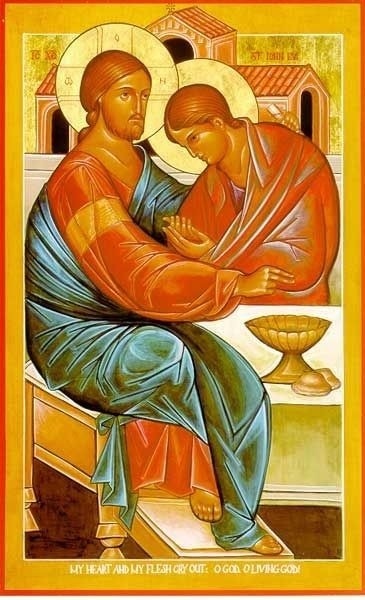
More than the other Gospel writers, John captures the scope and grandeur of the Incarnation.

The full creative force of God, the Wisdom that rejoices in creation, became part of creation through the birth of Jesus to Mary. That man Jesus, known best perhaps to “the disciple whom he loved,” showed his followers that love is the abiding quality in God’s own life. Love is also to be the characteristic of our lives.

As he reclined next to Jesus at the Last Supper, John heard the new commandment “that you love one another” from a privileged position — but that privileged position is now open to each one of us.

Each of us is a Beloved Disciple in our own right, invited to share the same intimacy with Jesus that John did, and called to share the same good news of love with those around us.

That is not what ships are built for

20121225-074400.jpg

“A ship in harbor is safe, but that is not what ships are built for.” -John Augustus Shedd

It’s tempting to read words like those from today’s Epistle and feel content. “So we have known and believe the love God has for us. God is love, and those who abide in love abide in God, and God abides in them” (1 John 4:16).

Abiding sounds like being snug in port, securely tied to the dock, battened down, gently rocking on the peaceful swells. It’s a lovely picture.

But that’s not what ships are built for, and that’s not what we are meant for.

John goes further in his letter: “Those who love God must love their brothers and sisters also” (1 John 4:21).

Abiding in God means living in the way God lives – out in the world, vulnerable, open, available, giving without fear. We can live that way because God did it first in the person of Jesus.

So don’t be afraid to put out from safe harbor, and don’t be afraid of the storms that may come. That’s what your ship is built for, and the One who built it abides in you.

For God alone my soul in silence waits

Early in the morning, the hotel lobby is a very comfortable place to read Morning Prayer with a cup of coffee close at hand (and it means I won’t disturb Lovely Wife, who is still asleep in the room).

I will admit, however, that it is tough to read Psalm 62:1 — “For God alone my soul in silence waits / from him comes my salvation” — while Jose Feliciano’s “Feliz Navidad” wafts from the speakers above my head.

Nevertheless, the brief time apart provides space for God’s “daily visitation,” in the lovely phrase from our collect for the Fourth Sunday of Advent:

Purify our conscience, Almighty God, by your daily visitation, that your Son Jesus Christ, at his coming, may find in us a mansion prepared for himself; who lives and reigns with you, in the unity of the Holy Spirit, one God, now and for ever. Amen. (BCP 212)

What small space of inner silence might you need to create in the middle of this holiday whirl, making room for God to visit so that you are “a mansion prepared” for Jesus’ coming?

The Living Hope of St. Thomas

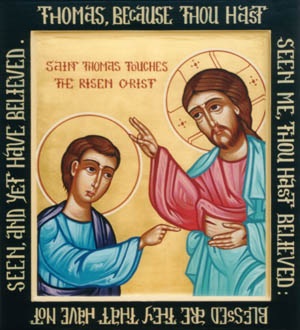
By the hand of Nicholas Pappas. Comeandseeicons.com

Three things strike me about the story of Thomas: his intellectual honesty, Jesus’ saving embrace, and the living hope that their relationship invites all of us to share.

Thomas is my favorite saint, and it’s a good thing, because I have preached on his feast day nearly every year since I have been ordained. I have taught homiletics (preaching) for many years, and I counsel new deacons and priests to become particularly familiar with the prologue to the Gospel of John and with the story of Thomas. Assisting clergy nearly always get to preach on “Low Sundays” like the First Sunday after Christmas and the Second Sunday of Easter, when these passages are appointed as the Gospel reading.

But Thomas (who was called the Twin), one of the twelve, was not with them when Jesus came. So the other disciples told him, “We have seen the Lord.” But he said to them, “Unless I see the mark  of the nails in his hands, and put my finger in the mark of the nails and my hand in his side, I will not believe.” (John 20:24-25)

Can you imagine how much Thomas wanted to believe Jesus was alive? Can you imagine what it cost him to admit that he needed evidence, to stand firm in his self-knowledge in the face of the others’ joy? Thomas is intellectually honest, and I admire that quality in him. He is self-aware and disciplined, even in the face of something he desires.

A week later, the disciples were again in the house, and Thomas was with them … [Jesus] said to Thomas, “Put your finger here and see my hands. Reach out your hand and put it in my side. Do not doubt but believe.” Thomas answered him, “My Lord and my God!” (John 20:26-28)

Here is another example of Jesus’ compassion, which reminds me of his returning to find the man born blind after he has been expelled from the synagogue (John 9:35). It is as if Jesus here asks Thomas, “What do you need from me in order to believe?” He does not berate Thomas, but offers his wounds as evidence. Here, too, is further evidence of Thomas’ honesty. When he has seen Jesus’ hands and side, he leaps straight to the proclamation, “My Lord and my God!” He is not the Doubter, but the first to name Jesus as Lord.

In Morning Prayer, we commonly use this prayer for mission on Fridays:

Lord Jesus Christ, you stretched out your arms of love on the hard wood of the cross that everyone might come within the reach of your saving embrace: So clothe us in your spirit that we, reaching forth our hands in love, may bring those who do not know you to the knowledge and love of you; for the honor of your Name. (BCP 100)

In the story of Thomas we see Jesus’ saving embrace bringing Thomas both to knowledge and to love.

We, too, are within the reach of Jesus. If we are honest about our doubts and fears, Jesus meets us with compassion and offers us “a new birth into a living hope” (1 Peter 1:3). “Although you have not seen him, you love him,” Peter continues, “and even though you do not see him now, you believe in him and rejoice with indescribable and glorious joy, for you are receiving the outcome of your faith, the salvation of your souls” (1 Peter 1:8-9).

We are also called by Jesus to reach out to others who may have doubts and fears. Like Jesus and like Thomas, we must meet them with compassion and gently offer them the evidence of our own living hope.

The Christmastide Lectionary

ChristmastideI know it’s still Thursday in the Third Week of Advent, but I want to give you all a jump on the complicated lectionary for the days after Christmas so that you can enjoy the holiday with minimal frustration.

Because Christmas Day occurs on a fixed date and several Major Feasts fall on the next few days after it, the Daily Office lectionary has to supply several options for the days between Christmas and the Epiphany, which also falls on a fixed date.

Here’s the crib sheet for the offices during Christmastide this year. You may wish to print it out and fold it into your prayer book for easy reference.

(The abbreviations MP and EP, as you might expect, stand for Morning Prayer and Evening Prayer; BCP for the page number in the Book of Common Prayer):

Dec. 23 – Fourth Sunday of Advent
MP and EP as on BCP 938
Collect on BCP 212

Dec. 24 – Christmas Eve
MP as on BCP 938 “Dec. 24”
MP Collect on BCP 212 (4 Advent)
EP as on BCP 938 “Christmas Eve”
EP Collect on BCP 212 (Christmas Day – second option)

Dec. 25 – Christmas Day
MP and EP as on BCP 940
Collect on BCP 212-13

Dec. 26 – Saint Stephen, Deacon and Martyr
MP and EP as on BCP 996
Collect on BCP 237

Dec. 27 – Saint John, Apostle and Evangelist
MP and EP as on BCP 996
Collect on BCP 238

Dec. 28 – The Holy Innocents
MP and EP as on BCP 996
Collect on BCP 238

Dec. 29 – Saturday after Christmas Day
MP and EP as on BCP 940 “Dec. 29”
Collect of a Martyr on BCP 246 (Thomas Becket)

Dec. 30 – First Sunday after Christmas Day
MP and EP as on BCP 940
Collect on BCP 213

Dec. 31 – Monday after 1 Christmas
MP as on BCP 940 “Dec. 31”
MP Collect on BCP 213 (1 Christmas)
EP as on BCP 940 “Eve of Holy Name”
EP Collect on BCP 213 (Holy Name)

Jan. 1 – The Holy Name of Our Lord Jesus Christ
MP and EP as on BCP 940
Collect on BCP 213

Jan. 2-4 – Weekdays after 1 Christmas
MP and EP as on dated days on BCP 940
Collect on BCP 213 (1 Christmas)

Jan. 5 – Saturday after 1 Christmas
MP as on BCP 940 “Jan. 5”
MP Collect on BCP 213 (1 Christmas)
EP as on BCP 940 “Eve of Epiphany”
EP Collect on BCP 214 (Epiphany)

Jan. 6 – The Epiphany
MP and EP as on BCP 942
Collect on BCP 214

What is the Office for?

“The key to [an examination of the orthodox principles behind the divine office] is to replace the substantial question by the more important existential one: not what is the office, but what is it for? It is not surprising that misunderstanding prevails, not only in Protestantism but also in Anglican practice, when our whole approach to liturgical studies remains historical instead of ascetical, substantial instead of existential. Tons of paper, oceans of ink and millions of words are expended on tracing the sources of ancient prayers, examining the meaning of lessons and psalms, and arguing about revision on historical principles, while most modern Christians are completely bewildered about what the office is for, what needs it is supposed to fulfill, and how it should be used. I am not meaning to be critical of liturgical scholarship as such, for it is of much value; I am critical of the failure to supplement it by ascetical interpretation. A driving instructor may usefully begin a series of lessons by explaining how an internal combustion engine works, but that is not teaching someone how to drive a car; it is not facing the existential question of what the car is for” (Martin Thornton, The Rock and the River 99 – by way of the Martin Thornton Facebook page).
chi-rho
“Most modern Christians are completely bewildered about what the office is for, what needs it is supposed to fulfill, and how it should be used.”
My hope is that this Daily Office Anchor Society provides some small help to you in terms of how to use the office.
What more would be helpful to you? How can we as a group encourage one another in this ascetical practice?

Our violence cannot save us

Weeping may spend the night,
but joy comes in the morning.

While I felt secure, I said,
“I shall never be disturbed.
You, Lord, with your favor, made me as strong as the mountains.”

Then you hid your face,
and I was filled with fear. (Psalm 30:6-7)

The world that Jesus was born into was characterized by violence.

His mother and father, poor and simple peasants, lived under the yoke of Roman imperial power. That power infected even the Jewish ruler, Herod, whose paranoia about the prophecy of another “king” caused him to have the children of Bethlehem slaughtered.

Violence infected the crowd that demanded Jesus be killed. “We can’t do it ourselves,” they said, so they handed him over to the Romans. Jesus died in agony, publicly executed as a criminal.

Two thousand years later, the infection has only spread. We no longer recognize violence, because it is so casual, so pervasive, ever-present on TV and in our “games.” We even call violence “security” and believe that being better-armed or striking first will make us safe.

Our violence cannot save us. It has never saved us. It will never save us.

Lord Jesus, quickly come! Our souls are full of heaviness and we are brought up short by our powerlessness.

Come again in your disarming vulnerability, your self-offering love, your peace that passes all understanding. Strengthen us to meet violence with love and to face the world unafraid.

Love divine, all loves excelling,
Joy of heaven to earth come down;
Fix in us thy humble dwelling;
All thy faithful mercies crown!
Jesus, Thou art all compassion,
Pure unbounded love Thou art;
Visit us with Thy salvation;
Enter every trembling heart.

Finish, then, Thy new creation;
Pure and spotless let us be.
Let us see Thy great salvation
Perfectly restored in Thee;
Changed from glory into glory,
Till in heaven we take our place,
Till we cast our crowns before Thee,
Lost in wonder, love, and praise.

All my hope on God is founded

Happy are they who have the God of Jacob for their help!
Whose hope is in the Lord their God.
Who made heaven and earth, the seas and all that is in them;
Who keeps his promise for ever. (Psalm 146:4-5)

On this First Sunday of Advent, we begin a new Church Year.

As you prepare to say the Daily Office, move your bookmark all the way back to the beginning of the lectionary for Year One (BCP 936). You may choose to begin Morning Prayer a little differently, perhaps by using the opening sentences for Advent and the Confession of Sin, and by saying the Jubilate instead of the Venite as the Invitatory Psalm (BCP 82).

Advent is the beginning of the year, and in this season we sound the note of hope which rings through every day, every hour of our lives in Christ.

But God’s power, hour by hour,
Is my temple and my tower.

Peter describes in his second letter the sense of expectation we feel as we wait for the Lord to fulfill his promises, and he encourages us not to lose heart. “The Lord is not slow about his promise, as some think of slowness, but is patient with you, not wanting any to perish, but all to come to repentance” (2 Peter 3:9).

We respond to the Lord’s patience with thanksgiving:

We bless you for our creation, preservation,
and all the blessings of this life;
but above all for your immeasurable love
in the redemption of the world by our Lord Jesus Christ;
for the means of grace, and for the hope of glory (BCP 101).

May your practice of the Daily Office this Advent nourish your hope and strengthen your trust in God’s goodness.

Come and See

Proclaim with me the greatness of the LORD; *
let us exalt his Name together.
(Psalm 34:3)

Today is the feast of St. Andrew, who with his brother Simon (St. Peter) was first called to follow Jesus.

The synoptic Gospels — Matthew, Mark, and Luke — place their calling together. The Gospel of John, as usual, tells a slightly different story.

The next day John again was standing with two of his disciples, and as he watched Jesus walk by, he exclaimed, ‘Look, here is the Lamb of God!’ The two disciples heard him say this, and they followed Jesus. When Jesus turned and saw them following, he said to them, ‘What are you looking for?’ They said to him, ‘Rabbi’ (which translated means Teacher), ‘where are you staying?’ He said to them, ‘Come and see.’ They came and saw where he was staying, and they remained with him that day. It was about four o’clock in the afternoon. One of the two who heard John speak and followed him was Andrew, Simon Peter’s brother. He first found his brother Simon and said to him, ‘We have found the Messiah’ (which is translated Anointed). He brought Simon to Jesus, who looked at him and said, ‘You are Simon son of John. You are to be called Cephas’ (which is translated Peter). (John 1:35-42)

After Jesus’ invitation to “come and see,” Andrew turns and extends the same invitation to his brother Simon.

As we begin a new church year this coming Sunday, who will you invite to “come and see” Jesus and to join you in praising God, not only with your lips but in your life?