Tag Archives: Morning Prayer

I want to know Christ

Who can tell how often he offends?
cleanse me from my secret faults.
Above all, keep your servant from presumptuous sins; let them not get dominion over me;
then shall I be whole and sound, and innocent of a great offense.
Let the words of my mouth and the meditation of my heart be acceptable in your sight,
O LORD, my strength and my redeemer.
(Psalm 19:12-14)

In his letter to the Philippians, Paul writes “I want to know Christ and the power of his resurrection and the sharing of his sufferings” (Phil. 3:11).

Paul is in many ways the model for us modern Christians who “want to know Christ.”

Like him, we rely on the testimony of others rather than having met the living Jesus in person.

Like him, we may have an experience of conversion (though perhaps not as dramatic as his Damascus Road experience), and we may have to spend time figuring out what it means and how we should live in response.

In the daily email “Brother, Give Us a Word” from the SSJE community, Br. David Vryhof writes: “Paul lived for God. His new life was born out of a deep desire to love and serve the God who had claimed him as his own.”

How has God claimed you? What do you desire in your relationship with God? What part of your life might need to be made new?

I have come to know Christ better as I spend time in prayer and the reading of Scripture, particularly as I practice the Daily Office. How do you know Christ in your life? Where do you feel his power and share his sufferings?

I have called you by name

Do not fear, for I have redeemed you;
I have called you by name, you are mine.
(Isaiah 43:1)

For my ordination to the diaconate 17 years ago, my Lovely Wife made a stole with cross-stitched images of birds and flowers taken from The Country Diary of an Edwardian Lady. It’s a glorious Easter stole, bursting with life.

January birds

At the top of the stole, just below my shoulder, is a golden cross with the same words from Isaiah stitched beneath it: “Do not fear, for I have redeemed you; I have called you by name, you are mine.”

In this week following the Baptism of our Lord, we have prayed in the Collect of the Day that “all who are baptized in his Name may keep the covenant they have made, and boldly confess him as Lord and Savior” (BCP 214).

We can be bold in our confession because God has acted first, and we are his. The whole sweep of salvation history teaches this lesson — God continually reaches out toward us and makes us his people. He redeems us, he calls us, we are his.

Because we do not need to fear, we can embrace new life in Christ and follow his lead, no matter where it takes us. Just as the Son is intimately known by the Father, we too are intimately known by the Son. “I do not call you servants any longer, because the servant does not know what the master is doing; but I have called you friends” (John 15:15).

Through baptism, Christ calls each of us by name. What fear might you need to lay aside so you can hear his call more clearly? Where might your friendship with Christ lead you?

The Rock of our salvation

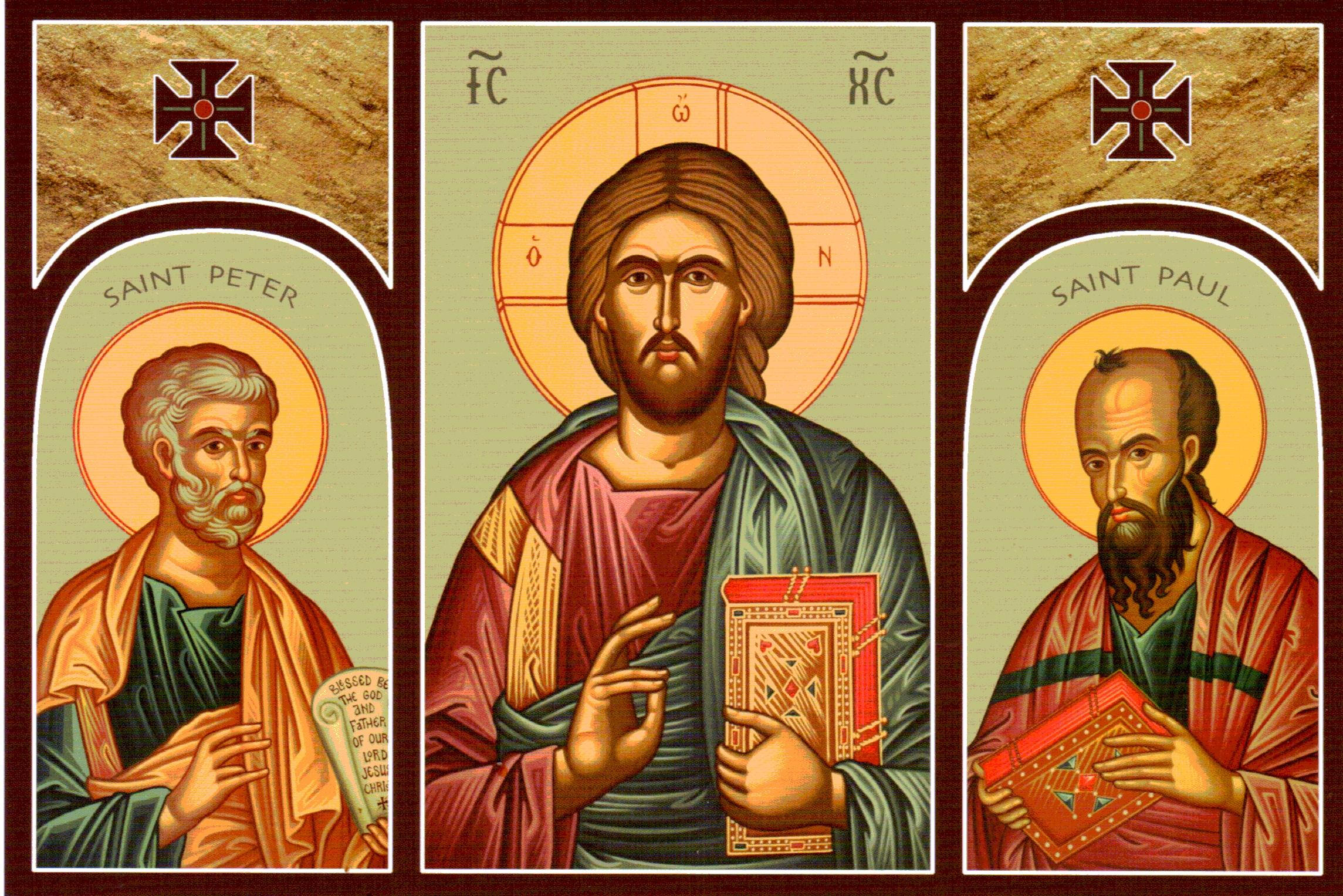
christ-with-saints-peter-and-paul

Come, let us sing to the Lord;
let us shout for joy to the Rock of our salvation.
Let us come before his presence with thanksgiving
and raise a loud shout to him with psalms. (BCP 82)

We open Morning Prayer with these words from the Venite (Psalm 95) most every day.

On this particular day, the Church commemorates the Confession of St. Peter, and a week from now we will celebrate the Conversion of St. Paul. Because these two apostles represent the preaching of the Gospel to Israel and to the Gentiles, this week is commonly observed as a “Week of Prayer for Christian Unity.”

Many people will be talking about unity in terms of the Church, and many will talk about Peter as “the rock” upon whom Christ built his Church, quoting Jesus’ pun as recorded by Matthew (16:18).

Truth is, though, Peter is not the foundation for our faith. He is not the Rock of our salvation — Jesus is.

Peter (and Paul) are examples of the firm and unshakeable faith that can be ours, however, when we build our spiritual homes on the Rock which is Jesus Christ. The Church, as the community of Christ’s followers, is meant to help us build on those strong foundations. We can learn from the Church’s 2,000 years of experience and apply it to our daily life and work.

Sometimes the Church is a rock; other times, we have to set our faces like flint against it “because they are not willing to listen to me” (Ezekiel 3:7). At all times, though, we are to “shout for joy to the Rock of our salvation and come before his presence with thanksgiving.”

Glory to God, whose power, working in us, can do infinitely more than we can ask or imagine. Glory to him from generation to generation in the Church, and in Christ Jesus for ever and ever. Amen. (BCP 100)

The hostility between us

But now in Christ Jesus you who were once far off have been brought near by the blood of Christ. For he is our peace; in his flesh he has broken down the dividing wall, that is, the hostility between us …. So he came and proclaimed peace to you who were far off and peace to those who were near; for through him both have access in one Spirit to the Father. (Ephesians 2:13-14, 17-18)

At a recent Commission on Ministry meeting in my diocese, we talked about the importance of reconciliation as a key element in any definition of Christian ministry.

Our Book of Common Prayer, in the Catechism, has this to say (BCP 855):

Q. What is the mission of the Church?
A. The mission of the Church is to restore all people to unity with God and each other in Christ.

Q. What is the ministry of the laity?
A. The ministry of lay persons is to represent Christ and his Church; to bear witness to him wherever they may be; and, according to the gifts given them, to carry on Christ’s work of reconciliation in the world; and to take their place in the life, worship, and governance of the Church.

“To restore all people to unity … to carry on Christ’s work of reconciliation.”

The hostility between us puts the lie to our name of “Christian.” Where we allow hostility to grow, or worse, promote it by our words and actions, we are not “bearing witness” to Christ.

It’s important, especially in this age of social media, not to confuse disagreement with hostility. Breaking down the hostility between us does not mean squelching disagreement — but it is important to be clear when we do disagree that we still honor the other person.

Reconciliation is hard work, but the heavy lifting has already been done. Jesus has broken down the dividing wall; it’s up to us not to keep putting the bricks back where they came from.

Instead, as Paul goes on to say, we are to place those bricks next to “Christ Jesus himself as the cornerstone. In him the whole structure is joined together and grows into a holy temple in the Lord; in whom you also are built together spiritually into a dwelling place for God” (Eph. 2:20-22).

This is my commandment

20130116-063434.jpg

I officiated at a wedding yesterday evening, where the couple chose John 15:9-12 as the Gospel reading.

“This is my commandment,” Jesus says to his disciples after the Last Supper, “that you love one another as I have loved you” (John 15:12).

This morning, with Katherine and Jack still on my mind, I began Morning Prayer and started to read Psalm 119, which is appointed for today. Psalm 119, as you may know, is a sort of acrostic where each section of the psalm begins with a different letter of the (Hebrew) alphabet and where every verse contains a play on the word “commandment.”

I couldn’t help mentally reframing the Psalm in the light of Jesus’ commandment:

Happy are they whose way is blameless,
who walk in the love of the Lord.

Happy are they who observe his love,
and seek him with all their heart.

Who never do any wrong,
but always walk in his love.

You laid down your love,
that we should fully keep it.

Oh, that my ways were made so direct
that I might keep your love! (Psalm 119:1-5 ed.)

I think this kind of love is what the former Pharisee Paul may have had in his mind as he wrote to the Ephesians.

But God, who is rich in mercy, out of the great love with which he loved us even when we were dead through our trespasses, made us alive together with Christ — by grace you have been saved — and raised us up with him and seated us with him in the heavenly places with Christ Jesus, so that in the ages to come he might show the immeasurable riches of his grace in kindness toward us in Christ Jesus. For by grace you have been saved through faith, and this is not your own doing, it is the gift of God. (Ephesians 2:4-8)

Through baptism, we share in the life that Christ lives in the world, and it is through us that the good news of the free gift of God’s love is communicated to the world. In marriage, we see the couple’s life together as a sign of Christ’s love, and we pray that their mutual affection will overflow in love and concern for others (BCP 429).

May it be so for all of us.

When he had found him

lindegaard-l-aveugle-de-naissance1Jesus heard that they had driven [the man born blind] out, and when he had found him, he said, “Do you believe in the Son of Man?” He answered, “And who is he, sir? Tell me, so that I may believe in him.” Jesus said to him, “You have seen him, and the one speaking with you is he.” He said, “Lord, I believe.” And he worshiped him. (John 9:35-38)

For me, these verses have long been an interpretive key for the Gospel of John, but I noticed something new today.

What has always impressed me is Jesus’ action here: “When he had found him.” Jesus actively finds the man in order to complete his healing and overcome his estrangement. This is a truth of the Gospel that applies to us today. Jesus actively desires that we be whole and reconciled, and his Spirit is working to find us wherever we may have gotten to.

Another element to this story struck me today, though.

John’s Gospel, according to most scholars, was written for a community of Jewish Christians who had recently been thrown out of the synagogues they had belonged to.

Like the man born blind, they had “seen the light” of Christ, but their religious community could not see that something new was happening. As Judaism sought to distance itself and differentiate itself from the growing Christian movement, followers of Jesus were expelled from the synagogues. They were probably feeling the same sense of estrangement, loss, and grief as the man in the story, wondering where they could go now.

Jesus actively found those early Christians, too. We are even today members of the reconciled community formed by Jesus’ active desire. Where we feel estranged, where we feel loss and grief, where familiar religious structures are changing, Jesus is there to find us.

“You have seen me,” Jesus says to us. “And the one speaking to you is me.”

Remember! Wake up!

I was ready to be sought out by those who did not ask, to be found by those who did not seek me. I said, “Here I am, here I am,” to a nation that did not call on my name. I held out my hands all day long to a rebellious people, who walk in a way that is not good, following their own devices; a people who provoke me to my face continually, sacrificing in gardens and offering incense on bricks; who sit inside tombs, and spend the night in secret places; who eat swine’s flesh, with broth of abominable things in their vessels; who say, “Keep to yourself, do not come near me, for I am too holy for you.” (Isaiah 65:1-5)

Today is one of those days when the readings and canticles pair up together beautifully to form an extended image and commentary.

We begin with God’s lament in Isaiah — the people do not seek him, though he says “Here I am.” They are rebellious, and they have forgotten their own identity as God’s chosen.

The first canticle appointed for this morning is Canticle 8 – The Song of Moses. In it, we remember our identity as the people saved by God and recount the story of the Exodus. “I will sing to the Lord, for he is lofty and uplifted; the horse and its rider has he hurled into the sea” (BCP 85).

We then read the Son of Man’s words to the church in Sardis from the Revelation to John: “Remember then what you received and heard; obey it, and repent. If you do not wake up, I will come like a thief, and you will not know at what hour I will come to you” (Rev. 3:3).

And then the second canticle appointed for today: Canticle 20. “Glory to God in the highest,” we say, “and peace to his people on earth.” Awakened, we raise our voices in praise.

As God’s people, we are saved, but forget that we are a chosen people. We are redeemed, but do not live like anything has changed.

“Remember!” says God. “Wake up!” says the Son of Man.

The Collect for Guidance, commonly used on Thursday mornings, is an excellent way to begin again — to remember and to wake up:

“Heavenly Father, in you we live and move and have our being: We humbly pray you so to guide and govern us by your Holy Spirit, that in all the cares and occupations of our life we may not forget you, but may remember that we are ever walking in your sight; through Jesus Christ our Lord” (BCP 100).

P.S. Having just returned from San Francisco, however, where the cioppino with Dungeness crab is simply marvelous, I will say that I have no intention of repenting from my love of the “broth of abominable things in my vessel.” Just sayin’.

cioppino

Let us go to the house of the Lord

20130109-070723.jpg

I was glad when they said to me,
“Let us go to the house of the Lord.”

Now our feet are standing
within your gates, O Jerusalem.
(Psalm 122:1-2)

Last night at dinner, I had a pleasant conversation with a colleague about prayer, Bible reading, churches that have impressed us, and finding a place at home to pray and read.

Back at the hotel, I am thinking this morning about the places where we pray.

The photo above is my most regular place of prayer: the desk in whatever hotel room I happen to find myself. It has the great benefit of being completely quiet, and I can arrange the space any way I want. It’s pretty easy to shut out distractions for a short while each morning as I pray and write.

My colleague joked that when he told his wife he wanted a place of his own at home to read, she just laughed. With her and five girls (and a dog) in the house, he’d be lucky for a few minutes of peace and quiet, and no chair is truly his own for long.

Several parishioners from my church recently traveled to Israel, and their feet actually stood within the gates of Jerusalem. They all reported how seeing and standing in the physical places of the Bible affected them.

Most of us, however, have to build “the house of the Lord” a little closer to home.

How have you created space for prayer in your own home? What still needs to be attended to so that you will find “peace within your walls” and “quietness within your towers”?

Crossing over and abiding

Icon of Joshua by St. Isaac of Syria Skete

Icon of Joshua by St. Isaac of Syria Skete

Be strong and courageous; for you shall put this people in possession of the land that I swore to your ancestors to give them …. I hereby command you: Be strong and courageous; do not be frightened or dismayed, for the Lord your God is with you wherever you go. (Joshua 1:6,9)

In this morning’s Old Testament lesson, Joshua is preparing to lead the people of Israel across the River Jordan into the Promised Land. God tells Joshua to “be strong and courageous” and reassures him that he will be with him.

Similarly, in the Gospel reading appointed for today, Jesus is speaking to the disciples at the Last Supper as he prepares to “cross over” through his death on the cross.

“As the Father has loved me, so I have loved you,” Jesus says; “abide in my love” (John 15:9). Jesus reassures the disciples in much the same way as God had reassured Joshua.

We, too, can receive God’s reassurance and a sense of his abiding presence in our lives — by doing just what Joshua and the disciples did.

God says to Joshua: “This book of the law shall not depart out of your mouth; you shall meditate on it day and night, so that you may be careful to act in accordance with all that is written in it” (Joshua 1:8).

“This is my commandment,” says Jesus to the disciples, “that you love one another as I have loved you … I do not call you servants any longer, because the servant does not know what the master is doing; but I have called you friends, because I have made known to you everything that I have heard from my Father” (John 15:12,15). We read in the book of Acts that the disciples did just what Jesus told them to.

Their abiding love, their joy at having “crossed over” with Jesus into new life, was visible to the Roman society in which the church began to grow. Tertullian (c. 200 AD) wrote about Roman society and how they saw the early Christians: “‘Look,’ they say, ‘how they love one another’ (for they themselves hate one another); ‘and how they are ready to die for each other’ (for they themselves are readier to kill each other)” (Apology 39.7).

Cross over (with God’s help) into the new life Christ has pioneered, and abide in friendship with him.

A tithe of your time

Then Jacob made a vow, saying, “If God will be with me, and will keep me in the way that I go, and will give me bread to eat and clothing to wear, so that I come again to my father’s house in peace, then the Lord shall be my God, and this stone, which I have set up for a pillar, will be God’s house; and of all that you give me I will surely give one-tenth to you.” (Gen. 28:20-22)

Earlier this week, I got into a conversation with a blogger named David Rosendahl regarding how we spend our time. He had done a time study and was reflecting on how little time it seemed he was devoting to “spiritual” things in relation to his work.

I commented that it actually seemed like he was tithing his time — that is, his study reveals that he spends about 10% as much time on spiritual things as he does on work. I also suggested that it’s important to consider whether the time you tithe is “first fruits,” time deliberately set aside for God rather than an afterthought.

In my case, I am typically awake for at least 12 hours each day, so a tithe of my time would be one hour and 20 minutes. Saying Morning Prayer and writing these reflections usually takes about an hour each morning; perhaps I still need to stretch a little and more regularly devote 20 minutes each day for Evening Prayer.

What might it look like for you to tithe your time? If you already do, how might you need to make sure you are giving of your “first fruits” to God?