
Tag Archives: John

Non nobis, Domine

Not to us, O Lord, not to us,
but to your Name give glory;
because of your love and because of your faithfulness.

Why should the heathen say,
“Where then is their God?”

Our God is in heaven;
whatever he wills to do he does.
(Psalm 115:1-3)

In his first “sign” at the wedding in Cana, Jesus deflects attention away from himself.

First, it’s a son’s normal reaction because his mom is pressuring him to do something: “What is it to you? My time has not yet come.” And even when Jesus does “whatever he wills to do” and changes the water into wine, the steward doesn’t know who did it, so he gives praise instead to the bridegroom for saving the best wine for last.

Not to us, O Lord, not to us, but to your Name give glory.

In Jesus, John and the other Gospel writers see the glory of God revealed, “the glory as of a father’s only son, full of grace and truth” (John 1:14).

Though Jesus does point to himself in the signs, especially those that follow this first one, what he’s really doing is pointing to God. “No one has ever seen God,” writes John. “It is God the only Son, who is close to the Father’s heart, who has made him known” (John 1:18).

Not to us, O Lord, not to us, but to your Name give glory.

We’re meant to follow in Jesus’ footsteps as his Body here on earth, sharing his forgiveness and healing power with those around us, and making known God’s love and faithfulness.

Morning and evening (at least) we’re also meant to give “Glory to God, whose power, working in us, can do infinitely more than we can ask or imagine. Glory to him from generation to generation in the Church, and in Christ Jesus for ever and ever” (BCP 102, 126).
Crossing over and abiding

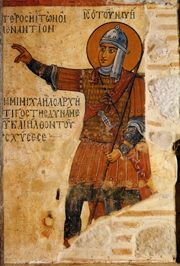
Icon of Joshua by St. Isaac of Syria Skete

Icon of Joshua by St. Isaac of Syria Skete

Be strong and courageous; for you shall put this people in possession of the land that I swore to your ancestors to give them …. I hereby command you: Be strong and courageous; do not be frightened or dismayed, for the Lord your God is with you wherever you go. (Joshua 1:6,9)

In this morning’s Old Testament lesson, Joshua is preparing to lead the people of Israel across the River Jordan into the Promised Land. God tells Joshua to “be strong and courageous” and reassures him that he will be with him.

Similarly, in the Gospel reading appointed for today, Jesus is speaking to the disciples at the Last Supper as he prepares to “cross over” through his death on the cross.

“As the Father has loved me, so I have loved you,” Jesus says; “abide in my love” (John 15:9). Jesus reassures the disciples in much the same way as God had reassured Joshua.

We, too, can receive God’s reassurance and a sense of his abiding presence in our lives — by doing just what Joshua and the disciples did.

God says to Joshua: “This book of the law shall not depart out of your mouth; you shall meditate on it day and night, so that you may be careful to act in accordance with all that is written in it” (Joshua 1:8).

“This is my commandment,” says Jesus to the disciples, “that you love one another as I have loved you … I do not call you servants any longer, because the servant does not know what the master is doing; but I have called you friends, because I have made known to you everything that I have heard from my Father” (John 15:12,15). We read in the book of Acts that the disciples did just what Jesus told them to.

Their abiding love, their joy at having “crossed over” with Jesus into new life, was visible to the Roman society in which the church began to grow. Tertullian (c. 200 AD) wrote about Roman society and how they saw the early Christians: “‘Look,’ they say, ‘how they love one another’ (for they themselves hate one another); ‘and how they are ready to die for each other’ (for they themselves are readier to kill each other)” (Apology 39.7).

Cross over (with God’s help) into the new life Christ has pioneered, and abide in friendship with him.

Your love, O Lord, reaches to the heavens

The Milky Way, from the bright star Sirius in the upper right corner all the way down to Eta Carina, the red nebula visible on the horizon, as seen from the Florida Keys. Image Credit: Tony Hallas/Science Fiction/Getty Images

“We might understand at some level that those tiny points of light in the night sky are similar to our sun, made of atoms identical to those in our bodies, and that the cavern of outer space extends from our galaxy of stars to other galaxies of stars, to distances that would take light billions of years to traverse. We might understand these discoveries in intellectual terms, but they are baffling abstractions, even disturbing, like the notion that each of us once was the size of a dot, without mind or thought. Science has vastly expanded the scale of our cosmos, but our emotional reality is still limited by what we can touch with our bodies in the time span of our lives.”

-Alan Lightman, Our Place in the Universe | Harper’s Magazine.

When I think about the Incarnation, the mystery toward which the season of Advent is leading us, I most often think of swimming in the lake at Interlochen arts camp in Michigan the summer after my junior year in college, one night around midnight.

The night sky was pitch-black, just like the water. I couldn’t tell where the warm water ended and the warm night air began. As I floated on my back in that womblike state, the Milky Way arched overhead from one end of the sky to the other.

All of that vast immensity is God’s creation. All of that creative power, filling “distances that would take light billions of years to traverse,” came to dwell in a child born to Mary. That child’s life and example transformed the people around him and continues to influence the world. That creative power could not be contained by death.

Lightman writes in this month’s Harper’s Magazine that “our emotional reality is still limited to what we can touch with our bodies in the time span of our lives.”

That’s why I think the Incarnation matters so much. That’s why many Christians (especially Anglicans) bow at the words “he became incarnate from the Virgin Mary, and was made man” in the Nicene Creed. We bow at the billions of burning stars contained in 11 short words.

“No one has ever seen God,” John writes in the prologue to his Gospel. “It is God the only Son, who is close to the Father’s heart, who has made him known” (John 1:18).

I hope that as you look on the baby in the manger this Christmas, your eyes will fill with stars and your heart with gratitude for God’s love, which “reaches to the heavens.”

Constant Love

From the Psalm (105:8): “He has always been mindful of his covenant …”

From the OT Lesson (Gen. 32:10): Jacob said … “O Lord, I am not worthy of the least of the steadfast love and all the faithfulness that you have shown to your servant.”

From the Gospel reading (John 10:28): “I give them eternal life, and they will never perish. No one will snatch them out of my hand.”

How does your life manifest constant love, steadfast love, faithful love? The psalmist is recounting Israel’s sojourn in Egypt, “when they were few in number, of little account, and sojourners in the land” (105:12). Jacob is understandably afraid to meet his brother Esau, whom he cheated out of his birthright. Jesus is being called on the carpet for his teaching in the Temple precincts. Yet in those circumstances, each one remembers God’s constant love. Each one shapes his response because of that steadfast love. Each one acts faithfully in love.

How does your life manifest constant love?