
Tag Archives: John

Food for the last and the least

And this is the will of him who sent me, that I should lose nothing of all that he has given me, but raise it up on the last day. (John 6:39)

First fruits

The Morning Prayer reading from the book of Deuteronomy on this Thanksgiving Day is set off with italics in my Bible: First Fruits and Tithes.

The people of Israel are grateful for their physical deliverance from slavery in Egypt. “The Lord brought us out of Egypt with a mighty hand and an outstretched arm, with a terrifying display of power, and with signs and wonders, and he brought us into this place and gave us this land, a land flowing with milk and honey” (Deut. 26:8-9).

In their gratitude, they are to give the first fruits of the land as an offering to God. But the story doesn’t end with their gratitude and offering; it also includes those who might easily be overlooked.

Their offering will be shared, the people with produce and food “giving it to the Levites, the aliens, the orphans, and the widows, so that they may eat their fill within your towns” (Deut. 26:12).

Anyone who comes

The people following Jesus don’t realize that what he is offering goes beyond bread, goes even beyond the manna that the children of Israel ate in the desert.

Jesus answered them, “Very truly, you are looking for me not because you saw signs, but because you ate your fill of the loaves” (John 6:26).

“I am the bread of life,” he says. “Whoever comes to me will never be hungry, and whoever believes in me will never be thirsty” (John 6:35). Sounds like he’s still talking about a physical deliverance.

But he goes on to talk about the will of the Father, and to hint at a much larger purpose.

“Everything that the Father gives me will come to me, and anyone who comes to me I will never drive away; for I have come down from heaven not to do my own will, but the will of him who sent me” (John 26:37-38).

Just like the first fruits and tithes were not only gifts and offerings to God, but also served as food for the last and least, so Jesus is bringing not just salvation for the chosen, but also for the despised and overlooked.

“Anyone who comes to me” — insider or outcast, Jew or Gentile, resident or alien, soldier or prisoner, family man or widow, mother or orphan — anyone and everyone is invited to share the feast.

Our “worthy service” is to extend the same invitation that Jesus extends. Anyone may come; everyone is to eat their fill.

Lord God of our Fathers; God of Abraham,Isaac, and Jacob; God and Father of our Lord Jesus Christ: Open our eyes to see your hand at work in the world about us. Deliver us from the presumption of coming to this table for solace only, and not for strength; for pardon only, and not for renewal. Let the grace of this Holy Communion make us one body, one spirit in Christ, that we may worthily serve the world in his Name. (BCP 372)
Signs of resurrection, seeds of hope

Signs of resurrection

Everything changes on Easter!

We reintroduce the Alleluias …

We recite or sing Christ our Passover in place of an Invitatory Psalm for the next 50 days …

We rehearse the salvation history of the Passover and the Exodus from Egypt (Exodus 12:1-14).

We remind ourselves in the stirring cadences of the Prologue to the Gospel of John of the present reality … “from his fullness we have received, grace upon grace” (John 1:16).

Alleluia! Christ is Risen! The Lord is risen indeed! Alleluia!

Seeds of hope

A student in my Education for Ministry (EfM) class gave me a lovely gift in an Easter card this year.

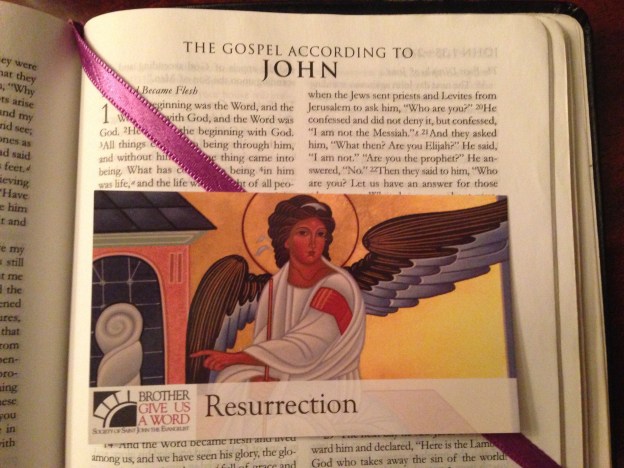
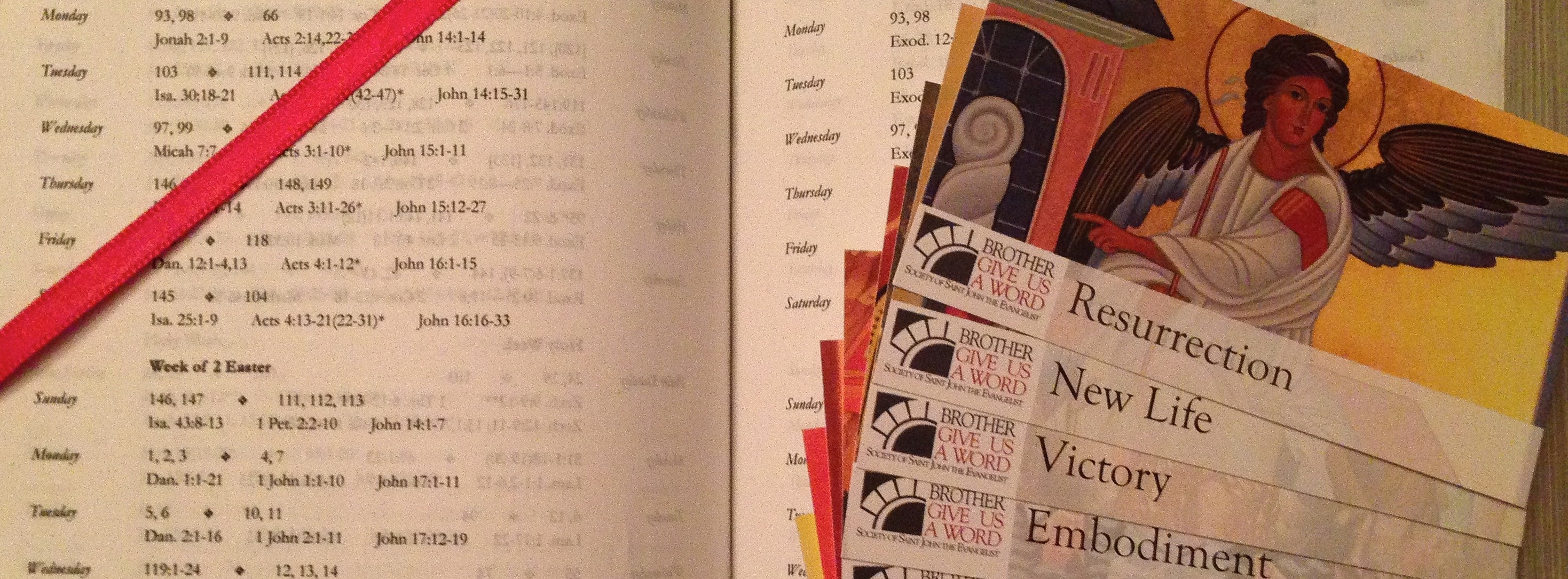
The brothers of the Society of St. John the Evangelist share a daily reflection on their website entitled “Brother, Give Us a Word.” They have also made the Easter Week reflections available as meditation cards.

IMG_0690On this morning’s card (Resurrection), Br. Geoffrey Tristram asks:

How do we allow those seeds of hope and resurrection deep within us to burst into new life? One way is to open our eyes and see the signs of resurrection all around us.

Even the simple changes to Morning Prayer are “signs of resurrection.” The birdsong and the rain I hear through the window are part of the “bursting into new life” going on outside. The steps I have been following in my recovery are “seeds of hope” deep within me.

Alleluia! Christ is Risen! The Lord is risen indeed! Alleluia!

Easter Day

O God, who for our redemption gave your only-begotten Son to the death of the cross, and by his glorious resurrection delivered us from the power of our enemy: Grant us so to die daily to sin, that we may evermore live with him in the joy of his resurrection; through Jesus Christ your Son our Lord, who lives and reigns with you and the Holy Spirit, one God, now and for ever. Amen. (BCP 222)

Surpassing human understanding

My God It's Full of Stars

In the beginning was the Word, and the Word was with God, and the Word was God. He was in the beginning with God. All things came into being through him, and without him not one thing came into being. What has come into being in him was life, and the life was the light of all people. The light shines in the darkness, and the darkness did not overcome it. (John 1:1-5)

In my Education for Ministry (EfM) group at St. Thomas Church is a priest who was ordained in 1955, about thirteen years before I was born.

He has embraced a sort of “second beginning” in his retirement, studying Old Testament all over again last year and now the New Testament this year. He has even gotten a scholarship to sign up for an online course in Biblical Hebrew!

In our reflections yesterday afternoon he shared his sense of wonder that the God who created everything that is — the universe, galaxies, stars, and planets — is present to us in the person of Jesus. “I’m having a hard time taking it all in,” he said.

After the Gospel reading at Morning Prayer today, we responded with Canticle 19:

O ruler of the universe, Lord God,
great deeds are they that you have done,
surpassing human understanding. (BCP 94)

It was in the light of this sense of wonder that I read Rabbi Daniel Brenner’s article about Bob Pollack, a Columbia University professor who teaches science to clergy.

The clergy in his class get restless and agitated when Pollack describes the universe’s origin “in a tiny particle fourteen and a half billion years ago,” but he responds with a lovely reflection on the second creation account in Genesis (2:4-25), which we also read this morning.

Look at Genesis. In Genesis the entire universe is made from words. The earth and sky and every plant and animal are made through God’s speech. But humans are not made in this way — God synthesizes humans from nature, from dirt, from a mix of organic and inorganic. In other words, we are made of live things and dead things. And we are the first example of chemistry and of transformation. As a result, we are the first species to have developed the ability to understand the bio-chemistry of the natural world. For this reason we are called “in God’s image.”

To the clergy’s objection (which I share) that understanding the natural world isn’t enough, Pollack also asked, “So what knowledge other than scientific knowledge do we need to thrive as humans?”

We also need, as we usually pray on Mondays at Morning Prayer, God’s help to “drive far from us all wrong desires, incline our hearts to keep your law, and guide our feet into the way of peace; that having done your will with cheerfulness during the day, we may, when night comes, rejoice to give you thanks” (BCP 99).

We need each day to reconnect to the God whose “ways are ways of righteousness and truth.”

May your sense of awe and wonder at God’s creation also lead you day by day to seek God’s help, and “may the peace of God, which passeth all understanding, keep your hearts and minds in the knowledge and love of God, and of his Son Jesus Christ our Lord” (BCP 339).

Daily his delight

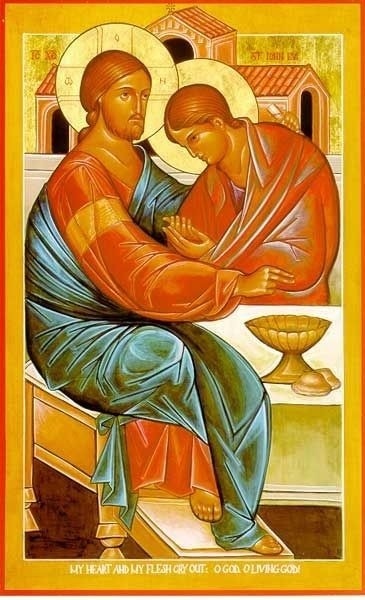
Icon of the Beloved Disciple from Mt. Angel Abbey

Icon of the Beloved Disciple from Mt. Angel Abbey – the inscription reads “My heart and my flesh cry out: O God, O living God!”

When he established the heavens, I was there,
when he drew a circle on the face of the deep,
when he made firm the skies above,
when he established the fountains of the deep,
when he assigned to the sea its limit,
so that the waters might not transgress his command,
when he marked out the foundations of the earth,
then I was beside him, like a master worker;
and I was daily his delight, rejoicing before him always.
(Proverbs 8:27-30)

Powerful Seeking

John’s gospel shines with both power and intimacy.

Jesus crackles with energy, turning water into wine, driving the moneychangers from the Temple, confounding learned and pious Nicodemus, speaking with a foreign woman, and healing with a word (whether the beggar by the pool wants it or not). And that’s only in the first five chapters of the story.

Jesus’ power radiates as clearly as his love and concern for people.

The man born blind, healed by Jesus’ touch and by a compress of mud (how like God’s own touch, forming mud and clay into the first human), is driven out of the synagogue by the religious leaders. But the story doesn’t end there, and John provides the key to understanding it fully.

“Jesus heard that they had driven him out, and when he had found him …” (John 9:35).

Jesus the power of God, whom John has come to understand is the same Word who was with God in the beginning, seeks out those who are hurting in order to effect their healing. He seeks out those who are estranged in order to effect their reconciliation.

As Reynolds Price writes in Incarnation: Contemporary Writers on the New Testament, the Gospel of John “says in the clearest voice we have the sentence that mankind craves from stories — The Maker of all things loves and wants me.”

Intimate Sending

John, the disciple whom Jesus loved, writes from a position of intimate knowledge. It is he who reclines next to Jesus at the Last Supper.

From within that close embrace, John sees both the betrayal Jesus suffers and the love that he demonstrates in washing the disciples’ feet and sending them out to serve one another.

Because today’s Feast of St. John falls on a Friday, in Morning Prayer we have the added poignancy of the Prayer for Mission that captures this intimate sending:

Lord Jesus Christ, you stretched out your arms of love on the hard wood of the cross that everyone might come within the reach of your saving embrace: So clothe us in your Spirit that we, reaching forth our hands in love, may bring those who do not know you to the knowledge and love of you; for the honor of your Name. Amen. (BCP 101)

Daily His Delight

Jesus, the Word of God, was with God at creation and was “daily his delight.” At the Incarnation, “God did not send the Son into the world to condemn the world, but in order that the world might be saved through him” (John 3:17).

John, the Beloved Disciple, who was close to Jesus’ heart and “daily his delight,” wrote his Gospel “so that you may come to believe that Jesus is the Messiah, and that through believing you may have life in his name” (John 20:31).

And you? The disciple whom Jesus loves?

You who have come within the reach of Jesus’ saving embrace and are “daily his delight,” how will you reach forth your hands in love to bring those who do not know Jesus into the knowledge and love of him?

Visions of peace

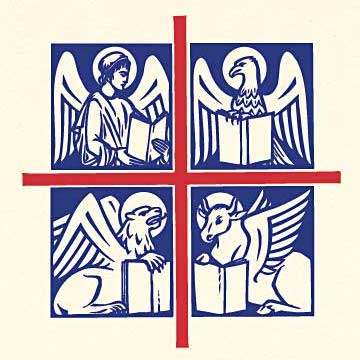
Four Evangelists cross from the Printery House

Four Evangelists cross from the Printery House

Therefore we praise you,
joining our voices with Angels and Archangels
and with all the company of heaven,
who forever sing this hymn
to proclaim the glory of your Name:

Holy, holy, holy Lord; God of power and might,
heaven and earth are full of your glory.
Hosanna in the highest.
Blessed is he who comes in the Name of the Lord.
Hosanna in the highest. (BCP 362)

Today the assigned readings and the canticles appointed for the day line up perfectly to create a single unifying image for Morning Prayer.

In the Book of Ezra, we read about the rebuilding of the Temple following the return of the Israelites from exile in Babylon. They are restoring the site of their worship, and with them we picture their prayers once more ascending to God, with incense surrounding the golden cherubim atop the Ark of the Covenant.

Glory to you, Lord God of our fathers;
you are worthy of praise; glory to you ….
Glory to you, seated between the Cherubim;
we will praise you and highly exalt you for ever.
(Canticle 13, BCP 90)

In the Revelation to John, we similarly see a vision of restoration, of worship to God in the heavenly City, the new Jerusalem. John describes his vision of a throne surrounded by 24 thrones, on which are seated 24 elders, in front of whom are seven torches and a sea of glass, and around whom are the “four living creatures, full of eyes in front and behind.”

Christian tradition has long associated the four living creatures — “at his feet the six-winged seraph; cherubim with sleepless eye” (Hymn 324) — with the four Evangelists: Matthew like a lion, Mark like a man, Luke like an ox, and John like an eagle.

In Canticle 18, we respond to the reading with the same song the angels and elders are singing around the throne:

And so, to him who sits upon the throne,
and to Christ the Lamb,
Be worship and praise, dominion and splendor,
for ever and for evermore.
(BCP 94)

Now, if that were the whole story, that would be enough — a nice symmetry making Morning Prayer extra lovely. Fine.

But there’s even more.

These visions of a restored Temple, of a City with the Lamb at its center, were recorded in order to give comfort to God’s people in hard times. The exiles were struggling to recover their sense of self, and it seemed like the grinding bureaucracy of the Babylonian empire might slow down or stop their building project. The early Christian communities of John’s time were beginning to be thrown out of the synagogues where they had been worshiping and to experience persecution by the Roman empire.

These are not just lovely songs, but visions of peace meant to sustain God’s people in times of trouble.

How will you imagine peace in your life today? What images will help you get through your struggles?

A Collect for Peace

O God, the author of peace and lover of concord, to know you is eternal life and to serve you is perfect freedom: Defend us, your humble servants, in all assaults of our enemies; that we, surely trusting in your defense, may not fear the power of any adversaries; through the might of Jesus Christ our Lord. Amen. (BCP 99)

Trinity Sunday

20130526-064647.jpg

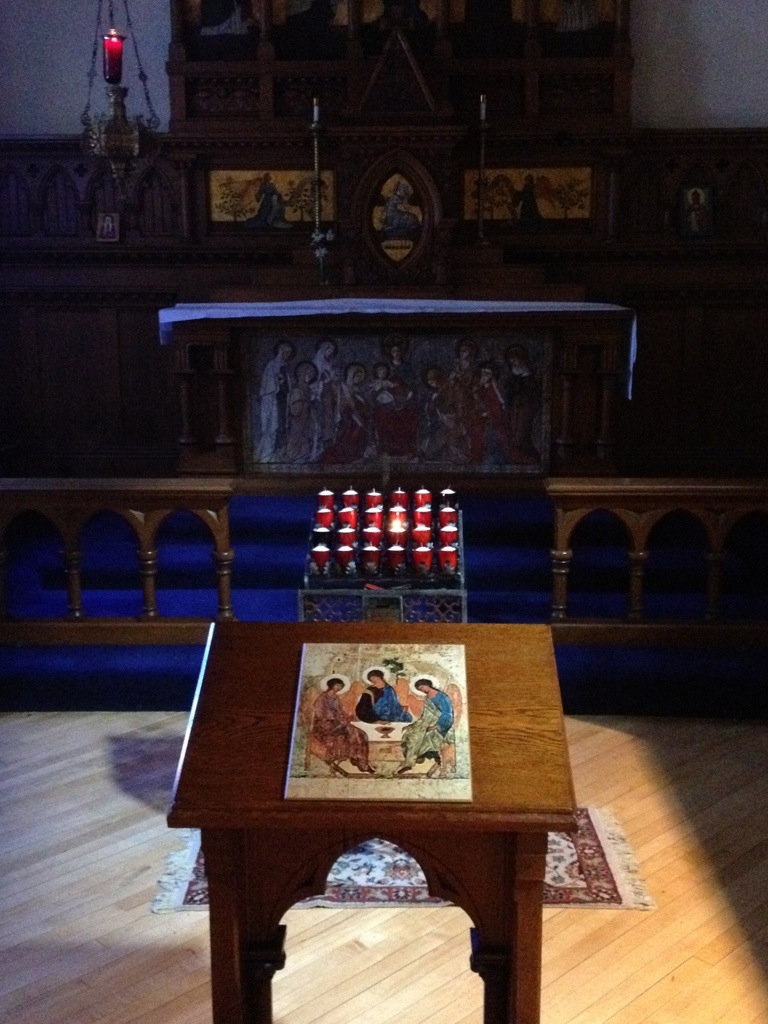
St. Augustine’s Chapel in the Cathedral Church of St. Paul, Fond du Lac

First Sunday after Pentecost: Trinity Sunday

O God, you have given to us your servants grace, by the confession of a true faith, to acknowledge the glory of the eternal Trinity, and in the power of your divine Majesty to worship the Unity: Keep us steadfast in this faith and worship, and bring us at last to see you in your one and eternal glory, O Father; who with the Son and the Holy Spirit live and reign, one God, for ever and ever. Amen. (BCP 228)

+ + + + +

I want to reflect not so much on the doctrine of the Trinity but on the method of Trinitarian faith.

It took more than 400 years of sustained practice and reflection before the Christian church articulated the doctrine of the Trinity. The Apostles’ Creed is first mentioned by Ambrose around 390; the Nicene Creed came after the Council of Nicaea in 325 and was revised by the Council of Constantinople in 381; Augustine wrote On the Trinity in 415; and the Athanasian Creed dates to sometime after the Council of Chalcedon in 451.

+ + + + +

From the beginning Christians gathered to pray daily (just as they had been doing as observant Jews), celebrated the Lord’s Supper, and ministered to those around them, making disciples through the power of the Spirit.

“No one has ever seen God,” writes the author of the Gospel of John. “It is God the only Son, who is close to the Father’s heart, who has made him known” (John 1:18).

“There is one body and one Spirit, just as you were called to the one hope of your calling, one Lord, one faith, one baptism, one God and Father of all, who is above all and through all and in all” (Ephesians 4:4-6).

“Jesus is Lord” rings the cry of faith; “We are one in the Spirit” say the apostles to Jew and Greek, slave and free, male and female; “How good it is to sing praises to our God” we pray every morning and every evening, joining our voices to the Psalmist’s (Ps. 147:1).

The doctrine of the Trinity is the attempt, however mathematical and philosophical it may be, to account for the lived experience of the Church, following the Lord Jesus in the power of God’s Spirit and in praise to the eternal Father — acknowledging the Trinity and worshiping the Unity.

Throughout the world the holy Church acclaims you:
Father, of majesty unbounded,
your true and only Son, worthy of all worship,
and the Holy Spirit, advocate and guide.

(Te Deum laudamus, BCP 95)

The Word who is trustworthy

[A bishop] must have a firm grasp of the word that is trustworthy in accordance with the teaching, so that he may be able both to preach with sound doctrine and to refute those who contradict it. (Titus 1:9)

The Episcopal Diocese of Fond du Lac, where I serve as a deacon, is preparing to elect a new bishop. Our bishop, Russ Jacobus, has announced his retirement, and the Standing Committee is working on a diocesan profile so share with those who are eventually nominated. The election will take place in October.

Already this year, we have had several survey days for members of the diocese to discuss what is required (and desired) in a bishop, and what is required of each of us as members of Christ’s Body, the Church.

“Having a firm grasp of the word that is trustworthy …” is an awfully good place to start.

One of the particular treasures of the Daily Office is that it soaks you in Scripture. You can’t help it — as you follow the Daily Office lectionary, you read all 150 Psalms every seven weeks, the New Testament in the course of a year, and the Old Testament over the course of two years.

But even more than that, in the Daily Office you read Scripture in the context of worship, in the context of prayer, in the context of a living relationship with Jesus, the Word who himself is trustworthy.

“I myself have seen and have testified that this is the Son of God,” says John the Baptist in tonight’s Gospel reading (John 1:34).

It’s not just bishops who need to be able to “preach with sound doctrine.” All of us bear witness to the love we have known in Jesus, the love revealed on every page of the Scriptures and in every canticle and collect of the Daily Office.

I have seen and have testified to the Word who is trustworthy. You can trust him, too.

If the Son makes you free

Lord, you now have set your servant free
to go in peace as you have promised;
For these eyes of mine have seen the Savior,
whom you have prepared for all the world to see:
A Light to enlighten the nations,
and the glory of your people Israel.
(Nunc dimittis, BCP 120)

The Scripture readings appointed for Morning Prayer on this Feast of the Presentation of Our Lord Jesus Christ in the Temple (that’s a mouthful!) all point to the freedom represented by the infant son of Mary and Joseph.

The Psalmist takes us back to the perennial complaint: “Why are you so full of heaviness, O my soul, and why are you so disquieted within me?” (Ps. 42:1).

Both Hannah’s song (1 Samuel 2) and Zechariah’s song (Canticle 16, BCP 92) point to a child as the symbol of God’s saving action in the world.

In Hannah’s song, sung in her joy after she has become pregnant, God is the one who “makes poor and makes rich, he brings low, he also exalts. He raises up the poor from the dust; he lifts up the needy from the ash-heap, to make them sit with princes and inherit a seat of honor” (1 Sam. 2:7-8).

Zechariah, the father of John the Baptist, sings a song to God and to his infant son: “You, my child, shall be called a prophet of the Most High, for you will go before the Lord to prepare his way, to give his people knowledge of salvation by the forgiveness of their sins” (BCP 92).

And the one presented in the Temple this day?

As an adult, Jesus invites the Jews who had believed in him to understand that the truth will set them free. The Son, the true Son of God, has come to set all people free from their slavery to sin. Our souls no longer need be heavy. We will know salvation by the forgiveness of our sins.

“So if the Son makes you free, you will be free indeed” (John 8:36).

That’s a promise worth singing about!

I have called you by name

Do not fear, for I have redeemed you;
I have called you by name, you are mine.
(Isaiah 43:1)

For my ordination to the diaconate 17 years ago, my Lovely Wife made a stole with cross-stitched images of birds and flowers taken from The Country Diary of an Edwardian Lady. It’s a glorious Easter stole, bursting with life.

January birds

At the top of the stole, just below my shoulder, is a golden cross with the same words from Isaiah stitched beneath it: “Do not fear, for I have redeemed you; I have called you by name, you are mine.”

In this week following the Baptism of our Lord, we have prayed in the Collect of the Day that “all who are baptized in his Name may keep the covenant they have made, and boldly confess him as Lord and Savior” (BCP 214).

We can be bold in our confession because God has acted first, and we are his. The whole sweep of salvation history teaches this lesson — God continually reaches out toward us and makes us his people. He redeems us, he calls us, we are his.

Because we do not need to fear, we can embrace new life in Christ and follow his lead, no matter where it takes us. Just as the Son is intimately known by the Father, we too are intimately known by the Son. “I do not call you servants any longer, because the servant does not know what the master is doing; but I have called you friends” (John 15:15).

Through baptism, Christ calls each of us by name. What fear might you need to lay aside so you can hear his call more clearly? Where might your friendship with Christ lead you?

When he had found him

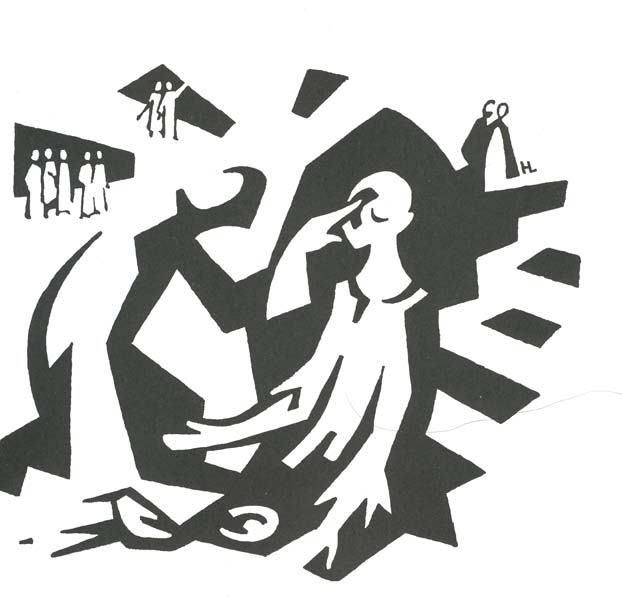
lindegaard-l-aveugle-de-naissance1Jesus heard that they had driven [the man born blind] out, and when he had found him, he said, “Do you believe in the Son of Man?” He answered, “And who is he, sir? Tell me, so that I may believe in him.” Jesus said to him, “You have seen him, and the one speaking with you is he.” He said, “Lord, I believe.” And he worshiped him. (John 9:35-38)

For me, these verses have long been an interpretive key for the Gospel of John, but I noticed something new today.

What has always impressed me is Jesus’ action here: “When he had found him.” Jesus actively finds the man in order to complete his healing and overcome his estrangement. This is a truth of the Gospel that applies to us today. Jesus actively desires that we be whole and reconciled, and his Spirit is working to find us wherever we may have gotten to.

Another element to this story struck me today, though.

John’s Gospel, according to most scholars, was written for a community of Jewish Christians who had recently been thrown out of the synagogues they had belonged to.

Like the man born blind, they had “seen the light” of Christ, but their religious community could not see that something new was happening. As Judaism sought to distance itself and differentiate itself from the growing Christian movement, followers of Jesus were expelled from the synagogues. They were probably feeling the same sense of estrangement, loss, and grief as the man in the story, wondering where they could go now.

Jesus actively found those early Christians, too. We are even today members of the reconciled community formed by Jesus’ active desire. Where we feel estranged, where we feel loss and grief, where familiar religious structures are changing, Jesus is there to find us.

“You have seen me,” Jesus says to us. “And the one speaking to you is me.”