
Sermon at Morning Prayer | Sunday, June 21, 2015

“I will never be able to hold her again, but I forgive you,” a daughter of Ethel Lance said. “And have mercy on your soul. You hurt me. You hurt a lot of people, but God forgives you, and I forgive you.”

“As we said in the Bible study, we enjoyed you,” survivor Felicia Sanders said. “But may God have mercy on you.”

How in the world can these people from Emanuel AME Church in Charleston be at peace?

How in the world can they have forgiveness in their hearts?

How did they come to possess “the peace that passes understanding”?

The Cycle of Gospel Living

It’s clear that most of us do not have that peace.

We try to talk about racism and violence and the other ills that plague us, but we end up talking past each other and inflaming each other further. The news media and social media erupt with argument and counter-argument.

Even when we are fellow-Christians trying to speak about the Gospel, we do not always help as we had hoped to. We try to “proffer the Word of life,” but we still talk past each other.

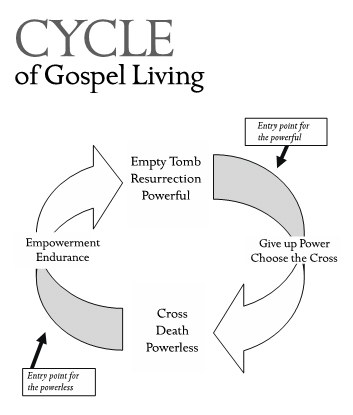
The Rev. Eric H. F. Law of the Kaleidoscope Institute teaches about the “Cycle of Gospel Living,” and I believe it can help us in these challenging conversations.

We have studied this cycle in our Education for Ministry groups this year, as we reflect on “Living Faithfully in a Multicultural World.”

Take a moment to look at the diagram carefully.
9ae68-6a0120a7d143f3970b014e8774c2bb970d-pi

We all participate in the dying and rising of Christ, in the cross and resurrection, but we enter the cycle from different places – the powerless from the bottom, the powerful from the top.

This cycle is reflected in all three of the readings assigned for the Daily Office today:

From the bottom, from complete defeat and disaster for Israel, “The wife of Phinehas said, ‘The glory has departed from Israel, for the ark of God has been captured.’” (1 Samuel 4:22)

After speaking to someone on top, a rich young man, Jesus turns to his disciples and says, “Truly I tell you, it will be hard for a rich person to enter the kingdom of heaven” (Matt. 19:23).

And writing to Christian Jews living in “the Dispersion,” in a variety of different places, James says, “Let the believer who is lowly boast in being raised up, and the rich in being brought low” (James 1:9-10).

The Coded Gospel

How in the world can these people be at peace?

How can we come to possess the peace that passes understanding?

“If you have decided you want what we have and are willing to go to any length to get it – then you are ready to take certain steps…. Here are the steps we took, which are suggested as a program of recovery” (Big Book 58-9).

Through my own experiences in recovery I have heard in the 12 Steps of AA what Richard Rohr calls “the coded Gospel” (Breathing Under Water).

An experience of powerlessness can trigger our awareness that we cannot handle our life alone.

When we admit our powerlessness, we can find reprieve – “a daily reprieve contingent upon the maintenance of our spiritual condition” (Big Book 85).

We may even find that our regular spiritual practices become an oasis, rather than a burden.

Sitting in the Oasis

The members of Emanuel AME Church were meeting for their regular Wednesday night Bible study.

They were sitting “in the oasis,” and they welcomed a stranger to join them, even offering him a seat of honor next to their pastor.

As African-American people in South Carolina, they lived in relative powerlessness – even though their pastor was also a state senator, the streets around their church are named for Confederate generals, a constant reminder of slavery and of past and present violence against people of color.

As people of color, their identification with Jesus, their entry into the cycle of gospel living, may have been at the bottom, but their endurance like Jesus, their empowerment by Jesus, and the daily maintenance of their spiritual condition in union with the resurrected Jesus produced in them an oasis, full of living water.

Choosing the Cross

We do not necessarily have the same experience of the Gospel.

Our identification with Jesus, our entry into the cycle of Gospel living, is more likely to start at the top and to require us to choose the cross, giving up the power and privilege we enjoy as white people in northeast Wisconsin.

Whether something like addiction calls us up short, whether the death of a loved one brings us low, whether we are cut to the quick by the words of Scripture, our falling and failing will also lead us into “the way of the cross, [which is] none other than the way of life and peace” (BCP 99).

You Cannot Transmit Something You Haven’t Got

So how did they come to possess the peace that passes understanding?

And how can we come to share in the peace that does not “treat the wound of [God’s] people carelessly” (Jer. 6:14)?

The “Big Book” of AA reassures me that “the answers will come, if your own house is in order. But obviously you cannot transmit something you haven’t got” (164).

Many people in the Episcopal Church, especially as we prepare for General Convention, are calling us to a preach resurrection and engage in the kind of practices that will get us what we need to transmit.

A Memorial to the Church by the Acts 8 Moment invites the Episcopal Church to:

  • recommit itself to the spiritual disciplines at the core of our common life,
  • go into our neighborhoods boldly …, and
  • restructure our church for the mission God is laying before us today.

And 3 Practices TEC invites us to:

  • follow Jesus together
  • into the neighborhood, and
  • travel lightly

The Spiritual Disciplines at the Core

Like the 12 Steps of recovery, the “spiritual disciplines at the core of our common life” are deceptively simple:

  • Celebrate the Holy Eucharist on Sundays and Major Feasts
  • Pray every morning and evening, soaking yourself in the Scriptures
  • Confess your sins to God, and to another person if you need to
  • Feast during Christmas and Easter and on Major Feasts; fast during Lent and on Fridays
  • Baptize, confirm, and teach new disciples
  • Care for each other “in sickness and in health”

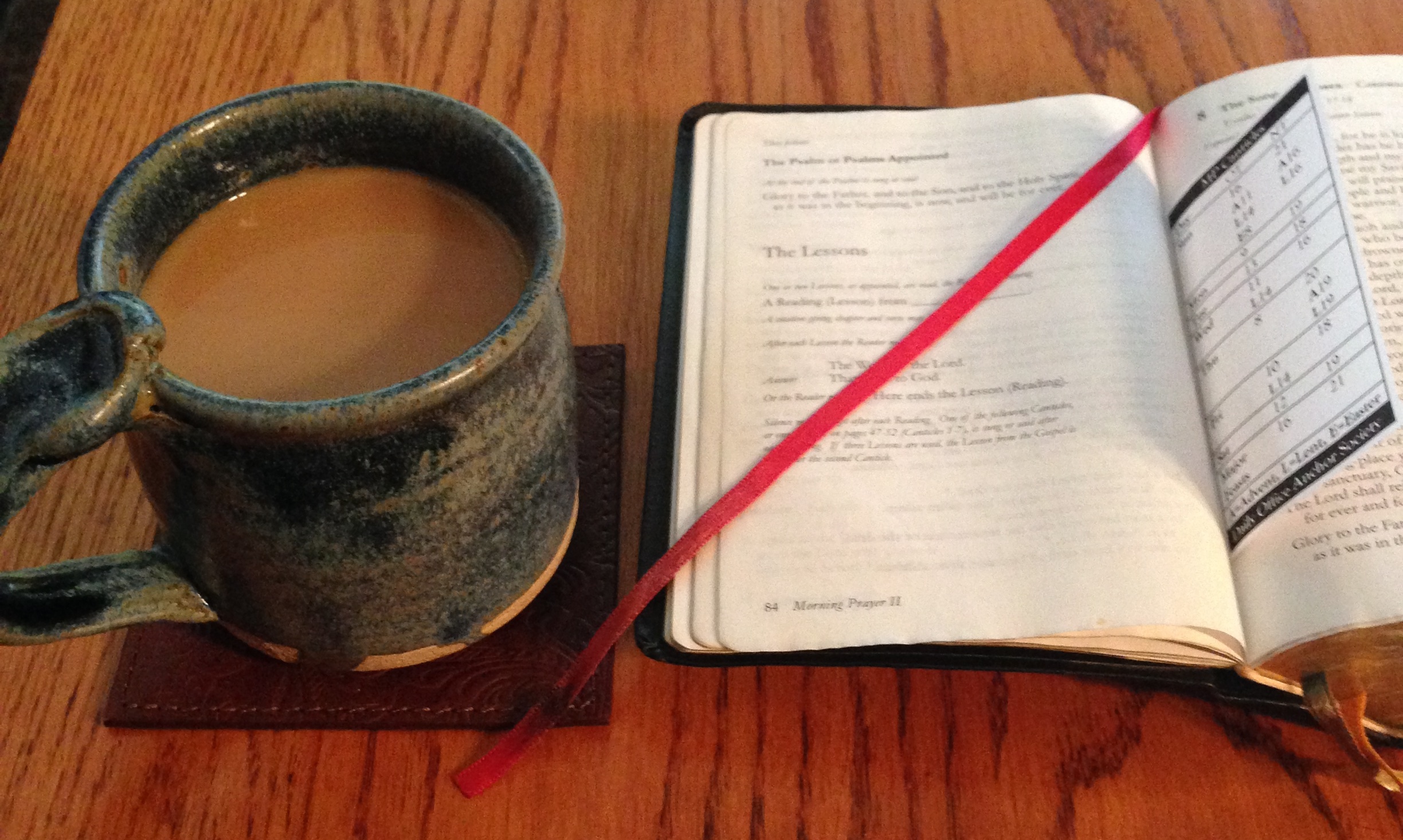
And, just like the folks in AA have a “Big Blue Book” we have a “Red Book” (the Book of Common Prayer).

2012-08-06 13.03.01

The “daily maintenance of our spiritual condition” is not a depressing burden, as I feared when I first entered recovery.

“You’ve got it all backwards,” a fellow deacon said when I called him in a panic. “Every day you don’t drink is an oasis!”

Rather than being a burden, our spiritual disciplines can create in us an oasis, a place where we are free to greet the stranger whom we meet in our churches or as we follow Jesus out into the neighborhood.

And one last thing, these practices are mostly portable, making it easy to travel lightly.

Sure, we usually gather in a church building on Sundays and holidays, but the book we need for the Daily Office fits easily into a briefcase – in fact, you don’t even need a book, since the Forward Movement iPhone app works just as well!

And soaking daily in the Scriptures means that following God “is not too hard for you, nor is it too far away. It is not in heaven … neither is it beyond the sea …. No, the word is very near you; it is in your mouth and your heart for you to observe” (Deut. 30:14).

The Word is Very Near You

Listen again to that word:

“We enjoyed you … and may God have mercy on you.”

These are the words of a woman who lives in the risen life of Jesus Christ our Savior.

These are the words of someone whose own experience of powerlessness, death, and violence is being transformed by her endurance, empowering her to offer a blessing instead of a curse.

We may not be able to offer those same words – we are not at the same place in the cycle of gospel living – but we can also participate in the resurrection life.

For us it may require a costly admission or an unwelcome realization, and it may require us to choose the cross, giving up the power and privilege we hold onto so tightly.

But we, too, can know the peace of Christ, recognize it in our neighbors, and share it with those around us.

And may the peace of God, which passes all understanding, keep our hearts and minds in the knowledge and love of God, and of his Son Jesus Christ our Lord; and the blessing of God Almighty, the Father, the Son, and the Holy Spirit, be among us, and remain with us always. Amen.

By your endurance you will gain your souls | The martyrs of Charleston

My sight has failed me because of trouble; *
LORD, I have called upon you daily; I have stretched out my hands to you.
Do you work wonders for the dead? *
will those who have died stand up and give you thanks?
Will your loving-kindness be declared in the grave? *
your faithfulness in the land of destruction?
Will your wonders be known in the dark? *
or your righteousness in the country where all is forgotten?
But as for me, O LORD, I cry to you for help; *
in the morning my prayer comes before you. (Psalm 88:10-14)

The Rev. Dr. Eric H.F. Law of the Kaleidoscope Institute, in his book The Wolf Shall Dwell With the Lamb, describes the “Cycle of Gospel Living.”

This cycle is also used in the Education for Ministry program in which mentors and our students reflect on “Living Faithfully in a Multicultural World.”

The psalmist and the martyrs of Charleston — along with the African-American community more generally — have entered the cycle of Gospel living from the point of powerlessness.

How long, O Lord?
Will you forget me for ever?
how long will you hide your face from me? (Psalm 13:1)

Their endurance has united them with the suffering of Jesus on the cross, whose suffering is not the end of the story. The cross leads to the empty tomb, to resurrection, and to the power of life in Christ.

After an event like the shooting at Emmanuel AME Church in Charleston, social media is justifiably full of anger directed toward well-meaning (mostly white) Christians who “have treated the wound of my people carelessly, saying ‘Peace, peace’ when there is no peace” (Jer. 6:14).

In his 1963 Letter From a Birmingham Jail, the Rev. Martin Luther King, Jr. spoke of his disappointment with the “white moderate, who is more devoted to ‘order’ than to justice”:

Shallow understanding from people of good will is more frustrating than absolute misunderstanding from people of ill will. Lukewarm acceptance is much more bewildering than outright rejection.

The problem now (as then) is that we are all speaking about the Gospel, but we are talking past each other.

What we “well-meaning Christians” must understand is that we enter the cycle of Gospel living from a completely different position than many (most?) Christians do.

We participate in the cycle when we give up our power, “just as the Son of Man came not to be served but to serve, and give his life a ransom for many” (Matt. 20:28).

We participate by falling and failing, by giving up our power and privilege, which no one is taking away from us.

Richard Rohr writes in his daily reflection that:

This is why Christianity has as its central symbol of transformation a naked, bleeding man who is the picture of failing, losing, and dying … and who is really winning — and revealing the secret pattern to those who will join him there.

All of us who are Christians participate in the cycle of Gospel living. All of us center our lives on the crucified and risen Jesus.

But we experience the cycle of Gospel living differently from each other, we come to the saving knowledge of Christ’s death and resurrection from different directions, and we must be tender with one another for Jesus’ sake.

A Collect for Fridays

Almighty God, whose most dear Son went not up to joy but first he suffered pain, and entered not into glory before he was crucified: Mercifully grant that we, walking in the way of the cross, may find it none other than the way of life and peace; through Jesus Christ our Lord. Amen. (BCP 99)

A Prayer for Mission

Lord Jesus Christ, you stretched out your arms of love on the hard wood of the cross that everyone might come within the reach of your saving embrace: So clothe us in your Spirit that we, reaching forth our hands in love, may bring those who do not know you to the knowledge and love of you; for the honor of your Name. Amen. (BCP 101)

Scope of belief and scale of revelation

You are God: we praise you;
You are the Lord: we acclaim you;
You are the eternal Father: all creation worships you.

Throughout the world the holy Church acclaims you;
Father, of majesty unbounded,
your true and only Son, worthy of all worship,
and the Holy Spirit, advocate and guide. (BCP 95)

As I sit on my patio saying Morning Prayer I am thinking about the scope of belief and the scale of revelation.

Creation

“All creation worships you” we say in the Te Deum laudamus, the ancient canticle of praise.

The scope of our belief is not just the seemingly endless universe spanning 14 billion light-years, but the power of God himself, the “Father, of majesty unbounded” — that is, beyond all our measuring and all our perception.

And yet the scale of revelation is that even the chirping of the birds on this misty morning speaks to me of the nature of creation, of its goodness.

Church

“Throughout the world the holy Church acclaims you.”

At our Deacons’ Council meeting yesterday, we spoke with Bishop Matt Gunter about the Diocese of Fond du Lac joining in a companion relationship with another diocese in the Anglican Communion.

He shared his experience with the Diocese of Renk in South Sudan, and others on the council spoke of mission trips to Guadalajara, Mexico or to Lima, Peru.

The bishop of our neighboring Diocese of Eau Claire, one of the smallest in the Episcopal Church, is visiting their companion Diocese of Harare, Zimbabwe, one of the largest in the Anglican Communion.

Our belonging to that worldwide Church is mediated to us, brought to scale, through relationships with people in our own parishes or in the places we visit.

We participate in that worldwide acclamation by joining others around the altar for Communion on Sundays and praying the Offices as fellow-Christians do in every time zone around the globe.

The Church is brought to human scale by people in a parish and pages in a book. They are the signs to me that I belong.

Daily Office Basics


Human Scale

But these small-scale revelations draw me back out into consideration of a mystery.

Like the people around me, who show me God in their faces, and like the book that contains the words of the Scriptures and the prayers of the Church — like these, God comes to us in human scale.

“The Father, of majesty unbounded” is known to us in the person of Jesus, his “true and only Son, worthy of all worship.”

The mystery that we call the Incarnation is all about scope and scale.

In a specific person who lived in a specific place at a specific time, the God who is beyond all knowing chose to reveal something of himself to us.

And in that revelation, our notions of scope and scale are turned upside down and we begin to see ourselves as God sees us.

“Look at the birds of the air; they neither sow nor reap nor gather into barns, and yet your heavenly Father feeds them. Are you not of more value than they?” (Matt. 6:26).

Listen to the chirping of birds in the garden, to the witness of the people around you, to the words of the prayers and the Scriptures.

For those who have ears to hear, that human scale reveals a love of limitless scope.


Resilient partnerships for personal growth

As we made spiritual progress, it became clear that, if we ever were to feel emotionally secure, we would have to put our lives on a give-and-take basis; we would have to develop the sense of being in partnership or brotherhood with all those around us. We saw that we would need to give constantly of ourselves without demand for repayment. When we persistently did this, we gradually found that people were attracted to us as never before. And even if they failed us, we could be understanding and not too seriously affected. (As BIll Sees It 220)

Resilience

One of the most inspiring projects I have seen recently is Iris Place, the new peer-run respite that just opened in Appleton, Wisconsin.

Iris Place is a program of NAMI Fox Valley, which I serve as board vice president, and it is one of three such peer-run respites supported by grants from the State of Wisconsin’s mental health reform budget package.

Here’s a taste of how the staff of Iris Place describe their work:

Peer Run Respite Centers are crisis alternatives with the intended outcome of diverting hospitalization by building mutual, trusting relationships between staff members and users of services which facilitate resilience and personal growth.

As people have an opportunity to stay connected to peers while moving through challenging thoughts, feelings and impulses, the need for external intervention is diminished. This alternative approach to handling crisis teaches people healthier attitudes about themselves and others.

There is an economic benefit to the peer-run respite model — the average cost per night at a PRRC is $250 compared with $2,500 for a day of inpatient hospitalization — but more important is the willingness of a community to come together in support of those who are hurting.

Partnership

The partnership extends beyond the Certified Peer Specialists who staff Iris Place 24/7 to include the Iris Place Advisory Board, which includes local government officials and law enforcement representatives, regional mental health and healthcare providers, and neighbors.

Unlike the two other peer-run respites in Wisconsin that have run into zoning issues and NIMBY concerns from local residents, Iris Place is blooming in the Fox Cities, which have proven to be the right community.

There’s even a lovely sense of rightness to the location itself.

Iris Place is housed in the former St. Bernadette’s Convent and supported by the generosity of the parish.

2015-03-09 14.17.31

Though it’s not explicitly stated, entering the house unfolds in the classical monastic way: guests who call ahead are greeted as they arrive, and if the fit is right, they are invited to join their peers in the “enclosure” for a brief stay.

Personal Growth

Iris Place is one example of peers helping each other through the common difficulties they face.

How might you “develop the sense of being in partnership” with those around you?

In what way are you called to “give constantly of [yourself] without demand for repayment”?

I welcome your responses in the comments.

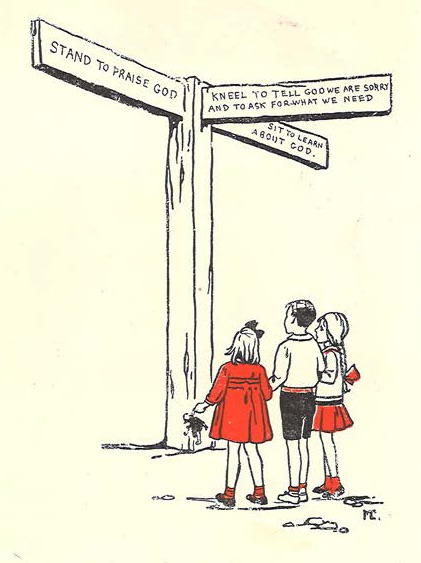
A Child’s Guide to Morning Prayer

Follow the link to discover A Child’s Guide to Morning Prayer (1954) from the Society for the Propagation of Christian Knowledge, or SPCK, gently illustrated by Margaret Chester.

Essentially you will find the same pattern in the Daily Office of the Episcopal Church today, though there are a few more options for canticles, and a bit more variety in the Collects. On this site, you will find several Resources to help you navigate the Offices more easily.

Thanks to Fr. Tony Clavier of the Episcopal Diocese of Springfield, for bringing this charming book to my attention.

Enjoy! And better yet, share it with a child you know!

Leading change from Sand County to County General

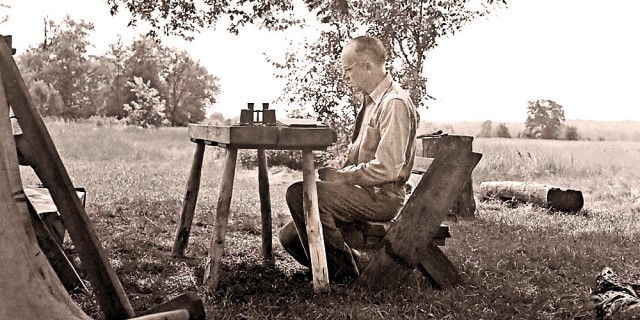
I’ve been reading Aldo Leopold’s classic of ecology and conservation A Sand County Almanac, and I just finished his biography A Fierce Green Fire by Marybeth Lorbiecki.

Aldo-leopold-640x320

Aldo Leopold at “The Shack,” his family’s Sand County farm.

In one particular passage, she recounts Leopold’s struggles to sway public opinion during the Wisconsin “deer crisis” of 1942.

Leopold and other conservationists had become convinced that it was necessary to reverse the earlier practice of killing predators like wolves in order to “protect” species like deer.

Changing Years of Thinking

In fact, what Leopold had come to understand is that ecosystems or animals and plants depend upon the balance offered by predators and fire and other “dangers” — otherwise, species without predators or plants untouched by periodic fires overpopulate and damage the ecosystem themselves.

“A lot of people were swayed,” Lorbiecki writes, “but not enough; changing years of thinking was a difficult task. ‘The real problem is not how we handle the deer in this emergency,’ Leopold [said]. ‘The real problem is one of human management.'”

Leopold outlined his approach in this way:

The public we are talking about consists of three groups. Group 1 is the largest; it is indifferent to conservation questions. Group 2 is the smallest; it thinks with its head, but is silent. Group 3 is of intermediate size, and does all of its thinking with mouth or pen. Perhaps a Conservation Commission would do better not to try to convert Group 3, but to convince Group 2 that there is a problem and that it should say or do something about it. Perhaps this would shorten the 23 years [it had taken that long to get an effective conservation policy passed.] (Lorbiecki 162)

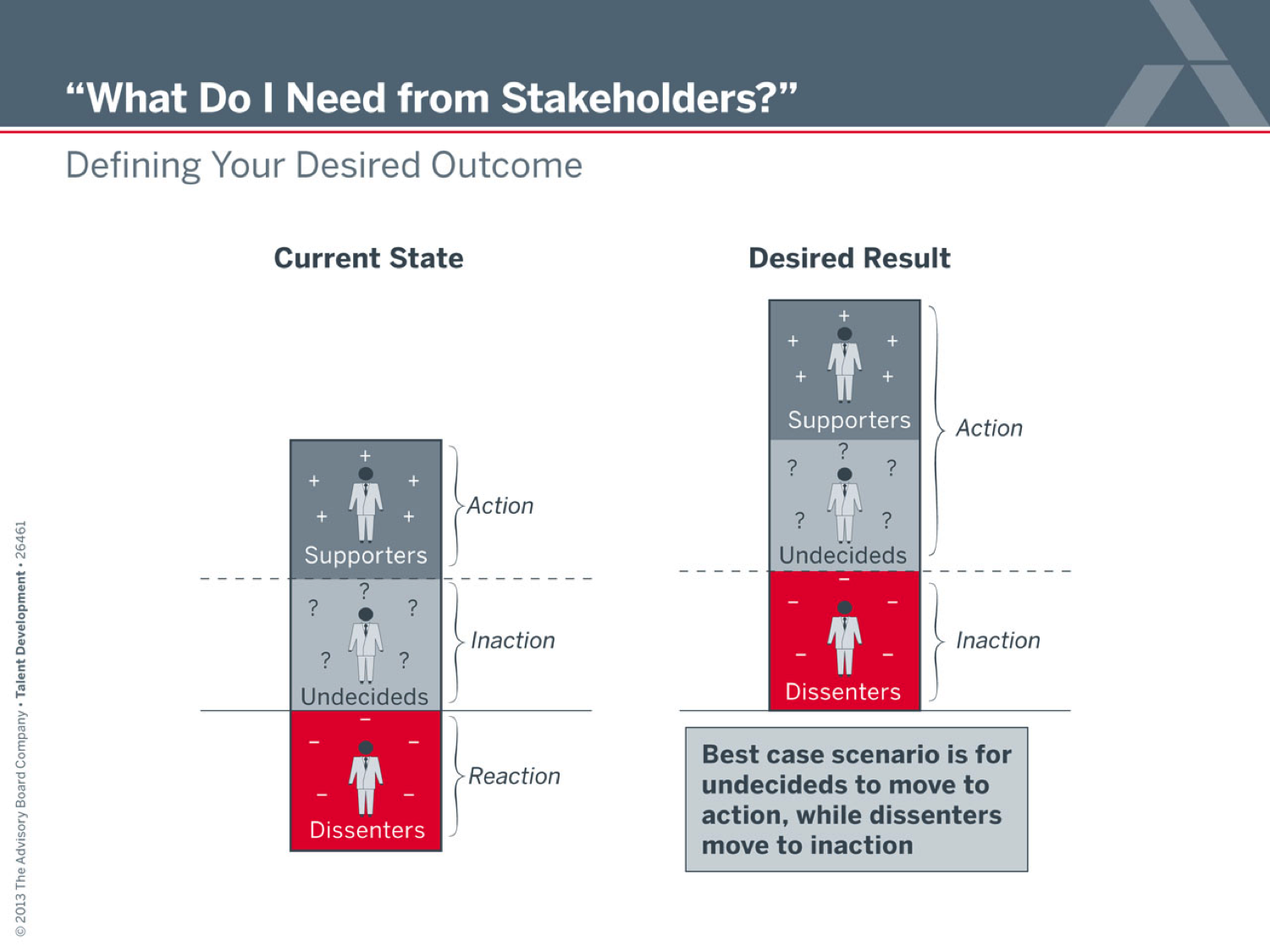
So Leopold identified three groups of stakeholders: Group 1, the undecided; Group 2, supporters; and Group 3, the opposition.

From Sand County to County General

When I taught healthcare leaders as a member of the talent development faculty at the Advisory Board Company, we outlined an approach that included a stakeholder analysis just like Leopold’s and suggested three strategies to take for effective change leadership.

Copyright 2013 The Advisory Board Company

Copyright 2013 The Advisory Board Company

Just as Leopold outlined, the first strategy is to move Supporters (his Group 2) from vague action to specific action. Give your supporters a schedule inviting them to act now.

The second strategy is to move the Undecided (his Group 1) from inaction to action. Here, you must identify “what’s in it for me” — that is for each of them. Why should they join you? How will they benefit?

And the third strategy, somewhat counter-intuitively, is to move the dissenters from active reaction against the change (“with mouth or pen,” as Leopold describes his Group 3) to passive inaction. It’s best if your opponents just do nothing and let the change proceed.

So often, even if we have done a careful stakeholder analysis, we fall into the twin pitfalls of change leadership:

Preaching to the choir

As I know from being an Episcopal minister, the choir is already sitting up at the front of the church with us!

Talking to our supporters is easy, because they agree with us, but it doesn’t necessarily move our change forward.

In fact, our supporters may get tired of hearing us go on about the issue all the time, and we run the risk of alienating them.

Going for 100%

When we know we’re right, we often spend a lot of time trying to convince others that they’re wrong.

The State Journal said of Leopold: “He, better than any other man in Wisconsin and probably better than any other man in the entire country, knows what real conservation is and how to achieve it” (Lorbiecki 162).

However, Leopold came to see the wisdom of backing off from arguments lest his opponents’ charges of “Leopoldian egotism” prove true (Lorbiecki 163).

Effective change leadership consists not necessarily in convincing opponents of the change that you are right, but of negating their inclination to act against the change.

This calls for political savvy in addition to strong convictions.

A Change in Ethics

Sixty years on, we are still facing issues related to conservation; clearly, the changes Leopold identified as necessary take time to play out.

Organizations, just like ecological communities, also tend to embrace change slowly.

Even if change is effective, it is hard to sustain. It can be a challenge to teach new members of the group the hard-won wisdom gained in previous change efforts.

Lorbiecki asks, “How could such a revolution in cultural thought [Leopold’s “Land Ethic”] be accomplished?”

For Leopold, “Ethics are a kind of community-instinct-in-the-making.” He told his students: If the individual has a warm personal understanding of land, he will perceive of his own accord that it is something more than a breadbasket. He will see land as a community of which he is only a member, albeit now the dominant one. He will see the beauty, as well as the utility, of the whole, and know the two cannot be separated. We love (and make intelligent use of) what we have learned to understand. (Lorbiecki 174-5)

Change Things, Love People

Whether you are leading change in a large organization or a small volunteer group, you are pursuing complementary purposes.

First, you must apply your leadership and political skill in the service of effectiveness — things must change, or you wouldn’t be leading the effort in the first place.

Second, you are also helping make or preserve a “community instinct.” You must apply your passion and understanding to the people around you, seeing not only their utility, but also their beauty.

People are part of any change, and the two cannot be separated.

To paraphrase Leopold, “we love (and make intelligent use of) the people we have learned to understand.”

Trinity Sunday | Eve of the Visitation

Who is like the LORD our God, who sits enthroned on high, *
but stoops to behold the heavens and the earth?
He takes up the weak out of the dust *
and lifts up the poor from the ashes.
He sets them with the princes, *
with the princes of his people.
He makes the woman of a childless house *
to be a joyful mother of children. (Psalm 113:5-8)

This evening one of the Episcopal Church’s seven Principal Feasts (Trinity Sunday) overlaps one of our many Holy Days (the Visitation of the Blessed Virgin Mary).

In this happy juxtaposition, we ponder this evening the universal mystery of the triune God, “who sits enthroned on high,” and who is made known to us in a specific man, Jesus, born to a specific woman, Mary, whose visit to her relative Elizabeth we honor tomorrow.

“No one has ever seen God,” John reminds us in the prologue to his gospel. “It is God the only Son, who is close to the father’s heart, who has made him known” (John 1:18).

The Trinity whom we adore

John’s gospel opens with a hymn of creation:

In the beginning was the Word, and the Word was with God, and the Word was God. He was in the beginning with God. All things came into being through him, and without him not one thing came into being. What has come into being in him was life, and the life was the light of all people. The light shines in the darkness, and the darkness did not overcome it. (John 1:1-5).

John purposely reminds us of the opening of the Hebrew Bible, when in the beginning the spirit of God swept over the face of the waters (Gen. 1:1-2). He goes on to equate the Word — who was with God in the beginning — with Jesus, “a father’s only son, full of grace and truth” (John 1:14).

In the mystery that Christians call the Incarnation, we see “the Lord our God, who sits enthroned on high, but stoops to behold the heavens and the earth.”

Who is like our God, indeed?

Born of the Virgin Mary

“Hail, Mary, full of grace,” many Christians pray as they say the prayers of the rosary. “Blessed art thou among women, and blessed is the fruit of thy womb, Jesus.”

“My soul proclaims the greatness of the Lord,” Mary herself cries out in the prayer we call the Magnificat, “and my spirit rejoices in God my Savior” (BCP 119).

https://www.flickr.com/photos/edithosb/204407850

In this morning’s Gospel for Trinity Sunday, Nicodemus puzzles over Jesus’ words about being born again. “Can one enter a second time into the mother’s womb and be born?”

Jesus responds with a wry twist. “Do not be astonished that I said to you, ‘You must be born from above.’ The wind blows where it chooses and you hear the sound of it, but you do not know where it comes from or where it goes. So it is with everyone who is born of the Spirit” (John 3:7-8).

Mary herself had asked the angel, “How can this be, since I am still a virgin?” to which she got the equally unsettling reply that “the Holy Spirit will come upon you, and the power of the Most High will overshadow you” (Luke 1:35-36).

The Spirit of Love

That same Spirit, Luke goes on to recount in his second volume, the Acts of the Apostles, fell on the early church and inspired them to go out into the world proclaiming that “Jesus is Lord.”

In Jesus, the apostles saw God, “the Lord who sits enthroned on high,” stooping down and joining his creatures. Before he left his disciples, Jesus promised that they would share in his spirit, the spirit of love.

At evening prayer tonight, we prayed for that same Spirit of love.

O God, you manifest in your servants the signs of your presence: Send forth upon us the Spirit of love, that in companionship with one another your abounding grace may increase among us; through Jesus Christ our Lord. Amen. (BCP 125)

O God, send us your Spirit through Jesus our Lord.

In companionship with one another …

Abounding grace …

“Hail Mary, full of grace …”

… full of grace and truth.

Longing to be clothed

You have turned my wailing into dancing;
you have put off my sack-cloth and clothed me with joy. (Psalm 30:12)

I carry on my person everywhere I go two talismans of my recovery. 

The first is a medallion celebrating my first year of sobriety. 

  
The second is a bracelet — the last thing I bought without telling my wife — that helps me remember I don’t need to spend money when I am feeling “restless, irritable, and discontented.”

  
But what recovery really looks like for me is the Pendleton shirt I’m wearing in this picture with my grandson. 

  
After I lost my job, I was at home a lot more often. I would usually wear jeans and a turtleneck and my favorite plaid shirt. 

I remember sitting on the couch one evening thinking, “I really like this shirt; I should buy another one.”

It took only a few seconds for my new inner voice to respond. “Don’t be an idiot. This is a Pendleton shirt, and it will last forever. You won’t outlive this shirt; you don’t need to buy another one.”

Paul writes that:

We do not lose heart. Even though our outer nature is wasting away, our inner nature is being renewed day by day …. in this tent we groan under our burden, because we wish not to be unclothed but to be further clothed” (2 Cor. 4:16, 5:4). 

Even though God is working in us to renew our inner nature, we may need reminders of that hidden process from time to time. 

How often? 

“One day at a time,” says AA. “Daily we begin again,” say the Benedictines. 

Even though we “wish not to be unclothed,” we may have to spend time being uncomfortably open and vulnerable — honestly sitting with our restlessness and our “stinking thinking” — before we can experience a new kind of peace and serenity.

Being content, being at peace, being calm — these are what it means to be “clothed with joy.”

May the God of hope fill us with all joy and peace in believing through the power of the Holy Spirit. Amen. (BCP 102)

Birds on a wire

Birds on a wire

It’s been a regular bird convention in our backyard today.

I just started reading Aldo Leopold’s book A Sand County Almanac, and one of the early chapters (July) makes me wonder what to expect this summer.

At 3:30 am, with as much dignity as I can muster of a July morning, I step from my cabin door bearing in either hand the emblems of my sovereignty, a coffee pot and notebook … I get out my watch, pour coffee, and lay notebook on knee. This is the cue for the proclamations to begin.

At 3:35 the nearest field sparrow avows, in a clear tenor chant, that he holds the jackpine copse north to the riverbank, and south to the old wagon track … the robin’s insistent caroling awakens the oriole … next the wren — the one who discovered the knot-hole in the eave of the cabin, explodes into song. Half a dozen other wrens give voice, and now all is bedlam. Grosbeaks, thrashers, yellow warblers, bluebirds, vireos, towhees, cardinals — all are at it … my ear can no longer filter out priorities. Besides, the pot is empty and the sun is about to rise.

My Nana was an avid birdwatcher, and my mother also feeds the birds so they congregate near her windows.

I’m much more familiar with the birds in the Zoology collection at the Field Museum in Chicago, where I worked for nearly a decade. I used to lead behind-the-scenes tours for donors, and the collections managers would simply leave specimens out for me to talk about if they couldn’t be there.

https://www.flickr.com/photos/linepithemate/2853299183/

As fascinating a story as the birds in their mothballed drawers could tell, I’m coming late to realize that there’s a story coming down the wires live right now.

One-liners, limits, and leaders

Lines

In these Instagram days, we love one-liners about important topics.

But even more, we like cool pictures tagged #goals or #vision or #leadership.

2015-05-28 19.37.30

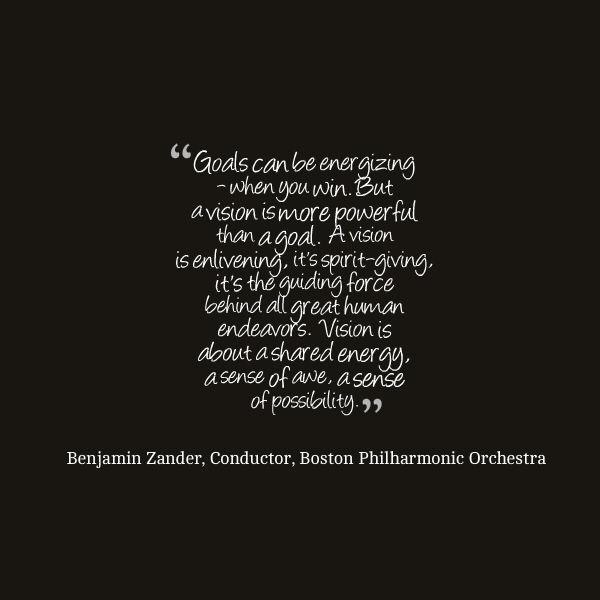
“Vision is about a shared energy, a sense of awe, a sense of possibility.”

That sounds fantastic, doesn’t it?

And the quote comes from the conductor of a symphony, so it’s a little artsy, too. Even better.

Maybe a picture of a #sunset would make it more powerful?

Limits

The real power of a vision comes when it is used, put into practice in specific ways in a particular organization by a certain group of people.

Lofty visions and limited scope actually go hand in hand.

Listen to entrepreneurs number 4 and 3 in this short video from GoToMeeting.

http://www.youtube.com/watch?v=J24tfsOU-BQ

Be precise … concentrate on your goals, what you want to achieve, and only on them.

Prioritize your manpower appropriately. Don’t chase every single possible thing for your startup to do.

Visions take form when we apply limits in order to clarify our focus, when we make choices about staffing and budgeting based on that vision, when we test and measure our success by the standard that our vision sets.

Leaders

Visionary leaders are standard-bearers, constantly reminding their people not only of the lofty purpose but also of the limited scope and choices that entails.

I think of Gary Mecklenburg, who began every speech (internal or external) by saying, “I am CEO of Northwestern Memorial Hospital, an academic medical center where the patient comes first.”

He might go on to add that we focused on Best Patient Care and Best People.

Two sentences, two key concepts. Repeated every single time he spoke to anyone.

It got so we could all repeat it, even if we had forgotten to wear our “Patients First” lapel pin to work that day.

Visionary leaders are not only shaped by their learning (much of it coming from unglamorous, repetitious work) but are also creative in their practice.

Bearing Fruit

The creative fruit of leadership grows from seeds planted and watered, branches pruned and shaped steadily over time.

So let the one-liners and the cool pictures lead you to wonder how you might put a lofty vision into practice.

But learn from other visionary leaders about the concentration, discipline, and repetition that eventually bears fruit.