To unity, knowledge, and maturity

Ss_Simon_and_Jude

The gifts he gave were that some would be apostles, some prophets, some evangelists, some pastors and teachers, to equip the saints for the work of ministry, for building up the body of Christ, until all of us come to the unity of the faith and of the knowledge of the Son of God, to maturity, to the measure of the full stature of Christ. (Ephesians 4:11-13).

Unity

We often hear in the Church the old saw that “unity does not mean uniformity.” What we are trying to express, I think, is that we don’t have to march in lockstep, we don’t all have to be believers in the same exact way.

The Church is gifted — not only with those who guard the faith (apostles) but also with those who upbraid the faithful (prophets); not only with traveling preachers (evangelists) but also with local leaders (pastors and teachers). We all have the same purpose, though: to equip the saints for the work of ministry, to build up the body of Christ.

You may serve in the food kitchen, you may lead youth group, you may knit prayer shawls, you may provide pastoral care, you may give generously, you may go on mission trips, you may host a fellowship group in your home, you may advocate for political change, you may lead a Bible study. As David Allen says, “you can do anything, but you can’t do everything.”

Whatever you do, then, do it in order to equip the saints and to build up the body.

Knowledge

My own particular interests are in teaching the Bible and the practice of the Daily Office.

Isaiah has harsh words in today’s Old Testament lesson for religious leaders who teach nothing more than “precept upon precept, precept upon precept, line upon line, line upon line, here a little, there a little” (Isa. 28:10).

That is to say, teaching only Bible facts without teaching saving wisdom is no help in equipping the saints. It puffs up the teacher (as Miracle Max would say, “hoo hoo hoo, look who knows so much!”), but it does not build up the learner.

How do the words of Scripture become “living and active” in our lives? How do they soak into us until they are there when we need them?

One reason I teach about the Daily Office is that it is a method for reading Scripture in the context of worship that has helped Christians throughout the centuries to “inwardly digest” the Scriptures even as they “read, mark, and learn” (BCP 236) them in Bible studies and other forums. Again, no one method is complete or self-sufficient; each has a particular purpose.

Maturity

The gifts given to the Church are “for building up the body of Christ, until all of us come to the unity of the faith and of the knowledge of the Son of God, to maturity, to the measure of the full stature of Christ.”

“Equipping the saints” ultimately means enabling them to stand on their own two feet — to help learners become believers, and to help believers become ministers themselves.

Another program I’m involved in is Education for Ministry, a program of theological education for lay people created by the School of Theology of the University of the South. This year there are 11 students in my group at St. Thomas Church.

Along with the study we pursue in the four-year curriculum — Old Testament, New Testament, Church history, and theology — we also engage in a process of theological reflection, learning to identify where our beliefs and positions come from and how to turn our insights into action.

As we share our “spiritual autobiographies” with one another, we start to trace how God has acted in our lives. As we study the Scriptures, we learn about how God has acted in the life of Israel and of the Church. Reading church history is a humbling exercise in seeing how we keep getting it wrong, over and over again. And our study of theology is no academic exercise, but an attempt to go from “milk” to “solid food” (1 Cor 3:2) as we serve in our various ministries.

Being “lifelong learners” is wonderful, but as St. Benedict puts it, “the Lord waits for us daily to translate into action, as we should, his holy teachings” (RB Prologue).

Collect of the Day

O God, we thank you for the glorious company of the apostles, and especially on this day for Simon and Jude; and we pray that, as they were faithful and zealous in their mission, so we may with ardent devotion make known the love and mercy of our Lord and Savior Jesus Christ; who lives and reigns with you and the Holy Spirit, one God, for ever and ever. Amen. (BCP 245)
 

Daily build the home I seek

building-second-temple-events

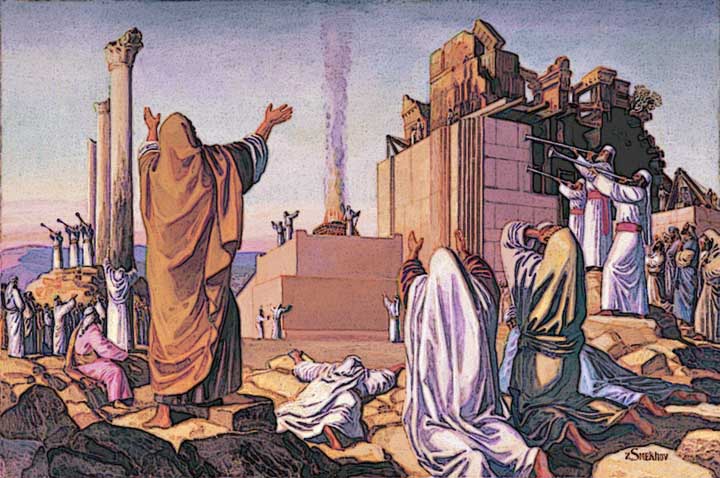
Today’s reading from the Book of Ezra features the laying of the cornerstone for the Second Temple.

The people’s joy and shouting is tempered by weeping as some of the older exiles remember the beauty of the First Temple. Those days are gone now, even though there is promise for the future.

That feeling reminds me of a poem I wrote on retreat many years ago about building a spiritual home.

Matthew 7:7 (Commentary)

Asking is not enough,
            says Bede
            the venerable
We must diligently seek

 Read the blueprint
           heart’s desire
Lay the first stone

 On stone and stone
           the house
           reveals itself
Plan becomes a home

I must lay my heart
           (rejected stone)
           firmly in place
Daily build the home I seek

Mepkin Abbey + July 1998

What animated Ezra and the returning exiles was a vision of restoration — a new Temple rising in the place of the old. Similarly, our Christian hope looks toward a new Jerusalem, the City of God which needs no Temple.

Getting there — arriving at home — will involve loss and rebuilding, weeping and joy, celebration and hard work.

A Collect for Fridays

Almighty God, whose most dear Son went not up to joy but first he suffered pain, and entered not into glory before he was crucified: Mercifully grant that we, walking in the way of the cross, may find it none other than the way of life and peace; through Jesus Christ our Lord. Amen.

Continual prayer and reconciliation

Seven times a day do I praise you, *
because of your righteous judgments. 
Great peace have they who love your law; *
for them there is no stumbling block. 
I have hoped for your salvation, O LORD, *
and have fulfilled your commandments. 
I have kept your decrees *
and I have loved them deeply. 
I have kept your commandments and decrees, *
for all my ways are before you.
(Psalm 119:164-168)

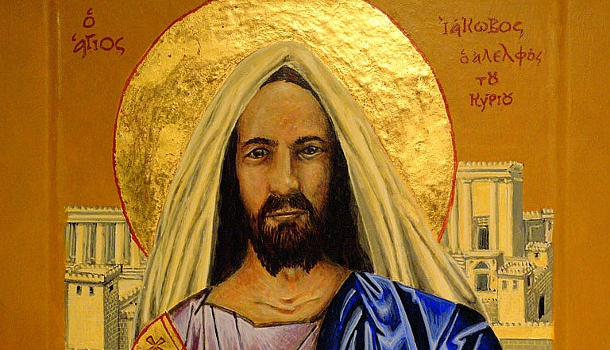
James of Jerusalem, the brother of Jesus, is called the Just because of his decision not to place restrictions on Gentile converts (Acts 15:19).

He was an early leader of the movement Jesus started, even though he wasn’t a believer until after his brother died. After the resurrection, Jesus appeared to Peter and the 12 apostles, then to about 500 followers, then to James, and then to all of the apostles (1 Cor. 15:7).

Imagine being a leader in a movement your brother started, a bishop in the new church, and remaining faithful to that cause for nearly 30 years after he died.

Imagine being a faithful, prayerful, traditional person — and discovering that your new understanding of God meant relaxing some of the restrictions of your faith in order to welcome more people into relationship with God.

Imagine being such an enduring witness to inclusion that your fellow parishioners throw you off the church roof for your trouble.

How does the example of James invite you to continual prayer?

With whom do you need to be reconciled?

What witness are you called to bear?

Collect of the Day

Grant, O God, that, following the example of your servant James the Just, brother of our Lord, your Church may give itself continually to prayer and to the reconciliation of all who are at variance and enmity; through Jesus Christ our Lord, who lives and reigns with you and the Holy Spirit, one God, now and for ever. Amen. (BCP 245)

The roads to Zion mourn

Twin Towers 9-11 by William Wray -- http://williamwray.blogspot.com

Twin Towers 9-11 by William Wray — http://williamwray.blogspot.com

How lonely sits the city that once was full of people! How like a widow she has become, she that was great among the nations! She that was a princess among the provinces has become a vassal. She weeps bitterly in the night, with tears on her cheeks; among all her lovers she has no one to comfort her; all her friends have dealt treacherously with her, they have become her enemies. Judah has gone into exile with suffering and hard servitude; she lives now among the nations, and finds no resting place; her pursuers have all overtaken her in the midst of her distress. The roads to Zion mourn, for no one comes to the festivals; all her gates are desolate, her priests groan; her young girls grieve, and her lot is bitter. Her foes have become the masters, her enemies prosper, because the LORD has made her suffer for the multitude of her transgressions; her children have gone away, captives before the foe. (Lamentations 1:1-5)

+ + + + +

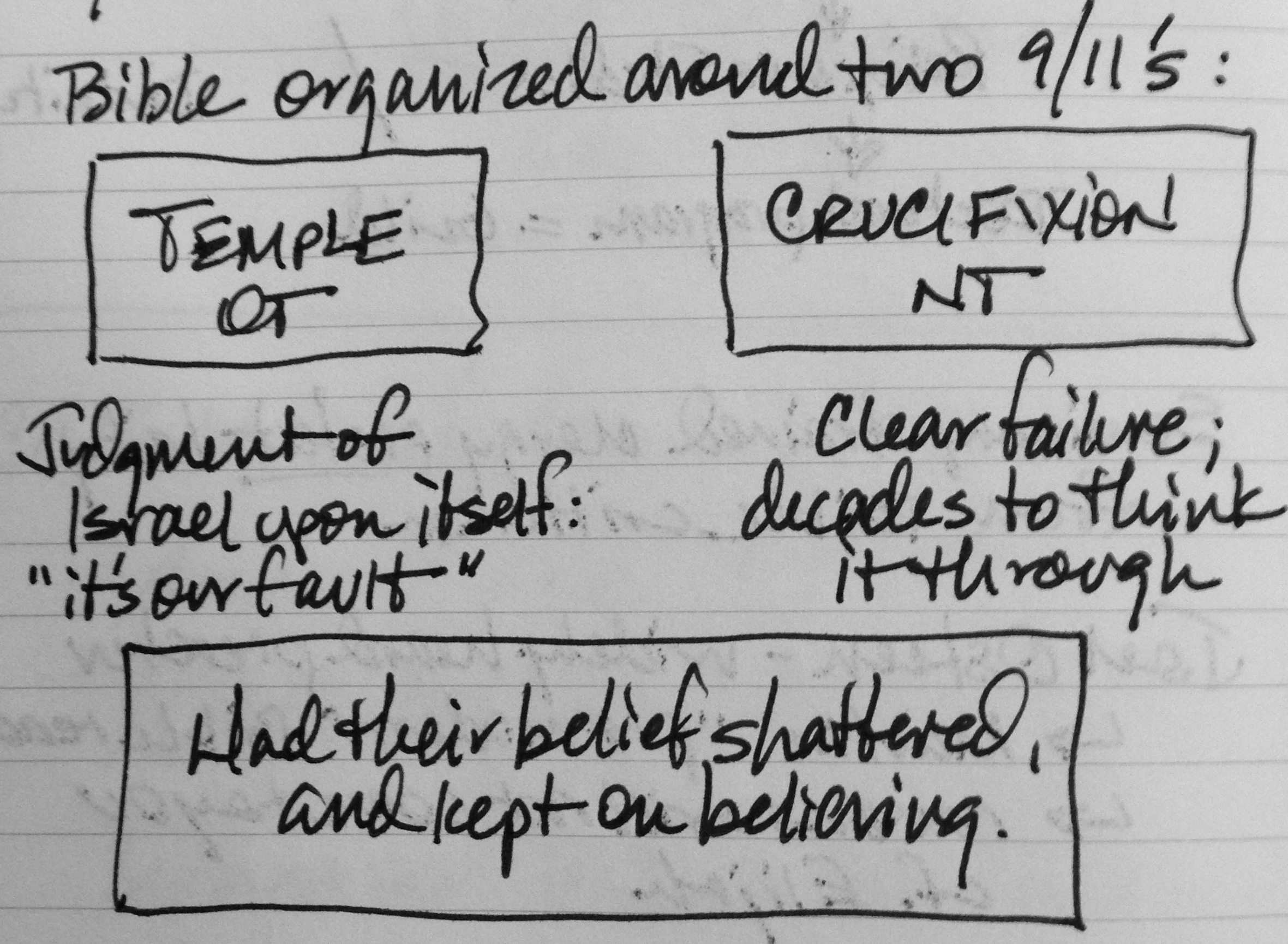
In his course this fall at Seabury titled “This Dangerous Book: Strategies for Teaching the Bible,” John Dally suggests that the Bible is organized around two 9-11’s.

The Hebrew Bible, or the Old Testament, was compiled into its final form after the destruction of the First Temple in 586 BCE and the exile of the Jews into Babylon.

The New Testament is the record of the Church’s attempt to understand the disaster of Jesus’ crucifixion.

Notes from the first session of John Dally's "This Dangerous Book: Strategies for Teaching the Bible" at Seabury.

Notes from the first session of John Dally’s “This Dangerous Book: Strategies for Teaching the Bible.”

The passage this morning from the Book of Lamentations captures the despair of the people of Judah over the destruction of the Temple. In the juxtaposition of this lesson and the canticle appointed for today (Canticle 13), we can see the seeds of Israel’s judgment on itself — “God is worthy of praise; this disaster must be our fault.” An empire has crushed the hope of God’s people.

The story that becomes clear throughout the Hebrew scriptures is the story of God seeking the people of Israel and their turning away from him again and again. In the New Testament, we see the same story written in small letters, but on a cosmic scale.

The New Testament story concerns Jesus of Nazareth — “we had hoped that he was the one to redeem Israel” (Luke 24:21).

Not only did God come into the world he had created, but once again we turned away from him. Even when some came to accept him and place their hope in him, they had their hopes terribly dashed when he was killed by the Romans. Yet again, an empire crushed the hopes of God’s people.

In both cases, however, as John Dally observes, the people of God had their belief shattered and kept on believing.

Paul sums up the Christian understanding beautifully: “Just as we have borne the image of the man of dust, so will we bear the image of the man of heaven” (1 Cor. 15:49).

Though the Bible is organized around two disasters, they are not the point of the story. The point of the Biblical story is the unswerving love of God for the people he made. Just as the Jews in exile came to understand that God was with them in Torah rather than Temple, the early Church came to realize that not even death could separate them from the love of God or stop the plan of salvation that Jesus had set into motion.

Come to a sober and right mind

A friend spoke to me earlier this week about sobriety. He said, “What we really have is a daily reprieve contingent on the maintenance of our spiritual condition.”

I now know that he was quoting from the Big Blue Book of Alcoholics Anonymous, but those words spoke volumes to me about the difference between duty and grace.

The duty of “maintaining our spiritual condition” is at the heart of programs like AA — and I’m beginning to understand how hard and serious that work is in every life.

The gift, the grace of a daily reprieve, is what sobriety represents.

I have often thought of my struggles to maintain a regular discipline of prayer — or any discipline of any kind, for that matter.  Like Paul, “I do not understand my own actions. I do not do what I want, but the very thing I hate” (1 Cor. 7:15).

My friend has me thinking differently today.

What if the daily prayer, the day without drinking, the day without shopping (or whatever else it may be), is not a burdensome duty to fail at yet again — but is actually the gift of rest for a moment?

The work is hard enough without making grace and rest a duty, too.

“Come unto me, all who travail and are heavy laden, and I will refresh you,” says our Lord (Matt. 11:28).

Come to a sober and right mind as you maintain your spiritual condition.

Come to a daily reprieve.

A reason for the hope that is in us

Anchor for the Soul – Allyson Johnson


Today the Episcopal Church commemorates the Oxford Martyrs — Hugh Latimer and Nicholas Ridley, bishops burned at the stake together under the Roman Catholic Queen Mary in 1555, and Thomas Cranmer, Archbishop of Canterbury, burned at the stake in 1556.

As James Kiefer writes on the Lectionary Page, Latimer’s last words at the stake are well known: “Be of good cheer, Master Ridley, and play the man, for we shall this day light such a candle in England as I trust by God’s grace shall never be put out.” Latimer and Ridley bore enduring witness to the power of Christ’s transforming love, cheerfully joining their suffering to his.

Cranmer was trapped between his Protestant beliefs and his understanding that the monarchy in England was ordained by God. Ordered to submit to the Roman Catholic obedience — and to the Pope — by Queen Mary, he finally signed a letter of submission, but she didn’t believe he was sincere. When he was sent to the stake, he said, “I have sinned, in that I signed with my hand what I did not believe with my heart. When the flames are lit, this hand shall be the first to burn.”

The primary work of Cranmer’s hand, the Book of Common Prayer for which he was largely responsible, stands as his enduring witness. Nearly 465 years after its first printing, it is still the means by which Anglicans shape our lives of prayer and Scripture reading, celebrate our common life in Christ around the Communion table, mark the seasons of our human life and death, and make ourselves “ready to give a reason for the hope that is in us” (BCP 247).

Collect of a Martyr

Almighty God, who gave to your servants Hugh Latimer, Nicholas Ridley, and Thomas Cranmer boldness to confess the Name of our Savior Jesus Christ before the rulers of this world, and courage to die for this faith: Grant that we may always be ready to give a reason for the hope that is in us, and to suffer gladly for the sake of our Lord Jesus Christ; who lives and reigns with you and the Holy Spirit, one God, for ever and ever. Amen. (BCP 246)

Not a destination but a starting block

Taylor Hall at the DeKoven Center in Racine, Wisconsin

Taylor Hall at the DeKoven Center in Racine, Wisconsin

Yet whatever gains I had, these I have come to regard as loss because of Christ. More than that, I regard everything as loss because of the surpassing value of knowing Christ Jesus my Lord. For his sake I have suffered the loss of all things, and I regard them as rubbish, in order that I may gain Christ and be found in him, not having a righteousness of my own that comes from the law, but one that comes through faith in Christ, the righteousness from God based on faith. I want to know Christ and the power of his resurrection and the sharing of his sufferings by becoming like him in his death, if somehow I may attain the resurrection from the dead. (Philippians 3:7-11)

It feels a little strange reflecting on “the loss of all things” while I am also enjoying a weekend at the DeKoven Center, one of the places I have come to cherish, “a place where prayer has been valid,” (to echo T. S. Eliot’s description of Little Gidding).

This place always reminds me of the heritage I have in the church, and the voice in my head sounds a little like Paul as I describe it:

“If anyone else has reason to be confident, I have more: baptized in my second month, a member of the people called Episcopalians, of the tribe of clergy; an acolyte, reader, LEM, campus minister, deacon; as to the church, “Anglo-Catholic among friends” and a member of the Fellowship of the SSJE; as to zeal, an EfM mentor and preacher; as to righteousness, made my mature commitment to Christ in the summer of 1989.”

Even the image at the top of this blog evokes that confidence — a page from my grandfather’s prayer book and Bible forms the backdrop to a picture of him sitting on the steps of this very place back in the 1940s.

But what if, as Paul goes on to say, all that is “rubbish” because of the surpassing value of knowing Christ?

What if I didn’t need to cling to “a goodly heritage” but could instead step out freely, secure in Christ?

I think even Paul would admit that his extensive training in the law and his upbringing as a Pharisee served him well in his new role as an apostle and as a mentor to others, but I think he is exactly right that they count for nothing in the most importance race of his life: pressing on toward the kingdom.

In fact, I picture him shedding his long Pharisaical robes in order to run more swiftly, free and unencumbered.

Perhaps this place where prayer has been valid is not supposed to be a destination, but rather the starting block against which I can push off and run, “forgetting what lies behind and straining forward to what lies ahead … the heavenly call of God in Christ Jesus.”

Ease and comfort and shined shoes

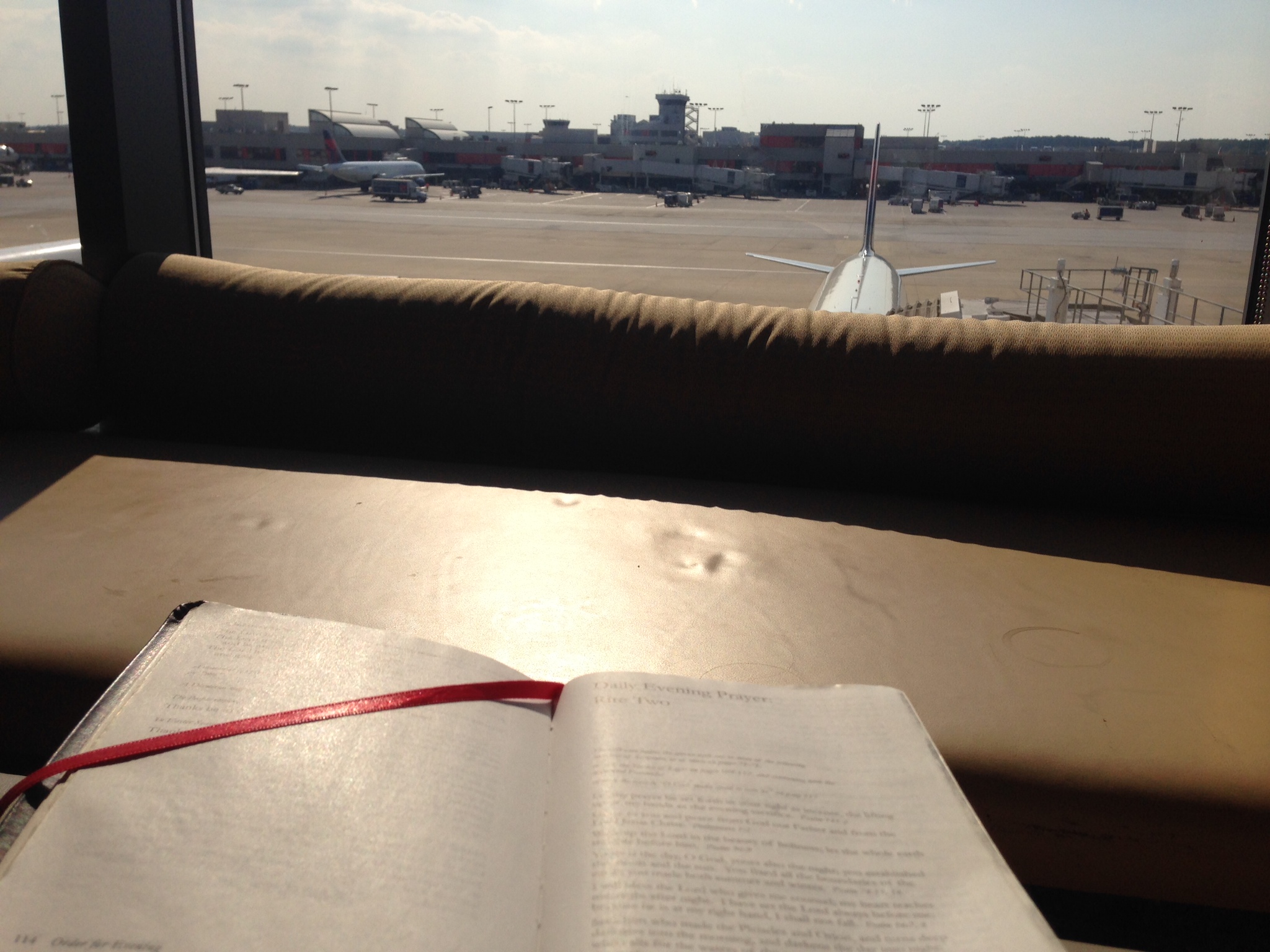
IMG_0002

“What kind of book is that?” she asked.

I looked up from my seat by the window in the Delta SkyClub to see the server who had cleared my plates and napkins and drink glasses for the last two hours.

“It’s my prayer book and Bible,”  I replied. We spoke then of the ministry and her cousin who is a Methodist pastor.

Come now, you rich people, weep and wail for the miseries that are coming to you. Your riches have rotted, and your clothes are moth-eaten. Your gold and silver have rusted, and their rust will be evidence against you, and it will eat your flesh like fire. You have laid up treasure for the last days. Listen! The wages of the laborers who mowed your fields, which you kept back by fraud, cry out, and the cries of the harvesters have reached the ears of the Lord of hosts. You have lived on the earth in luxury and in pleasure; you have fattened your hearts in a day of slaughter. You have condemned and murdered the righteous one, who does not resist you. (James 5:1-6)

On this Friday I am very mindful of the fact that I live in luxury.

I fly from place to place on business, I wear a new suit and sit in First Class and get my shoes shined regularly in the airport, I enjoy free drinks and excellent service in the SkyClub, I can afford an $80 leather-bound Book of Common Prayer and Bible combination, and my wife and I own two houses, one more than we need.

I am looking forward to a weekend in Chicago with our best friends at the Hard Rock Hotel, and to the Lyric Opera concert tomorrow night at the Pritzker Pavilion in Millennium Park, and to dinner downtown with two other friends, and to a safe and comfortable drive home.

On this Friday I am also mindful of the Lord Jesus, who died for my sins and the sins of the whole world.

And with him they crucified two bandits, one on his right and one on his left. Those who passed by derided him, shaking their heads and saying, “Aha! You who would destroy the temple and build it in three days, save yourself, and come down from the cross!” In the same way the chief priests, along with the scribes, were also mocking him among themselves and saying, “He saved others; he cannot save himself. Let the Messiah, the King of Israel, come down from the cross now, so that we may see and believe.” Those who were crucified with him also taunted him. (Mark 15:27-32)

On this Friday the psalmist’s words ring false in my ear, because I am not in duress.

I prayed with my whole heart, as one would for a friend or a brother; *
I behaved like one who mourns for his mother, bowed down and grieving.
But when I stumbled, they were glad and gathered together; they gathered against me; *
strangers whom I did not know tore me to pieces and would not stop.
They put me to the test and mocked me; *
they gnashed at me with their teeth. (Psalm 35:14-16)

Instead, I enjoy ease and comfort and shined shoes.

Cares and occupations

2013-03-04 09.24.25

A Collect for Guidance

Heavenly Father, in you we live and move and have our being: We humbly pray you so to guide and govern us by your Holy Spirit, that in all the cares and occupations of our life we may not forget you, but may remember that we are ever walking in your sight; through Jesus Christ our Lord. Amen.

I’m in Pittsburgh today to do some work at my company’s home office.

Seeing the way the office has changed in just the few months since I was in last reminds me how many people now work for the company — around 300 — and how many people’s efforts need to be coordinated and properly directed to the company’s goals.

When I’m presenting to prospective clients, the vision is simple and compelling. We help reduce costs and increase revenue in hospitals and health systems. The outcomes are impressive, but for any one hospital, they are the result of hundreds of people changing the way they work, holding one another accountable for performance, regularly reviewing data, and fine-tuning their efforts in order to sustain those gains.

Every single one of those people — in the hospital, or in my company — has their own “cares and occupations” to attend to as well as the organization’s “cares and occupations.” Every single person has to balance their needs and interests with their organization’s.

At work, we are called upon to remember that we are walking in the sight of our bosses, that what we do appears on reports and affects other people’s work and the organization’s goals.

In our personal lives, our desires and plans overlap with our spouse’s and family’s needs, our hobbies and interests connect with our friends’ and neighbors’ pastimes.

At church, our need for spiritual refreshment or our plans for ministry to the community intersect with other members’ hopes and cares.

There’s an intriguing notion weaving through this morning’s Daily Office readings.

Solomon and God are at odds over Solomon’s behavior — he’s been following other “foreign” gods. Though God is angry with Solomon, he can’t renege on his promise entirely or forget his ultimate purpose, so he leaves a remnant instead of tearing the entire kingdom away from Solomon. God’s ultimate purpose will survive this detour.

James is warning his readers over their friendship with the world and their judgmental attitude. He’s asking them to turn away from their own desires and their own ill-will toward others, and to turn back to focus on God’s will and leave judgment to him. If we’re causing ourselves or others to swerve away from God, we need to get back on track.

At work, at home, and at church we face the same situation. We are regularly required to see our own agendas, our own “cares and occupations,” in light of the company’s goals, our family’s needs, our church’s thriving.

We contribute to their success, but we can so easily let our “cares and occupations” distract us from the larger goal.

In what way do you need to refocus your attention today? How will you remember you are “ever walking in God’s sight”?

That they might lovely be

The St. Augustine Chapel at the Cathedral of St. Paul in Fond du Lac, Wisconsin

The St. Augustine Chapel at the Cathedral of St. Paul in Fond du Lac, Wisconsin

Over on Twitter this morning, Charles Hawkins (@Parish_Parson) shared an article by Rowan Williams on Augustine and the Psalms. It’s a typically dense read, but well worth attempting on this feast day.

Williams says that “the psalms represent the unifying of the divine and the human voice in Christ.”

What is distinctive about any hermeneutic of the Psalms is that singing them is quite simply and literally an appropriation of Christ’s life, in history and eternity. And, from this act of appropriation, the church as a whole is revealed as the community where humanity is allowed full scope to say what it is, in terms of its failure and pain, so that it may fully become what it is created to be, the multiple echo of the Word’s response to the Father. “Do not hear anything spoken in the person of Christ as if it had nothing to do with you who are members of the Body of Christ” (Enarrat. Ps. 143.1).

He goes on to say that “the singing of the psalms becomes the most immediate routine means of identifying with the voice of Christ. And that identification carries implications for the kind of mutual relation that concretely defines the life of the church.”

What we try to do in the Daily Office as we sing or recite the psalms morning and evening, day after day, is to more and more become the Body of Christ, in which one member cannot say to the other “I have no need of you” (1 Cor. 12).

The more there is love, the more suffering at the lovelessness of others in the church (Enarrat. Ps. 98.13, referring to Paul in 2 Cor 11). But such love is precisely what we have to offer the loveless within the Body; thus the cost must be borne.

Here Williams’ words call to mind the hymn by Samuel Crossman:

My song is love unknown,
my Savior’s love to me
love to the loveless shown
that they might lovely be.

This love which “bears all things, believes all things, hopes all things, endures all things” (1 Cor. 13) is precisely the bond of our unity as the Body of Christ, the unity we pray for in the Collect appointed for this week:

Grant, O merciful God, that your people, being gathered together in unity by your Holy Spirit, may show forth your power among all peoples, to the glory of your Name; through Jesus Christ our Lord, who lives and reigns with you and the Holy Spirit, one God, for ever and ever. Amen. (BCP 232)