Not only with our lips, but in our lives

New Yorker pic


The Prayers

This morning we look at the third and final section of the Daily Office.

Having “opened our lips,” prayed the Invitatory and other Psalms, read Lessons and responded with Canticles, and said the Apostles’ Creed, we conclude the Office with various Prayers.

Because the Daily Office is the public worship of the Church, the prayers in this section are more formal, like the Prayers of the People on Sunday morning. They serve the same purpose of reminding us to pray for people and concerns we might not otherwise remember.

There is certainly also room here for your own personal prayers of intercession and thanksgiving.

Let’s take each portion in turn.

The Lord’s Prayer

If you’re praying the Office alone, you can omit the opening sentence and response (BCP 97).

The Lord’s Prayer is offered in traditional and contemporary language. Since every parish I have served uses the traditional form in worship, I like to use the contemporary form when I pray the Office; it helps keep the words fresh for me.

Suffrages

These are like miniature Prayers of the People, with versicles and responses touching on the major topics of our intercessory prayer.

Say Suffrages A most mornings; according to liturgical scholar Derek Olsen, Suffrages B were traditionally attached to the Te Deum (Canticle 21) and are most appropriately used when you have used that Canticle at Morning Prayer.

When I say Evening Prayer, I like to use Suffrages B, which in that Office take the form of a litany “that this evening may be holy, good, and peaceful” (BCP 122).

The Collect of the Day

It is customary to pray three collects at each office: The Collect of the Day, the Collect of the Day of the Week, and a Prayer for Mission.

The Collect of the Day is usually the collect from the Sunday before; so this week it would be the Collect for the First Sunday of Advent (BCP 211). Basically, you use Sunday’s collect all through the week here.

Exceptions to that rule are on Major Feasts, when you use the Collect appointed for that particular feast instead. For example, on Saturday, December 21 — the Feast of St. Thomas the Apostle — you would use the Collect for that day (BCP 237) instead of the Collect for the Third Sunday of Advent. See the Calendar of the Church Year (BCP 15-33) for all the details of Major Feasts and other observances.

On days like today, when a saint (St. John of Damascus) is simply commemorated on the calendar (BCP 30), you might say the Collect of the Day from Sunday, and then add an appropriate collect from the Common of Saints (BCP 245 and following).

Many more exceptions abound, and we don’t need to belabor that point here. The Collect of the Day — the first of the three at the Office — is usually from the Sunday before, and it helps carry the “theme” or flavor of the Sunday throughout the week.

Collect of the Day of the Week

On BCP 98-100 you will notice seven Collects printed. Three are labeled for Sundays, Fridays, and Saturdays. The remaining four are labeled by topic, such as “For Peace” or “For Renewal of Life.” It is customary to use these four on the other days of the week, like this:

Sunday – A Collect for Sundays
Monday – A Collect for the Renewal of Life
Tuesday – A Collect for Peace
Wednesday – A Collect for Grace
Thursday – A Collect for Guidance
Friday – A Collect for Fridays
Saturday – A Collect for Saturdays

The Sunday, Friday, and Saturday collects clearly bring the themes of Resurrection, Crucifixion, and Creation/Sabbath to our prayers on those days. Just as every Sunday is a celebration of the Resurrection, a little Easter, so every Friday is a Good Friday, and every Saturday a chance to rest from our work and “put away all earthly anxieties” (BCP 99).

The same pattern for Collects of the Day of the Week occurs in Evening Prayer.

Prayer for Mission

The rubrics allow for the Daily Office to serve as the opening portion of the Eucharist (like the Liturgy of the Word in a typical Sunday service). They also allow for the use of one of the forms of Prayers of the People, like those on BCP 383 and following.

If you aren’t doing either of those things, then the third collect at the Office is one of the Prayers for Mission. The prayer at the top of BCP 101 is especially suitable for use on Friday mornings, of course. In Evening Prayer, there are three different Prayers for Mission, too.

After the three collects — the Collect of the Day, the Collect of the Day of the Week, and the Prayer for Mission — you may take time to add your own prayers.

Many people use cycles of prayer, like the Anglican Cycle of Prayer or a diocesan cycle, to help them remember to pray for other members of our church family. Many also take some time for silent prayer or meditation here.

The General Thanksgiving

This prayer of thanksgiving has one of the longest pedigrees in our prayer book history, having been composed in 1596. Then, as now, cultivating an attitude of humility and being mindful of God’s blessings is central to our spiritual growth.

We pray that our gratitude will be “not only with our lips, but in our lives, by giving up our selves to [God’s] service” (BCP 101).

A Prayer of St. Chrysostom

Even if you say the Office alone, you are joining in the Church’s unceasing praise and taking your part in the communion of saints.

The Prayer of St. Chrysostom is a beautiful reminder that when we gather for prayer, Christ is in our midst.

Dismissal


If you’re saying the Office alone, you may omit the dismissal.

Closing Sentences

The Office ends, as it began and as it has been filled throughout, with the words of Scripture.

There are three verses here that you may use to conclude your prayer.

+ + + + +

I hope you have found these last four blog posts helpful, whether you are beginning to pray the Offices or have been using this part of the Church’s pattern for prayer for some time already.

Like many things in life, it takes a lot longer to explain the Daily Office that it does simply to do it. Many people find that they need only 20-30 minutes to pray the Office — the Invitatory and Psalter, the Lessons, and the Prayers. Twenty minutes, once or twice a day, is not a lot of time — but it can be an oasis of grace and peace in our otherwise busy lives.

My hope is that understanding how the Office is put together will help you feel more comfortable using it.

Every blessing!


To hear his holy Word

Image by Michael Podesta Graphic Design

Image by Michael Podesta Graphic Design

The Three-Part Office

The Daily Office is structured in three parts: the Invitatory and Psalter, the Lessons, and the Prayers.

Introductory material like we discussed yesterday, and the apparently complicated Daily Office Lectionary, can obscure that three-part structure, but it helps to keep it in mind.

On Sunday, we discussed finding your place and preparing to say the Office. Yesterday, we talked about beginning the Office and praying the Psalms. Today we will focus on the Lessons, the readings from Scripture organized by the lectionary in a two-year cycle.

Tomorrow we will finish this series by looking at the Prayers, especially the Collects, which are so distinctive in our prayer book worship.

The Daily Office Lectionary

On Sunday we looked briefly at the Daily Office Lectionary in order to mark our place with the Psalms and Lessons appointed for the day and the particular Office we were praying.

One of the particular treasures of the Daily Office is that it soaks you in Scripture. You can’t help it — as you follow the Daily Office lectionary, you will read all 150 Psalms every seven weeks, the New Testament in the course of a year, and the Old Testament over the course of two years.

Since the Church Year starts in Advent, a little before the calendar year, the Year Two lectionary for even-numbered years like 2014 starts a little before 2014. We’re now beginning Year Two.

Week of 1 Advent

Tuesday          5,6          *          10,11
Amos 3:1-11          2 Pet. 1:12-21          Matt. 21:12-22

We looked at the Psalms yesterday; remember that the Psalms for Morning Prayer are listed first and those for Evening Prayer second.

There are three Scripture passages appointed for each day — Old Testament (or Apocrypha), New Testament (Acts and the Epistles), and Gospel.

The instructions on BCP 934 suggest that two readings be used in the morning and one in the evening. They also suggest that in Year One, you read the Gospel in the evening and in Year Two in the morning.

So today at Morning Prayer, you will read the lessons from Amos and Matthew. At Evening Prayer, you will read the lesson from 2 Peter.

You’ll notice as you go from day to day that you are doing what is called “course reading” — reading through an entire book over the course of several days or weeks. That means most days you won’t have to move your bookmarks, because you’ll pick up reading where you left off the day before.

Lessons and Canticles

Most Episcopalians are familiar with the way Scripture lessons are read in church on Sunday mornings.

We usually read an Old Testament lesson, say or sing a Psalm, read a New Testament lesson, sing a Gradual Hymn during the Gospel procession, and then hear the Gospel read.

It’s actually not too different in the Daily Office. The pattern in the Office is to read a lesson, then respond with a “canticle,” a song made up of verses from Scripture.

So today, we read the passage from Amos, then read a canticle, read the passage from Matthew, then read another canticle.

If you turn in the service of Morning Prayer to BCP 85, you’ll see that there are 14 canticles printed over the next several pages. How do you know which canticle to read?

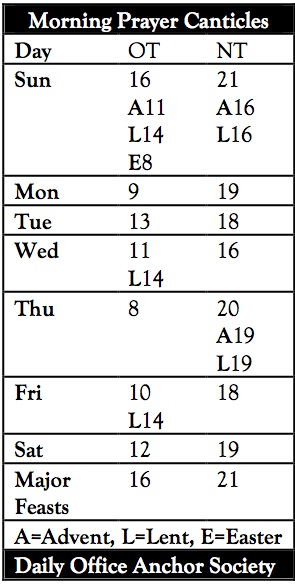
MP Canticles

Enter the handy-dandy Daily Office Anchor Society Canticles Bookmarks!

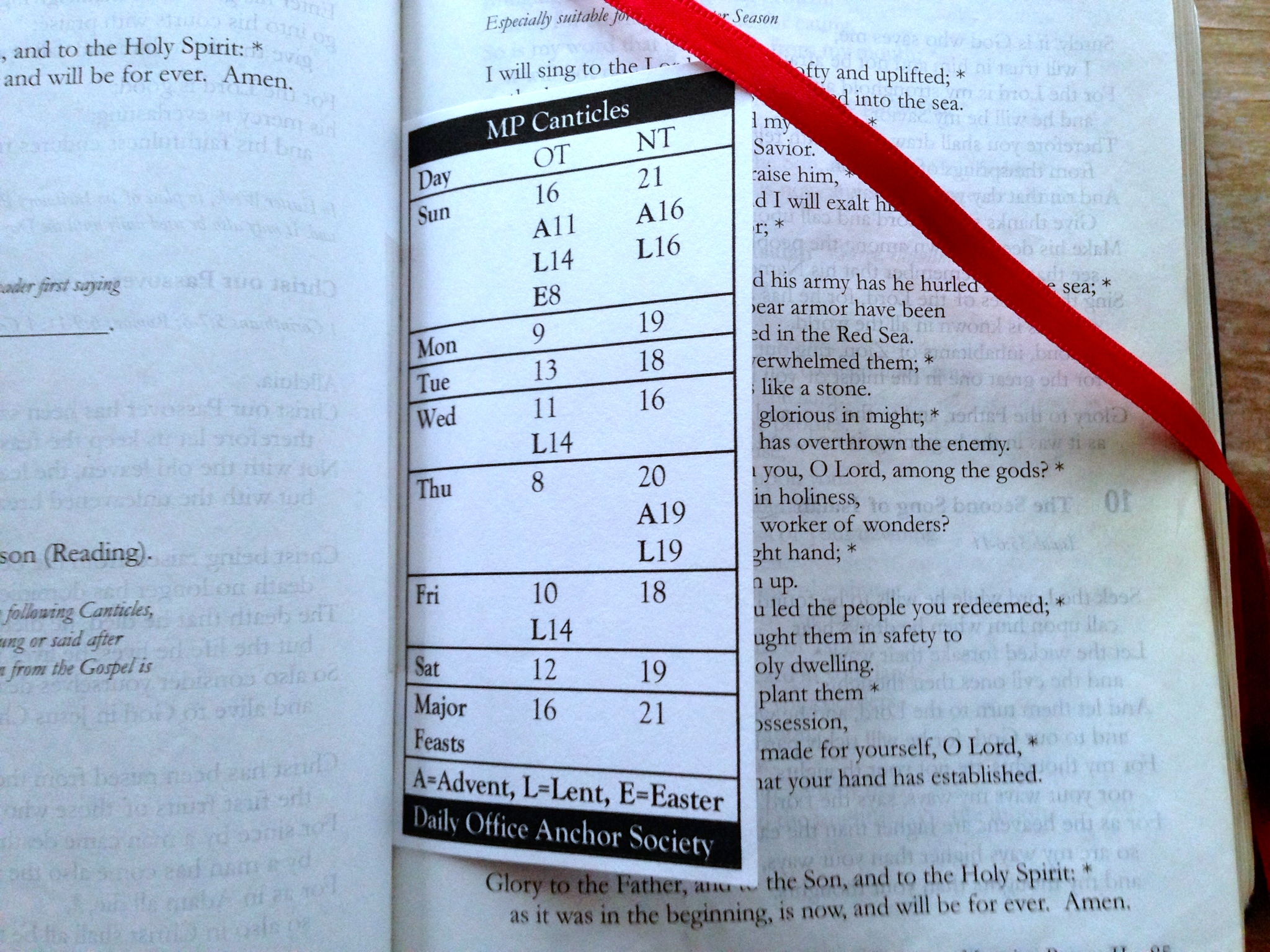
What they do is replicate the tables found at BCP 144 which lay out which canticles to read on any given day of the week. I suggest that you print them out from the Resources page, trim them to size, and tape them into your prayer book at BCP 84 for Morning Prayer and BCP 118 for Evening Prayer.

Since today is Tuesday, after the Old Testament reading we will turn to BCP 90 and read Canticle 13. Like the Invitatory Psalms, the Canticles have been known for centuries by their Latin names. Benedictus es, Domine is Latin for “Blessed are you, Lord.”

After the New Testament reading, we will turn back to BCP 93 and read Canticle 18, A Song to the Lamb.

Just like there are seasonal sentences of Scripture that you could say to begin the Office, there are also seasonal emphases in the Canticles. You’ll notice on Sundays, Wednesdays, Thursdays, and Fridays on the table above that there are different canticles appointed during Advent, Lent, or Easter. You’ll also see at the bottom of the table that any time there is a Major Feast on the church calendar, you would use Canticles 16 and 21 at Morning Prayer.

It feels like a lot of information, but the pattern for the Lessons is actually pretty simple:

Old Testament reading

Canticle from table

New Testament reading

Canticle from table

The Apostles’ Creed

The last thing we do in the Lessons section of the Office — after hearing God’s holy Word and responding in song — is recite the Apostles’ Creed (BCP 96).

The Apostles’ Creed is the ancient baptismal creed of the Church. When we baptize anyone even today, we renew our own baptismal covenant by reciting the Apostles’ Creed. Every day, morning and evening, we remember our baptism.

In the Daily Offices “we come together in the presence of Almighty God our heavenly Father, to set forth his praise, to hear his holy Word, and to ask, for ourselves and on behalf of others, those things that are necessary for our life and our salvation” (BCP 79).

Tomorrow, we will conclude this series by looking at the Prayers “for ourselves and on behalf of others” which conclude the Office.

Beginning the Office

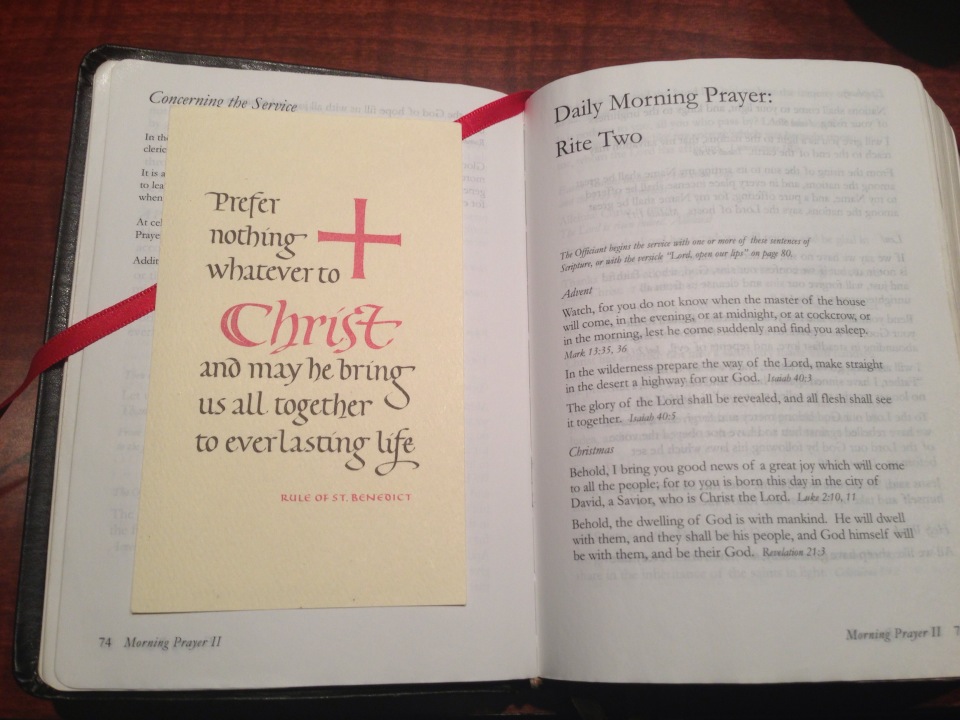
Prefer Nothing to Christ

Yesterday we prepared to say the Office by finding our place in the Book of Common Prayer and marking various places in the prayer book and Bible for easy reference.

Today we will begin the Office, looking at the opening sentences, the Confession of Sin, the Invitatory and Psalter.

Tomorrow we will look at the Lessons and Canticles, and the next day at the Prayers.

Where to begin?

The proper beginning of Morning Prayer is the opening sentences on BCP 80: “Lord, open our lips. / And our mouth shall proclaim your praise.”

At Evening Prayer (and other offices throughout the day), the opening sentences are “O God, make speed to save us. / O Lord, make haste to help us.” (BCP 117).

You’ll notice, though, that there are several pages of material printed before those opening sentences. You may choose to begin the Office with a seasonal sentence from Scripture and/or the Confession of Sin.

Seasonal Sentences

Look at BCP 75-78. You’ll see four pages of Scripture verses chosen to fit the seasons of the Church Year.

You might choose to begin the Office with one of these sentences in order to give your prayers the “flavor” of the season. This is especially helpful to distinguish seasons like Advent and Christmas, Lent and Easter, from the long “ordinary” seasons after Epiphany and Pentecost.

Since it’s Advent now, you might choose to begin with “Watch, for you do not know when the master of the house will come …” (BCP 75). Over the next four weeks, you might change it up a little by using one of the other two choices.

Confession of Sin

Look at BCP 79. The italics at the very top of the page are called rubrics. They are directions telling you what to do next.

In this case, the rubrics say, The following Confession of Sin may be said; or the Office may continue at once with “Lord, open our lips” (BCP 79).

“May” is an important word in the rubrics, and it means what it says. You don’t have to say the Confession every time you say the Office; you may say it.

Many people who say both Morning and Evening Prayer choose to say the Confession only in the evening.

In this somewhat more penitential season of Advent, and certainly in the season of Lent, it may seem right to say the Confession at every Office. Again, the choice helps us focus on the season of the Church Year and its emphases.

At any rate, if you’re saying the Office alone, you can omit the introduction to the Confession and simply start, “Most merciful God …”

When you say the absolution at the top of BCP 80, change the pronouns from “you” to “us” — you’ll see the rubrics there to remind you.

The Invitatory and Psalter

Everything we’ve said so far is optional, remember. You could simply begin the Office here on BCP 80 with “Lord, open our lips.”

It’s customary to make a sign of the cross with your thumb over your lips when you say “Lord, open our lips” at Morning Prayer and to make the regular sign of the cross at the sentence “O God, make speed to save us” at the other offices.

Here’s how it goes:

Lord, + open our lips.
And our mouth shall proclaim your praise.
Glory to the Father, and to the Son, and to the Holy Spirit:
as it was in the beginning, is now, and will be for ever. Amen.
Alelluia.

Pause here for breath while we talk about …

The Invitatory Psalm

The Office begins with a selection from the Psalter, which you looked up in the Daily Office Lectionary and marked with a bookmark. Before you say those Psalms, however, you say the Invitatory (or opening) Psalm.

There are two Invitatory Psalms, called Venite and Jubilate after the first word of the Psalm in Latin: “Come” and “Be joyful,” respectively.

Because the Venite is commonly used all the time as the Invitatory, you might like to use the Jubilate during Advent and Lent, just to set the season apart a little. There’s also a special canticle called Pascha nostrum, or “Christ our Passover,” that’s meant for use during Easter.

Again you’ll notice some optional material on BCP 80-82 before the Invitatory Psalms are printed. These are antiphons, or refrains, which you may use in order to give a seasonal flavor to the Venite or Jubilate, which you say every day.

So today, saying the Jubilate might go something like this:

Our King and Savior now draws near: Come let us adore him.

Be joyful in the Lord, all you lands; *
serve the Lord with gladness
and come before his presence with a song.

Know this: The Lord himself is God; *
he himself has made us, and we are his;
we are his people and the sheep of his pasture.

Enter his gates with thanksgiving;
go into his courts with praise; *
give thanks to him and call upon his Name.

For the Lord is good;
his mercy is everlasting; *
and his faithfulness endures from age to age.

Our King and Savior now draws near: Come let us adore him.

The Psalm or Psalms Appointed

The Office continues with the Psalms appointed for the morning or evening.

You may say the “Glory to the Father” at the end of all the Psalms, or at the end of each individual Psalm.

Before you turn to the Psalms, though, let me suggest that you refer to the Table of Canticles that you printed out from the Resources page and taped here at BCP 84. Move your Morning Prayer bookmark or ribbon to mark the canticle assigned to follow the first reading.

Today is Monday, for example, so Canticle 9 is appointed to follow the OT reading.

IMG_0008

If you take a moment now to mark it, you can read the Psalms, then turn directly to the OT lesson, then when you come back here, you can continue on with the Office very smoothly.

What you’re doing with your Morning Prayer bookmark or ribbon is holding your place in the service as you turn to the other resources you need for the Office: the Psalms, the Scripture readings, the Collects and other prayers.

We’ll look in more detail at the Lessons and the Canticles tomorrow morning.

Until then, I hope the Office is beginning to feel a bit more manageable. Every blessing!

Finding your place

IMG_0008


Saying the Daily Office is relatively simple, but it’s certainly not self-explanatory.

So as the new church year begins on this First Sunday of Advent, here are a few hints to help you find your place.

First, you will find it easier to pray the Office if you mark your Book of Common Prayer and your Bible ahead of time. Use the bookmarks on the Resources page of this blog or your own bookmarks, ribbons, or whatever else you like.

Start with a bookmark for the Daily Office Lectionary, which begins on BCP 937 — today, we begin Year Two of the lectionary, so you’ll be reading down the right-hand page.  The entries look like this:

Sunday          146, 147          *          111, 112, 113
Amos 1:1-5, 13–2:8          1 Thess. 5:1-11          Luke 21:5-19

Place a bookmark at Psalm 146, or BCP 803. The psalms for Morning Prayer are listed first, then those for Evening Prayer.

Place bookmarks in your Bible for the Old Testament (OT) reading from Amos, the Epistle (NT) reading from 1 Thessalonians, and the Gospel reading from Luke.

Place a bookmark at BCP 211, where the Collect of the Day for the First Sunday of Advent is located.

Place bookmarks at the beginning of Morning Prayer (BCP 75) and Evening Prayer (BCP 115).

Finally, print out the two Tables of Canticles from the Resource page; place the Morning Prayer Table at BCP 84 and the Evening Prayer Table at BCP 118.

Pro tips:

I have found it helpful to tape the Tables of Canticles into the BCP at the pages above, as they are small and have a habit of falling out. See the picture above for an example.

Also, after I say the Opening Sentences on BCP 80 and the Invitatory on BCP 82-83, I move the Morning Prayer bookmark (in my case, a ribbon) to the Canticle which will follow the Psalms and OT lesson. Today, for example, that would be for Sunday, in Advent (A), so Canticle 11. That way, after I flip forward to the Psalms and then read the passage from the OT, I can simply flip back to the Morning Prayer bookmark and continue with the canticle. You will certainly work out your own rhythm.

Lastly, you may find it helpful to refer to the document called “Praying the Daily Offices,” also found on the Resources page. It will remind  you what to do next as you move through the three sections of the Daily Office — Invitatory and Psalms, Lessons and Canticles, Prayers — and the bookmarks will already be where you need them when the time comes.

Whether you are beginning the Daily Office in Advent (or beginning again), I hope these few pointers will help you not only to find your place in the prayer book, but to claim your place in God’s kingdom.


In this world and in the age to come

hanukkah_4160 egg2cake


A Prayer of St. Chrysostom

Almighty God, you have given us grace at this time with one accord to make our common supplication to you; and you have promised through your well-beloved Son that when two or three are gathered together in his Name, you will be in the midst of them: Fulfill now, O Lord, our desires and petitions as may be best for us; granting us in this world knowledge of your truth, and in the age to come life everlasting. Amen. (BCP 102)

Knowledge of God’s truth

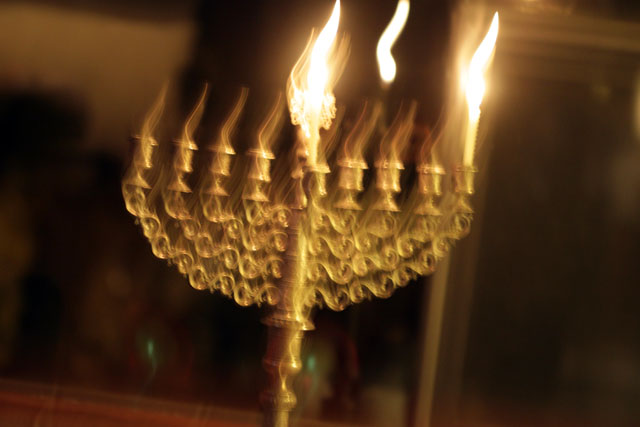
In this morning’s reading from 1 Maccabees we have the story of the rededication of the Temple — the event celebrated at Hanukkah each year. Judas Maccabeus and his followers have liberated the Temple and labored to rebuild it, replacing the desecrated altar and all of the vessels and fittings for the sanctuary.

Early in the morning on the twenty-fifth day of the ninth month, which is the month of Chislev, in the one hundred forty-eighth year, they rose and offered sacrifice, as the law directs, on the new altar of burnt offering that they had built. At the very season and on the very day that the Gentiles had profaned it, it was dedicated with songs and harps and lutes and cymbals. All the people fell on their faces and worshiped and blessed Heaven, who had prospered them. So they celebrated the dedication of the altar for eight days, and joyfully offered burnt offerings; they offered a sacrifice of well-being and a thanksgiving offering. (1 Macc. 4:54-56)

The rededication of the Temple is part of the story of salvation history — the understanding that God continually acts on behalf of his people, bringing them back again and again from their sin and neglect of his covenant with them.

Life everlasting

The rededication of the Temple echoes through the Christian story, too, but is transformed in the visions recorded in the Revelation to John. He pictures a heavenly city, the new Jerusalem, with no more need for a Temple because of the presence of the throne of God and of the Lamb.

Then the angel showed me the river of the water of life, bright as crystal, flowing from the throne of God and of the Lamb through the middle of the street of the city. On either side of the river is the tree of life with its twelve kinds of fruit, producing its fruit each month; and the leaves of the tree are for the healing of the nations. Nothing accursed will be found there any more. But the throne of God and of the Lamb will be in it, and his servants will worship him; they will see his face, and his name will be on their foreheads. And there will be no more night; they need no light of lamp or sun, for the Lord God will be their light, and they will reign forever and ever. (Rev. 22:1-5)

Even the lampstands of the Temple will no longer be necessary, “for the Lord God will be their light” for ever.

When two or three are gathered

These stories have been a source of hope and encouragement for Jews and Christians alike, visions of heaven and reminders of God’s continuing care for those who follow him.

Our hope for life in the age to come, however, should also govern how we act here and now. Today’s teaching from the Gospel of Matthew underscores that fact.

Jesus addresses the question of disagreements among believers, outlining a sort of progressive response — first speak to the person alone, then with two or three, then with the whole assembly. If they still don’t agree, he says, “let such a one be to you as a Gentile and a tax collector”  (Matt. 18:17).

This is a critical point that we usually miss. What does Jesus do with Gentiles and tax collectors?

He seeks them out, talks with them (men and women alike), dines with them, has his mind changed by them, comes into their households, and proclaims that the kingdom of God has come near to them.

Our hope for life in the age to come should create in us the same urgency for reconciliation that Jesus demonstrated, seeking out the one lamb that was lost from the hundred, even giving up his own life in order to break forever the separation of death.

“When two or three are gathered together,” Christ who is in the midst of us sends us out to fulfill our mission: to restore all people to unity with God and each other in Christ (BCP 855).

+ + + + +

Fulfill now, O Lord, our desires and petitions as may be best for us; granting us in this world knowledge of your truth, and in the age to come life everlasting. Amen.

Searching and fearless

Step Four
Made a searching and fearless moral inventory of ourselves.

“We want to find exactly how, when, and where our natural desires have warped us. We wish to look squarely at the unhappiness this has caused others and ourselves. By discovering what our emotional deformities are, we can move toward their correction … Without a searching and fearless moral inventory, most of us have found that the faith which really works in daily living is still out of reach” (12 Steps and 12 Traditions).

Notes from the first session of John Dally's "This Dangerous Book: Strategies for Teaching the Bible" at Seabury.

Notes from the first session of John Dally’s “This Dangerous Book: Strategies for Teaching the Bible” at Seabury.

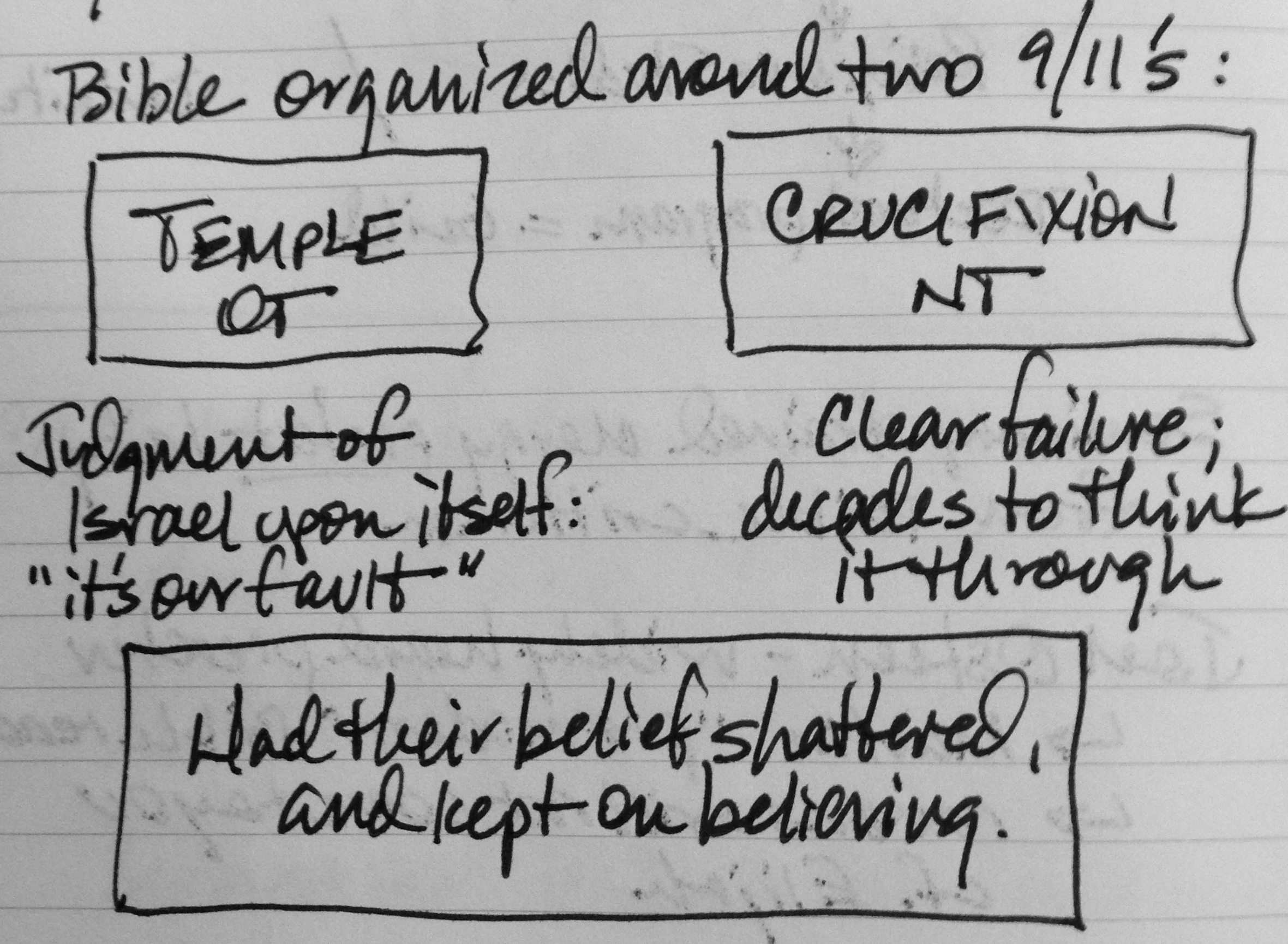
Three weeks ago, I wrote about one of the central ideas from the class I am taking at Seabury this fall: that the Bible is organized around two 9/11’s.

The Hebrew Bible, in particular, came into its present shape after the destruction of the Temple and the exile into Babylon. John Dally suggests that Israel’s judgment upon themselves is that “it’s our fault.”

So mortals ate the bread of angels;
he provided for them food enough.

But they did not stop their craving,
though the food was still in their mouths.

Whenever he slew them, they would seek him,
and repent, and diligently search for God.

But they flattered him with their mouths
and lied to him with their tongues.

Their heart was not steadfast toward him,
and they were not faithful to his covenant.

(Psalm 78:25-37 passim)

Perhaps the Hebrew Bible is also, to use the language of the 12 Steps, Israel’s “searching and fearless moral inventory.”

Step Four concludes with this reminder: “Therefore, thoroughness ought to be the watchword when taking inventory. In this connection, it is wise to write out our questions and answers. It will be an aid to clear thinking and honest appraisal. It will be the first tangible evidence of our complete willingness to move forward.”

What the priest Ezra and the people are doing in this morning’s reading from the Book of Nehemiah is repenting of their sins and laying before God and each other their written confession:

You have been just in all that has come upon us, for you have dealt faithfully and we have acted wickedly; our kings, our officials, our priests, and our ancestors have not kept your law or heeded the commandments and the warnings that you gave them …. Because of all this we make a firm agreement in writing, and on that sealed document are inscribed the names of our officials, our Levites, and our priests. (Nehemiah 9:33-34, 38)

In a larger sense, the whole of the Hebrew Bible is the written confession of the people of God regarding their failure and their renewed desire to live as God intends, the “tangible evidence of their complete willingness to move forward.”

It is difficult to commit to a “searching and fearless moral inventory,” but I also draw comfort knowing that I am by no means alone in my struggles, that others have found a way forward into a “faith that really works in daily living.”

How do your prayers and your reading of Scripture both challenge and comfort you today?

No longer strangers and sojourners

genuflect

I stretched forth my hand against myself;
I have broken my covenant.

My speech is softer than butter,
but war is in my heart.

My words are smoother than oil,
but they are drawn swords.

Cast your burden upon the Lord,
and he will sustain you;
he will never let the righteous stumble.

(Psalm 55, adapted)

The class I’m taking this fall at Bexley Seabury is called “This Dangerous Book” for a reason.

We’re together investigating how texts, images, and sounds in juxtaposition can help us experience the Bible at a heart level rather than in our heads.

Our exercise last night was to do some free association on a text appointed for All Saints’ Day. The reading from the Book of Daniel stirred up in me various “beasts” like Daniel saw “in the visions of his head as he lay in bed.”

I saw in my vision by night
the four winds of heaven
stirring up the great sea
and four great beasts
came up out of the sea
different from one another.
(Dan. 7:2-3)

Though I am struggling with several “great beasts” — various kinds of sin in my life — the experience of the saints reassures me that I am not alone. I am not unique in my struggles, and in fact I can learn how to live from those “who have come out of the great ordeal” before me (Rev. 7:14).

In many recovery programs, those who have gone before are called sponsors; in our tradition they are called saints. Thanks be to God that we are not left to deal with our “great beasts” alone, that we are not left to swim the great sea by ourselves.

We are no longer strangers and sojourners, but fellow citizens with the saints and members of the household of God (Eph. 2:19).

Hail, hail! Lion of Judah!

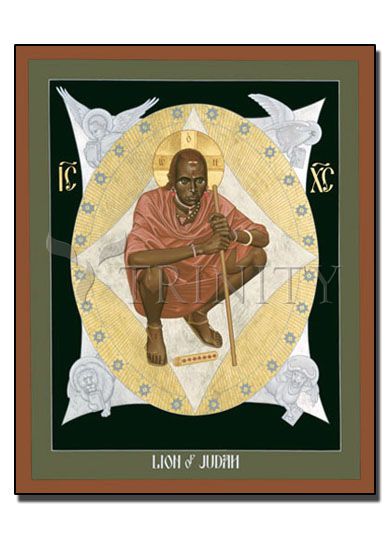
Icon by Robert Lentz, OFM from Trinity Stores -- https://www.trinitystores.com

Icon of the Lion of Judah by Br. Robert Lentz, OFM

Then I saw in the right hand of the one seated on the throne a scroll written on the inside and on the back, sealed with seven seals; and I saw a mighty angel proclaiming with a loud voice, “Who is worthy to open the scroll and break its seals?” And no one in heaven or on earth or under the earth was able to open the scroll or to look into it. And I began to weep bitterly because no one was found worthy to open the scroll or to look into it. Then one of the elders said to me, “Do not weep. See, the Lion of the tribe of Judah, the Root of David, has conquered, so that he can open the scroll and its seven seals.” (Revelation 5:1-5)

It’s got to be at least 25 years ago now.

A group of Episcopal campus ministers from around Illinois were gathered at Brent House, the campus ministry at the University of Chicago, for a weekend planning session of some kind.

At Eucharist one evening we sang Victory Chant (Hail Jesus) by Donnie McClurkin, and I remember being powerfully moved by the refrain:

Hail, hail Lion of Judah!
How wonderful You are!
Hail, hail Lion of Judah!
How powerful You are!

Hail Jesus! You’re my King!
Your life frees me to sing
I will praise You all my days
You’re perfect in all Your ways

At the time, I think it was the music that impressed me most — the joyous, rhythmic chant sung by friends who were all excellent singers.

I’ve written before about how I ran across this icon of the Lion of Judah by Br. Robert Lentz, OFM, but today it really cements in my mind the powerful “otherness” of Jesus.

That is to say, it helps me understand that the Risen Jesus is always more than we think, always other than we think.

He is both Lion and Lamb. He is not only Jewish, but Gentile. He is not only Mediterranean, but Indian and Chinese and African (and even English and Scottish, Irish and Welsh). He is both Judge and Lover, both King and Suffering Servant.

Part of Jesus’ “otherness,” to my mind, is his power.

“Who is worthy to open the scroll?” asks the terrible angel. “The Lion of Judah,” says the elder, “because he has conquered.”

Jesus has conquered death, we proclaim every Sunday, trampled down death by death. His power, though, is not just for himself but for us. His life — his conquering life — overcomes even our powerlessness and frees us to sing.

Hail, hail! Lion of Judah!

Visions of peace

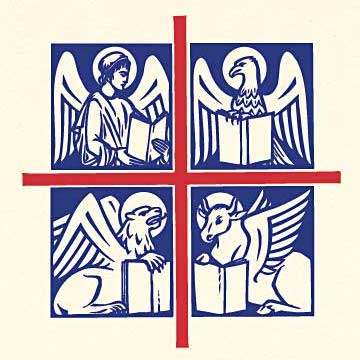
Four Evangelists cross from the Printery House

Four Evangelists cross from the Printery House

Therefore we praise you,
joining our voices with Angels and Archangels
and with all the company of heaven,
who forever sing this hymn
to proclaim the glory of your Name:

Holy, holy, holy Lord; God of power and might,
heaven and earth are full of your glory.
Hosanna in the highest.
Blessed is he who comes in the Name of the Lord.
Hosanna in the highest. (BCP 362)

Today the assigned readings and the canticles appointed for the day line up perfectly to create a single unifying image for Morning Prayer.

In the Book of Ezra, we read about the rebuilding of the Temple following the return of the Israelites from exile in Babylon. They are restoring the site of their worship, and with them we picture their prayers once more ascending to God, with incense surrounding the golden cherubim atop the Ark of the Covenant.

Glory to you, Lord God of our fathers;
you are worthy of praise; glory to you ….
Glory to you, seated between the Cherubim;
we will praise you and highly exalt you for ever.
(Canticle 13, BCP 90)

In the Revelation to John, we similarly see a vision of restoration, of worship to God in the heavenly City, the new Jerusalem. John describes his vision of a throne surrounded by 24 thrones, on which are seated 24 elders, in front of whom are seven torches and a sea of glass, and around whom are the “four living creatures, full of eyes in front and behind.”

Christian tradition has long associated the four living creatures — “at his feet the six-winged seraph; cherubim with sleepless eye” (Hymn 324) — with the four Evangelists: Matthew like a lion, Mark like a man, Luke like an ox, and John like an eagle.

In Canticle 18, we respond to the reading with the same song the angels and elders are singing around the throne:

And so, to him who sits upon the throne,
and to Christ the Lamb,
Be worship and praise, dominion and splendor,
for ever and for evermore.
(BCP 94)

Now, if that were the whole story, that would be enough — a nice symmetry making Morning Prayer extra lovely. Fine.

But there’s even more.

These visions of a restored Temple, of a City with the Lamb at its center, were recorded in order to give comfort to God’s people in hard times. The exiles were struggling to recover their sense of self, and it seemed like the grinding bureaucracy of the Babylonian empire might slow down or stop their building project. The early Christian communities of John’s time were beginning to be thrown out of the synagogues where they had been worshiping and to experience persecution by the Roman empire.

These are not just lovely songs, but visions of peace meant to sustain God’s people in times of trouble.

How will you imagine peace in your life today? What images will help you get through your struggles?

A Collect for Peace

O God, the author of peace and lover of concord, to know you is eternal life and to serve you is perfect freedom: Defend us, your humble servants, in all assaults of our enemies; that we, surely trusting in your defense, may not fear the power of any adversaries; through the might of Jesus Christ our Lord. Amen. (BCP 99)