

Category Archives: Sermons

The power and the presence of God

victory of life and peace

The Fifth Sunday in Lent + Healing Sunday

Sermon given at St. Thomas Episcopal Church + Menasha, WI

About 46 years ago, I was baptized, my Episcopal priest father scooping the water over my head with his hand, and my parents and godparents promising on my behalf to renounce Satan and all his works, to turn to Jesus Christ as Lord and Savior, and to see that I was brought up in the Christian faith and life.

About 35 years ago, I was confirmed, renewing that commitment to Jesus Christ and promising (with God’s grace) to follow him as my Savior and Lord. My godfather, Bishop Folwell, laid his hands on my head and prayed that the Holy Spirit would empower me for God’s service.

About 25 years ago, Katrin and I married each other, joining hands, and promising to “have and to hold, from this day forth, for better for worse, for richer for poorer, in sickness and in health, as long as we both shall live.”

A couple months after that, a high school friend of Katrin’s invited me to attend a John Guest evangelistic crusade in Chicago. Seriously? An evangelistic crusade? People waving their hands in the air? As the altar call began, my skeptical self was confronted by a vision of Jesus in person. That night, I accepted Jesus as my Savior and made a mature commitment to follow him as my Lord.

About 18 years ago, Bishop Frank Griswold laid his hands on my head and made me a deacon in God’s one, holy, catholic, and apostolic Church. I promised not only to be loyal to the doctrine, discipline, and worship of the Episcopal Church; but more importantly “to make Christ and his redemptive love known to those among whom I live, and work, and worship.”

+ + + + +

We make promises before we fully understand what they will mean for us and for our lives. We vow to follow, and then we find out where we’re going.

Our namesake Thomas exemplifies this pattern. Things are coming to a head between Jesus and the religious authorities, and they could expect trouble in the days ahead.

“Then Jesus told them plainly, ‘Lazarus is dead. For your sake I am glad I was not there, so that you may believe. But let us go to him.’ Thomas, who was called the Twin, said to his fellow disciples, ‘Let us also go, that we may die with him’” (John 11:14-16).

We make promises in time, without fully understanding them, and it’s only over time that we come to appreciate how they will impact our futures.

But underneath these promises, in all our lives, in all of the details of what we promise and who we share our lives with, underneath it all is the presence and the power of God continually working for our health and our salvation.

+ + + + +

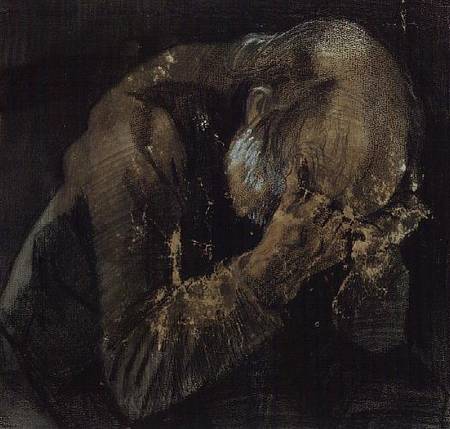
A little more than 5 months ago, head in my hands, I admitted that I was powerless over alcohol and that my life had become unmanageable, and I made a decision to turn my life and my will over to the care of God as I understand Him.
XTD68231

Ezekiel’s valley of dry bones is such an accurate picture of those moments.

“The hand of the Lord came upon me, and he brought me out by the spirit of the Lord and set me down in the middle of a valley; it was full of bones. He led me all around them; there were very many lying in the valley, and they were very dry. He said to me, ‘Mortal, can these bones live?’ I answered, ‘O Lord GOD, you know’” (Ezekiel 37:1-3).

When we admit we are powerless, time stops, and in the present moment we see how broken and dry and dead we have become. It’s only through that awareness that we begin to rely on God entirely. “Can these bones live? O Lord God, you know.” The meetings I now go to, the 12 Steps I now follow like millions before me are about learning to live a sober life, sober meaning “dependent on God and free from self-centeredness, fear, anger, and resentment.”

As our Gospel lesson continues (John 11:21-27), Jesus is almost to Bethany, and there is Martha – brimming with anger, seething with resentment: “Lord, if you had been here, my brother would not have died,” What she really means is, “if you had been here, I wouldn’t be in pain right now.”

Her faith tries to reassert itself: “But even now I know that God will give you whatever you ask of him.”

Jesus says to her, “Your brother will rise again.” Martha says to him – focusing back on her pain, her frustration – that’s no help to me, but sure, “I know that he will rise again in the resurrection on the last day.”

Jesus looks her straight in the eyes – no hiding – and says to her, “I am the resurrection and the life. Those who believe in me, even though they die, will live, and everyone who lives and believes in me will never die. Do you believe this?”

She blinks, realizing as she looks back at him that her trust is stronger than her grief, “Yes, Lord, I believe that you are the Messiah, the Son of God, the one coming into the world.”

Martha trusts Jesus, and even knows him to be the Messiah, but she actually has no idea the breadth of his power or the depth of his love for her, for Mary, and for their brother, for his brother Lazarus.

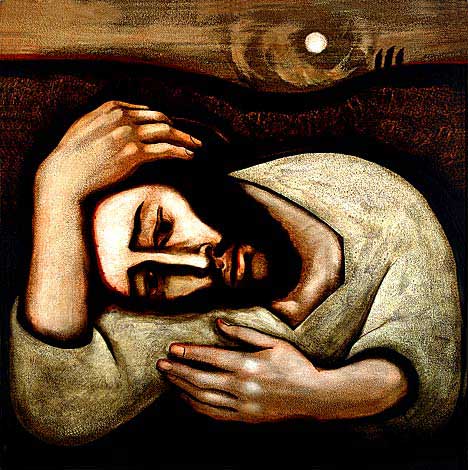
What is happening here is that, faced with our grief and frustration, faced with our anger and resentment, faced with our fear of death, God’s heart breaks.
christ-in-gethsemane-p

“God the only Son, who is close to the Father’s heart” (John 1:18), stands with us and weeps.

When God’s eternal Spirit, blowing through all creation, touches the tears on Jesus’s cheeks, even death is no match – even graves spring open.

Underneath our helplessness, underneath our fear and resentment, in all of the details of how we have failed ourselves and those we love, underneath even our own death is the presence and the power of God continually working for our health and our salvation.

+ + + + +

Until he died about 10 years ago, there was never a time in my life when my father did not pray for me. I can still hear his voice and feel his hand on my forehead:

Rodger, I lay my hands upon you and anoint you with oil, in the Name of the Father, and of the Son, and of the Holy Spirit; beseeching our Lord Jesus Christ, that all your pain and sickness of body being put to flight, the blessing of health may be restored to you and you may enjoy that victory of life and peace which will enable you to serve him now and always. Amen. 

Woven throughout my life, woven into the fabric of the promises I have made to God and the admission of my failures, is another pattern of healing prayers being offered on my behalf.

One of my first conscious memories of healing prayers other than my father’s is from about 30 years ago on my first Happening – Happening number 12 in the Diocese of Albany. I loved the singing, but I was rapidly losing my voice. I asked the Spiritual Director to pray for me at the healing service, and it felt like there was soothing honey pouring down my throat – for the rest of the weekend I could sing freely and loudly, even hitting the high notes in “I am the bread of life.” Thirty years later, and I’m still singing at Happenings – this last one was Happening number 67 in the Diocese of Fond du Lac.

Here at St. Thomas, I know myself to be surrounded by healing prayer, whether it’s in the chapel after the Eucharist, or here at the rail during a healing service, or at birthday and anniversary prayers during the Peace, or through special prayers for healing after my foot surgery. Your healing ministry also took the form of an invitation – since I have been home more often these last few months – to join the Thursday morning men’s Bible study group.

We ask for healing – we accept God’s invitation to health – before we fully understand what it will mean, before we fully grasp what wholeness may free us to do.

We admit our vulnerability, and find that, paradoxically, our weakness and honesty helps to strengthen others.

We are healed in eternity – because in praying for healing we are made open to God’s eternal love for all of creation. Like with Lazarus, even death cannot stop God’s love.

Underneath these healing prayers, in all our lives, in all of the details of our sickness and pain, in all the frustration of our limitations, in the loneliness and separation we feel, in all the push and pull of our relationships, underneath it all is the presence and the power of God continually working for our health and our salvation.

+ + + + +

If you desire to know the presence and the power of God in your life more fully, I will invite you in a moment to come forward and ask a member of the healing team to pray for you.

Who knows what that healing will mean for you, who knows where it will take you, who knows what it may set you free to do with and for others?

If you’d like to know “that victory of life and peace which will enable you to serve God now and always,” I invite you to come forward now and ask.
victory of life and peace


Temple and Empire: Sermon for 3 Advent

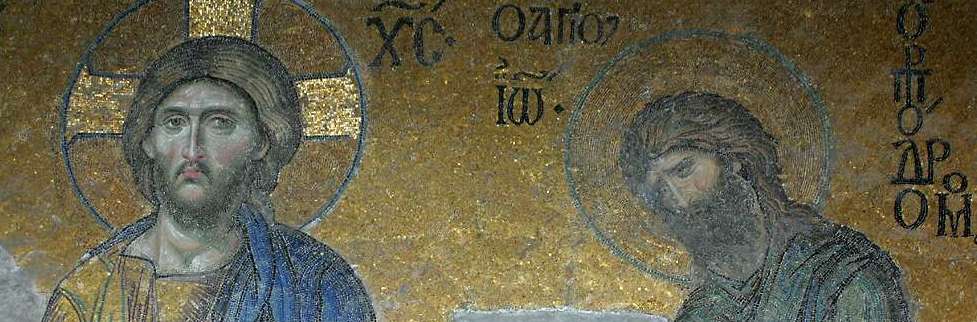
Christ and John the Baptist from www.richard-seaman.com

Christ and John the Baptist from http://www.richard-seaman.com

Temple and Empire

 “From the days of John the Baptist until now
the kingdom of heaven has suffered violence,
and the violent take it by force” (Matt. 11:12)

 Advent is not about waiting for Christmas; it’s about waiting for the kingdom of heaven to come. Advent is the season when we join the fight and look forward to the kingdom come.

It’s no coincidence that we read from the Book of Revelation at the Daily Office during Advent. It’s about longing for the Temple to fall and anticipating the day when the Empire will collapse.

In the biblical story the Temple, according to John Dally, professor of theology and culture at Bexley Seabury, stands for religion and purity over against the relationship that God desires with his creatures – symbolized by the Garden of Eden and by the table fellowship between Jesus and his disciples.

Empire is every impulse of violence that crushes human beings for monetary gain or personal pride. In the biblical story, the people of Israel contend against both the Babylonian and the Roman empires, and they are consistently urged to remember the poor and the needy.

Today we have made religion into a violent battle about belief, with the same rigid purity codes, exclusionary rhetoric, and shame-based culture that Jesus fought against. We keep trying to rebuild the Temple. And the constant splintering of denominations – Orthodox against Roman, Protestant against Catholic, some 24,000 Christian denominations in America today — betrays the violence at the heart of our dealings with each other.

Today we can live heedless of the suffering of billions of people around the world because we belong to the only remaining superpower – we are the only Empire left in the globalized First World. We play with electronic toys or watch flat-screen TVs or buy Christian consumer goods made overseas in sweatshop conditions, we send unmanned drones around the world to kill people (guilty, innocent, who cares?) just like in a video game, and we put children into jail on minor charges for profit.

Both Jesus and John the Baptist fought against Temple and Empire throughout their short lives. Advent is the season when we join the fight and look forward to the kingdom come.

John the Baptist

John is near the end of his life.

He has been taken by force, bound, and imprisoned in Herod’s jail. His judgment against King Herod (and more importantly, Herod’s adultery with his brother’s wife Herodias) has put him in the prison of the Roman Empire’s puppet state.

He sends a question to Jesus by his disciples: “Are you the one who is to come, or are we to wait for another?”

Jesus replies: “Go and tell John what you hear and see: the blind receive their sight, the lame walk, the lepers are cleansed, the deaf hear, the dead are raised, and the poor have good news brought to them. And blessed is anyone who takes no offense at me.”

That’s not much help.

John has been preaching the message his father sang at his birth:

This was the oath [God] swore to our father Abraham,
to set us free from the hands of our enemies
Free to worship him without fear
holy and righteous in his sight
all the days of our lives

You, my child, shall be called the prophet of the Most High,
for you will go before the Lord to prepare his way,
To give his people knowledge of salvation
by the forgiveness of their sins. (Luke 1:68-79)

Though his ministry has focused on preaching repentance and baptizing people for the forgiveness of their sins, surely in the back of John’s mind is also the promise of freedom in Zechariah’s song, that God’s people would be “free from the hands of our enemies, free to worship him without fear all the days of our life.”

From the perspective of his jail cell, as he lies there in the hands of the Empire, John must not get much comfort from Jesus’ healing ministry or his preaching against the Temple religion.

Jesus

Jesus is near the beginning of his ministry.

He answers John’s question by pointing to the breaking in of the kingdom of God:  “the blind receive their sight, the lame walk, the lepers are cleansed, the deaf hear, the dead are raised, and the poor have good news brought to them. And blessed is anyone who takes no offense at me.”

Jesus’ life and ministry are focused on subverting the Temple and its righteousness codes – depending on which Gospel you read, in fact, he has already overturned the tables of the moneychangers in the Temple (or he will before long).

Dally suggests that Jesus takes the architecture of the Temple as the map of the people he will minister to – to those excluded at every stage. In the Holy of Holies, it’s only the High Priest and only once a year; in the Court of the Priests, it’s only the Levitical priests; in the Court of the Israelites, it’s only men; in the Court of the Women, it’s everybody but Gentiles, lepers and Nazirites.

The Ethiopian eunuch from the Book of Acts, baptized by the Apostle Philip as one of the first Gentile converts to the Way, wouldn’t even have been able to get into the Court of the Gentiles – the bazaar where the souvenir shops and the moneychangers were.

The healing Jesus points to in his answer to John is possible only because he goes out of his way to associate with the blind, the lame, the deaf – and especially ritually impure women and unclean lepers, Samaritan women and the undeserving poor.

In his focus on overturning the Temple religion, Jesus has not yet begun to fulfill his mother’s song, the Magnificat we just said together:

He has shown the strength of his arm,
he has scattered the proud in their conceit.
He has cast down the mighty from their thrones,
and has lifted up the lowly.
He has filled the hungry with good things,
and the rich he has sent away empty. (Luke 1:46-55)

 Mary’s vision has to do with the overturning of the powerful – the proud, the mighty, the rich – but it won’t be long before the religious leaders use the power of the Empire to have Jesus put to death on the cross like a common criminal.

Without Fear

Today in Herod’s jail, the criminal John the Baptist is one of those people Isaiah describes “who are of a fearful heart.”

“Are you the one who is to come, or are we to wait for another?”

The prophet Isaiah reassures the people of Israel:

Here is your God.
He will come with vengeance,
with terrible recompense.
He will come and save you. (Isaiah 35:4)

But Jesus doesn’t seem to be taking charge here. He doesn’t seem to be overthrowing anybody. In fact, John is still in jail and will be beheaded before much longer.

Jesus’ answer is not a direct response to the power of Empire, but it points at the hope of God’s kingdom, which is already coming into the world.

It’s not here yet – Empire and Temple still hold their power over people’s lives – but it’s coming and nothing will stop it.

How will you join the fight?

Advent is not about waiting for Christmas;
it’s about waiting for the kingdom of heaven to come. 

Advent is the season when we join the fight
and look forward to the kingdom come.

 How will you fight against Empire in this relentlessly commercial season? How will you fight against our culture, which engages in a war on the poor rather than on the businesses and policies that keep them in poverty? How will you work to keep people out of the literal prisons we build with private corporations – and with occupancy quotas that local governments have to meet?

How will you fight against the building of the Temple in this religious season? How will you fight against the judgmental attitude that sneers at “Christmas and Easter” worshippers or takes offense when someone wishes you “Happy Holidays”? How will you work to respect the dignity of every human being – Christian or not? How will you demonstrate that you are “so clothed in Christ’s spirit that you reach out your arms of love to bring everyone into his saving embrace”?

How will you practice repentance and forgiveness at holiday gatherings and with difficult family members? How will you, like John, preach repentance and forgiveness of sins to a world – and people like you and me – so desperately in need of them?

How will you practice self-giving in a season of consumer frenzy and self-centeredness? How will you, like Jesus, give your comfortable life away in order to heal people and bring them into fellowship – even if it means giving up your own power, your own privilege?

Advent is not about waiting for Christmas;
it’s about waiting for the kingdom of heaven to come.

Advent is the season when we join the fight
and look forward to the kingdom come.