
Category Archives: Daily Office

Forgetful of the cleansing

For this very reason, you must make every effort to support your faith with goodness, and goodness with knowledge, and knowledge with self-control, and self-control with endurance, and endurance with godliness, and godliness with mutual affection, and mutual affection with love. For if these things are yours and are increasing among you, they keep you from being ineffective and unfruitful in the knowledge of our Lord Jesus Christ. For anyone who lacks these things is nearsighted and blind, and is forgetful of the cleansing of past sins. (2 Peter 1:5-9)

One of the first insights I had about the Daily Office after I entered recovery was that, even though the rubrics say the Confession of Sin is optional at the beginning of Morning Prayer (BCP 79), for me it is required.

It’s so easy for me to be “forgetful of the cleansing of past sins,” to press forward without remembering the hard-won lessons of my recovery and my new life.

It’s easy for me to start thinking things are fine, but how quickly I can slip back into the thoughts that led me into trouble in the first place. How little I really want to do what is good, how little I want to wait for anything, how little thought I give to anyone else, how little self-control I have!

The grace that filled me when I entered recovery, admitting my powerlessness and my need for God’s help, is the same kind of grace that is given to us in the sacrament of baptism.

It occurred to me today that we make our Confession of Sin and then say the Apostles’ Creed each morning so that we do not become “forgetful of the cleansing of past sins.”

The point is not to rehearse our past sins over and over — they have been forgiven, and we are made new in baptism. Rather, the point is to learn from our experience in order to better trust in the hope we have been given.

The point is to be mindful each day of our need for God, and each day to recommit ourselves to walking in the steps laid out for us.

Therefore, brothers and sisters, be all the more eager to confirm your call and election, for if you do this, you will never stumble. For in this way, entry into the eternal kingdom of our Lord and Savior Jesus Christ will be richly provided for you. (2 Peter 1:10-11)

A Collect for the Renewal of Life

O God, the King eternal, whose light divides the day from the night and turns the shadow of death into the morning: Drive far from us all wrong desires, incline our hearts to keep your law, and guide our feet into the way of peace; that, having done your will with cheerfulness while it was day, we may, when night comes, rejoice to give you thanks; through Jesus Christ our Lord. Amen. (BCP 99)

What can the righteous do?

What can the righteous do?

When the foundations are being destroyed,
what can the righteous do?
The Lord is in his holy temple;
the Lord’s throne is in heaven.
His eyes behold the inhabited world;
his piercing eye weighs our worth. (Psalm 11:3-5)

Weighing our worth

When [the people] heard [the parable of the wicked tenants], they said, “Heaven forbid!” But he looked at them and said, “What then does this text mean: ‘The stone that the builders rejected has become the cornerstone’? Everyone who falls on that stone will be broken to pieces; and it will crush anyone on whom it falls.” When the scribes and chief priests realized that he had told this parable against them, they wanted to lay hands on him at that very hour, but they feared the people. (Luke 20:16b-19)

Who does he think he is?

I mean, seriously, what can we do?

This guy is in our church teaching, and there’s something not quite right about him. Who does he think he is?

No matter what question we ask him, he slips away sideways, and when we try to go in for the kill, we trip over his words and he makes us look bad. It’s aggravating! Someone should throw him out of here.

Trouble is, the kids love him. The young adults are coming back to church. Even the Rite One crowd seems to like him, and a couple of them cornered us after the service last Sunday and asked if what he said about the Bible was true.

Maybe the bishop can do something about him. Maybe we should call the cops.

What are we going to do?

Not “Black” but “Good”

I have said to the LORD, “You are my God; *
listen, O LORD, to my supplication.
O Lord GOD, the strength of my salvation, *
you have covered my head in the day of battle. (Psalm 140:6-7)

Days of Special Devotion

“Good Friday, and all Fridays of the year, in commemoration of the Lord’s crucifixion, except for Fridays in the Christmas and Easter seasons …” are days of special devotion for Christians, according to the Book of Common Prayer (BCP 17).

Fridays, which Christians have observed as fast days since about 60 AD, are to be observed with “special acts of discipline and self-denial.”

For generations of Roman Catholics this has meant not eating meat on Fridays, for example. Here in Wisconsin, we all enjoy “Fish Fry Fridays” because so many of our neighbors do not eat meat when they go out for dinner.

Fridays for Christians are about doing without, sacrificing even a little something in imitation of our Lord, who sacrificed everything for our sake.

Blessed is the King

Today’s reading from the Gospel of Luke recounts Jesus’ triumphal entry into Jerusalem as he heads toward his final confrontation with the religious authorities.

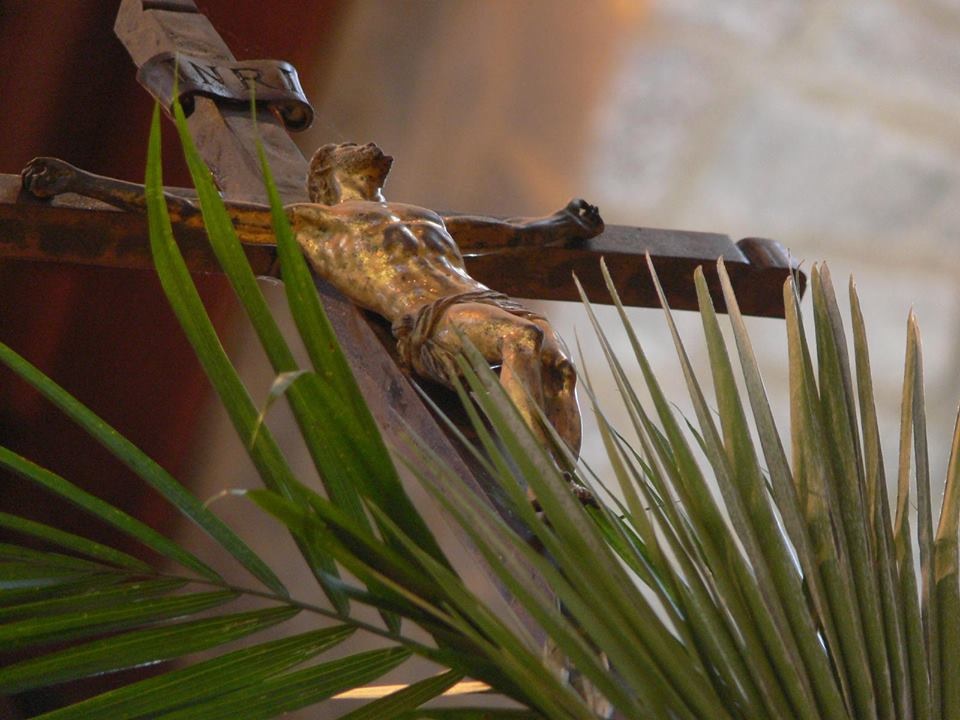
We commemorate the last week of Jesus’ life each year during Holy Week, and we often reenact this scene as we process into church on Palm Sunday, carrying palm, branches and singing “All glory, laud, and honor / to thee, redeemer King.”

Three of the Gospels — Matthew, Mark, and Luke — tell the story of Jesus overturning the tables of the money changers in the courts of the Temple, a deliberately provocative act as the feast of Passover approaches that effectively sets him on “the way of the cross.”

Throughout the rest of Holy Week the tension mounts as Jesus says farewell to his disciples, prays that he be spared from the trial, determines to do God’s will, and faces arrest, beatings, and denunciations from soldiers and from the crowd that was with him just days before.

“My kingdom is not from this world,” he replies in response to Pilate’s questioning. The Roman governor can do nothing but send him off to be crucified.

From the Society of St. John the Evangelist -- www.ssje.org

From the Society of St. John the Evangelist — http://www.ssje.org

Not “Black” but “Good”

The prayers in the Daily Office remind us that every Friday is for us a commemoration of that “Good” Friday, just as every Saturday we rest and remember God’s goodness in creation, and every Sunday we rejoice in the power of the resurrection.

Though that Friday was a dark and terrible day, we call it “Good” because in it we see the first act in a three-day drama of salvation.

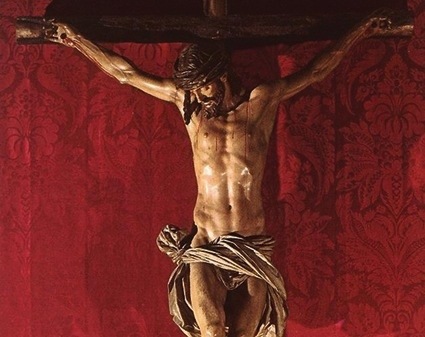
Every Friday — this Friday after Thanksgiving Day just like all the rest — the Church invites us to live a cross-shaped life, imitating our Lord, “who stretched out [his] arms of love on the hard wood of the cross that the whole world might come within the reach of [his] saving embrace” (BCP 101).

A Collect for Fridays

Almighty God, whose most dear Son went not up to joy but first he suffered pain, and entered not into glory before he was crucified: Mercifully grant that we, walking in the way of the cross, may find it none other than the way of life and peace; through Jesus Christ your Son our Lord. Amen.

Food for the last and the least

And this is the will of him who sent me, that I should lose nothing of all that he has given me, but raise it up on the last day. (John 6:39)

First fruits

The Morning Prayer reading from the book of Deuteronomy on this Thanksgiving Day is set off with italics in my Bible: First Fruits and Tithes.

The people of Israel are grateful for their physical deliverance from slavery in Egypt. “The Lord brought us out of Egypt with a mighty hand and an outstretched arm, with a terrifying display of power, and with signs and wonders, and he brought us into this place and gave us this land, a land flowing with milk and honey” (Deut. 26:8-9).

In their gratitude, they are to give the first fruits of the land as an offering to God. But the story doesn’t end with their gratitude and offering; it also includes those who might easily be overlooked.

Their offering will be shared, the people with produce and food “giving it to the Levites, the aliens, the orphans, and the widows, so that they may eat their fill within your towns” (Deut. 26:12).

Anyone who comes

The people following Jesus don’t realize that what he is offering goes beyond bread, goes even beyond the manna that the children of Israel ate in the desert.

Jesus answered them, “Very truly, you are looking for me not because you saw signs, but because you ate your fill of the loaves” (John 6:26).

“I am the bread of life,” he says. “Whoever comes to me will never be hungry, and whoever believes in me will never be thirsty” (John 6:35). Sounds like he’s still talking about a physical deliverance.

But he goes on to talk about the will of the Father, and to hint at a much larger purpose.

“Everything that the Father gives me will come to me, and anyone who comes to me I will never drive away; for I have come down from heaven not to do my own will, but the will of him who sent me” (John 26:37-38).

Just like the first fruits and tithes were not only gifts and offerings to God, but also served as food for the last and least, so Jesus is bringing not just salvation for the chosen, but also for the despised and overlooked.

“Anyone who comes to me” — insider or outcast, Jew or Gentile, resident or alien, soldier or prisoner, family man or widow, mother or orphan — anyone and everyone is invited to share the feast.

Our “worthy service” is to extend the same invitation that Jesus extends. Anyone may come; everyone is to eat their fill.

Lord God of our Fathers; God of Abraham,Isaac, and Jacob; God and Father of our Lord Jesus Christ: Open our eyes to see your hand at work in the world about us. Deliver us from the presumption of coming to this table for solace only, and not for strength; for pardon only, and not for renewal. Let the grace of this Holy Communion make us one body, one spirit in Christ, that we may worthily serve the world in his Name. (BCP 372)

For ourselves and on behalf of others

Have mercy on us, O Lord, have mercy,
for we have had more than enough of contempt,
Too much of the scorn of the indolent rich,
and of the derision of the proud. (Psalm 123:4-5)

In light of the renewed anger in Ferguson following last night’s announcement that the grand jury will not indict police officer Darren Wilson in the killing of Michael Brown, and in light of the repeated calls for “peace, peace where there is no peace” (Jer. 6:14), the Daily Office and today’s readings speak a word we need to hear.

We begin Morning Prayer each day by reminding ourselves that we come together “to set forth [God’s] praise, to hear his holy Word, and to ask, for ourselves and on behalf of others, those things that are necessary for our life and for our salvation” (BCP 79).

For ourselves

Morning Prayer begins with the Confession of Sin for a reason. We need first and foremost to admit what we’ve done wrong and recommit to doing right. We do this every day because we stumble and fall every day.

In today’s Gospel reading, the blind beggar from Jericho speaks with our voice: “Jesus, Son of David, have mercy on me!” (Luke 18:38). We are all blind to the depth of our sins, but God’s mercy opens our eyes so that we can see truthfully. We see our sin, but we also see that we are held in love.

Seeing clearly convicts us, every day, of our need to repent.

And we have a lot to admit to and repent for. In today’s Old Testament reading, God has Zechariah act out a prophecy against us.

“Be a shepherd of the flock doomed to slaughter,” God tells Zechariah, for “Those who buy them kill them and go unpunished; and those who sell them say, ‘Blessed be the Lord, for I have become rich’; and their shepherds have no pity on them” (Zech. 11:4-5).

We who are rich and comfortable and safe in our houses — that includes me and that includes nearly everyone reading these words — we benefit from the same social order that kills young black men and goes unpunished.

We are made to feel safe and secure by the police and the legal system and courts and judges, by a system that focuses our attention on the career of Darren Wilson instead of on the body of Michael Brown.

In the media coverage of looters whom we can look down on, in public officials’ calls for peace and order and restraint, in our own desire to get back to our Thanksgiving cooking and Christmas shopping, we demonstrate that we “have no pity on them.”

On behalf of others

But “my thoughts are not your thoughts, nor are your ways my ways, says the Lord” (Isaiah 55:8). We who are called to follow Christ are called instead to put on “the mind of Christ” (1 Cor. 2:16).

When we pray for others in the spirit of Christ, we see that they need the same love that we depend on day by day. We see that even though their experience is different than ours, their human spirit is the same.

The founder of the Society of St. John the Evangelist, Richard Meux Benson, writes:

In praying for others we learn really and truly to love them. As we approach God on their behalf we carry the thought of them into the very being of eternal Love, and as we go into the being of him who is eternal Love, so we learn to love whatever we take with us there.

As we approach God “on their behalf” …. on their behalf, not ours … we ask different questions.

What do they need in the midst of their situation? The looters, the police, the young people, the larger St. Louis community?

What strength do they require to endure their heartbreak? What consolation do they need in their grief? Michael Brown’s family, Darren Wilson and his family, the young and old who live in Ferguson?

What inspiration will show them how they can serve? The lawyers and the judges, the pastors and the police, the protestors and the property owners?

God knows what I have done and left undone, God knows what I need, and God loves me every day.

As I turn my thoughts and prayers to the needs and concerns of other people, whom God also loves every day, as I approach God on their behalf, perhaps I can begin to learn to love them as God does.

Perhaps I can also learn to act toward them like God does through Jesus.

Lord Jesus Christ, you stretched out your arms of love on the hard wood of the cross that everyone might come within the reach of your saving embrace: So clothe us in your Spirit that we, reaching forth our hands in love, may bring those who do not know you to the knowledge and love of you; for the honor of your Name. Amen. (BCP 101)

20140413-055308.jpg

Being remembered

The server I mentioned in this post from last September recognized me in the Delta SkyClub again tonight.

“Are you a pastor? You’ve been here before, about a year ago.”

And as it happens, the Scripture passage I was reading that night, James 5, came up again in the lectionary yesterday.

“I have a memory for faces,” Angela said.

Thank you, Angela, for remembering me.

Friends abiding in Christ

The Fellowship of St. John is composed of men and women throughout the world who desire to live their Christian life in special association with the Society of St. John the Evangelist … Together [with the brothers] they form an extended family, a company of friends abiding in Christ and seeking to bear a united witness to him as “the Way, the Truth, and the Life,” following the example of the Beloved Disciple. (Rule of the FSJ)

Singing the Daily Office

I was first drawn to the Society of St. John the Evangelist because of the Daily Office.

When I was in the Diocese of Chicago’s discernment process leading to ordination as a deacon, I attended a weekend retreat held at the DeKoven Center in Racine, WI. In the bookshop (a necessity wherever Episcopalians gather) I found a cassette tape of the SSJE brothers discussing and singing Morning and Evening Prayer.

I’m a devotee of the Daily Office, as those who read this blog will understand.

What I found most attractive about SSJE was that they were a monastic order who worshiped according to the Book of Common Prayer. That meant they were praying essentially the same prayers I was, using the same forms for Morning and Evening Prayer, for Noonday Prayer, and for Compline.

My own project, so to speak, has been to pray the Daily Office “by the book” these last 20 years — and I find immense support and encouragement knowing that the brothers are praying from the same book.

A sign to the Church

Later I came to value even more the Society’s wisdom about Christian community.

When the Church Insurance Company began to mandate training in sexual misconduct prevention in the early 1990s, the Diocese of Chicago’s pastoral care officer (Chilton Knudsen, who went on to be Bishop of Maine) invited me to help write the curriculum for the diocese.

All told, I spent more than a dozen years training lay people and clergy in the Dioceses of Chicago and Milwaukee in the prevention of child abuse and sexual harassment.

The early years of teaching were very difficult. Nobody wants to talk about child sexual abuse in the first place. Lay people, especially vestry members, resented the mandatory training that focused so heavily on penalties — up to and including the threat of losing insurance coverage. Clergy resented being told how to practice pastoral care and being required to accept limits on their freedom.

The tension was palpable; I would finish each four-hour training session with a splitting headache.

When the community published their Rule of the Society of St. John the Evangelist in 1997, I discovered in its pages an extended meditation on right relationship in Christian community.

The contemporary Rule helped me reframe my teaching, away from penalties and toward a vision of ministry and interpersonal behavior so clear, so transparent, that any attempt at abuse would stand out by sharp contrast.

That vision of right relationship also transformed those who attended the training in later years. Rather than grudging, reluctant attendance, parish leaders became more eager to invite each year’s new Sunday School teachers and youth workers. Many parishes even began scheduling training sessions a year in advance.

Christ’s gift of enduring love

Meditating on the SSJE community’s Rule transformed not only my teaching, but also my own spirituality.

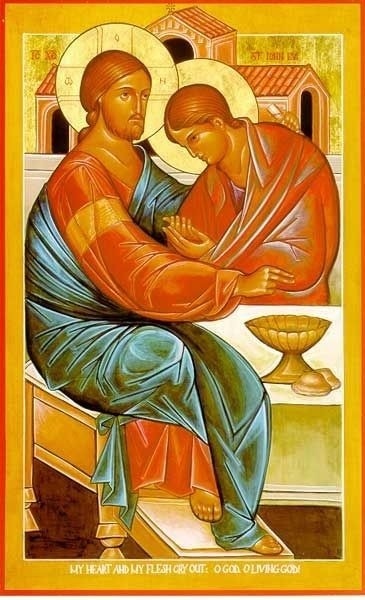
I began training sessions with an icon of Jesus and the Beloved Disciple — an image of the intimacy which God desires each one of us to experience with God and with each other.

Icon of the Beloved Disciple from Mt. Angel Abbey

Icon of the Beloved Disciple from Mt. Angel Abbey

My teaching focused on the ordering of our affections and our disciplined care for vulnerable children and adults, over against the disorganized, scatter-shot attention to safety that is too prevalent in our institutions.

My spiritual life these last 17 years has blossomed with extended reflection on the Beloved Disciple and intimacy with God.

That’s not to say I don’t fall short, and sometimes pretty spectacularly. Disorder and lack of discipline, sin and failing, are a daily reality. The Rule of Benedict, on which most Western monastic Rules are based, observes that “every day we begin again to follow our Lord’s teaching.”

What I have come to understand in the company of the SSJE brothers is that I do not need to hide from that suffering, for it will be transformed by Christ and will bear fruit in my life.

If we abide in that perfect love shown on the cross we will receive the grace to face together all that we are tempted to run from in fear. Christ’s gift of enduring love will be the heart of our life as a community … Love will make us [people] of faith who know God’s power to bring life out of death. (SSJE Rule, Chapter Two).


A window on the whole

“Facing the Canon” is a lengthy, but lovely interview with NT (Tom) Wright.

At 15:00 or so, in response to a question about how we should read the Bible “properly,” he responds by saying “we should be reading the whole Bible all the time, but that’s difficult as it’s a very long book.”

He then points to the Anglican practice of the Daily Office as an approach to the task. Each short passage we read — morning and evening, day after day — is a window, as it were, on the whole Bible story.

The place of God’s dwelling

At the Advisory Board Company, we teach a course called “Leading Amidst Uncertainty.”

In one of my favorite moments we suggest to leaders, as they must respond personally to the anxiety arising from uncertainty, that they regularly pause to breathe.

This timeless wisdom is not copyrighted, and it’s free for anyone at any time.

We go on to suggest making time for reflection in whatever way may work best — go outside for a walk or exercise to clear your head, schedule five minutes of nothing on your calendar to regroup, or eat lunch away from your desk to find clarity.

My teaching brought me to Kalamazoo, Michigan this week, so I took advantage of being just 30 minutes away to stop in for a visit this afternoon at St. Gregory’s Abbey in Three Rivers.

St. Gregory’s is a Benedictine Abbey in the Episcopal Church. I have been a confrater, or associate, of the abbey for at least 20 years but have rarely visited. It must be 10 years since my last visit.

Before vespers I had some time to sit quietly in the sun, to pet one of the Abbey cats, and to have tea with the monks and with another guest, the Rt. Rev. Ed Little, Bishop of Northern Indiana.

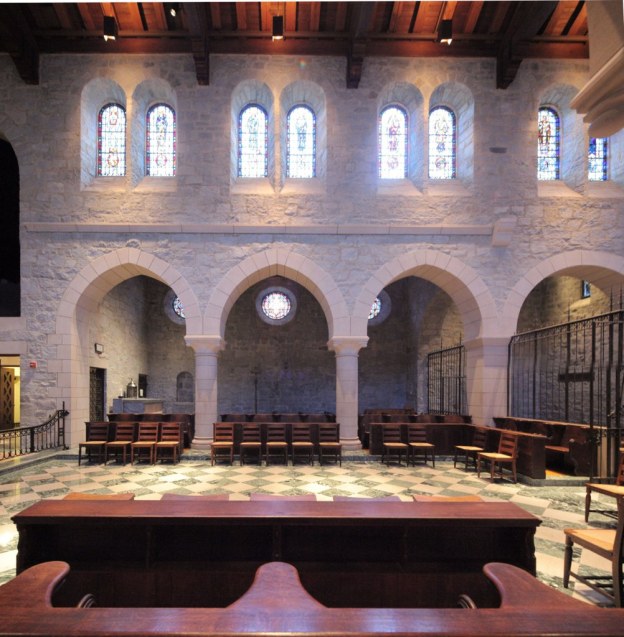
The Abbey Church is one of the loveliest I know, and vespers in that quiet place redolent of incense is truly peaceful.

St. Gregory's Abbey Church

Vespers in St. Gregory’s Abbey Church

The chapter appointed for this evening (a short Scripture passage) is also a personal favorite of mine:

See what love the Father has given us, that we should be called children of God; and that is what we are. The reason the world does not know us is that it did not know him. Beloved, we are God’s children now; what we will be has not yet been revealed. What we do know is this: when he is revealed, we will be like him, for we will see him as he is (1 John 3:1-2).

I am grateful for a couple of hours today in “the place of God’s dwelling” — or at least one particular place — and for the pause to breathe.

Ferguson and our Christian faith

Today the Episcopal Church commemorates Jonathan Myrick Daniels, a seminarian killed during the civil rights protests in Selma, Alabama in 1965.

Daniels died protecting a girl from a man pointing a shotgun at her. He took the blast meant for her, and was killed instantly.

The pictures today from Ferguson, Missouri make it look like not much has changed in the last 50 years.

Today, protestors are lined up against police armed with automatic weapons, tear gas, and the kind of military vehicles made near where I live.

I believe we Christians (perhaps especially in America) must always strive to remember that we serve in the name of Jesus, an innocent man who was killed during a time of protest and civil disturbance by the military occupiers of his country.

Looking again at pictures like this, we may also have to think again about which side we’re standing on.

Collect for Jonathan Myrick Daniels

O God of justice and compassion, you put down the proud and the mighty from their place, and lift up the poor and afflicted: We give you thanks for your faithful witness Jonathan Myrick Daniels, who, in the midst of injustice and violence, risked and gave his life for another; and we pray that we, following his example, may make no peace with oppression; through Jesus Christ the just one: who lives and reigns with you and the Holy Spirit, one God, for ever and ever.