
Category Archives: Daily Office

Sermon at Morning Prayer | Sunday, June 21, 2015

“I will never be able to hold her again, but I forgive you,” a daughter of Ethel Lance said. “And have mercy on your soul. You hurt me. You hurt a lot of people, but God forgives you, and I forgive you.”

“As we said in the Bible study, we enjoyed you,” survivor Felicia Sanders said. “But may God have mercy on you.”

How in the world can these people from Emanuel AME Church in Charleston be at peace?

How in the world can they have forgiveness in their hearts?

How did they come to possess “the peace that passes understanding”?

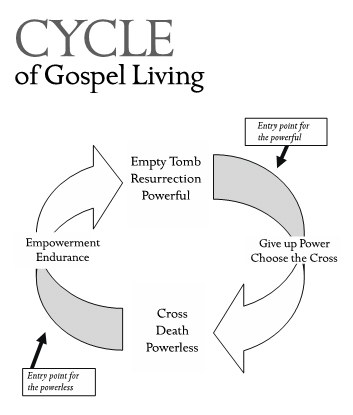
The Cycle of Gospel Living

It’s clear that most of us do not have that peace.

We try to talk about racism and violence and the other ills that plague us, but we end up talking past each other and inflaming each other further. The news media and social media erupt with argument and counter-argument.

Even when we are fellow-Christians trying to speak about the Gospel, we do not always help as we had hoped to. We try to “proffer the Word of life,” but we still talk past each other.

The Rev. Eric H. F. Law of the Kaleidoscope Institute teaches about the “Cycle of Gospel Living,” and I believe it can help us in these challenging conversations.

We have studied this cycle in our Education for Ministry groups this year, as we reflect on “Living Faithfully in a Multicultural World.”

Take a moment to look at the diagram carefully.
9ae68-6a0120a7d143f3970b014e8774c2bb970d-pi

We all participate in the dying and rising of Christ, in the cross and resurrection, but we enter the cycle from different places – the powerless from the bottom, the powerful from the top.

This cycle is reflected in all three of the readings assigned for the Daily Office today:

From the bottom, from complete defeat and disaster for Israel, “The wife of Phinehas said, ‘The glory has departed from Israel, for the ark of God has been captured.’” (1 Samuel 4:22)

After speaking to someone on top, a rich young man, Jesus turns to his disciples and says, “Truly I tell you, it will be hard for a rich person to enter the kingdom of heaven” (Matt. 19:23).

And writing to Christian Jews living in “the Dispersion,” in a variety of different places, James says, “Let the believer who is lowly boast in being raised up, and the rich in being brought low” (James 1:9-10).

The Coded Gospel

How in the world can these people be at peace?

How can we come to possess the peace that passes understanding?

“If you have decided you want what we have and are willing to go to any length to get it – then you are ready to take certain steps…. Here are the steps we took, which are suggested as a program of recovery” (Big Book 58-9).

Through my own experiences in recovery I have heard in the 12 Steps of AA what Richard Rohr calls “the coded Gospel” (Breathing Under Water).

An experience of powerlessness can trigger our awareness that we cannot handle our life alone.

When we admit our powerlessness, we can find reprieve – “a daily reprieve contingent upon the maintenance of our spiritual condition” (Big Book 85).

We may even find that our regular spiritual practices become an oasis, rather than a burden.

Sitting in the Oasis

The members of Emanuel AME Church were meeting for their regular Wednesday night Bible study.

They were sitting “in the oasis,” and they welcomed a stranger to join them, even offering him a seat of honor next to their pastor.

As African-American people in South Carolina, they lived in relative powerlessness – even though their pastor was also a state senator, the streets around their church are named for Confederate generals, a constant reminder of slavery and of past and present violence against people of color.

As people of color, their identification with Jesus, their entry into the cycle of gospel living, may have been at the bottom, but their endurance like Jesus, their empowerment by Jesus, and the daily maintenance of their spiritual condition in union with the resurrected Jesus produced in them an oasis, full of living water.

Choosing the Cross

We do not necessarily have the same experience of the Gospel.

Our identification with Jesus, our entry into the cycle of Gospel living, is more likely to start at the top and to require us to choose the cross, giving up the power and privilege we enjoy as white people in northeast Wisconsin.

Whether something like addiction calls us up short, whether the death of a loved one brings us low, whether we are cut to the quick by the words of Scripture, our falling and failing will also lead us into “the way of the cross, [which is] none other than the way of life and peace” (BCP 99).

You Cannot Transmit Something You Haven’t Got

So how did they come to possess the peace that passes understanding?

And how can we come to share in the peace that does not “treat the wound of [God’s] people carelessly” (Jer. 6:14)?

The “Big Book” of AA reassures me that “the answers will come, if your own house is in order. But obviously you cannot transmit something you haven’t got” (164).

Many people in the Episcopal Church, especially as we prepare for General Convention, are calling us to a preach resurrection and engage in the kind of practices that will get us what we need to transmit.

A Memorial to the Church by the Acts 8 Moment invites the Episcopal Church to:

  • recommit itself to the spiritual disciplines at the core of our common life,
  • go into our neighborhoods boldly …, and
  • restructure our church for the mission God is laying before us today.

And 3 Practices TEC invites us to:

  • follow Jesus together
  • into the neighborhood, and
  • travel lightly

The Spiritual Disciplines at the Core

Like the 12 Steps of recovery, the “spiritual disciplines at the core of our common life” are deceptively simple:

  • Celebrate the Holy Eucharist on Sundays and Major Feasts
  • Pray every morning and evening, soaking yourself in the Scriptures
  • Confess your sins to God, and to another person if you need to
  • Feast during Christmas and Easter and on Major Feasts; fast during Lent and on Fridays
  • Baptize, confirm, and teach new disciples
  • Care for each other “in sickness and in health”

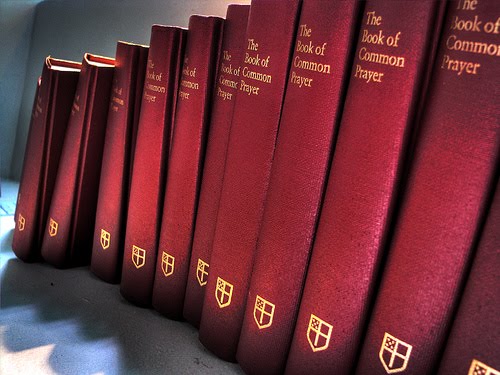
And, just like the folks in AA have a “Big Blue Book” we have a “Red Book” (the Book of Common Prayer).
2012-08-06 13.03.01

The “daily maintenance of our spiritual condition” is not a depressing burden, as I feared when I first entered recovery.

“You’ve got it all backwards,” a fellow deacon said when I called him in a panic. “Every day you don’t drink is an oasis!”

Rather than being a burden, our spiritual disciplines can create in us an oasis, a place where we are free to greet the stranger whom we meet in our churches or as we follow Jesus out into the neighborhood.

And one last thing, these practices are mostly portable, making it easy to travel lightly.

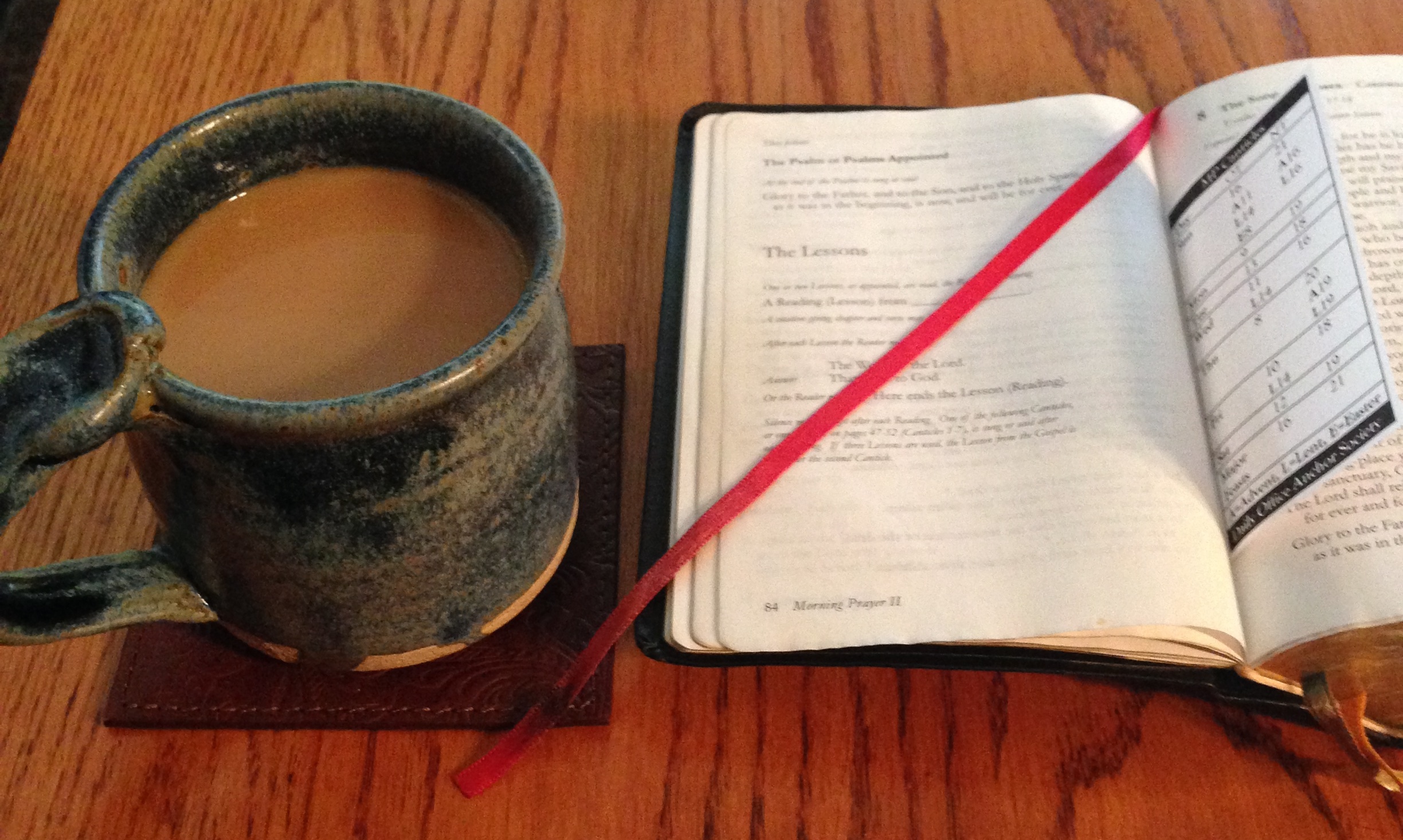
Sure, we usually gather in a church building on Sundays and holidays, but the book we need for the Daily Office fits easily into a briefcase – in fact, you don’t even need a book, since the Forward Movement iPhone app works just as well!

And soaking daily in the Scriptures means that following God “is not too hard for you, nor is it too far away. It is not in heaven … neither is it beyond the sea …. No, the word is very near you; it is in your mouth and your heart for you to observe” (Deut. 30:14).

The Word is Very Near You

Listen again to that word:

“We enjoyed you … and may God have mercy on you.”

These are the words of a woman who lives in the risen life of Jesus Christ our Savior.

These are the words of someone whose own experience of powerlessness, death, and violence is being transformed by her endurance, empowering her to offer a blessing instead of a curse.

We may not be able to offer those same words – we are not at the same place in the cycle of gospel living – but we can also participate in the resurrection life.

For us it may require a costly admission or an unwelcome realization, and it may require us to choose the cross, giving up the power and privilege we hold onto so tightly.

But we, too, can know the peace of Christ, recognize it in our neighbors, and share it with those around us.

And may the peace of God, which passes all understanding, keep our hearts and minds in the knowledge and love of God, and of his Son Jesus Christ our Lord; and the blessing of God Almighty, the Father, the Son, and the Holy Spirit, be among us, and remain with us always. Amen.

By your endurance you will gain your souls | The martyrs of Charleston

My sight has failed me because of trouble; *
LORD, I have called upon you daily; I have stretched out my hands to you.
Do you work wonders for the dead? *
will those who have died stand up and give you thanks?
Will your loving-kindness be declared in the grave? *
your faithfulness in the land of destruction?
Will your wonders be known in the dark? *
or your righteousness in the country where all is forgotten?
But as for me, O LORD, I cry to you for help; *
in the morning my prayer comes before you. (Psalm 88:10-14)

The Rev. Dr. Eric H.F. Law of the Kaleidoscope Institute, in his book The Wolf Shall Dwell With the Lamb, describes the “Cycle of Gospel Living.”

This cycle is also used in the Education for Ministry program in which mentors and our students reflect on “Living Faithfully in a Multicultural World.”

The psalmist and the martyrs of Charleston — along with the African-American community more generally — have entered the cycle of Gospel living from the point of powerlessness.

How long, O Lord?
Will you forget me for ever?
how long will you hide your face from me? (Psalm 13:1)

Their endurance has united them with the suffering of Jesus on the cross, whose suffering is not the end of the story. The cross leads to the empty tomb, to resurrection, and to the power of life in Christ.

After an event like the shooting at Emmanuel AME Church in Charleston, social media is justifiably full of anger directed toward well-meaning (mostly white) Christians who “have treated the wound of my people carelessly, saying ‘Peace, peace’ when there is no peace” (Jer. 6:14).

In his 1963 Letter From a Birmingham Jail, the Rev. Martin Luther King, Jr. spoke of his disappointment with the “white moderate, who is more devoted to ‘order’ than to justice”:

Shallow understanding from people of good will is more frustrating than absolute misunderstanding from people of ill will. Lukewarm acceptance is much more bewildering than outright rejection.

The problem now (as then) is that we are all speaking about the Gospel, but we are talking past each other.

What we “well-meaning Christians” must understand is that we enter the cycle of Gospel living from a completely different position than many (most?) Christians do.

We participate in the cycle when we give up our power, “just as the Son of Man came not to be served but to serve, and give his life a ransom for many” (Matt. 20:28).

We participate by falling and failing, by giving up our power and privilege, which no one is taking away from us.

Richard Rohr writes in his daily reflection that:

This is why Christianity has as its central symbol of transformation a naked, bleeding man who is the picture of failing, losing, and dying … and who is really winning — and revealing the secret pattern to those who will join him there.

All of us who are Christians participate in the cycle of Gospel living. All of us center our lives on the crucified and risen Jesus.

But we experience the cycle of Gospel living differently from each other, we come to the saving knowledge of Christ’s death and resurrection from different directions, and we must be tender with one another for Jesus’ sake.

A Collect for Fridays

Almighty God, whose most dear Son went not up to joy but first he suffered pain, and entered not into glory before he was crucified: Mercifully grant that we, walking in the way of the cross, may find it none other than the way of life and peace; through Jesus Christ our Lord. Amen. (BCP 99)

A Prayer for Mission

Lord Jesus Christ, you stretched out your arms of love on the hard wood of the cross that everyone might come within the reach of your saving embrace: So clothe us in your Spirit that we, reaching forth our hands in love, may bring those who do not know you to the knowledge and love of you; for the honor of your Name. Amen. (BCP 101)

Scope of belief and scale of revelation

You are God: we praise you;
You are the Lord: we acclaim you;
You are the eternal Father: all creation worships you.

Throughout the world the holy Church acclaims you;
Father, of majesty unbounded,
your true and only Son, worthy of all worship,
and the Holy Spirit, advocate and guide. (BCP 95)

As I sit on my patio saying Morning Prayer I am thinking about the scope of belief and the scale of revelation.

Creation

“All creation worships you” we say in the Te Deum laudamus, the ancient canticle of praise.

The scope of our belief is not just the seemingly endless universe spanning 14 billion light-years, but the power of God himself, the “Father, of majesty unbounded” — that is, beyond all our measuring and all our perception.

And yet the scale of revelation is that even the chirping of the birds on this misty morning speaks to me of the nature of creation, of its goodness.

Church

“Throughout the world the holy Church acclaims you.”

At our Deacons’ Council meeting yesterday, we spoke with Bishop Matt Gunter about the Diocese of Fond du Lac joining in a companion relationship with another diocese in the Anglican Communion.

He shared his experience with the Diocese of Renk in South Sudan, and others on the council spoke of mission trips to Guadalajara, Mexico or to Lima, Peru.

The bishop of our neighboring Diocese of Eau Claire, one of the smallest in the Episcopal Church, is visiting their companion Diocese of Harare, Zimbabwe, one of the largest in the Anglican Communion.

Our belonging to that worldwide Church is mediated to us, brought to scale, through relationships with people in our own parishes or in the places we visit.

We participate in that worldwide acclamation by joining others around the altar for Communion on Sundays and praying the Offices as fellow-Christians do in every time zone around the globe.

The Church is brought to human scale by people in a parish and pages in a book. They are the signs to me that I belong.

Daily Office Basics


Human Scale

But these small-scale revelations draw me back out into consideration of a mystery.

Like the people around me, who show me God in their faces, and like the book that contains the words of the Scriptures and the prayers of the Church — like these, God comes to us in human scale.

“The Father, of majesty unbounded” is known to us in the person of Jesus, his “true and only Son, worthy of all worship.”

The mystery that we call the Incarnation is all about scope and scale.

In a specific person who lived in a specific place at a specific time, the God who is beyond all knowing chose to reveal something of himself to us.

And in that revelation, our notions of scope and scale are turned upside down and we begin to see ourselves as God sees us.

“Look at the birds of the air; they neither sow nor reap nor gather into barns, and yet your heavenly Father feeds them. Are you not of more value than they?” (Matt. 6:26).

Listen to the chirping of birds in the garden, to the witness of the people around you, to the words of the prayers and the Scriptures.

For those who have ears to hear, that human scale reveals a love of limitless scope.


A Child’s Guide to Morning Prayer

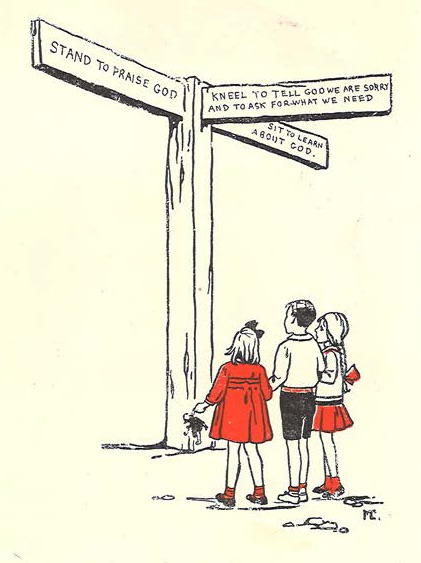
Follow the link to discover A Child’s Guide to Morning Prayer (1954) from the Society for the Propagation of Christian Knowledge, or SPCK, gently illustrated by Margaret Chester.

Essentially you will find the same pattern in the Daily Office of the Episcopal Church today, though there are a few more options for canticles, and a bit more variety in the Collects. On this site, you will find several Resources to help you navigate the Offices more easily.

Thanks to Fr. Tony Clavier of the Episcopal Diocese of Springfield, for bringing this charming book to my attention.

Enjoy! And better yet, share it with a child you know!

Trinity Sunday | Eve of the Visitation

Who is like the LORD our God, who sits enthroned on high, *
but stoops to behold the heavens and the earth?
He takes up the weak out of the dust *
and lifts up the poor from the ashes.
He sets them with the princes, *
with the princes of his people.
He makes the woman of a childless house *
to be a joyful mother of children. (Psalm 113:5-8)

This evening one of the Episcopal Church’s seven Principal Feasts (Trinity Sunday) overlaps one of our many Holy Days (the Visitation of the Blessed Virgin Mary).

In this happy juxtaposition, we ponder this evening the universal mystery of the triune God, “who sits enthroned on high,” and who is made known to us in a specific man, Jesus, born to a specific woman, Mary, whose visit to her relative Elizabeth we honor tomorrow.

“No one has ever seen God,” John reminds us in the prologue to his gospel. “It is God the only Son, who is close to the father’s heart, who has made him known” (John 1:18).

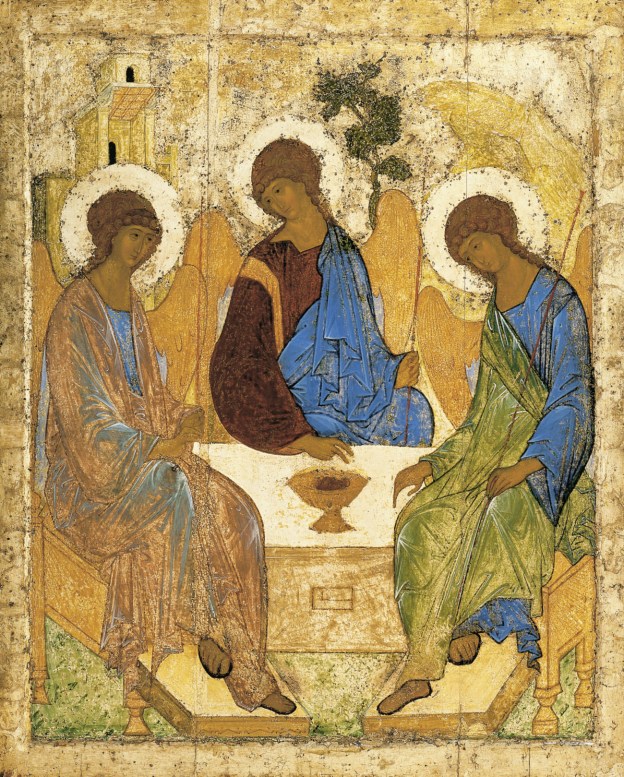
The Trinity whom we adore

John’s gospel opens with a hymn of creation:

In the beginning was the Word, and the Word was with God, and the Word was God. He was in the beginning with God. All things came into being through him, and without him not one thing came into being. What has come into being in him was life, and the life was the light of all people. The light shines in the darkness, and the darkness did not overcome it. (John 1:1-5).

John purposely reminds us of the opening of the Hebrew Bible, when in the beginning the spirit of God swept over the face of the waters (Gen. 1:1-2). He goes on to equate the Word — who was with God in the beginning — with Jesus, “a father’s only son, full of grace and truth” (John 1:14).

In the mystery that Christians call the Incarnation, we see “the Lord our God, who sits enthroned on high, but stoops to behold the heavens and the earth.”

Who is like our God, indeed?

Born of the Virgin Mary

“Hail, Mary, full of grace,” many Christians pray as they say the prayers of the rosary. “Blessed art thou among women, and blessed is the fruit of thy womb, Jesus.”

“My soul proclaims the greatness of the Lord,” Mary herself cries out in the prayer we call the Magnificat, “and my spirit rejoices in God my Savior” (BCP 119).

https://www.flickr.com/photos/edithosb/204407850

In this morning’s Gospel for Trinity Sunday, Nicodemus puzzles over Jesus’ words about being born again. “Can one enter a second time into the mother’s womb and be born?”

Jesus responds with a wry twist. “Do not be astonished that I said to you, ‘You must be born from above.’ The wind blows where it chooses and you hear the sound of it, but you do not know where it comes from or where it goes. So it is with everyone who is born of the Spirit” (John 3:7-8).

Mary herself had asked the angel, “How can this be, since I am still a virgin?” to which she got the equally unsettling reply that “the Holy Spirit will come upon you, and the power of the Most High will overshadow you” (Luke 1:35-36).

The Spirit of Love

That same Spirit, Luke goes on to recount in his second volume, the Acts of the Apostles, fell on the early church and inspired them to go out into the world proclaiming that “Jesus is Lord.”

In Jesus, the apostles saw God, “the Lord who sits enthroned on high,” stooping down and joining his creatures. Before he left his disciples, Jesus promised that they would share in his spirit, the spirit of love.

At evening prayer tonight, we prayed for that same Spirit of love.

O God, you manifest in your servants the signs of your presence: Send forth upon us the Spirit of love, that in companionship with one another your abounding grace may increase among us; through Jesus Christ our Lord. Amen. (BCP 125)

O God, send us your Spirit through Jesus our Lord.

In companionship with one another …

Abounding grace …

“Hail Mary, full of grace …”

… full of grace and truth.

Longing to be clothed

You have turned my wailing into dancing;
you have put off my sack-cloth and clothed me with joy. (Psalm 30:12)

I carry on my person everywhere I go two talismans of my recovery. 

The first is a medallion celebrating my first year of sobriety. 

  
The second is a bracelet — the last thing I bought without telling my wife — that helps me remember I don’t need to spend money when I am feeling “restless, irritable, and discontented.”

  
But what recovery really looks like for me is the Pendleton shirt I’m wearing in this picture with my grandson. 

  
After I lost my job, I was at home a lot more often. I would usually wear jeans and a turtleneck and my favorite plaid shirt. 

I remember sitting on the couch one evening thinking, “I really like this shirt; I should buy another one.”

It took only a few seconds for my new inner voice to respond. “Don’t be an idiot. This is a Pendleton shirt, and it will last forever. You won’t outlive this shirt; you don’t need to buy another one.”

Paul writes that:

We do not lose heart. Even though our outer nature is wasting away, our inner nature is being renewed day by day …. in this tent we groan under our burden, because we wish not to be unclothed but to be further clothed” (2 Cor. 4:16, 5:4). 

Even though God is working in us to renew our inner nature, we may need reminders of that hidden process from time to time. 

How often? 

“One day at a time,” says AA. “Daily we begin again,” say the Benedictines. 

Even though we “wish not to be unclothed,” we may have to spend time being uncomfortably open and vulnerable — honestly sitting with our restlessness and our “stinking thinking” — before we can experience a new kind of peace and serenity.

Being content, being at peace, being calm — these are what it means to be “clothed with joy.”

May the God of hope fill us with all joy and peace in believing through the power of the Holy Spirit. Amen. (BCP 102)

Enough, and more than enough

Today is, so to speak, a “patronal feast” of this blog, since this is one of three times in the two-year Daily Office lectionary that Hebrews 6:19 is read.

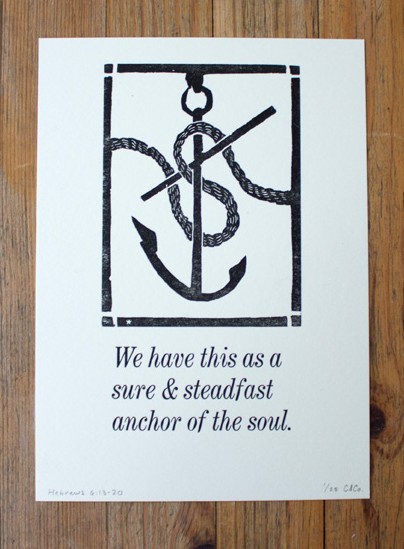
We have this hope, a sure and steadfast anchor of the soul.

That verse, however, is only one part of the origin story of the “Daily Office Anchor Society.”

The name was first used as a tongue-in-cheek description following a retreat for newly-ordained GenX clergy held at the DeKoven Center in Racine, Wisconsin many (increasingly many) years ago.

At one point in the weekend we all realized that each of us had received at our ordinations a copy of the leather-bound, slipcased Daily Office Book along with the well-meaning expectation that of course “you’ll be saying the Offices every day now.”

Dave Walker’s “Cartoon Church” from the Church Times paints a pretty good picture of what we were up against.

That expectation of piety, coupled with virtually no exposure to the Offices (how often does *your* church have Evensong, huh?), we all experienced as an anchor dragging us down.

Being a card-carrying member of the “Daily Office Anchor Society” was not really a good thing.

The leather-bound, slipcased Daily Office Book, displayed on our shelves but rarely used, became a visible symbol of our failure to meet expectations — other people’s expectations, the Church’s expectations, and our own.

Daily Office Book

These days, nearly 20 years later, I no longer feel that the Daily Office represents a weight of expectation, a letter of law or institutional requirement against which I am judged.

Praying the Daily Office is instead a portable practice (I use a leather-bound BCP and Bible, but you could use the Forward Day by Day app on your iPhone) that allows me to participate in the Church’s ceaseless prayer and to “travel light” like the seventy disciples that Jesus sent out in today’s Gospel passage.

After this the Lord appointed seventy others and sent them on ahead of him in pairs to every town and place where he himself intended to go. He said to them, “The harvest is plentiful, but the laborers are few; therefore ask the Lord of the harvest to send out laborers into his harvest. Go on your way. See, I am sending you out like lambs into the midst of wolves. Carry no purse, no bag, no sandals; and greet no one on the road. Whatever house you enter, first say, ‘Peace to this house!’ And if anyone is there who shares in peace, your peace will rest on that person; but if not, it will return to you. (Luke 10:1-6)

There is a sense of lightness, I think, that is the fruit of time spent in Jesus’ presence.

The seventy found, even though they had no supplies (no buildings, no tools, none of the stuff we usually haul around with us), that their relationship with Jesus was enough — and more than enough.

It’s this sense of lightness, I think, that the recent Memorial to the Church seeks to recall us to.

The Episcopal Church has enough, and more than enough, if it accepts the call:

To recommit itself to the spiritual disciplines [Daily Office, Eucharist, etc.] at the core of our common life, to go into our neighborhoods boldly with church planters and church revitalizers, and to restructure our church for the mission God is laying before us today.

The seventy returned to Jesus with joy, exclaiming over the power they had been able to tap into. “Lord, in your name even the demons submit to us!”

I have found in my own life, through experiences of loss and grace and through practices of recovery that build hope — what Richard Rohr calls the “coded Gospel” — that my relationship with Jesus is enough.

The Daily Office, for me, is the way I spend time in Jesus’ presence most mornings so that for the rest of the day I can travel lightly into my neighborhood and hold lightly my expectations about what success looks like.

In this way, the Office serves me as a “sure and steadfast anchor” connecting me to Jesus, who is my hope.

How do you stay connected to Jesus? What builds hope in your life? What helps you to set aside expectations and find that you have enough, and more than enough?

The spiritual disciplines at the core

As a practitioner and promoter of one of “the spiritual disciplines at the core of our common life,” in fact the first-named of those disciplines (see BCP 13), I have endorsed the Memorial to the Church found here. I urge you all to do likewise.

The Memorial also calls upon the church to go into our neighborhoods boldly and to restructure our church for the mission God has in mind for us.

The Daily Office is a portable discipline (I use a prayer book/Bible combo, but you could show your neighbor the Forward Day by Day app on your iPhone), and praying it means living in the “big, exciting room” of the Scriptures, the “house built on rock” (Matthew 7:24).

NT Wright on Scripture in worship | A big, exciting room we come in and inhabit

I couldn’t possibly agree more with N.T. Wright’s comments in this five-minute video on Scripture in worship from Glenn Packiam’s Mystery of Faith Blog.

With attention to what we are doing, we are fortunate in our “gentle Anglican liturgy”  — in the morning and evening offices and in the Holy Eucharist — “to inhabit the world of Scripture” just as Wright describes:

What one is doing is turning Scripture into a world where you come in and live, a big exciting room that you come in and inhabit.

Wright gently bemoans how the public reading of Scripture is too often sidelined in worship. He even describes being invited to preach at a “modern-style” service and at the last minute being asked, “Would you like a Scripture reading?”

The public reading of Scripture is itself the primary act of worship. It is not conveying information to the congregation; it’ll do that as well, but it does that as the byproduct … of celebrating the mighty acts of God.

And so what do we do in this “big exciting room that you come in and inhabit”?

When you have built this great house of praise and worship, which is the scriptural story surrounded with the psalms and the prayers of the people of God, then you turn it into intercession, because you’re now living in a room where intercession makes sense.

I’m reminded here of what the founder of the Society of St. John the Evangelist, Fr. Richard Meux Benson, says about praying for others:

As we approach God on their behalf we carry the thought of them into the very being of eternal Love, and as we go into the being of him who is eternal Love, so we learn to love whatever we take with us there.

In the first half of the video, Wright has actually been describing the Daily Office, a point that I think might have been lost on his listeners, because he then goes on to clarify that the same thing is happening in the Eucharist.

I am grateful to Packiam and his colleagues for sharing this short glimpse of Wright’s deep, lifelong meditation on Scripture.

However, I find Packiam’s comment as he introduces the clip so poignant:

It is precisely because Prof. Wright is an ‘outsider’ to our modern worship world that his thoughts may be helpful. He may see things we miss. What he chose to address was the absence of Scripture in worship.

Here as elsewhere in his books and videos, I think N.T. Wright is explaining historic Christian worship from the “inside,” especially when he calls it “an act of humility, a way of saying ‘I’m not making this up as I go along.’ It’s a gift from the whole worldwide church, and I inhabit it gratefully.”

The public reading of Scripture — and especially the pattern we have inherited in the Daily Office — is a gift from the worldwide church, indeed, and I inhabit it gratefully. I hope you do, too.

Pay attention to how you listen (and look)

For while they live among his works, they keep searching, and they trust in what they see, because the things that are seen are beautiful. (Wisdom 13:7)

The writer of the book of Wisdom expresses a theme common to our discussion of science and faith.

Either the amazing beauty of millions of galaxies testifies to the creative power of God, or the distant stars bear mute witness to the emptiness and loneliness of our plight.

It matters how you look.

For the Wisdom writer, those who “live among his works” but who are “still searching” haven’t looked closely enough or carefully enough.

They’ve seen the beauty of creation, but haven’t recognized the Creator.

They’ve clicked on the image in this post, the most detailed image ever compiled of the Andromeda Galaxy (M31). Perhaps they’ve noticed that it contains 1.5 billion pixels, but they haven’t comprehended “the bright immensities” (Hymn 459) that span what little we can see of the universe — more than 14 billion light years back into time.

The Wisdom writer goes on to wonder, “If they had the power to know so much that they could investigate the world, how did they fail to find sooner the Lord of these things?” (Wisdom 13:9).

In the Gospel passage appointed for this morning, Jesus has just gotten through explaining the parable of the sower to his disciples (spoiler alert: they didn’t get it) and is trying another example on them, the parable of the lamp under a jar.

Jesus interrupts himself — I picture him rolling his eyes at a bewildered James and John (the “dunderheads” as John the evangelist calls them) — and says “Pay attention to how you listen; for to those who have, much more will be given; and from those who do not have, even what they seem to have will be taken away” (Luke 8:18).

Pay attention to how you listen.

When they come to him and say, “Your mother and your brothers are standing outside” and he replies “my mother and my brothers are those who hear the word of God and do it,” then pay attention to hearing the word of God.

When you are in trouble and cry out that everything is hopeless, and Jesus replies “Where is your faith?” — then pay attention to the Word of God himself!

It matters how you listen, and it matters to whom you listen.

In the middle of a swirling storm, in the howling wind and the snap and strain of the lines, in the cries of the disciples pulling at the oars, Jesus speaks softly and the storm responds in kind.

In the tug and pull of relationships Jesus says “notice,” and the lines of the family are redrawn. And in the real anxieties and worries of your life, Jesus says “just a little faith is enough.”

Even in the rendering of starlight that you’re looking at on your smartphone, God the “maker of heaven and earth, of all that is, seen and unseen,” says “Here I am.”

So pay attention to how you listen (and look).