
Category Archives: Daily Office

Be merciful, just as your Father is merciful

My heart recoils within me; my compassion grows warm and tender. I will not execute my fierce anger; I will not again destroy Ephraim; for I am God and no mortal, the Holy One in your midst, and I will not come in wrath. (Hosea 11:8-9)

In the Gospel appointed for today, we hear Jesus in the Sermon on the Mount telling us to love our enemies.

“If you love those who love you, what credit is that to you?” he asks. “Even sinners do the same.”

“But love your enemies, do good, and lend, expecting nothing in return. Your reward will be great, and you will be children of the Most High; for he is kind to the ungrateful and the wicked. Be merciful, just as your Father is merciful” (Luke 6:35-36).

Popular sentiment on Facebook and elsewhere these days runs more like this — if someone doesn’t like you, don’t keep them in your life. If someone disagrees with you, unfriend them or block their posts. Love those who love you.

But we are called to “a still more excellent way,” as Paul would describe it (1 Cor. 13). We are called to see clearly what people are up to, and to love them still. We are called to engage, not to disengage, and to be merciful to others with the warm and tender compassion of God.

Church Geek Note:

Today on the church calendar we commemorate William Tyndale and Miles Coverdale, translators of the Bible (1536, 1569). Just a year after Tyndale was executed for heresy (for daring to translate the New Testament into English), Coverdale completed the work and the Matthew Bible was published in 1537 in England. The Psalter from Coverdale’s Great Bible of 1539 was used in the English Book of Common Prayer in 1549 and 1662, and (with many revisions over the years) in American Prayer Books through 1928.

Our current Psalter is a translation directly from the Hebrew that takes advantage of 400 years of biblical scholarship. However, Marion Hatchett writes in his Commentary on the American Prayer Book that “the rhythmic expression which characterized Coverdale’s work has been preserved. So that the psalms may be congruent with the services in traditional language, the vocabulary has been largely restricted to that available to Coverdale” (551).

Almighty God, you planted in the heart of your servants William Tyndale and Miles Coverdale a consuming passion to bring the Scriptures to people in their native tongue, and endowed them with the gift of powerful and graceful expression and with strength to persevere against all obstacles: Reveal to us your saving Word, as we read and study the Scriptures, and hear them calling us to repentance and life; through Jesus Christ our Lord, who lives and reigns with you and the Holy Spirit, one God, for ever and ever. Amen.
Faith Alive: Being Apostles

20121005-054937.jpg

Now during those days, Jesus went out to the mountain to pray; and he spent the night in prayer to God. And when day came, he called his disciples and chose twelve of them, whom he also named apostles. (Luke 6:12-13)

Then Ananias said to Saul, “The God of our ancestors has chosen you to know his will, to see the Righteous One and to hear his own voice; for you will be his witness to all the world of what you have seen and heard. And now why do you delay? Get up, be baptized, and have your sins washed away, calling on his name.” (Acts 22:14-16)

We hear this morning from both books in Luke’s “orderly account” — the Gospel that bears his name and the Book of Acts — about the naming of Jesus’ first apostles and the dramatic conversion of Saul, who became Paul, the apostle to the Gentiles.

Being an apostle implies both a close relationship to Jesus and a mission to share his message.

If we are in relationship with Jesus, we will do what he does — spend the night in prayer to God and follow the way of the cross, which we will find is “none other than the way of life and peace” (BCP 99).

If we are sent on a mission like Paul, we will not delay but will instead live into our baptism now by sharing the Good News of what the living Lord is doing in our lives.

Immediately after reading the lessons in either Morning or Evening Prayer, we recite the Apostles’ Creed, the early baptismal creed of the church.

Every day, twice a day, we reconnect to the very first apostles of Jesus Christ and pledge ourselves — using the same words their followers used — to share in their mission.

“Glory to God, whose power, working in us, can do infinitely more than we can ask or imagine. Glory to him from generation to generation in the Church, and in Christ Jesus for ever and ever. Amen.” (BCP 102)

Some shouted one thing, some another

Then the tribune came, arrested him, and ordered him to be bound with two chains; he inquired who he was and what he had done. Some in the crowd shouted one thing, some another; and, as he could not learn the facts because of the uproar, he ordered him to be brought into the barracks. (Acts 21:33-34)

This morning, as I read the biography of St. Francis provided in the Church of England’s Twitter feed, I was reminded that Francis, too, was bound in chains early in his life when his father took him to court for selling bolts of cloth (and the horse that had pulled the wagon) and giving the money to a local church.

In both cases, public opinion was sharply divided over these followers of Christ. In both cases, neither side of the debate got at the heart of the matter.

Was Paul teaching against Jewish law and actually bringing Greeks into the Temple? Was Francis undermining good order by his dramatic poverty and his embrace of lepers?

We’ve seen in history what happened to these two followers of the Gospel.

Paul’s radical new community — no longer male nor female, Jew nor Greek, slave nor free — became more accommodated to Greco-Roman society, even within the time period of the Nw Testament, and ultimately became the state religion of the Roman Empire.

Francis’ Friars Minor, even during his lifetime, preferred to live in convents like the other monastic orders — approved bastions of the Roman Church and medieval society 1,200 years on from the New Testament days — rather than following his simple rule of begging and preaching.

What still gets lost in the debate, even today, is the central question each of these men faced: How complete is Christ’s claim on my life?

Some shout one thing, some another, but what is the voice of the living Lord trying to say?

What to do with these emotions?

Let his days be few,
and let another take his office.

Let his children be fatherless,
and his wife become a widow. (Psalm 109:7-8)

The Daily Office lectionary this morning suggests omitting several verses of Psalm 109, one of the psalms known as an “imprecatory” psalm because it asks God to curse one’s enemies.

This particular psalm gained some notoriety earlier this year in an email circulated by Kansas House Speaker Mike O’Neal asking people to pray for President Obama and citing these verses. What to do with these emotions?

I like this introduction to the Psalms in A New Zealand Prayer Book: He Karakia Mihinare o Aotearoa: “The wide appeal of the psalms rests on their ability to give words to some of our deepest feelings in the face of life’s experiences. Whether for joy, worship and exaltation, or degradation and rejection, or hope, faith, love, anger, or despair, the psalms contain verses that reflect such moods. In them the various writers expressed to God the thoughts of their heart and spirit. The richness of the psalms still speaks to us and in them we too can find words to match many of our moods and express them before God. In turn God can still address us through these psalms.”

Psalm 109 and others like it “give words to some of our deepest feelings” — feelings of anger and bitterness and the hope that our enemies will suffer — but “in turn God can still address us through these psalms.”

As we pour out our rage, we do so in the light of Christ, who “stretched out [his] arms of love on the hard wood of the cross that everyone might come within the reach of [his] saving embrace” — not just us, but our enemies, too.

As we choke out our bitterness, the Word of God “opens our lips” so our mouths can instead “show forth [his] praise.”

Though these imprecatory verses of the Psalter do not express the Christian understanding of God’s relationship with people (which is why they are usually omitted from our public worship), they do still express our very human frustrations and fears.

They may, in fact, help us in our private prayers to more honestly bring all of our concerns to God in order that we might be freed from anger and made whole again.


Ordained and Constituted in a Wonderful Order

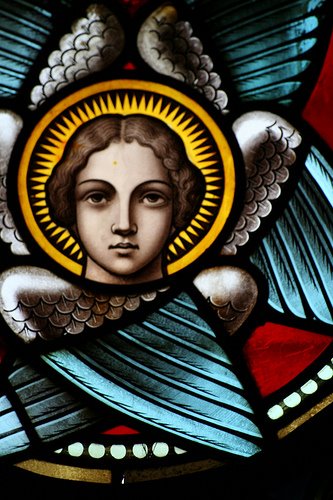
Then I looked, and I heard the voice of many angels surrounding the throne and the living creatures and the elders; they numbered myriads of myriads and thousands of thousands, singing with full voice, “Worthy is the Lamb that was slaughtered to receive power and wealth and wisdom and might and honor and glory and blessing!” (Revelation 5:11-12)

Year by year, the Easter celebration begins when the deacon sings: “Rejoice now, heavenly hosts and choirs of angels, and let your trumpets shout Salvation for the victory of our mighty King!” (BCP 286).

Week by week, the Great Thanksgiving at every celebration of the Eucharist begins as the priest or bishop sings, “Therefore we praise you, lifting our voices with Angels and Archangels and with all the company of heaven” (BCP 362).

Night by night, each of us closes the day with this quiet prayer: “That your holy angels may lead us in paths of peace and goodwill, we entreat you, O Lord” (BCP 122).

Saint Michael and All Angels

Everlasting God, you have ordained and constituted in a wonderful order the ministries of angels and mortals: Mercifully grant that, as your angels always serve and worship you in heaven, so by your appointment they may help and defend us here on earth; through Jesus Christ our Lord, who lives and reigns with you and the Holy Spirit, one God, for ever and ever. Amen. (BCP 244)
Will Your Wonders Be Known in the Dark?

Will your wonders be known in the dark?
or your righteousness in the country where all is forgotten?

But as for me, O Lord, I cry to you for help;
in the morning my prayer comes before you.
(Psalm 88:13-14)

Many years ago, about the time that we moved to Wisconsin, I struggled through a period when I was certainly clinically depressed.

I was stuck in my head, unable to translate any plan into action. We lived in a beautiful wooded area near Lake Geneva, and I thought it would be lovely to take a walk in the morning, but I could never even make myself actually put on my shoes.

At the time I was reading Steven Covey’s Seven Habits of Highly Effective People, and I was impressed by a concept he calls the “daily private victory.”

Whatever simple action or task you decide, if you accomplish it, by definition the day is won. The daily private victory is won, and you have not failed.

I remember reading that description, thinking “I will make walking my daily private victory,” and then getting up and walking through the door! As I came out into the actual sunshine, I felt I had also come out of the darkness in my mind.

The psalmist knows the interior darkness, knows what it is to live “in the country where all is forgotten.” He also knows, as I do, that coming out of the dark is not simply a matter of will.

I could never have simply willed myself out of my depression. It took an insight, a grace from outside of me, to help me take one single step.

That is the central message of our Christian faith. By ourselves we cannot save ourselves. It takes grace from outside ourselves that helps us take the first faltering steps into the sunshine. “We have seen his glory, the glory as of a father’s only son, full of grace and truth” (John 1:14). Or, to put it in another way, “I can do all things through Christ who strengthens me” (Phil. 4:13).

The daily private victory is also a cumulative process. “In the morning my prayer comes before you,” says the psalmist, and it is the same for us. As we daily practice the basics — walking, praying, being thankful — we get stronger and stronger until one day we fear the dark no longer.

With You I Am Well Pleased

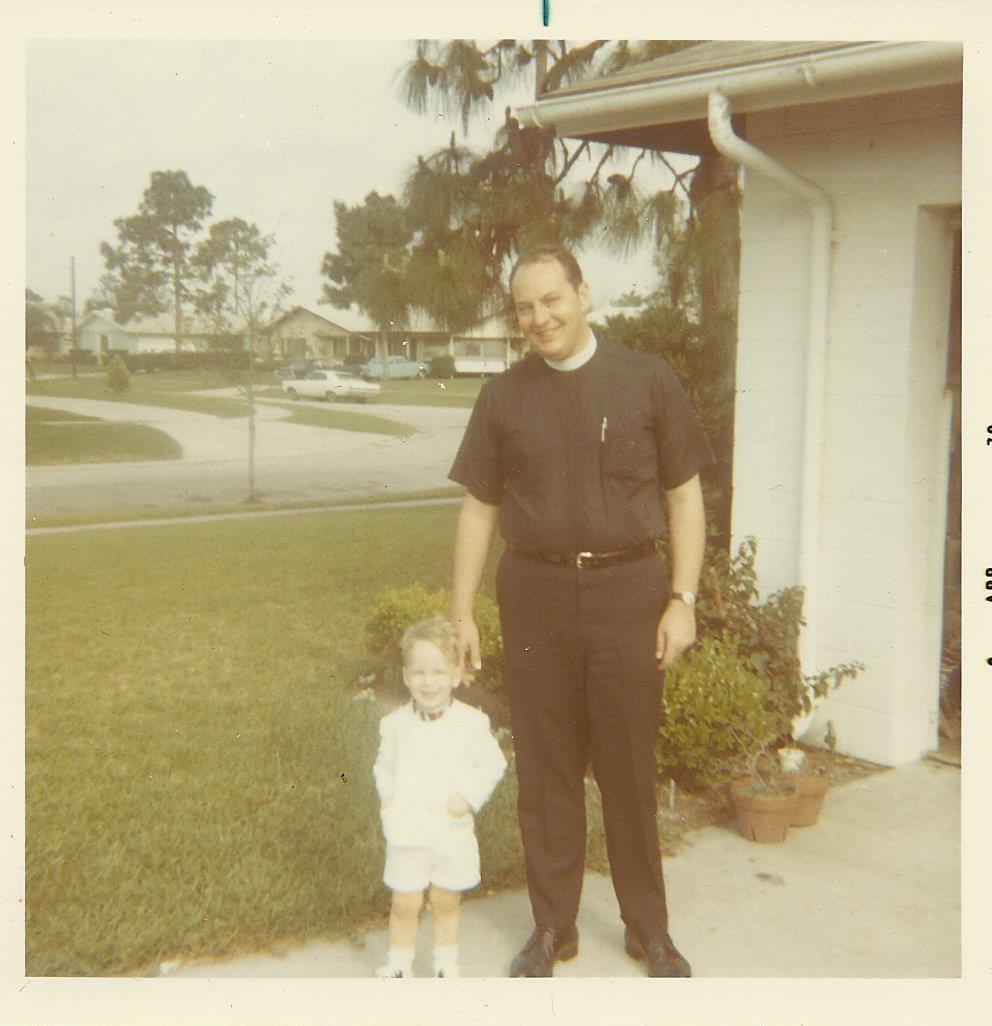
Dad and me in Orlando, 1970.

You are my Son, the Beloved. With you I am well pleased. (Luke 3:22)

I am among the most fortunate of people, because I know that my father loved me.

In this picture, you can see his hand touching my cheek, a simple gesture of physical affection that characterized his relationship with me and our whole family.

He held me in his arms (and he held my mother and my siblings, too), and he told me he loved me in countless ways. When I shared this picture on Facebook, my sister instantly responded that she recognized his gesture — the “sense memory” is as strong for her as it is for me.

The last time I served at the altar with him before he died, this account of the Baptism of Our Lord was the appointed Gospel reading. After I read the Gospel, Dad got up to preach but then stopped, saying, “I’m going to do something I’ve never done before. I’m going to sit down, because this is my son, my beloved, and I want to hear what he has to say.”

My wife and I have spoken many times about what a blessing it is for both of us to have had this kind of unconditional love in our lives. Even though we do not have children of our own, we have been privileged to share our love with others, especially our “daughter” Anna (we don’t put quotation marks around her in real life, you understand). We are well pleased with her, and I’m especially looking forward to holding her son, my grandson, after he’s born in October.

You have it in your power to give this kind of love, too. You can be for another person — a child or a grownup — the same kind of blessing that my father was. You can embrace them in the kind of love the Father has for all of his children.

Who is your beloved? Who needs to feel the touch of your hand on their cheek and hear from you that you are well pleased?

Turning the World Upside Down

Some of them were persuaded and joined Paul and Silas, as did a great many of the devout Greeks and not a few of the leading women. But the Jews became jealous, and with the help of some ruffians in the marketplaces they formed a mob and set the city in an uproar …. When they could not find them, they dragged Jason and some believers before the city authorities, shouting, “These people who have been turning the world upside down have come here also, and Jason has entertained them as guests. They are all acting contrary to the decrees of the emperor, saying that there is another king named Jesus.” (Acts 17:4-7)

“Turning the world upside down.” Just what was so crazy about Paul and Silas’ preaching that prompted such a backlash?

Well, for one thing, their message resonated not just with some of the Jews in the synagogue at Thessalonica, but also with some “devout Greeks,” those Gentiles known as “God-fearers” who were attracted to Jewish worship and teaching. We’ve also been reading over the last several days about the presence of “leading women” like Lydia, slave-girls set free from evil spirits, and jailers treated with kindness finding a place in the new community and being baptized as new believers.

Paul and Silas, and the communities they were creating, mixed up Jews and Gentiles, slaves and free, jailers and prisoners, men and women into a new family of believers that was in sharp contrast to the divided, patriarchal Greco-Roman culture of their time.

Their egalitarian preaching so threatened some people’s sense of order that Jewish believers joined up with “ruffians” to attack someone’s house, drag him before the authorities, and loudly support the emperor’s position.

Think about that for a minute.

When was the last time you saw such angry energy directed against people who believe that everyone has a place in Christ’s new community of love?

When was the last time you saw believers joining with those in power to keep women and the poor and prisoners “in their proper place”?

The world still needs to be turned upside down.

“Lord Jesus Christ, you stretched out your arms of love on the hard wood of the cross that everyone might come within the reach of your saving embrace: So clothe us in your Spirit that we, reaching forth our hands in love, may bring those who do not know you into the knowledge and love of you; for the honor of your Name” (BCP 101).

Sir, We Would See Jesus

So how did the Greeks know Phillip could lead them to Jesus?

What set him apart from the festival crowd in Jerusalem on that Passover long ago?

For that matter, what sets you and me apart from the crowds of people “among whom we live, and work, and worship”?

Would a stranger at the Appleton Farmer’s Market or at the airport (or on the flight, for that matter?) be able to identify me as a Christian in the press of people and in the fog of their own concerns?

Perhaps more to the point, if they did pick me out, would they think I’d welcome the interruption?

What was it about Phillip that shone so clearly that the Greeks knew he’d welcome them and help them find Jesus?

God grant that we may shine so brightly and similarly radiate welcome.

Guide Our Feet Into the Way of Peace

O God, the King eternal, whose light divides the day from the night and turns the shadow of death into morning: Drive far from us all wrong desires, incline our hearts to keep your law, and guide our feet into the way of peace (BCP 99).

Josh Thomas and the good folks at dailyoffice.org continue to publish each week the names of military personnel killed in the war in Afghanistan, and they provide links to the total human cost of the wars in Iraq and Afghanistan.

7 More Lost in Afghan War; They Have Names

Total War Deaths:  7977

Iraq: Total Deaths: 4804
-no casualties this past week

Afghanistan: Total Deaths: 3173

CANTU, Shane W., 20, PFC, US Army, Corunna, MI, 173rd Airborne Brigade Combat Team
SCHMIDT, Jonathan P., 28, SSGT, Petersburg, VA, 52nd Ordnance Group, 20th Support Command
BORDER, Jeremie S., SSGT, age not given, US Army, Mesquite, TX, 1st Special Forces Group (Airborne)
ROOKEY, Kyle R., 23, SPEC, US Army, Oswego, NY, 4th Infantry Division
TERWISKE, Alec R., 21, LCPL, USMC, Dubois, IN, I Marine Expeditionary Force
MONTENEGRO, Jr., Jose L., 31, CWO2, US Army, Houston, TX, 82nd Airborne Division
RAMIREZ, Thalia S., 28, CWO2, US Army, San Antonio, TX, 82nd Airborne Division

Source: iCasualties.org

Total Coalition Deaths, non-U.S. : Iraq, 318 (UK 179, Italy, 33, Poland 30) as of February 24, 2009
Total Coalition Deaths, non-U.S.: Afghanistan: 1059 (UK 425, Canada 158, France 88) as of August 20, 2012

Human Costs of War:

* more than 99,000 injured and 552,000 disability claims
* rates of suicide, divorce, and spousal or child abuse have doubled or more among military families since the wars began

Source: “Costs of War,” Eisenhower Study Group, Watson Institute for International Studies, Brown University, June 2011

* Other reports have found that at least 217,000 of the 1.6 million troops that have returned from the wars suffer from post-traumatic stress syndrome (PTSD), 165,000 have been diagnosed with depression, and 1,600 have lost at least one limb.

Source: The New York Times

Estimates of civilian casualties in Iraq range from 105,000 to 1,033,000 For information, click here.
Estimates of civilian casualties in Afghanistan range from 17,000 to 37,000 For information, click here.

For Peace Among the Nations

Almighty God our heavenly Father, guide the nations of the world into the way of justice and truth, and establish among them that peace which is the fruit of righteousness, that they may become the kingdom of our Lord and Savior Jesus Christ. (BCP 816)

For our Enemies

O God, the Father of all, whose Son commanded us to love our enemies: Lead them and us from prejudice to truth; deliver them and us from hatred, cruelty, and revenge; and in your good time enable us all to stand reconciled before you; through Jesus Christ our Lord. (BCP 816)