
Category Archives: Daily Office

Fire and water

If you choose, you can keep the commandments, and to act faithfully is a matter of your own choice. He has placed before you fire and water; stretch out your hand for whichever you choose. (Ecclus. 15:15)

It was a special treat to say Morning Prayer today with my mom, and we will definitely do it again the next time I visit. We had not thought to do it on previous visits, but she made a conscious decision to ask me this time.

This morning’s wisdom from Ecclesiasticus (Sirach) is all about discipline, about making conscious decisions to act faithfully.

When we fail to choose consciously, when we act instead on impulse or autopilot, we may not live up to the faithfulness we desire. When we act on impulse, we may not consider the impact our actions will have on others.

When we sin (the word we use for falling short), we must make the decision to turn around and try again. Turning around, becoming more conscious of our actions, is not always easy, and it often helps to have someone you love or a friend you trust to help you see more clearly what you know you want to do.

Then I acknowledged my sin to you,
and did not conceal my guilt.

I said, “I will confess my transgressions to the Lord.”
Then you forgave me the guilt of my sin. (Psalm 32:5-6)

“To act faithfully is a matter of your own choice,” says Sirach, and it’s a choice we must make each day.

Not neglecting to meet together …

And let us consider how to provoke one another to love and good deeds, not neglecting to meet together, as is the habit of some, but encouraging one another, and all the more as you see the Day approaching. (Heb. 10:24-25)

Today I will be attending the Annual Convention of the Episcopal Diocese of Fond du Lac.

The day begins with Morning Prayer, during which the Deans will be commissioned. In between business sessions, Bishop Jacobus will deliver his pastoral address in the context of Noonday Prayer.

It is good to pray the Offices with others, in part because you realize that even when you pray the Office by yourself, as most of us do, you are not truly al0ne.

A Prayer of St. Chrysostom

Almighty God, you have given us grace at this time with one accord to make our common supplication to you; and you have promised through your well-beloved Son that when two or three are gathered together in his Name, you will be in the midst of them: Fulfill now, O Lord, our desires and petitions as may be best for us; granting us in this world knowledge of your truth, and in the age to come life everlasting. Amen. (BCP 102)

Red-Letter Days

20121018-125413.jpg

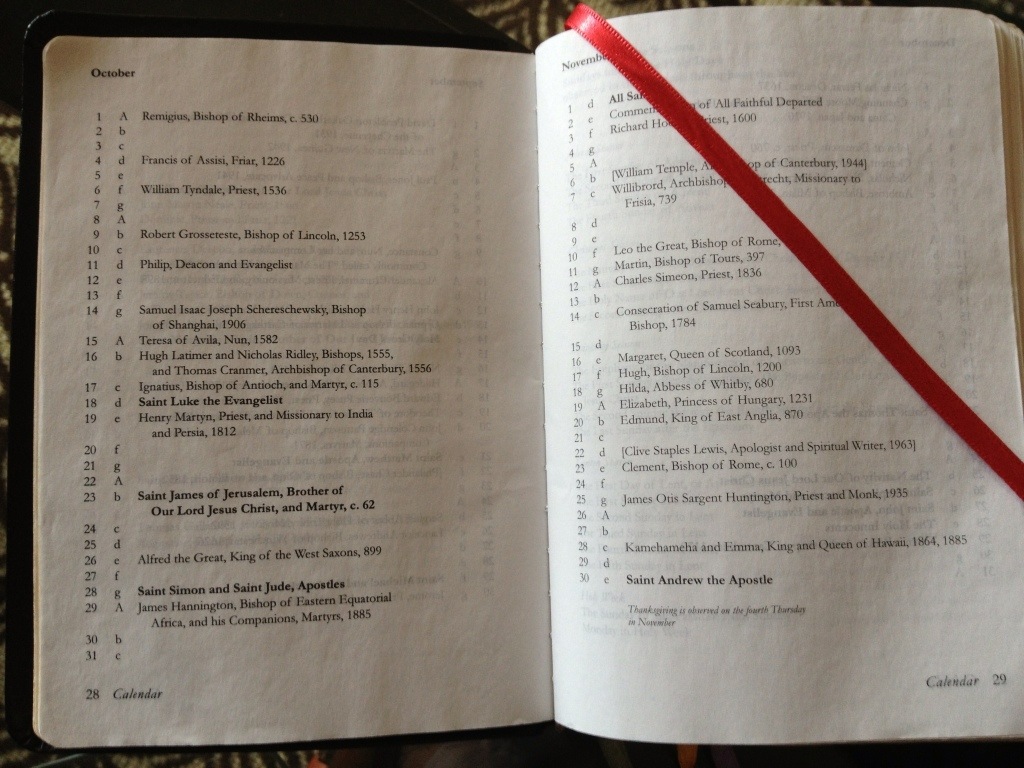
In my post this morning I reflected on the lessons appointed for the Thursday after Proper 23, having completely missed the fact that today is actually the Feast of St. Luke the Evangelist.

Perhaps if the Calendar in the front of the Book of Common Prayer still printed the Major Feasts in red (the origin of the term “red-letter days) I might have caught it. The current prayer book (see above) is a bit more subtle.

I probably wouldn’t have caught it, anyway, since my early-morning, barely-caffeinated routine has me turning first to the bookmarked Daily Office Lectionary, 961 pages away from the Calendar page for October, and then marking psalms and readings with the appropriate ribbons.

Oh well, there’s always Evening Prayer. I’ll have a chance to erase the black mark soon enough.

20121018-080815.jpg

In the Daily Office, several themes recur on particular days each week.

On Sundays we rejoice in Christ’s resurrection, on Saturdays we relax in God’s creation, on Fridays we remember Christ’s sacrifice on the cross. The collects appointed for those three days (BCP 98-99, 123) draw the themes out fairly obviously.

It’s a little more subtle, but on Thursdays we can discern a baptismal theme. The canticle suggested for use after the first lesson on Thursday mornings is the Song of Moses (BCP 85). The story of the Exodus is linked in the Christian mind with the Easter Vigil, and therefore with Baptism. For that reason, the Song of Moses is also to be used on Sunday mornings throughout Easter season.

Today’s readings center on two characters in peril on the sea.

Jonah, who has survived being in the belly of the whale (baptism by ingestion?), finally gets around to his mission, preaching to the people of Nineveh.

Paul’s confidence in God reassures the sailors that they will survive the violent storm and the shipwreck. Note that Paul also celebrates the Eucharist with them, the breaking and blessing of bread that follows Baptism.

We are baptized into Christ’s life, and each week we can remember, relax, and rejoice in God’s saving grace.

Thanksgiving for the Birth of a Child

O God, you have taught us through your blessed Son that whoever receives a little child in the name of Christ receives Christ himself: We give you thanks for the blessing you have bestowed upon this family in giving them a child. Confirm their joy by a lively sense of your presence with them, and give them calm strength and patient wisdom as they seek to bring this child to love all that is true and noble, just and pure, lovable and gracious, excellent and admirable, following the example of our Lord and Savior, Jesus Christ. Amen. (BCP 443)

My wife and I have just become grandparents, so in addition to the prayer above (from the service Thanskgiving for the Birth of a Child) I’ll be saying the Magnificat at Evening Prayer tonight with a new appreciation.

Rejoice with us as our souls proclaim the greatness of the Lord!

Continuous, if marginal, improvement

In the morning, Lord, you hear my voice;
early in the morning I make my appeal and watch for you. (Psalm 5:3)

I grow weary because of my groaning;
every night I drench my bed
and flood my couch with tears. (Psalm 6:6)

The company I work for is the leader in patient flow automation — improving patient care and hospital operations by making data more visible, smoothing out communication, and coordinating the efforts of employees in every area of the hospital.

We provide enormous amounts of data — dashboards to help you see in the moment whether you’re on track, standard reports in more than 90 flavors to help you drill down into the details and uncover roadblocks, and a custom reporting solution that will even email you the report automatically.

Our best clients have literally transformed their health systems by streamlining their patient flow, taking care of hundreds more patients every month in the same number of beds they have always had.

But, here’s the thing.

A few of our clients never look at the reports. They try to do their work without knowing what to expect. They make the same mistakes over and over again because they can’t see the pattern. They end up acting like every day is a crisis, when most days they will simply need to discharge some patients and admit some more, just like they do every day.

Think of the Daily Office as your dashboard, as your daily report.

“Early in the morning” and every evening,” as the Psalmist says, you can check in and see how you’re doing. Early in the morning you can remind yourself of the direction you want to take, and every evening you can take stock of where you strayed. In Morning Prayer you begin the day with the praise of God on your lips, and at Evening Prayer the words of confession bring the day to a close.

Using reports in your work, using the Daily Office, is not a magic bullet. You won’t necessarily change overnight, but you won’t change at all if you’re not paying attention. Continuous, if marginal, improvement is the order of the day.

For Guidance

Direct us, O Lord, in all our doings with your most gracious favor, and further us with your continual help; that in all our works begun, continued, and ended in you, we may glorify your holy Name, and finally, by your mercy, obtain everlasting life; through Jesus Christ our Lord. Amen. (BCP 832)

Richly usable words

Thomas Cranmer’s phrases echo through English literature and popular culture.

From “God Talk: The Book of Common Prayer at 350” — a literary appreciation by James Wood in The New Yorker:

“A grand sonority (with the characteristic Cranmerian triad of ‘all holy desires,  all good counsels, and all just works’) gives way to a heartfelt request: please defend us from enemies, so that we may ‘pass our time in rest and quietness.’ It’s interesting to compare the original Latin of this old prayer, which  appeared in the Sarum Missal: ‘Tempora sint tua protectione tranquilla‘ can be roughly translated as ‘May our time under thy protection be tranquil.’ In a fourteenth-century English primer, it was translated into English, and the prayer was now that ‘our times be peaceable.’ But Cranmer has made the plea smaller and closer at hand. In the Book of Common Prayer, the language seems not to refer to the epoch (our time) but to something more local (my days); and tranquillity and peace have become the comfier ‘rest  and quietness.’”

Wood draws a conclusion that I would not when he says, “the words persist, but the belief they vouchsafe has long gone.” He does go on, however, to say that “the words are, in the absence of belief, as richly usable as they were three hundred and fifty years ago.”

I hope, for my part, that you will find your belief strengthened by the “richly usable” words of our Book of Common Prayer, and especially by the canticles, collects, and prayers of the Daily Office.

A Collect for Peace

Most holy God, the source of all good desires, all right judgments, and all just works: Give to us, your servants, that peace which the world cannot give, so that our minds may be fixed on the doing of your will, and that we, being delivered from the fear of our enemies, may live in peace and quietness; through the mercies of Christ Jesus our Savior (BCP 123).

Patterns of life

“Praying the Office just every once in a while isn’t enough. It has to become a discipline. That doesn’t mean that if you miss it once you’re lost or anything, but its power lies in the force of habits. Habits of mind, habits of devotion, habits of thought. That’s what transforms us—patterns of life.”

From a longer address on the Daily Office and the Anglo-Catholic social conscience at Derek Olsen’s blog.

A hidden dying to self day by day

From the Rule of the Society of St. John the Evangelist, Chapter 18: The Daily Office

“But for the office to be truly a means of our transfiguration we must cooperate by continually re­newing our inner attentiveness, laying aside again and again the preoccupations and daydreams that confuse and tie us down.  This effort to keep our hearts open to Christ will be needed all our lives; it is a hidden dying to self day by day.”

Seven times a day will I praise you

When I read the verse from Psalm 119 this morning (164), the word “seven” reminded me of a favorite hymn — King of Glory, King of Peace — with words by George Herbert:

Seven whole days, not one in seven,
I will praise thee;
In my heart, though not in heaven,
I can raise thee

Small it is, in this poor sort
To enroll thee;
E’en eternity’s too short
To extol thee.

-George Herbert

And here’s a video of the hymn being sung at Washington National Cathedral.