Category Archives: Daily Office

Confident of the glory

The psalmist captures perfectly how we feel when we discover we are not in agreement on a particular issue, or that we are even working at cross purposes. We feel betrayed and deceived.

For had it been an adversary who taunted me,
then I could have borne it;
or had it been an enemy who vaunted himself against me,
then I could have hidden from him.

But it was you, a man after my own heart,
my companion, my own familiar friend.

We took sweet counsel together,
and walked with the throng in the house of God.
(Psalm 55:13-15)

How can someone I thought I knew think so differently from me? If we don’t share these attitudes or opinions, what do we actually have in common?

Holy Week teaches us exactly what we have in common — the passion, death, and glorious resurrection of Jesus Christ which opens to us the way of everlasting life.

Like us, Jesus had men and women after his own heart, companions, familiar friends. One betrayed him, one denied him, most of them abandoned him, and they all hid in fear when they heard he had died.

Like the disciples, forgiven for their failings by the Risen Lord, we now share in Christ’s reconciling mission and are clothed by the Holy Spirit to reach forth our hands in love and to bring those who do not know Christ into the knowledge and love of Christ (see BCP 101).

Like the disciples and Christians ever since, we “take sweet counsel together” but disagree on what we’re supposed to do next. Share the good news with Jews only, or with Gentiles, too? Require circumcision or not? Men only as teachers and leaders, or women, too? Keep the kosher food laws or not? Couch the gospel in Jewish terms or translate it into Greek philosophical terms? Become the state religion or keep being persecuted? For 2,000 years we have taken sweet counsel together and disagreed on what to do next.

Paul writes to the Philippians to encourage them not to “worry about anything, but in everything by prayer and supplication with thanksgiving let your requests be made known to God” (4:6).

When we take sweet counsel with God and with one another, we are reminded what we share in common. We are reminded that our disagreements and our partial understanding and our personal agendas pale in the face of the glory that is revealed through Christ’s suffering, death, and resurrection.

We do not have to worry — Christ is our confidence. It’s not a zero-sum game; we can embrace “whatever is true, whatever is honorable, whatever is just, whatever is pure, whatever is pleasing, whatever is commendable, if there is any excellence, and if there is anything worthy of praise” (Phil. 4:8).

When we take sweet counsel together, we may come to understand a surprising truth. Through Christ, God is continually working a new thing. Not with the power of the state, but through weakness. Not with military might or the rule of law, but by the will of the Father. Not angry over our betrayal, but forgiving even his torturers. Not condemning the weak, but giving us the Holy Spirit and sending us out in his Name.

Collect for Wednesday in Holy Week

Lord God, whose blessed Son gave his body to be whipped and his face to be spit upon: Give us grace to accept joyfully the sufferings of the present time, confident of the glory that shall be revealed; through Jesus Christ your Son our Lord, who lives and reigns with you and the Holy Spirit, one God, for ever and ever. Amen. (BCP 220)


God’s wheat, ground by the teeth of wild beasts

20130314-031452.jpg

In his spirited defense during the early brackets in Lent Madness, the Rev. David Sibley wrote this about Ignatius of Antioch, an early Bishop of Rome:

“Ignatius’ letter to the Romans expressed his firm desire to be led to his martyrdom, begging the church in Rome to let him be ‘food for the wild beasts… God’s wheat… ground by the teeth of wild beasts, so that I may prove to be pure bread’ (Rom 4:1). Around AD 115, Ignatius was granted his wish, as he was martyred in the coliseum, given over to the teeth of lions.”

In my insomnia this morning, I was thinking of the election of Pope Francis and of the extraordinary challenge he faces as the spiritual leader of more than half the world’s Christians. As quickly as a puff of white smoke, he has become not only a source of guidance and a focus of reverence, but also a lightning rod for controversy, anger, and ridicule.

Exercising spiritual leadership at any level — you don’t have to be Pope! — can feel like being “ground by the teeth of wild beasts.” It is a terrible responsibility to educate the faithful, minister to the sick, reconcile the estranged, lead the congregation in worship, and feed the hungry, and if you’re honest about your own failings you’ll know how unprepared you are.

How appropriate is Psalm 69, appointed for Morning Prayer today!

O God, you know my foolishness,
and my faults are not hidden from you.

Let not those who hope in you be put to shame through me, Lord God of hosts;
let not those who seek you be disgraced because of me, O God of Israel.
(Ps. 69:6-7)

Here’s what puts Ignatius’ martyrdom, Francis’ new role as Bishop of Rome, and our own ministries with those among whom we live, and work, and worship into perspective: We are not the bread of life. Jesus is.

We may be “God’s wheat,” but the “living bread that came down from heaven” (John 6:51) is Jesus himself. What we can do — all we can do — is give “our selves, our souls and bodies” fully to the task at hand. We unite our offering to his in order to become through him the Body of Christ, the Bread of Heaven.

God grant that we may all offer solid food, nourishing bread, faithful witness to those whom God calls us to serve.

Be still and know that I am God

My God It's Full of Stars

The heavens declare the glory of God,
and the firmament shows his handiwork.

One day tells its tale to another,
and one night imparts knowledge to another.

Although they have no words or language,
and their voices are not heard,

Their sound has gone out into all lands,
and their message to the ends of the world.

(Psalm 19:1-4)

Another travel week begins on a Sunday evening, and this layover in the Detroit airport is just about the first chance I have had to catch my breath since last Sunday.

But for now, it’s good to be still, even for a few minutes.

It’s good to pause and reflect on a solid Sunday today: two Eucharists with healing services, another lively session of “Episcopal 101” after which a young man gave me a long, handwritten list of his questions for upcoming sessions, and a thoughtful Education for Ministry (EfM) session.

It’s good to remember the warm glow of conversation over a packed dinner table with friends last night.

It’s good to have finished some work yesterday morning and to have had a Saturday afternoon to read for a bit.

It’s good to be headed out to work again, headed to work with colleagues who are good at what they do and generous with their time.

The dark outside the airport window is full of stars, though I can’t see them right now. “The heavens declare the glory of God,” as do the myriad human encounters that fill our days.

For now, it’s good to be still, even for a few minutes.

Kindle our hearts and awaken hope

theideasmithy.com


Collect for the Presence of Christ

Lord Jesus, stay with us, for evening is at hand and the day is past; be our companion in the way, kindle our hearts, and awaken hope, that we may know you as you are revealed in Scripture and the breaking of bread. Grant this for the sake of your love. Amen. (BCP 124)

+ + + + +

When I travel, I am fortunate to travel with colleagues most of the time. We enjoy eating dinner together as we discuss the coming day’s meetings and demos.

Last night, however, the meal I shared with a sales executive and our vice president took on a holier tone.

One of the other sales executives in our region lost his 24-year old daughter in a car accident just over a week ago. As he and his family struggle with their grief, our VP has been close by to comfort his longtime friend. The company’s CEO and our President also visited him this week to demonstrate our concern and support for him.

Over dinner last night, our VP spoke about how God has been visibly present in our colleague’s life these past several days. His grief is forging in him a new resolve to make a difference, and his sense of God’s presence gives him hope that he can endure and honor his daughter’s memory.

The circle of light over our dinner table, the low murmur of our voices as we talked, might just as well have been a candlelit church filled with the sound of praying.

+ + + + +

Keep watch, dear Lord, with those who work, or watch, or weep this night, and give your angels charge over those who sleep. Tend the sick, Lord Christ; give rest to the weary, bless the dying, soothe the suffering, pity the afflicted, shield the joyous; and all for your love’s sake. Amen. (BCP 124)

Teach your children well

I am at HIMSS, the annual meeting and trade show for healthcare IT, meeting clients and colleagues both in my company’s booth and after the day’s show is ended.

Yesterday I reconnected with a friend and former colleague, who shared with me a recent experience of “house church” when he and his wife told the parable of Jesus and the rich young man (Luke 18:18-30), and their children reenacted the story. The 18-month old played Peter, naturally, tugging on Jesus’ sleeve: “But what about us, Lord?”

The psalmist this morning underscores the importance of teaching the faith to our children:

That which we have heard and known,
and what our fathers have told us,
we will not hide from their children.

We will recount to generations to come
the praiseworthy deeds and the power of the Lord,
and the wonderful works he has done.
(Psalm 78:3-4)

At the Lenten Retreat I recently attended, Phyllis Tickle spoke of how the Biblical story is told in tent and synagogue and Temple. For Jews, the destruction of the Temple in 70 AD focused their faith and practice on the synagogue and home.

She suggested that as the institutional church (Christianity’s Temple) is becoming less prominent in people’s lives, it becomes even more important to share the stories of faith in small groups (synagogue) and at home (in the tent).

Even during difficult times — times of persecution or the loss of cherished traditions — the people of God recount the praiseworthy deeds and the power of the Lord so that their children will learn about the faith.

It was entirely appropriate, then, that the Canticle following the Old Testament lesson this morning was drawn from the Song of the Three Young Men, who though they were thrown into Nebuchadnezzar’s fiery furnace, sang songs of praise to God (Daniel 3).

Their song, recounted in the Apocryphal book known as the Prayer of Azariah, has formed part of the Church’s daily prayers for centuries now (Canticles 12 and 13 in our BCP).

Glory to you, Lord God of our fathers;
you are worthy of praise; glory to you.
Glory to you for the radiance of your holy Name;
we will praise you and highly exalt you for ever.
(BCP 90)

Whatever your circumstances may be, share your praise of God with your children so they will learn about the praiseworthy deeds and the power of the Lord.

Putting away all earthly anxieties

Sabbath Manifesto

A Collect for Saturdays

O God, who after the creation of the world rested from all your works and sanctified a day of rest for all your creatures: Grant that we, putting away all earthly anxieties, may be duly prepared for the service of your sanctuary, and that our rest here upon earth may be a preparation for the eternal rest promised to your people in heaven; through Jesus Christ our Lord. Amen. (BCP 99)

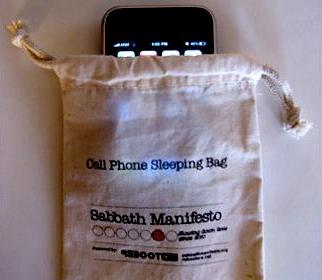
Today, apparently, is the National Day of Unplugging sponsored by the Sabbath Manifesto, whose “cell phone sleeping bag” is pictured above. The Sabbath Manifesto promotes ten principles for a weekly day of rest, starting with “Avoid Technology.”

Sunday — even though some Christians refer to it as the Sabbath — is pretty much a work day for me, starting at 7 am with preparations for the 8 am service at St. Thomas and ending after our Education for Ministry session wraps up around 2:30 pm. That means Saturday bears the brunt of weekend tasks.

I don’t know about you, but I have nine things on my to-do list for today, and five of them will require me to be on the web or pulling together a presentation or writing something (this blog post is one, so that will leave four more).

If I’m honest with myself, though, only one item on my list actually requires me to use the computer. Gotta fill out the expense reports for work so I’ll get reimbursed! The rest I could actually do more quietly, by reading and writing and thinking.

And if I’m really honest with myself, I could have done my expense reports on Thursday night at the hotel.

It’s the whole “putting away all earthly anxieties” thing that’s really tough, isn’t it? If we’re not anxious about something, we worry that we’re slacking. If we’re not connected, we worry that we’re missing something. If we can’t stare at the shiny screen, we’re anxious that we won’t know how to amuse ourselves.

One of my first bosses is an excellent writer, especially gifted at writing personal thank-you notes. One of his idiosyncracies is to use the word “eager” instead of the word “anxious.” Try it yourself sometime, as I have done for years now, and you’ll see a subtle difference.

Rather than being anxious, why not be eager? Why not put away your anxieties and give your eagerness a chance to play, at least one day a week?

I’m going to try it today. Seriously, right after I finish my expense report.

Merciful promise beyond all measure

genuflectOne of the niceties of the Daily Office during Lent is that Canticle 14: A Song of Penitence is appointed to be read on Sunday, Wednesday, and Friday mornings and on Monday evenings.

See the canticle itself on BCP 90, the table of when canticles are to be read on BCP 144, and handy versions of the tables to place in your prayer book on the Resources page of this blog.

Canticle 14 comes from the Prayer of Manasseh, one of the books in the Apocrypha. These are books which were in the Hebrew Scriptures around the time of Christ and used by Christians from the beginning.

The apocryphal books still commonly appear interleaved among the Old Testament books in Roman Catholic Bibles. In some Protestant Bibles, they are separated into a section called the Apocrypha and located between the Old and New Testaments. In most Protestant Bibles today, however, they are omitted entirely.

But I digress.

The reason I like this canticle so much is what it teaches us about penitence during this season of Lent.

All things quake with fear at your presence;
they tremble because of your power.
But your merciful promise is beyond all measure;
it surpasses all that our minds can fathom.

The God who “made the heavens and the earth, with all their vast array” is the “same Lord whose property is always to have mercy” (BCP 337). The character of God is goodness toward God’s creation.

The loveliest line in the canticle comes next:

And now, O Lord, I bend the knee of my heart,
and make my appeal, sure of your gracious goodness.
I have sinned, O Lord, I have sinned,
and I know my wickedness only too well.

Consciousness of God’s grace comes with a consciousness of our own sinfulness. It is entirely appropriate for us to “bend the knee of our heart.” However, our sin is not the point, and dwelling on (or wallowing in) our sin is not what God desires.

For you, O Lord, are the God of those who repent,
and in me you will show forth your goodness.
Unworthy as I am, you will save me,
in accordance with your great mercy,
and I will praise you without ceasing all the days of my life.

What a wonderful prayer to make four times a week during Lent! What a wonderful witness to the world, our repentance and our praise of God’s goodness.

The prayer book rubrics drily note that the Canticle is suitable for “other penitential occasions,” too. I invite you to spend some time reflecting on the Canticle or reading the Prayer of Manasseh, bending the knee of your heart, and then praising God for “merciful promise beyond all measure.”

That which God has purposed

But if you call yourself a Jew and rely on the law and boast of your relation to God and know his will and determine what is best because you are instructed in the law, and if you are sure that you are a guide to the blind, a light to those who are in darkness, a corrector of the foolish, a teacher of children, having in the law the embodiment of knowledge and truth, you, then, that teach others, will you not teach yourself? (Romans 2:17-21)

There is a serious vein running through today’s lessons from Jeremiah and Isaiah through to Paul and Christ.

Jeremiah recounts God’s judgment on God’s people and on Jerusalem. “The whole land shall be a desolation; yet I will not make a full end. Because of this the earth shall mourn, and the heavens above grow black; for I have spoken, I have purposed; I have not relented nor have I turned back” (Jer. 4:27-28).

God’s judgment is terrible, and he is unrelenting.

Except then comes the Canticle, the Second Song of Isaiah (Isa. 55:6-11), with its familiar words of reassurance:

For as rain and snow fall from the heavens
and return not again, but water the earth,
Bringing forth life and giving growth,
seed for sowing and bread for eating,
So is my word which goes forth from my mouth;
it will not return to me empty,
But it will accomplish that which I have purposed,
and prosper in that for which I sent it.

Christians, of course, read these words in the light of Christ the Word who “goes forth from God,” so to speak, and who accomplishes what God purposes.

What God purposes, we know from our vantage point post-Easter, is not desolation but restoration. God has “relented” once for all in Christ and continues to be present to us through the Holy Spirit, advocate and guide. How can we forget what God has done for us, has won for us, in Christ?

This is what frustrates Paul so much in his letter to the Romans. He basically asks, “Are you turning away from grace and back to the judgment under the law which cannot save?”

His question resonates with the prophets’ words. Are we turning away from restoration and teaching desolation? Are we preaching grace or sin?

Of course, it’s not an either/or thing. Grace freely given comes with a consciousness of sin. When I have been forgiven, I am acutely aware of exactly what I have done wrong. But the message from my forgiver — whether it’s my wife or the priest pronouncing God’s absolution on Sunday — is restoration, not condemnation.

Where in our lives do we still reflect a spirit of judgment, faces set in a disapproving frown? Where do we still dwell on faults more than freedom, quick to relay dirt and to dismiss others’ pain? Where do we still fail to preach the message of good news that animated Jesus and Paul and our forebears in this life in Christ?

Even worse, where does our judgmentalism and obsession with rectitude cause “the Name of God to be blasphemed” because of us (Rom. 2:24)? It’s happening all around us as people turn away from angry so-called “Christianity.” God forbid!

Like rain falling from the heavens is God’s grace falling on us, on all of us who “have no power in ourselves to help ourselves,” in the words of next Sunday’s Collect. What God has purposed is our restoration, our reconciliation with God, and our reaching out in love to the people around us.

What we can be sure of is that God’s word will prosper in us, will teach us, as we live out God’s restoring mission.

Seven whole days

Praise (II)Tres Riches Heures - July - Limbourg Bros
George Herbert
From The Temple (1633)

King of Glorie, King of Peace,
I will love thee:
And that love may never cease,
I will move thee.

Thou hast granted my request,
Thou hast heard me:
Thou didst note my working breast,
Thou hast spar’d me.

Wherefore with my utmost art
I will sing thee,
And the cream of all my heart
I will bring thee.

Though my sinnes against me cried,
Thou didst cleare me;
And alone, when they replied,
Thou didst heare me.

Sev’n whole dayes, not one in seven,
I will praise thee.
In my heart, though not in heaven,
I can raise thee.

Thou grew’st soft and moist with tears,
Thou relentedst:
And when Justice call’d for fears,
Thou disentedst.

Small it is, in this poore sort
To enroll thee:
Ev’n eternitie is to short
To extoll thee.

Can anybody play the drums?

20130225-065137.jpg

In 1973, during The Who’s concert at the Cow Palace in San Francisco, drummer Keith Moon collapsed twice after overdosing on tranquilizers and brandy. Guitarist Pete Townshend finally stepped to the mike and asked the crowd, “Can anybody play the drums?”

In fact, someone could. Who fan Scot Halpin, 19 years old, was right in the front row, and his friend’s frantic yelling caught the eye of the concert promoter, who had him brought up on stage.

+ + + + +

Go back about 1,940 years. The apostles are in Jerusalem, having just witnessed Jesus’ ascension. They realize they need to regroup and move forward, and in order to do so they need to replace Judas.

Matthias is the one who gets called up to the big stage. He’s been a follower all along, says Peter, “one of the men who has accompanied us during all the time that the Lord Jesus went in and out among us” (Acts 1:21).

What happened next was the rush of the Holy Spirit on the day of Pentecost. Surely Matthias was as unprepared as all of the apostles for the power of that moment and the change it brought to his life.

+ + + + +

St. Matthias has a day on the Church’s calendar, which is cool, but Rolling Stone magazine named Scot Halpin “Best Pick-Up Player of the Year” in 1973.

What practice do you need so that you’ll be ready to step onstage when your time comes?