Category Archives: Daily Office

Daily his delight

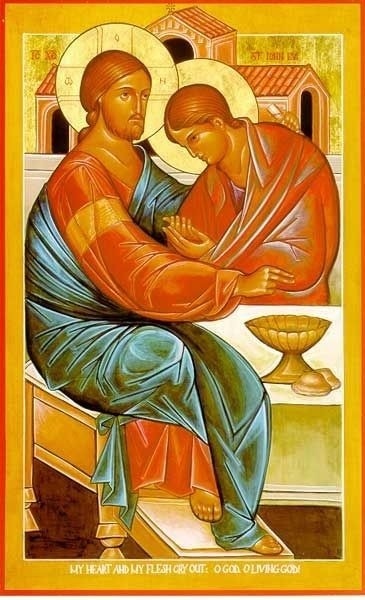
Icon of the Beloved Disciple from Mt. Angel Abbey

Icon of the Beloved Disciple from Mt. Angel Abbey – the inscription reads “My heart and my flesh cry out: O God, O living God!”

When he established the heavens, I was there,
when he drew a circle on the face of the deep,
when he made firm the skies above,
when he established the fountains of the deep,
when he assigned to the sea its limit,
so that the waters might not transgress his command,
when he marked out the foundations of the earth,
then I was beside him, like a master worker;
and I was daily his delight, rejoicing before him always.
(Proverbs 8:27-30)

Powerful Seeking

John’s gospel shines with both power and intimacy.

Jesus crackles with energy, turning water into wine, driving the moneychangers from the Temple, confounding learned and pious Nicodemus, speaking with a foreign woman, and healing with a word (whether the beggar by the pool wants it or not). And that’s only in the first five chapters of the story.

Jesus’ power radiates as clearly as his love and concern for people.

The man born blind, healed by Jesus’ touch and by a compress of mud (how like God’s own touch, forming mud and clay into the first human), is driven out of the synagogue by the religious leaders. But the story doesn’t end there, and John provides the key to understanding it fully.

“Jesus heard that they had driven him out, and when he had found him …” (John 9:35).

Jesus the power of God, whom John has come to understand is the same Word who was with God in the beginning, seeks out those who are hurting in order to effect their healing. He seeks out those who are estranged in order to effect their reconciliation.

As Reynolds Price writes in Incarnation: Contemporary Writers on the New Testament, the Gospel of John “says in the clearest voice we have the sentence that mankind craves from stories — The Maker of all things loves and wants me.”

Intimate Sending

John, the disciple whom Jesus loved, writes from a position of intimate knowledge. It is he who reclines next to Jesus at the Last Supper.

From within that close embrace, John sees both the betrayal Jesus suffers and the love that he demonstrates in washing the disciples’ feet and sending them out to serve one another.

Because today’s Feast of St. John falls on a Friday, in Morning Prayer we have the added poignancy of the Prayer for Mission that captures this intimate sending:

Lord Jesus Christ, you stretched out your arms of love on the hard wood of the cross that everyone might come within the reach of your saving embrace: So clothe us in your Spirit that we, reaching forth our hands in love, may bring those who do not know you to the knowledge and love of you; for the honor of your Name. Amen. (BCP 101)

Daily His Delight

Jesus, the Word of God, was with God at creation and was “daily his delight.” At the Incarnation, “God did not send the Son into the world to condemn the world, but in order that the world might be saved through him” (John 3:17).

John, the Beloved Disciple, who was close to Jesus’ heart and “daily his delight,” wrote his Gospel “so that you may come to believe that Jesus is the Messiah, and that through believing you may have life in his name” (John 20:31).

And you? The disciple whom Jesus loves?

You who have come within the reach of Jesus’ saving embrace and are “daily his delight,” how will you reach forth your hands in love to bring those who do not know Jesus into the knowledge and love of him?

Pattern and strength

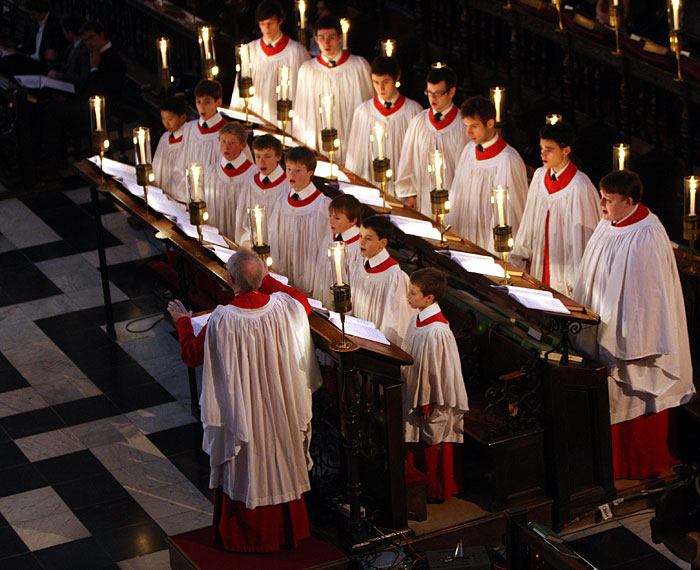
Choir of King's College, Cambridge

Choir of King’s College, Cambridge

Wherever the service is heard and however it is adapted, whether the music is provided by choir or congregation, the pattern and strength of the service, as Dean Milner-White pointed out, derive from the lessons and not the music. ‘The main theme is the development of the loving purposes of God …’ seen ‘through the windows and the words of the Bible’. Local interests appear, as they do here, in the Bidding Prayer; and personal circumstances give point to different parts of the service. Many of those who took part in the first service must have recalled those killed in the Great War when it came to the famous passage ‘all those who rejoice with us, but on another shore and in a greater light’. The centre of the service is still found by those who ‘go in heart and mind’ and who consent to follow where the story leads. (From the program of the 2013 service)

Pattern

Let us read and mark in Holy Scripture the tale of the loving purposes of God from the first days of our disobedience unto the glorious Redemption brought us by this Holy Child; and let us make this Chapel, dedicated to Mary, his most blessèd Mother, glad with our carols of praise. (From the program for the 2013 service)

Though the Festival of Nine Lessons and Carols as celebrated at King’s College, Cambridge is an elaborate feast of sight and sound, its pattern is clear to anyone familiar with the Daily Office.

After an opening prayer, the main body of the Lessons and Carols service consists of nine readings from Scripture carefully chosen to tell “the tale of the loving purposes of God from the first days of our disobedience unto the glorious redemption brought us by the Holy Child.”

Interspersed between the lessons are musical responses — carols and hymns — in place of the canticles we use in the Offices day by day.

The service of Lessons and Carols, like the Daily Offices, concludes with collects appropriate for the season.

Though the Festival of Lessons and Carols was planned in 1918 out of Dean Eric Milner-White’s felt need for “more imaginative worship,” its roots in the Prayer Book pattern of Morning and Evening Prayer are deep and nourishing.

Strength

The collects which conclude the service of Lessons and Carols, like the collects in the Daily Office, rehearse our “sure and certain hope” in the resurrection:

O God, who makest us glad with the yearly remembrance of the birth of thy only son, Jesus Christ: Grant that as we joyfully receive him for our redeemer, so we may with sure confidence behold him, when he shall come to be our judge; who liveth and reigneth with thee and the Holy Spirit, one God, world without end. Amen.

O God, who by his incarnation gathered into one things earthly and heavenly, grant you the fullness of inward peace and goodwill, and make you partakers of the divine nature; and the blessing of God Almighty, the Father, the Son and the Holy Spirit, be upon you and remain with you always. Amen.

In the strength of Christ we find not only rest but nourishment for service.

I’m weary with my former toil,
Here I will sit and rest awhile:
Under the shadow I will be
Of Jesus Christ, the apple tree.

This fruit doth make my soul to thrive,
It keeps my dying faith alive;
Which makes my soul in haste to be
With Jesus Christ, the apple tree. 

Further thoughts on hope

Anchor - Rattle Your Bones - Group

The local paper’s front page story today is a feature on Advent and the themes of Peace, Joy, Hope, and Love.

I was interviewed on the subject of hope, and here are few more thoughts on the subject.

Hope springs from knowing you’re not alone, from receiving help given by those who have been through difficulty, and from sharing what has helped you with other people.

The Episcopal Church’s “Daily Office” – our Morning and Evening Prayer – nourishes hope by joining people into a prayer tradition shared by Christians around the world and by the communion of saints through the centuries. I write this blog to help people practice this particular form of daily prayer.

I participate in recovery groups, where people help those who are in trouble by sharing what has worked for their own healing. In many cases, recovery involves working with a sponsor, whose personal concern builds hope and reassures us that we are not alone.

Through organizations like NAMI Fox Valley and the Littlest Tumor Foundation, which my wife and I support, people learn they are not alone in their fears — whether about mental illness or about tumors in children — and they receive comfort from other families who face the same struggles.

The people of St. Thomas Church in Menasha, WI — where I serve as deacon — generously share their faith in Jesus, their hope in the resurrection, and their experience of healing with newcomers and people in the wider community, and they invite people to join them in reaching out in care and concern through ministries like the Double Portion meal.

I think hope is something you do, perhaps even more than something you have. Participating in Christ’s risen life — through prayer, study, fellowship, and service — builds and strengthens and nourishes hope in us, and we in our turn build up, strengthen, and encourage one another to live in hope.

NAMI Fox Valley
http://www.namifoxvalley.org

Littlest Tumor Foundation
http://www.littlesttumor.org

St. Thomas Church
http://www.stthomaswi.com

Hope

Sure and Steadfast Anchor


I’m being interviewed this morning by the local newspaper on the subject of Advent and the theme of “hope.”

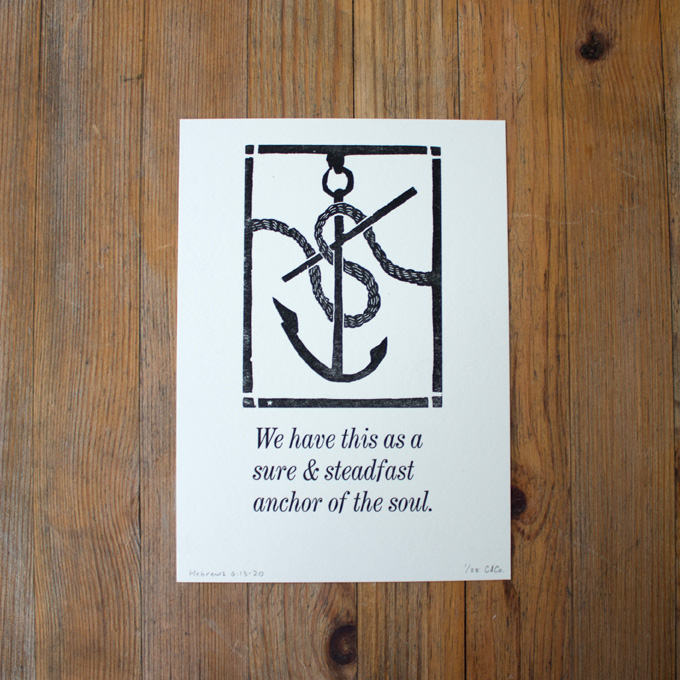
The title of this blog comes from Hebrews 6:19 — “We have this hope, a sure and steadfast anchor of the soul.” Our hope, of course, is Christ.

In the season of Advent, particularly, we focus on the hope of the resurrection and look forward to the coming kingdom of God.

More generally, though, I think hope springs from knowing you’re not alone, from receiving help given by those who have been through difficulty, and from sharing what has helped you with other people.

I’ll talk with the reporter today about my parish, about local nonprofit organizations I work with and support, about recovery groups, and about other places where people find (and give) hope.

Where do you find hope? Where do you give hope to others?


20 minutes with Derek Olsen

Richard Mammana, Jr. interviews Derek Olsen today in The Living Church.

I cannot praise Derek’s work highly enough. I commend his blog haligweorc (he explains the name in the article) to anyone wanting solid food on the subject of liturgical spirituality. He is, to use his own words, “a tireless advocate for the Book of Common Prayer and the spirituality embedded within it.”

I also recommend that if you don’t want to pray the Daily Office “old school” with bookmarks and ribbons, you use the Forward Movement Daily Prayer website or iOS app — both of which are built on the backbone of Derek’s St. Bede’s Breviary.


Not only with our lips, but in our lives

New Yorker pic


The Prayers

This morning we look at the third and final section of the Daily Office.

Having “opened our lips,” prayed the Invitatory and other Psalms, read Lessons and responded with Canticles, and said the Apostles’ Creed, we conclude the Office with various Prayers.

Because the Daily Office is the public worship of the Church, the prayers in this section are more formal, like the Prayers of the People on Sunday morning. They serve the same purpose of reminding us to pray for people and concerns we might not otherwise remember.

There is certainly also room here for your own personal prayers of intercession and thanksgiving.

Let’s take each portion in turn.

The Lord’s Prayer

If you’re praying the Office alone, you can omit the opening sentence and response (BCP 97).

The Lord’s Prayer is offered in traditional and contemporary language. Since every parish I have served uses the traditional form in worship, I like to use the contemporary form when I pray the Office; it helps keep the words fresh for me.

Suffrages

These are like miniature Prayers of the People, with versicles and responses touching on the major topics of our intercessory prayer.

Say Suffrages A most mornings; according to liturgical scholar Derek Olsen, Suffrages B were traditionally attached to the Te Deum (Canticle 21) and are most appropriately used when you have used that Canticle at Morning Prayer.

When I say Evening Prayer, I like to use Suffrages B, which in that Office take the form of a litany “that this evening may be holy, good, and peaceful” (BCP 122).

The Collect of the Day

It is customary to pray three collects at each office: The Collect of the Day, the Collect of the Day of the Week, and a Prayer for Mission.

The Collect of the Day is usually the collect from the Sunday before; so this week it would be the Collect for the First Sunday of Advent (BCP 211). Basically, you use Sunday’s collect all through the week here.

Exceptions to that rule are on Major Feasts, when you use the Collect appointed for that particular feast instead. For example, on Saturday, December 21 — the Feast of St. Thomas the Apostle — you would use the Collect for that day (BCP 237) instead of the Collect for the Third Sunday of Advent. See the Calendar of the Church Year (BCP 15-33) for all the details of Major Feasts and other observances.

On days like today, when a saint (St. John of Damascus) is simply commemorated on the calendar (BCP 30), you might say the Collect of the Day from Sunday, and then add an appropriate collect from the Common of Saints (BCP 245 and following).

Many more exceptions abound, and we don’t need to belabor that point here. The Collect of the Day — the first of the three at the Office — is usually from the Sunday before, and it helps carry the “theme” or flavor of the Sunday throughout the week.

Collect of the Day of the Week

On BCP 98-100 you will notice seven Collects printed. Three are labeled for Sundays, Fridays, and Saturdays. The remaining four are labeled by topic, such as “For Peace” or “For Renewal of Life.” It is customary to use these four on the other days of the week, like this:

Sunday – A Collect for Sundays
Monday – A Collect for the Renewal of Life
Tuesday – A Collect for Peace
Wednesday – A Collect for Grace
Thursday – A Collect for Guidance
Friday – A Collect for Fridays
Saturday – A Collect for Saturdays

The Sunday, Friday, and Saturday collects clearly bring the themes of Resurrection, Crucifixion, and Creation/Sabbath to our prayers on those days. Just as every Sunday is a celebration of the Resurrection, a little Easter, so every Friday is a Good Friday, and every Saturday a chance to rest from our work and “put away all earthly anxieties” (BCP 99).

The same pattern for Collects of the Day of the Week occurs in Evening Prayer.

Prayer for Mission

The rubrics allow for the Daily Office to serve as the opening portion of the Eucharist (like the Liturgy of the Word in a typical Sunday service). They also allow for the use of one of the forms of Prayers of the People, like those on BCP 383 and following.

If you aren’t doing either of those things, then the third collect at the Office is one of the Prayers for Mission. The prayer at the top of BCP 101 is especially suitable for use on Friday mornings, of course. In Evening Prayer, there are three different Prayers for Mission, too.

After the three collects — the Collect of the Day, the Collect of the Day of the Week, and the Prayer for Mission — you may take time to add your own prayers.

Many people use cycles of prayer, like the Anglican Cycle of Prayer or a diocesan cycle, to help them remember to pray for other members of our church family. Many also take some time for silent prayer or meditation here.

The General Thanksgiving

This prayer of thanksgiving has one of the longest pedigrees in our prayer book history, having been composed in 1596. Then, as now, cultivating an attitude of humility and being mindful of God’s blessings is central to our spiritual growth.

We pray that our gratitude will be “not only with our lips, but in our lives, by giving up our selves to [God’s] service” (BCP 101).

A Prayer of St. Chrysostom

Even if you say the Office alone, you are joining in the Church’s unceasing praise and taking your part in the communion of saints.

The Prayer of St. Chrysostom is a beautiful reminder that when we gather for prayer, Christ is in our midst.

Dismissal


If you’re saying the Office alone, you may omit the dismissal.

Closing Sentences

The Office ends, as it began and as it has been filled throughout, with the words of Scripture.

There are three verses here that you may use to conclude your prayer.

+ + + + +

I hope you have found these last four blog posts helpful, whether you are beginning to pray the Offices or have been using this part of the Church’s pattern for prayer for some time already.

Like many things in life, it takes a lot longer to explain the Daily Office that it does simply to do it. Many people find that they need only 20-30 minutes to pray the Office — the Invitatory and Psalter, the Lessons, and the Prayers. Twenty minutes, once or twice a day, is not a lot of time — but it can be an oasis of grace and peace in our otherwise busy lives.

My hope is that understanding how the Office is put together will help you feel more comfortable using it.

Every blessing!


To hear his holy Word

Image by Michael Podesta Graphic Design

Image by Michael Podesta Graphic Design

The Three-Part Office

The Daily Office is structured in three parts: the Invitatory and Psalter, the Lessons, and the Prayers.

Introductory material like we discussed yesterday, and the apparently complicated Daily Office Lectionary, can obscure that three-part structure, but it helps to keep it in mind.

On Sunday, we discussed finding your place and preparing to say the Office. Yesterday, we talked about beginning the Office and praying the Psalms. Today we will focus on the Lessons, the readings from Scripture organized by the lectionary in a two-year cycle.

Tomorrow we will finish this series by looking at the Prayers, especially the Collects, which are so distinctive in our prayer book worship.

The Daily Office Lectionary

On Sunday we looked briefly at the Daily Office Lectionary in order to mark our place with the Psalms and Lessons appointed for the day and the particular Office we were praying.

One of the particular treasures of the Daily Office is that it soaks you in Scripture. You can’t help it — as you follow the Daily Office lectionary, you will read all 150 Psalms every seven weeks, the New Testament in the course of a year, and the Old Testament over the course of two years.

Since the Church Year starts in Advent, a little before the calendar year, the Year Two lectionary for even-numbered years like 2014 starts a little before 2014. We’re now beginning Year Two.

Week of 1 Advent

Tuesday          5,6          *          10,11
Amos 3:1-11          2 Pet. 1:12-21          Matt. 21:12-22

We looked at the Psalms yesterday; remember that the Psalms for Morning Prayer are listed first and those for Evening Prayer second.

There are three Scripture passages appointed for each day — Old Testament (or Apocrypha), New Testament (Acts and the Epistles), and Gospel.

The instructions on BCP 934 suggest that two readings be used in the morning and one in the evening. They also suggest that in Year One, you read the Gospel in the evening and in Year Two in the morning.

So today at Morning Prayer, you will read the lessons from Amos and Matthew. At Evening Prayer, you will read the lesson from 2 Peter.

You’ll notice as you go from day to day that you are doing what is called “course reading” — reading through an entire book over the course of several days or weeks. That means most days you won’t have to move your bookmarks, because you’ll pick up reading where you left off the day before.

Lessons and Canticles

Most Episcopalians are familiar with the way Scripture lessons are read in church on Sunday mornings.

We usually read an Old Testament lesson, say or sing a Psalm, read a New Testament lesson, sing a Gradual Hymn during the Gospel procession, and then hear the Gospel read.

It’s actually not too different in the Daily Office. The pattern in the Office is to read a lesson, then respond with a “canticle,” a song made up of verses from Scripture.

So today, we read the passage from Amos, then read a canticle, read the passage from Matthew, then read another canticle.

If you turn in the service of Morning Prayer to BCP 85, you’ll see that there are 14 canticles printed over the next several pages. How do you know which canticle to read?

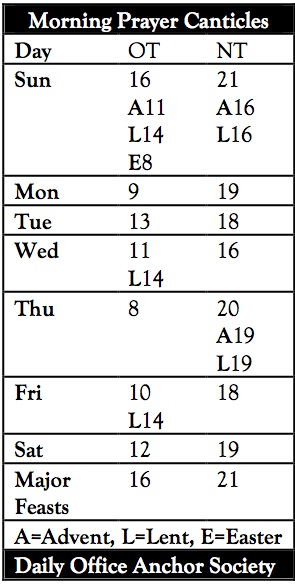
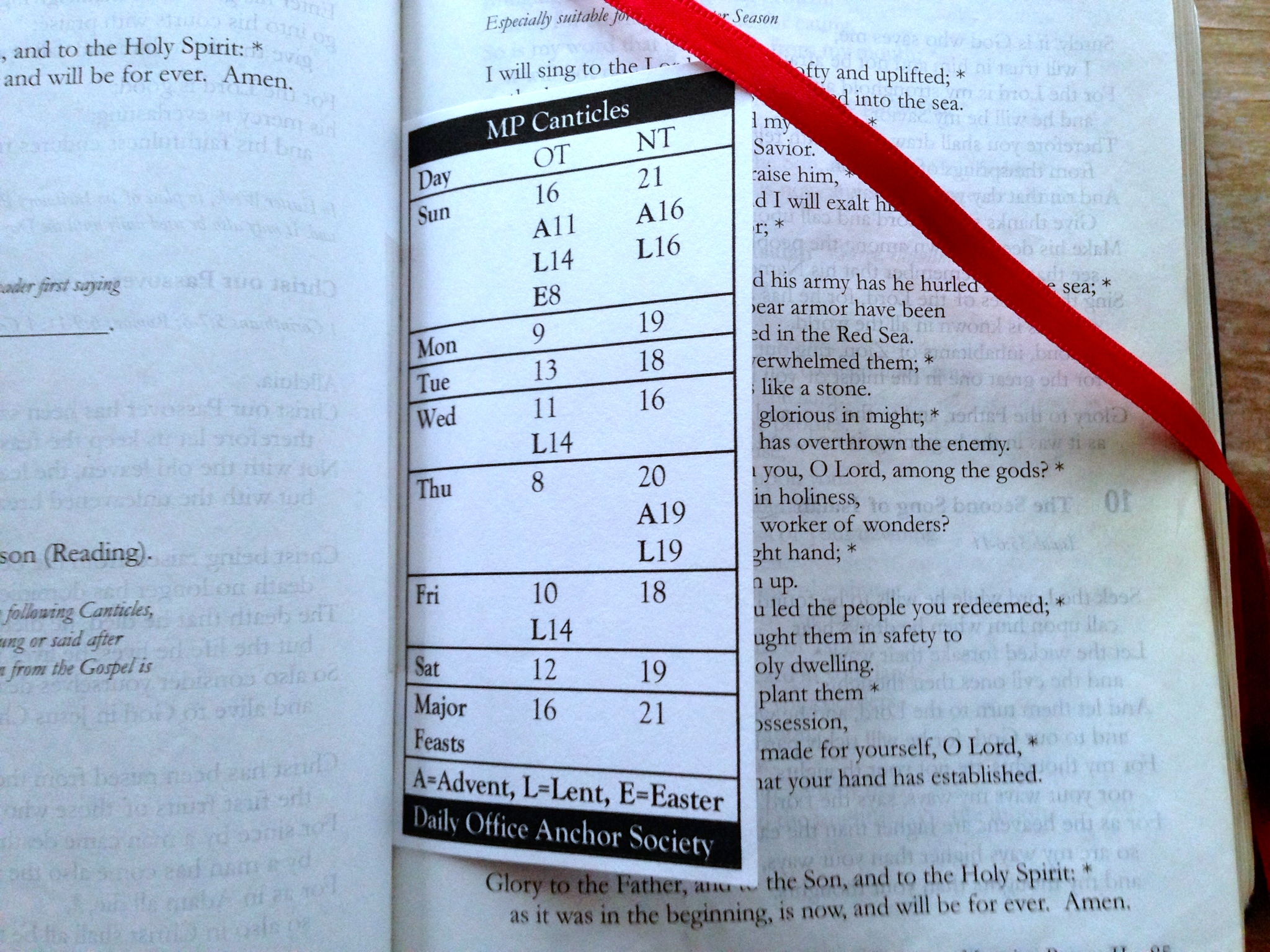
MP Canticles

Enter the handy-dandy Daily Office Anchor Society Canticles Bookmarks!

What they do is replicate the tables found at BCP 144 which lay out which canticles to read on any given day of the week. I suggest that you print them out from the Resources page, trim them to size, and tape them into your prayer book at BCP 84 for Morning Prayer and BCP 118 for Evening Prayer.

Since today is Tuesday, after the Old Testament reading we will turn to BCP 90 and read Canticle 13. Like the Invitatory Psalms, the Canticles have been known for centuries by their Latin names. Benedictus es, Domine is Latin for “Blessed are you, Lord.”

After the New Testament reading, we will turn back to BCP 93 and read Canticle 18, A Song to the Lamb.

Just like there are seasonal sentences of Scripture that you could say to begin the Office, there are also seasonal emphases in the Canticles. You’ll notice on Sundays, Wednesdays, Thursdays, and Fridays on the table above that there are different canticles appointed during Advent, Lent, or Easter. You’ll also see at the bottom of the table that any time there is a Major Feast on the church calendar, you would use Canticles 16 and 21 at Morning Prayer.

It feels like a lot of information, but the pattern for the Lessons is actually pretty simple:

Old Testament reading

Canticle from table

New Testament reading

Canticle from table

The Apostles’ Creed

The last thing we do in the Lessons section of the Office — after hearing God’s holy Word and responding in song — is recite the Apostles’ Creed (BCP 96).

The Apostles’ Creed is the ancient baptismal creed of the Church. When we baptize anyone even today, we renew our own baptismal covenant by reciting the Apostles’ Creed. Every day, morning and evening, we remember our baptism.

In the Daily Offices “we come together in the presence of Almighty God our heavenly Father, to set forth his praise, to hear his holy Word, and to ask, for ourselves and on behalf of others, those things that are necessary for our life and our salvation” (BCP 79).

Tomorrow, we will conclude this series by looking at the Prayers “for ourselves and on behalf of others” which conclude the Office.

Beginning the Office

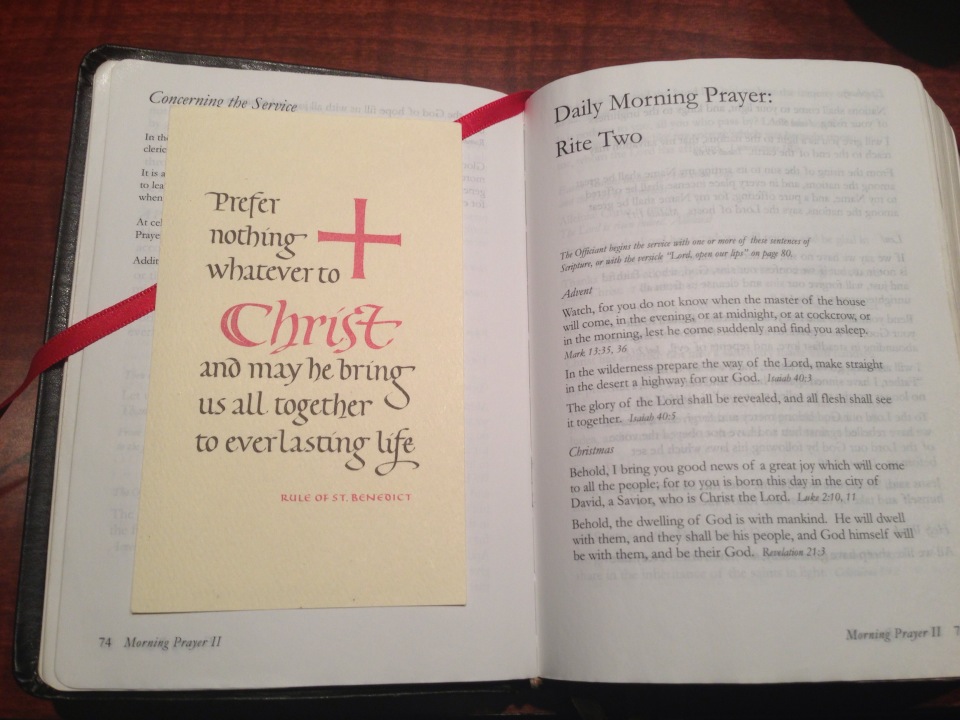
Prefer Nothing to Christ

Yesterday we prepared to say the Office by finding our place in the Book of Common Prayer and marking various places in the prayer book and Bible for easy reference.

Today we will begin the Office, looking at the opening sentences, the Confession of Sin, the Invitatory and Psalter.

Tomorrow we will look at the Lessons and Canticles, and the next day at the Prayers.

Where to begin?

The proper beginning of Morning Prayer is the opening sentences on BCP 80: “Lord, open our lips. / And our mouth shall proclaim your praise.”

At Evening Prayer (and other offices throughout the day), the opening sentences are “O God, make speed to save us. / O Lord, make haste to help us.” (BCP 117).

You’ll notice, though, that there are several pages of material printed before those opening sentences. You may choose to begin the Office with a seasonal sentence from Scripture and/or the Confession of Sin.

Seasonal Sentences

Look at BCP 75-78. You’ll see four pages of Scripture verses chosen to fit the seasons of the Church Year.

You might choose to begin the Office with one of these sentences in order to give your prayers the “flavor” of the season. This is especially helpful to distinguish seasons like Advent and Christmas, Lent and Easter, from the long “ordinary” seasons after Epiphany and Pentecost.

Since it’s Advent now, you might choose to begin with “Watch, for you do not know when the master of the house will come …” (BCP 75). Over the next four weeks, you might change it up a little by using one of the other two choices.

Confession of Sin

Look at BCP 79. The italics at the very top of the page are called rubrics. They are directions telling you what to do next.

In this case, the rubrics say, The following Confession of Sin may be said; or the Office may continue at once with “Lord, open our lips” (BCP 79).

“May” is an important word in the rubrics, and it means what it says. You don’t have to say the Confession every time you say the Office; you may say it.

Many people who say both Morning and Evening Prayer choose to say the Confession only in the evening.

In this somewhat more penitential season of Advent, and certainly in the season of Lent, it may seem right to say the Confession at every Office. Again, the choice helps us focus on the season of the Church Year and its emphases.

At any rate, if you’re saying the Office alone, you can omit the introduction to the Confession and simply start, “Most merciful God …”

When you say the absolution at the top of BCP 80, change the pronouns from “you” to “us” — you’ll see the rubrics there to remind you.

The Invitatory and Psalter

Everything we’ve said so far is optional, remember. You could simply begin the Office here on BCP 80 with “Lord, open our lips.”

It’s customary to make a sign of the cross with your thumb over your lips when you say “Lord, open our lips” at Morning Prayer and to make the regular sign of the cross at the sentence “O God, make speed to save us” at the other offices.

Here’s how it goes:

Lord, + open our lips.
And our mouth shall proclaim your praise.
Glory to the Father, and to the Son, and to the Holy Spirit:
as it was in the beginning, is now, and will be for ever. Amen.
Alelluia.

Pause here for breath while we talk about …

The Invitatory Psalm

The Office begins with a selection from the Psalter, which you looked up in the Daily Office Lectionary and marked with a bookmark. Before you say those Psalms, however, you say the Invitatory (or opening) Psalm.

There are two Invitatory Psalms, called Venite and Jubilate after the first word of the Psalm in Latin: “Come” and “Be joyful,” respectively.

Because the Venite is commonly used all the time as the Invitatory, you might like to use the Jubilate during Advent and Lent, just to set the season apart a little. There’s also a special canticle called Pascha nostrum, or “Christ our Passover,” that’s meant for use during Easter.

Again you’ll notice some optional material on BCP 80-82 before the Invitatory Psalms are printed. These are antiphons, or refrains, which you may use in order to give a seasonal flavor to the Venite or Jubilate, which you say every day.

So today, saying the Jubilate might go something like this:

Our King and Savior now draws near: Come let us adore him.

Be joyful in the Lord, all you lands; *
serve the Lord with gladness
and come before his presence with a song.

Know this: The Lord himself is God; *
he himself has made us, and we are his;
we are his people and the sheep of his pasture.

Enter his gates with thanksgiving;
go into his courts with praise; *
give thanks to him and call upon his Name.

For the Lord is good;
his mercy is everlasting; *
and his faithfulness endures from age to age.

Our King and Savior now draws near: Come let us adore him.

The Psalm or Psalms Appointed

The Office continues with the Psalms appointed for the morning or evening.

You may say the “Glory to the Father” at the end of all the Psalms, or at the end of each individual Psalm.

Before you turn to the Psalms, though, let me suggest that you refer to the Table of Canticles that you printed out from the Resources page and taped here at BCP 84. Move your Morning Prayer bookmark or ribbon to mark the canticle assigned to follow the first reading.

Today is Monday, for example, so Canticle 9 is appointed to follow the OT reading.

IMG_0008

If you take a moment now to mark it, you can read the Psalms, then turn directly to the OT lesson, then when you come back here, you can continue on with the Office very smoothly.

What you’re doing with your Morning Prayer bookmark or ribbon is holding your place in the service as you turn to the other resources you need for the Office: the Psalms, the Scripture readings, the Collects and other prayers.

We’ll look in more detail at the Lessons and the Canticles tomorrow morning.

Until then, I hope the Office is beginning to feel a bit more manageable. Every blessing!

Finding your place

IMG_0008


Saying the Daily Office is relatively simple, but it’s certainly not self-explanatory.

So as the new church year begins on this First Sunday of Advent, here are a few hints to help you find your place.

First, you will find it easier to pray the Office if you mark your Book of Common Prayer and your Bible ahead of time. Use the bookmarks on the Resources page of this blog or your own bookmarks, ribbons, or whatever else you like.

Start with a bookmark for the Daily Office Lectionary, which begins on BCP 937 — today, we begin Year Two of the lectionary, so you’ll be reading down the right-hand page.  The entries look like this:

Sunday          146, 147          *          111, 112, 113
Amos 1:1-5, 13–2:8          1 Thess. 5:1-11          Luke 21:5-19

Place a bookmark at Psalm 146, or BCP 803. The psalms for Morning Prayer are listed first, then those for Evening Prayer.

Place bookmarks in your Bible for the Old Testament (OT) reading from Amos, the Epistle (NT) reading from 1 Thessalonians, and the Gospel reading from Luke.

Place a bookmark at BCP 211, where the Collect of the Day for the First Sunday of Advent is located.

Place bookmarks at the beginning of Morning Prayer (BCP 75) and Evening Prayer (BCP 115).

Finally, print out the two Tables of Canticles from the Resource page; place the Morning Prayer Table at BCP 84 and the Evening Prayer Table at BCP 118.

Pro tips:

I have found it helpful to tape the Tables of Canticles into the BCP at the pages above, as they are small and have a habit of falling out. See the picture above for an example.

Also, after I say the Opening Sentences on BCP 80 and the Invitatory on BCP 82-83, I move the Morning Prayer bookmark (in my case, a ribbon) to the Canticle which will follow the Psalms and OT lesson. Today, for example, that would be for Sunday, in Advent (A), so Canticle 11. That way, after I flip forward to the Psalms and then read the passage from the OT, I can simply flip back to the Morning Prayer bookmark and continue with the canticle. You will certainly work out your own rhythm.

Lastly, you may find it helpful to refer to the document called “Praying the Daily Offices,” also found on the Resources page. It will remind  you what to do next as you move through the three sections of the Daily Office — Invitatory and Psalms, Lessons and Canticles, Prayers — and the bookmarks will already be where you need them when the time comes.

Whether you are beginning the Daily Office in Advent (or beginning again), I hope these few pointers will help you not only to find your place in the prayer book, but to claim your place in God’s kingdom.